Van's Air Force

The definitive Van's Aircraft support community! Buying, building or flying an RV? Join our exclusive family of mentors and enthusiasts!

What could cause the coolant temp to cycle?

CTCole

Well Known Member
Friend
Patron
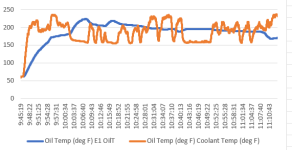
The coolant temp (only) on my 912iS has been cycling. The cycle period is irregular but the amplitude is fixed, between about 152 and 240 F. Here's an example from one flight today. Oil temp (blue line) stays quite constant, as did EGT. Coolant is 1:1 Dexcool:water, OAT was 18 F. I'll attach a graph of the coolant and oil temp data.

Takeoff was about where the lines first cross on the left (10:03:37). Landing was where they diverge on the right (11:10:43), as the oil temp drops and the coolant temp rises since it is no longer circulating. Oil temp rise at about 10:15:49 was a climb to get above clouds.

What could cause this? Can the temp sensor, or its electrical connections, fail this way? Are there diagnostic tests I can make?
1774306228519.png
 
Possibly a sticking thermostat, but I have never heard of that happening on a Rotax 912.
So I would suspect an electrical issue first.
I can't remember if the 912iS uses the same sensors for coolant temp as the ULS, but probably not so I can't help you with that.
 
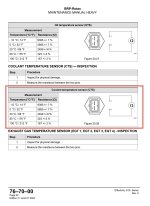
If you’ve ruled out electrical connector problems, you might want to make CTS resistance checks.
 

Attachments

  • IMG_3018.jpeg
    IMG_3018.jpeg
    370.3 KB · Views: 15
If you’ve ruled out electrical connector problems, you might want to make CTS resistance checks.
Looks like if a sense wire was intermittently shorting to ground the sensed resistance (nearly zero) would go low enough to produce a reading close to 240F.
 
Possibly a sticking thermostat, but I have never heard of that happening on a Rotax 912.
So I would suspect an electrical issue first.
I can't remember if the 912iS uses the same sensors for coolant temp as the ULS, but probably not so I can't help you with that.
Thermostat was my first guess, but the 912iS system doesn't seem to have one. Sounds like I should check the temp sensor connectors, wires, and conductivity.

Thanks!
 
Have you checked coolant level in expansion tank (not overflow tank). A faulty cap there can dump fluid into the overflow but not suck it back when needed.

Also, perhaps an issue with the water pump or something obstructing the flow somewhere in the system.
 
Is the spring installed in the coolant hose FF-1208A and FF-1208B as called out in KAI 49? Sometimes a hot hose going to a water pump will collapse when the water pump is pulling coolant from it.

BTW, don't worry about a head gasket. Coolant never touches it.
 
Have you checked coolant level in expansion tank (not overflow tank). A faulty cap there can dump fluid into the overflow but not suck it back when needed.

Also, perhaps an issue with the water pump or something obstructing the flow somewhere in the system.
Yes, the expansion tank is about 3/4 full, and the level has not changed from before to after the flights. I think intermittent flow blockage could cause the symptoms noted, though I would expect the temps to go even higher. Because of the difficulty of testing for such an intermittent fault, I'd like to list & test other possibilities first.
 
Is the spring installed in the coolant hose FF-1208A and FF-1208B as called out in KAI 49? Sometimes a hot hose going to a water pump will collapse when the water pump is pulling coolant from it.

BTW, don't worry about a head gasket. Coolant never touches it.
That puzzles me -- my KAI had cooling system installation in Chapter 50, and does not include those part numbers, nor an internal spring. Are those from the ULS installation?
 
That puzzles me -- my KAI had cooling system installation in Chapter 50, and does not include those part numbers, nor an internal spring. Are those from the ULS installation?
The newer silicone hoses do not have the spring...
 
That puzzles me -- my KAI had cooling system installation in Chapter 50, and does not include those part numbers, nor an internal spring. Are those from the ULS installation?
Yep, sorry, I'm a 912 ULS guy. I am spring-loaded (pun intended) to think that way. I haven't checked the 912iS KAI. Others say the spring is omitted with the iS. But there isn't that much difference between the iS and the ULS as far as cooling goes. Someone thought the spring in the coolant hose was prudent for the ULS. A collapsed water pump return hose might still be something to consider.
 
In the earlier model -12 the coolant radiator mounted to the pilot side requires a tight curve in the hose and it could collapse without the internal spring, regardless if it is rubber or silicone. With the newer front cooler radiator layout the curve is more gentle.
 
Probably not relevant but, do I understand that you mixed Dexcool 1:1 with H2O? Dexcool comes premixed.
Dexcool comes either way, concentrate or premixed. And if he did mix H2O with premixed coolant, that would only improve cooling (at the expense of frost protection).

1774367693899.png1774367731641.png
 
Something I noticed on my most recent condition inspection might be worth mentioning. The wire that runs to the water temperature sensor was dangling down and contacting the top of cylinder #1. The wire hadn't worn through yet, but I added another zip tie to the coolant line the wire runs along (there was already a zip tie further back, I added one about 3" forward of that). This provided more clearance for the wire.
 
Something I noticed on my most recent condition inspection might be worth mentioning. The wire that runs to the water temperature sensor was dangling down and contacting the top of cylinder #1. The wire hadn't worn through yet, but I added another zip tie to the coolant line the wire runs along (there was already a zip tie further back, I added one about 3" forward of that). This provided more clearance for the wire.
Thanks for the suggestion. I just uncowled the engine to inspect the wiring. The harness looks good, no fraying or evidence of abrasion or grounding; I don't see any place it might have an intermittent ground. I've brought the coolant temp sensor home to test resistance at different temps.
 
Back
Top