Van's Air Force

The definitive Van's Aircraft support community! Buying, building or flying an RV? Join our exclusive family of mentors and enthusiasts!

Access Panel Seal

Well, I tried re-gasketing my front access panels using the method in this thread (pro seal + PVA mold release) and, well, it looks like I took the "access" out of my access panels. They're totally stuck in place! That mold release doesn't release. I used all my strength and these panels are stuck on for good! I used three coats of that PVA stuff and yet the pro seal seems to have completely bonded to both surfaces. Not sure what to do now besides just screw the screws in and deal with it.

I suppose, on the bright side, the panels are totally waterproof now!
 
Last edited:
Not sure what to do now besides just screw the screws in and deal with it.
I'd try a gentle application of heat to soften the proseal, and a sharp steel pick levered into a screw hole to encourage the plate to lift. Start at one corner and work your way around.
 
I'd try a gentle application of heat to soften the proseal, and a sharp steel pick levered into a screw hole to encourage the plate to lift. Start at one corner and work your way around.
Worried more about messing up the $$,$$$ paint job at this point than prying these panels out. I managed to get a razor blade under one edge of one of the panels and the stuff is totally bonded. Pushing up from underneath the panel with all my strength and it doesn't budge. Certainly not popping out.
 
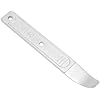
Try one of these trim tools from Amazon. Might be able to work it around from underneath without damaging anything while someone applies a little heat gun heat from the top.

$14.31


Product Image

High Strength 4140 Pry Tool, Prevent Breakage, Compact Size, Easy to Carry, Trim Removal Tool for Car Door Panel, Interior and Exterior Trim Removal​

 
First try water, as PVA is generally water soluble.

Going forward, waxing the underside of the hatch panels should ensure release from the PVA. I do not recall doing so, but perhaps I did and forgot, or there is some difference in PVA brands, or surface texture on the aluminum, like factory shiny vs scotchbrite.
 
Last edited:
Just as a data point, I did this on my plane using Fiber Glass mold release. I didn't spray it on the panels, I brushed it on. Three coats. I brushed it because I didn't want to dig out my spray gun and then clean it. I had a 2" chip brush handy so I went with it.

The panels popped of fairly easily. I feel for Mr. Draker. Having painted panels, ugh. I hope you find a solution.
 

Attachments

  • IMG_3243.jpeg
    IMG_3243.jpeg
    3.7 MB · Views: 78
Sometimes I have an idea which actually works out well. Amazing, but true.

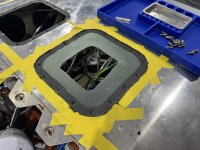
Subject is the hatch kit for the forward top skin of a 7, 9, or 10. The OP-43 installation drawing suggests forming a proseal gasket by using a piece of plastic wrap. I tried it and wasn't satisfied; too many surface irregularities because the plastic tends to wrinkle when trapped between the hatch and the support ring.

So I stripped it out and started over. This time, I sprayed three coats of ordinary PVA mold release on the back side of each hatch panel. Cure the PVA overnight, then mix proseal, spread it generously on the support ring, and screw down the hatch. Let it cure two or three days, then skim the squeeze out from the upper surface with a razor blade. When you remove the screws, the hatch will pop right out, leaving the PVA adhered to the proseal like a sheet of plastic. It won't peel off...but PVA is water soluble. Take the skin panel to the nearest water hose and it will rinse right off.

The nice thing is how easy it is to correct if not perfect. Got an air bubble cavity or other surface imperfection? Shoot another round of PVA on the hatch, slop more proseal on the clean dry previous, and screw it down again. The new proseal will adhere to the previous application just fine.

I buffed the assembled cover plate and skin with a red scotchbrite pad, which leaves a filler in the gap. A quick razor trim will clean up the ID of the ring.
.

Thanks for sharing! I plan to try this.
 
Happy ending. I spent quite a few hours armed with a lot of razor blades and tape and managed to hack through the proseal and get the panels off without scratching anything. What a scare LOL. I'm not going to be attempting that again. I think I'll use plastic wrap next time. The PVA stuck incredibly well to both the pro seal and the panel. Maybe the pint sized PVA that Amazon sells is a bootleg counterfeit or something!
 
I used some random mold release wax that worked even with my crappy fiberglass jobs. Applied 2 or 3 coats with a paper towel. All four panels released cleanly.
 
Happy ending. I spent quite a few hours armed with a lot of razor blades and tape and managed to hack through the proseal and get the panels off without scratching anything. What a scare LOL. I'm not going to be attempting that again. I think I'll use plastic wrap next time. The PVA stuck incredibly well to both the pro seal and the panel. Maybe the pint sized PVA that Amazon sells is a bootleg counterfeit or something!
I didn't have PVA, so I used the plastic wrap method. The Proseal surface wasn't super smooth, but it definitely works to seal the access panels. I did a little write up with a few pictures. It's not pretty, but its functional. Also not painted

 
Happy ending. I spent quite a few hours armed with a lot of razor blades and tape and managed to hack through the proseal and get the panels off without scratching anything. What a scare LOL. I'm not going to be attempting that again. I think I'll use plastic wrap next time. The PVA stuck incredibly well to both the pro seal and the panel. Maybe the pint sized PVA that Amazon sells is a bootleg counterfeit or something!
Can you share the product you used which didn’t work?
 
Can you share the product you used which didn’t work?

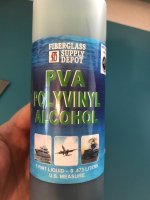
This is what I used. Sprayed on the (primed) rear surface of the access panels. Of course, it's always possible that I didn't apply it correctly.
 

Attachments

  • pva.jpg
    pva.jpg
    195.9 KB · Views: 16
This is what I used. Sprayed on the (primed) rear surface of the access panels. Of course, it's always possible that I didn't apply it correctly.
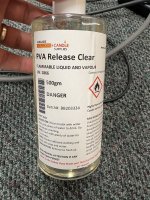
Seems like the right stuff. How many coats did you do? I have this one but I think it’s the same thing. I’m waiting to rivet my forward skins on before attempting this - so following your issues with interest!
 

Attachments

  • IMG_1599.jpeg
    IMG_1599.jpeg
    2.1 MB · Views: 12
Seems like the right stuff. How many coats did you do? I have this one but I think it’s the same thing. I’m waiting to rivet my forward skins on before attempting this - so following your issues with interest!
Per the directions on the bottle, I used one 'mist' coat plus three 'flow' coats, allowing the product to fully dry between coats. Sprayed from a HVLP sprayer at around 20PSI. The only thing I can think of that I might have gotten wrong was the total thickness of the dried product. Even with those multiple coats, it seemed to be more like dried paint rather than a sheet of plastic. If I did try it again, I'd lay it on much, much thicker, and even do a test beforehand to verify I could easily pull it off the metal surface. It really stuck fast to the metal, like paint.
 
I know this thread is about using proseal but I just put a tiny bead of RTV on it. Every year when I pull them for inspection, peel the old RTV off and reapply.
 
As a data point, I got my PVA from TAP Plastics, and applied it with a foam brush (multiple coats, I think) onto bare shiny aluminum. Hadn't thought about what effect primer/paint might have, but it seems like something to watch if you're planning on trying this method. Maybe mold release wax would be more appropriate if your parts are already painted.
 
Never tried PVA on primer. I think maybe we just learned something.
Yup, it could very well be the primer. I had trouble even scraping the PVA off the surface of the access plate with a razor blade, it stuck so well. For now, I've just left the stuck PVA on both surfaces, and will grind/scrape it off next Condition Inspection.
 
Yup, it could very well be the primer. I had trouble even scraping the PVA off the surface of the access plate with a razor blade, it stuck so well. For now, I've just left the stuck PVA on both surfaces, and will grind/scrape it off next Condition Inspection.
Did I miss something? PVA is water soluble...
 
I use a light smear of silicon grease on this area to prevent the panel sticking to the proseal. Works perfectly.
 
I know this thread is about using proseal but I just put a tiny bead of RTV on it. Every year when I pull them for inspection, peel the old RTV off and reapply.
For wet-sealing common access panels, that's exactly what I've always used. 3M gray silicone RTV is what we used in the Navy for preventing water intrusion on many access panels as well as around the base of most com and nav antennas.
 
I installed one access panel on the left side of my -14A and was concerned about sealing it after reading all the problems in this thread. I just bought a 12" square of 1/32" thick silicone sheet from Amazon and cut a gasket out of it. I used hole punches to make holes for the mounting rivets and the larger screw holes. The gasket was riveted between the reinforcing ring and the skin. The plane is not flying yet and I have not tried flooding it with water to test for leaks, but I am confident it will seal. No muss, no fuss.
 
Back
Top