Van's Air Force

The definitive Van's Aircraft support community! Buying, building or flying an RV? Join our exclusive family of mentors and enthusiasts!

Final Report N74MS RV 6

i have a fire bottle system in my rv6. it makes me "feel" safer. I mounted a 5lb bottle of halon in the foot well that feeds the engine compartment above the engine, pull the handle and it dumps all 5 lbs into the engine compartment.

halon 1211 requires a concentrating of 5%/6% to work correctly. I calculated about .4 lbs per second of halon needing to be sprayed into engine compartment to maintain 6%.
 
I would say THIS ^^ is the #1 prevention mechanism. I change my oil about every 30-40 hrs, and every single time I have the cowl off - I put a screwdriver or wrench on every single fitting I can get to in the engine compartment, visually inspect every lead and hose and just generally give the entire motor and accessories a really good eyeball with a shoplight in my hand.

@Taltruda shamed me into taught me to do this when I bought my first RV and I think its the only way to go.
Yeah whenever someone wants to just reach inside to dump the oil, or have an access panel to facilitate changing the oil without removing the cowling, I discourage it.. it’s really a great time to decowl and look around..
 
An exhaust system that is not well supported to the engine will tend to crack at the cylinder flanges.
(The entire weight of the system is being supported by the small flange welds).
‘Excercising’ the ball joints excessively will definitely tend to wear them quicker.
I agree

A properly designed exhaust installation should have the entire system connected to and moving with the engine.

This is the only way to minimize induced stress and wear.

In the early years of Vetterman exhaust production, the only purpose of the ball joints was to have some adjustment factor designed into the system to allow the outlet pipes exit out of the cowling to be optimized.

During a visit to Vans, Larry V. saw the support system design using the metal tube segments I had come up with, on the new prototype RV-8, and liked the adjustability it provided. Apparently enough, that he incorporated into his exhaust kits and provided instructions showing all the exhaust supports attached to the engine.

For some reason many years later, a change was made to recommending the supports be attached to the engine mount.
In my opinion this is a very bad idea.
If the mounts themselves survive, it likely will lead to the ball joints becoming worn, and if that wear is allowed to become excessive enough, it could possibly result in a failure such as occurred here

I wish we new more details about how the exhaust was suspended on this accident airplane.
There is not enough evidence in the docket photos to say with any certainty, but there is one clamp attached to an engine mount tube in a location that would be typical if the exhaust was supported from the mount, but it is not obvious in the photo what was actually attached at that point.
None of the engine sump bolts that are typically used for attachment of exhaust supports, appear to have any brackets, so I think there is at least some evidence to indicate that the exit pipes were supported by attachment to the engine mount.

I know people will say that the ball joints should be lubricated regularly with mouse milk, etc.

This would slow down the wear problem, but supporting from the engine mount is still a poor choice in my opinion. If nothing else, because there is typically a much higher rate of failure of the supports themselves, requiring constant inspection and repair.

 
Yeah whenever someone wants to just reach inside to dump the oil, or have an access panel to facilitate changing the oil without removing the cowling, I discourage it.. it’s really a great time to decowl and look around..
I have always been in the habit (on all my airplanes, not just the RV) of touching/feeling EVERYthing FWF when changing oil - and I've found many more faults that needed maintenance this way than during the annual inspection.

Ya'll still might be reading about me someday - but it won't be for lack of trying, I promise you that.
 
I have always been in the habit (on all my airplanes, not just the RV) of touching/feeling EVERYthing FWF when changing oil - and I've found many more faults that needed maintenance this way than during the annual inspection.

Ya'll still might be reading about me someday - but it won't be for lack of trying, I promise you that.
Me too, but I’ve always grabbed the exhaust and made sure it could move, just a bit, so it hadn’t seized. Never thought about it being loose or sloppy. I hope I would notice.
 
The Saf-air drain has an O-ring. From a previous post it seems as though the Komoto does not use an O-ring for the seal. Can anyone verify this for certain? I have the Saf-air installed on my 9A and that is what was installed on the accident aircraft. Your exhaust ball joint is much different than mine. Yours appears to have a clamp/hangar as part of it? Do you know who the exhaust manufacturer was?
i can't say 100% there is no O-ring in the T-202N Fumoto, however none is visible and the valve is a stainless steel ball/brass valve, Various online sites state in the description there are no O-rings or gaskets, and no non-metal parts are listed in the spec. The drain does have a temperature rating and I don't know if failure mode is better than SAF AIR's when exposed to exhaust gas. Sorry I don't know who made my exhaust, may be someone can recognize it from the picture.

1773676821714.png
 
on fire-retardant clothing
Just a side note, in the Petro-chemical industry we're required to wear FR clothing. It's come a long way in comfort and design, with good options from Ariat, Cinch, Carhart and more. I'm wearing a comfy long sleeved tee shirt that meets FR requirements.
 
Just a side note, in the Petro-chemical industry we're required to wear FR clothing. It's come a long way in comfort and design, with good options from Ariat, Cinch, Carhart and more. I'm wearing a comfy long sleeved tee shirt that meets FR requirements.
All this talk of fire and parachutes.... I might start going back to wearing my flight suits again. I surprisingly can still fit in them after I retired. I just didn't want to look like a Cosplay dork, lol.
 
All this talk of fire and parachutes.... I might start going back to wearing my flight suits again. I surprisingly can still fit in them after I retired. I just didn't want to look like a Cosplay dork, lol.
I get my fill of PPE at work. At home I've occasionally cut, weld, grind, in flipflops. I will be fine flying in short pants and sneakers. None of us are going to make it out alive. :ROFLMAO: :ROFLMAO:
 
All this talk of fire and parachutes.... I might start going back to wearing my flight suits again. I surprisingly can still fit in them after I retired. I just didn't want to look like a Cosplay dork, lol.
I always wear a flight suit - it even has a patch with my name on it! :cool: It's the only reason I learned to fly - so I could look cool in a flight suit, and get all the girls!
 
Would this help in the unlikely event of melting O-rings in the SafeAir quick-drain? Place a 2-3" piece hose, that is more heat/fire resistant than the O-rings in the SafeAir drain, on the drain exit. Plug the hose with something, maybe a bolt, and secure with hose clamps. The short piece of hose would of course need to be removed for oil changes.
EDIT: After re-thinking this...probably not a good idea. Couldn't tell on pre/post flight if the O-rings had failed in the quick-drain as the oil would be trapped in the short piece of hose you installed.
 
Last edited:
I always wear a flight suit - it even has a patch with my name on it! :cool: It's the only reason I learned to fly - so I could look cool in a flight suit, and get all the girls!
Years (and years) ago I was standing in the Doughnut Line at OSH (old-timers will know where I am talking about! Had to go early in the morning and stand in line! Only place to get them on field, way before it was AirVenture!) and was standing behind a guy who had skin grafts on both his forearms. Being 'in the profession', I had to ask how he was the recipient of that lovely procedure. He was flying an RV-4 and had an off-field landing that resulted in a fire. (Might have been before the cutout on the forward fuel tank support bracket was added to the plans.....) Other than the burns on his hands and arms, he said he did OK. He surmised that if he had a Nomex suit on, it might not have been so bad. That sounded like a good idea to me. I have never flown SuzieQ without a Nomex suit (bags) and Nomex gloves. It's not to be cool, :cool: but for that extra layer of protection should the unexpected happen. I also wear a flight helmet. I'd feel naked without either of those! That's just the way I fly.......... YMMV.....
 
Years (and years) ago I was standing in the Doughnut Line at OSH (old-timers will know where I am talking about! Had to go early in the morning and stand in line! Only place to get them on field, way before it was AirVenture!) and was standing behind a guy who had skin grafts on both his forearms. Being 'in the profession', I had to ask how he was the recipient of that lovely procedure. He was flying an RV-4 and had an off-field landing that resulted in a fire. (Might have been before the cutout on the forward fuel tank support bracket was added to the plans.....) Other than the burns on his hands and arms, he said he did OK. He surmised that if he had a Nomex suit on, it might not have been so bad. That sounded like a good idea to me. I have never flown SuzieQ without a Nomex suit (bags) and Nomex gloves. It's not to be cool, :cool: but for that extra layer of protection should the unexpected happen. I also wear a flight helmet. I'd feel naked without either of those! That's just the way I fly.......... YMMV.....
On June 13, 2021 a B17 with 7 onboard had an engine fire right after takeoff. They put the airplane down in a muddy farm field and everyone got out. A few seconds hesitation could have made the event fatal to all. The lesson to be learned is in the event of a fire put the airplane on the ground IMMEDIATELY.
 
During a visit to Vans, Larry V. saw the support system design using the metal tube segments I had come up with, on the new prototype RV-8, and liked the adjustability it provided. Apparently enough, that he incorporated into his exhaust kits and provided instructions showing all the exhaust supports attached to the engine.

For some reason many years later, a change was made to recommending the supports be attached to the engine mount.
In my opinion this is a very bad idea.

If the mounts themselves survive, it likely will lead to the ball joints becoming worn, and if that wear is allowed to become excessive enough, it could possibly result in a failure such as occurred here
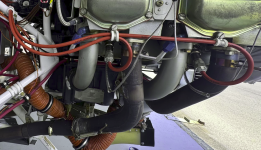
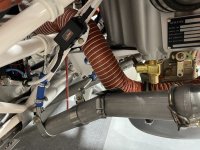
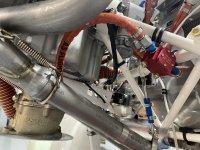
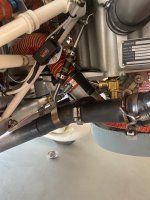
Looks like I’ll be re-engineering my exhaust system supports for my RV6, O-360. Pictured is my tailpipe hangars as installed in accordance with installation instructions from Vans included in my firewall forward kit - from 4 years ago.
 

Attachments

  • IMG_2239.jpeg
    IMG_2239.jpeg
    2.9 MB · Views: 158
  • IMG_2172.jpeg
    IMG_2172.jpeg
    2.9 MB · Views: 155
Looks like I’ll be re-engineering my exhaust system supports for my RV6, O-360. Pictured is my tailpipe hangars as installed in accordance with installation instructions from Vans included in my firewall forward kit - from 4 years ago.
For clarification, the many years later change was made by Vetterman exhaust, and they began recommending supporting from the engine mount.
It is clear that you have a Vans produced exhaust system, so the explanation is not that the instructions came from Vetterman.
I was never part of the loop of evaluating instructions for an installation like that, but it has never been done on any Vans Aircraft prototype so I’m not sure why someone would have produced instructions that showed that method other than it was because that is the way that Vetterman exhaust had been recommending.
 
For clarification, the many years later change was made by Vetterman exhaust, and they began recommending supporting from the engine mount.
Really? That doesn't make sense.
It is clear that you have a Vans produced exhaust system, so the explanation is not that the instructions came from Vetterman.
I was never part of the loop of evaluating instructions for an installation like that, but it has never been done on any Vans Aircraft prototype so I’m not sure why someone would have produced instructions that showed that method other than it was because that is the way that Vetterman exhaust had been recommending.
Definitely NOT :oops: the way Vetterman recommended hanging his 4-pipe exhaust for the RV-4! (Granted that was YEARS ago!) Logic would tell one that the ENGINE moves independently from the ENGINE MOUNT and if you want to break an exhaust system, suspend it from something ridged, like the engine mount!! And that blue tubing connected with clamps was definitely not in the -4 plans!! I can't tell if this is a Vetterman exhaust system: Scott Mc says it is not. But it does not seem like it would be his method of supporting an important firewall forward component! IMHO this needs some major redesigning! And be mounted to the ENGINE!!

But: Scott Hersha: these pictures are from 4 years ago and your airplane has been flying. How does the system look now? How have other builders supported their exhaust systems? Mine is only one example of many,......


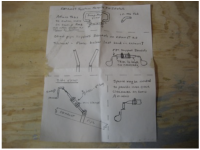
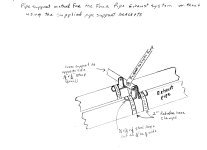
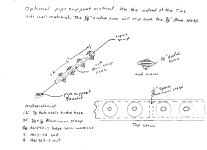
I do have my old hand-drawn instructions from Vetterman and could probably scan them and post those, if needed. Knowing your exhaust system is very different from mine.........

IMHO, of course....

Addendum:
Just pulled the old instructions (which I have had no need to look at for decades). The written instructions say: 4) Install the pipe support brackets........ Use metal straps from the pipe support brackets to the engine pan or airframe'....... And the diagrams say: '[support] strap to engine sump or engine mount tube not shown"
Huh. Looks like they have recommended that for quite some time. Happy to know my builder brain at the time thought mounting it to the engine mount seemed like the lesser of the two ideas..... Who knew?🤷‍♂️
 
Last edited:
My 9A with PV IO360M1B and Vetterman crossovers showed the supports on the engine, that's I built it up - drawings dated circa 2017-2018.
 
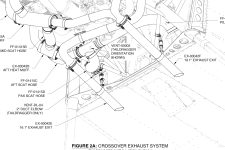
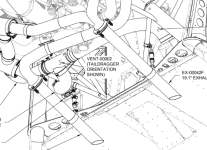
Just to add to the confusion and debate - attached are the plans from the original RV-14 and the EXP119 variant. In a nutshell, two different strategies for "hanging" the tail pipe are used...One is ok, the other is, we'll see I guess...

Original RV-14
Screenshot 2026-03-18 at 2.32.21 PM.png

EXP119 RV-14
Screenshot 2026-03-18 at 2.33.38 PM.png
 
Really? That doesn't make sense.

Definitely NOT :oops: the way Vetterman recommended hanging his 4-pipe exhaust for the RV-4! (Granted that was YEARS ago!) Logic would tell one that the ENGINE moves independently from the ENGINE MOUNT and if you want to break an exhaust system, suspend it from something ridged, like the engine mount!! And that blue tubing connected with clamps was definitely not in the -4 plans!! I can't tell if this is a Vetterman exhaust system: Scott Mc says it is not. But it does not seem like it would be his method of supporting an important firewall forward component! IMHO this needs some major redesigning! And be mounted to the ENGINE!!

But: Scott Hersha: these pictures are from 4 years ago and your airplane has been flying. How does the system look now? How have other builders supported their exhaust systems? Mine is only one example of many,......


I do have my old hand-drawn instructions from Vetterman and could probably scan them and post those, if needed. Knowing your exhaust system is very different from mine.........

IMHO, of course....
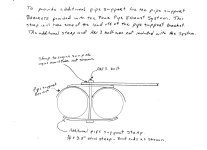
Something like this?? :)

Screenshot 2026-03-18 at 2.51.56 PM.png

Pretty unambiguous...

(@mburch had a pic on his website - thanks!)
 
(@mburch had a pic on his website - thanks!)

Full blog post here if you want to see how it turned out: https://www.rv7blog.com/2011/07/10/exhaust-pipe-supports/

I used a different set of sump mounting bolts due to clearance issues, and I recently replaced a broken sump-mounted tab with a new one that I made out of slightly thicker material, but otherwise my installation is per the scribble that came with the Vetterman exhaust kit in the late 2000's.

I give my exhaust pipes a gentle shake during preflight, but they basically don't move since the mounting setup isn't exactly floppy; basically I'm just checking for a broken exhaust hanger. I do lube the ball joints at annual or oil-change time, and when I do that I exercise them to make sure they're free, but to do so requires unbolting the center spreader bar to get any kind of real movement.

When I consider how much the engine moves around at startup and shutdown, I can't imagine wanting to attach the exhaust to the mount:

 
This is from the Vans RV-14 EXP119 Conversion Instructions. Clearly shows the hangars coming from the engine mount. Edit: Every pre-flight i grab each tail pipe and ensure it moves freely. I also mouse milk the ball joints (we have the Vetterman system).

1773865975537.png
 
This is from the Vans RV-14 EXP119 Conversion Instructions. Clearly shows the hangars coming from the engine mount. Edit: Every pre-flight i grab each tail pipe and ensure it moves freely. I also mouse milk the ball joints (we have the Vetterman system).

View attachment 112801

That style of ball joint is different, using the spring assembly. I am not sure if they perform differently.
My Bucker has these spring brackets and the exhaust is supported off of the firewall. No issues.
 
Don't forget to lube the slip joints which IMO are more important than the ball joints. When the slip joints freeze and the engine expands all the tension is on the welds again. Really a good idea to remove the pipes occasionally, clean the slip joints then lube liberally with nickel anti-seize.
Almost every time I've removed a cracked exhaust the slip joints are seized.
 
For clarification, the many years later change was made by Vetterman exhaust, and they began recommending supporting from the engine mount.
It is clear that you have a Vans produced exhaust system, so the explanation is not that the instructions came from Vetterman.
I was never part of the loop of evaluating instructions for an installation like that, but it has never been done on any Vans Aircraft prototype so I’m not sure why someone would have produced instructions that showed that method other than it was because that is the way that Vetterman exhaust had been recommending.
Just to be clear - even though I got my exhaust system from Vans, this is not a Vetterman system. That is according to whoever owns/runs Vetterman now. I was trying to replace a tail pipe that I had punched a hole in for my ASA crankcase vac system (that I removed), and they told me that what I have is not their system and they therefore don’t have that pipe. I don’t know who makes mine, but apparently it’s not Vetterman. I still have my receipt from Vans and I think I have the install drawings. I’ll check when I get home, but this is the way they show to install. When I grab my tail pipes during preflight, they don’t move - at all. However, with my cowling off I can grab the pipe at the ball join and move it around a little. I keep that area lubed, with mouse milk for now until I can find something that handles high heat better. I’ll figure out how to change my hangers with the blue tubes to connect to an engine case bolt. Obviously it will have to be connect to the tail pipe further forward and I don’t know how that will affect the security of the tail pipes.
 
Looks like I’ll be re-engineering my exhaust system supports for my RV6, O-360. Pictured is my tailpipe hangars as installed in accordance with installation instructions from Vans included in my firewall forward kit - from 4 years ago.
I have the same exhaust system/setup but mine is attached to the engine case on both sides (instead of your white adel to the engine mount). The security of the tail pipes is solid like you describe Scott. They will move a little with enough persuasion but that is what they are designed to do. Slip joint, spring, and rubber joints all contribute
 
Last edited:
Just to be clear - even though I got my exhaust system from Vans, this is not a Vetterman system.
I am aware of that. That is why in my post where I was replying to yours, I said, ” it is clear that you have a Vans produced system.”
The style of retention system at the ball joint is the giveaway for that.
That doesn’t change any of the other things I mentioned though.

I have the original prototype system on my airplane from before they went into production at Vans more than 10 years ago, and from initial installation, it has been supported from attached points on the engine case.
 
Last edited:
Something like this?? :)

View attachment 112791

Pretty unambiguous...

(@mburch had a pic on his website - thanks!)
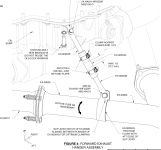
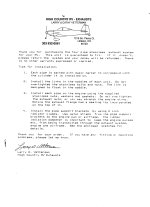
Or something like this................... (Finally got the scanner working.......) 😊 From the original exhaust kit issued in....what 1992?.....by High Country. Also quite unambiguous....except for the attaching it 'to the engine pan or airframe' part in the letter. Mine are attached to the oil pan bolts as per the plans.... Which, again, to me makes more sense as the exhaust support system is moving with the engine. But I digress.......
 

Attachments

  • Zephie and me051.jpg
    Zephie and me051.jpg
    622.8 KB · Views: 45
  • Zephie and me050.jpg
    Zephie and me050.jpg
    754.6 KB · Views: 41
  • Zephie and me049.jpg
    Zephie and me049.jpg
    692.3 KB · Views: 43
  • Zephie and me052.jpg
    Zephie and me052.jpg
    884 KB · Views: 48
Following up on this thread, I just reworked the exhaust hangers on my -7 after having had the exhaust tied to the engine mount for the last 5+ years. No damage to the exhaust or engine mount in that time, but the mounting hardware took a beating, The new installationI uses the Van's EA EXHAUST HANGER KIT purchased a couple of months ago; looks pretty much like Matt's installation.

By the way, that Vans exhaust hanger kit came with instructions that suggested an alternate method of using clamps on the engine mount for horizontal support. They didn't look like a Van's document; I ignored them and followed the OP-54 drawing. Maybe Van's is getting that kit from Vetterman?

Here's a slow-motion video of the first engine start with the new hanger setup. Whole lotta shakin' goin' on and I can't imagine having any exhaust component attached to the engine mount -


ds
 
Last edited:
I must say -- after reading the NTSB's report, I came-up with more questions than answers.
 
Following up on this thread, I just reworked the exhaust hangers on my -7 after having had the exhaust tied to the engine mount for the last 5+ years. No damage to the exhaust or engine mount in that time, but the mounting hardware took a beating, The new installationI uses the Van's EA EXHAUST HANGER KIT purchased a couple of months ago; looks pretty much like Matt's installation.

By the way, that Vans exhaust hanger kit came with instructions that suggested an alternate method of using clamps on the engine mount for horizontal support. They didn't look like a Van's document; I ignored them and followed the OP-54 drawing. Maybe Van's is getting that kit from Vetterman?

Here's a slow-motion video of the first engine start with the new hanger setup. Whole lotta shakin' goin' on and I can't imagine having any exhaust component attached to the engine mount -


ds
Now you know where to find the first set of cracks/breaks...

You might want to consider shortening the amount of space between the stainless steel tube ends inside the fuel hose.
Also, remove the steel tube/hose assembly that crosses between the two exhaust hangars. Switch to a solid, flat aluminum bar (.125") with grommets in the ends for the bolts.
 
I am aware of that. That is why in my post where I was replying to yours, I said, ” it is clear that you have a Vans produced system.”
The style of retention system at the ball joint is the giveaway for that.
That doesn’t change any of the other things I mentioned though.

I have the original prototype system on my airplane from before they went into production at Vans more than 10 years ago, and from initial installation, it has been supported from attached points on the engine case.
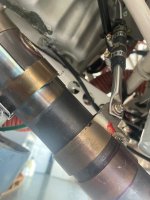
“Re-hung” my pipes as a result of this post. Now hanging off the engine case bolts on both sides:
 

Attachments

  • F414F3E5-55B2-4BD9-AACC-ADFFF01B1103.jpeg
    F414F3E5-55B2-4BD9-AACC-ADFFF01B1103.jpeg
    4 MB · Views: 71
  • 79ECEEE9-6FEC-44AD-AAF3-D07829A9D3D0.jpeg
    79ECEEE9-6FEC-44AD-AAF3-D07829A9D3D0.jpeg
    2.8 MB · Views: 71
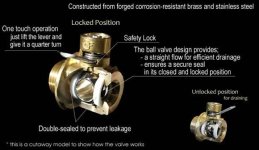
FYI, I obtained the following info from Fumoto. The operation temperature range is -40 to 365 degrees F. The photo shows a cross section of the valve. It is a classic ball valve .

My comments: It looks like the seals are PTFE, which is common for ball valves. PTFE seals will typically not melt until somewhere north of 500 degrees F. Viton is typically rated at 400 to 450 deg F with intermittent up to 500 deg F. Typically neoprene is rated to 180 deg F with intermittent use up to 275 deg F. I am not sure what orings are in the drain valve that failed.

fumoto-valve-frs-brz-wrx-2.jpg
 
FYI, I obtained the following info from Fumoto. The operation temperature range is -40 to 365 degrees F. The photo shows a cross section of the valve. It is a classic ball valve .

My comments: It looks like the seals are PTFE, which is common for ball valves. PTFE seals will typically not melt until somewhere north of 500 degrees F. Viton is typically rated at 400 to 450 deg F with intermittent up to 500 deg F. Typically neoprene is rated to 180 deg F with intermittent use up to 275 deg F. I am not sure what orings are in the drain valve that failed.

View attachment 118164
Well shucks. I bought one of these to replace my saf-air valve as a result of this conversation and the speculation that it was all metal. Sounds like I'll be going back to the original steel plug.

It would be very interesting to build a test rig with a scrap sump and surrogate exhaust tube to cause flame impingement on various oil drain valves at representative EGTs. Horton, you up for that? I could donate a couple of quick drain valves.
 
Horton, you up for that? I could donate a couple of quick drain valves.

Not much juice for the squeeze. The Fumoto is more than adequate, unless the installer is dumb enough to install it close to a head pipe or system joint. If normal running temperature is a concern, just attach a thermister to it and go fly to see how hot it actually gets. And off course, the good 'ole steel plug is foolproof.
 
Back
Top