Van's Air Force

The definitive Van's Aircraft support community! Buying, building or flying an RV? Join our exclusive family of mentors and enthusiasts!

Oil in my filtered airbox

ge9a

Well Known Member
Friend
I probably should have asked this question long ago, but can someone tell me why I'm getting a fair amount of oil in my filtered airbox, making a bit of a mess of things? This is on an IO-320. Every time I change the oil (which is every 25 hrs), the filtered airbox is a mess, requiring clean-up. I don't mind the clean-up, per se, but should I be worried about this? For what it's worth, it is probably oil AND some fuel mixed with it, it has a blue-ish tinge to it, different than straight, dirty oil.

The engine does not burn excessive oil - I top back up to 6 qts every 13 or 14 hours between oil changes. And it runs well, no issues with starting, hot or cold. Hot starting is of course not as easy as cold starting, but still not too bad (usually). The engine now has about 260 hrs on it, and this has always been a messy problem.

Thanks in advance for any insight.
 
I have found some cases where engine oil that leaked from some other part of the engine eventually pool on the top & eventually seep into the air box.
More likely (if you are finding a nasty black or nasty dark blue slime) this may be results of over priming your engine during start up. Any excess priming will just run down & through the intake ports, plenum, servo & end up in the bottom of your filter box.
 
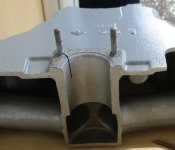
If it isn't external seep as Ralph has mentioned, you could have a stud for your fuel injection that has cracked the sump which is where all your oil lives. It's about the only way to get oil where you're finding it...I can't think of any other way that makes much sense. My RV-4 quick oil drain is over top the FAB and has leaked down on the box, but not enough to get inside and make a mess.
 
I have found some cases where engine oil that leaked from some other part of the engine eventually pool on the top & eventually seep into the air box.
More likely (if you are finding a nasty black or nasty dark blue slime) this may be results of over priming your engine during start up. Any excess priming will just run down & through the intake ports, plenum, servo & end up in the bottom of your filter box.
THIS!!

I had this issue - I reduced the amount of priming and its not gone away but it is drastically reduced. I think the fuel from priming washes oil leaked from valve guides down the intake and into the FAB. It doesn't take much to make a mess.

Again - try to reduce your prime and see if that helps - it did for me.
 
If it isn't external seep as Ralph has mentioned, you could have a stud for your fuel injection that has cracked the sump which is where all your oil lives.

It would be easy enough to inspect with a scope to confirm or deny.

IMG_0123.jpg

More likely (if you are finding a nasty black or nasty dark blue slime) this may be results of over priming your engine during start up. Any excess priming will just run down & through the intake ports, plenum, servo & end up in the bottom of your filter box.

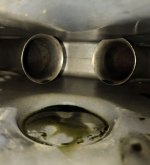
That's why the horizontal induction sump typically has a sniffle drain. The yuck pools in the plenum. Yours pools in the airbox.

IMG_20250226_123540793.jpg
 
Depends whether it is engine oil or the trace oil that forms when gas evaporates. The fact that it is blue implies the latter, but only a guess. If that is the case, we need to figure out why fuel is getting down there. One possibility is consistentlty over priming and another is an intake valve that is not sealing properly The air is pushed backward during the compression stroke and it takes the injected fuel with it; Injector is always flowing. This fuel sticks to the walls and migrates down. Compression test would identify that.

If you think it is engine oil, Dans suggestions make a lot of sense.
 
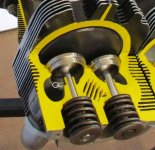
We often hear about over-priming, and there certainly is such a thing. However, I suspect most folks don't realize where a constant flow injection puts the fuel when running even a few short seconds of prime. The nozzle is in the top of the intake passage, upstream of the intake valve and above the intake tube. Further, with the engine static, three out of four valves are closed (yeah, yeah, I know about overlap). The nozzle position and the fact that it's a flat engine all but guarantees the vast majority of prime fuel goes down the intake tubes, not into a cylinder. A perfect prime quantity would thoroughly wet the tube walls, with no excess to drip out the bottom. Unfortunately, given the tube is curved, most of it collects on one side and runs down.

I can't prove it without installing a scope camera in an intake tract, but I would cheerfully bet even the perfect prime quantity puts some liquid fuel in the plenum or airbox.

IMG_1755.jpg
 
We often hear about over-priming, and there certainly is such a thing. However, I suspect most folks don't realize where a constant flow injection puts the fuel when running even a few short seconds of prime. The nozzle is in the top of the intake passage, upstream of the intake valve and above the intake tube. Further, with the engine static, three out of four valves are closed (yeah, yeah, I know about overlap). The nozzle position and the fact that it's a flat engine all but guarantees the vast majority of prime fuel goes down the intake tubes, not into a cylinder. A perfect prime quantity would thoroughly wet the tube walls, with no excess to drip out the bottom. Unfortunately, given the tube is curved, most of it collects on one side and runs down.

I can't prove it without installing a scope camera in an intake tract, but I would cheerfully bet even the perfect prime quantity puts some liquid fuel in the plenum or airbox.

View attachment 111503
I need 5-6 seconds of prime to start when temps are below 30. I suspect over 2/3 of that fuel goes down to the FAB. I do the prime in 2 shots in hopes more gets to the valve area. I believe that once started, all that fuel in the FAB evaporates over time and gets sucked in. I fly a lot in the winter and have never found oil or blue staining in the FAB. The big question is whether it is engine oil or fuel residue.
 
Last edited:
Tail of the two partners, one (me) primes minimally, the other religiously follows what his flight instructor taught him to prime a full 6 seconds before starting. To make it even more interesting it could be up to 15 seconds later that he turns the key.

Filter housing was always clean till he became a partner in the plane… dark muck is the normal now.

& yes, the fuel pool does evaporate, a bit, the remainder combines with any dust present to turn into that nasty gritty muck.

Also, that muck over time acts like wet sand paper & can wear the fiberglass housing straight through. Check often & clean.
 
Wow! Lots of good suggestions here, as always. This is why I love this forum.

I have a vertical induction so I deduced many years ago that I don't need a sniffle valve. For me, at the time, it was just one more thing that could fail, so I opted not to install one. Would a sniffle valve help reduce this problem on an engine with vertical induction?

Regarding excessive priming, that could definitely be a culprit, and is certainly plausible. An RV person with LOTS of experience starting engines instructed me on how to start my engine, and using his method, my engine generally starts before the prop spins a full rev (when cold). But I can see where this method could certainly cause excessive priming. I will look into that and come up with something that might be better.

I'm not at my hangar, so I can't look at the engine, but as I sit here, I can't envision where a sniffle valve would be installed. Does anyone have a picture handy?

i will certainly look for a crack near the F.I. servo mounting studs. I would think I'd see a LOT of oil in/on the airbox if that were the case (why wouldn't all of the engine oil leak out when the engine isn't running?). Definitely something to rule out, and I will.

Thanks again for all of the input and advice. Always appreciated. Always learning.
 
No available sniffle location in an updraft sump.
Lots a folks put a little drain hole in the bottom of the air box. It would be possible to install a drain fitting and a hose in the same location, to pipe the muck out of the cowl, but I've not seen anyone do it.
 
Back
Top