Van's Air Force

The definitive Van's Aircraft support community! Buying, building or flying an RV? Join our exclusive family of mentors and enthusiasts!

Avionics opinions

jeffrob918

I'm New Here
What would you all consider the “holy grail” of avionics/panel setup? What EFIS, auto pilot etc. for an RV8 cross country machine. Thank you, Jeff

 
Recently a similar thread on this and could probably be summarized with: Doesn't matter, you really can't go wrong with any of the majors so it just boils down to personal preference. They all have perks, bugs, and prices that in grand scheme of things will differ only by rounding error.
 
Yup- everybody is going to have their favorite, and their favorite is going to be whatever they have :)

I went with a Garmin 650 for IFR just because I've flown behind their stuff for years and I'm comfortable with it. From there, it seemed logical to keep it in the family with a G3X system.

My backup G5 died an in infant mortality, and when I called Team G3, he diagnosed it over the phone with me and said "yup, it's dead. Where do you want me to send a replacement and do you have a credit card to hold the core charge on until you send the old one back?"

I had a replacement unit on my front porch the next day and the credit card never got charged because I sent the old one back for the core charge within the time window.

I have no complaints.
 
For an RV8, with limited panel space, AFS has their electronic circuit breaker system called the ACM.

While it's not Garmin, it allows one to utilize space that would otherwise be devoted to CBs. One could squeeze dual 7" Dynon screens and dual GTN650 navigators. With enough Tetris, maybe even 10" and 7" Dynon screens. All the switches would have to go on the right console. That would maximize the panel real-estate to build a very capable and redundant IFR panel.

Although, with that budget, capability, and mission to necessitate said capabilities, I question the decision to build an RV8. A larger panel from a side-by-side RV would allow the same, or even fancier panel to be built with a more functional and ergonomic layout.
 
What would you all consider the “holy grail” of avionics/panel setup? What EFIS, auto pilot etc. for an RV8 cross country machine. Thank you, Jeff
Five words: "It depends on your mission."

I've flown a lot of cross country VFR in my GRT and it works fine. My one complaint about it is that there is no simulator available, so I have to learn it while flying. That's fine for VFR, but most EFIS systems have so many IFR features and capabilities that you might want to get one with a PC simulator to practice at home. I think that greatly reduces the number of options.
 
IMVHO the best thing to do is try as many different ones as you can and see which one meshes best with your brain. Look through the installation manuals as a tiebreaker.

My 5c (since the penny is discontinued):

I found that for whatever reason Dynon just clicked with me and was "intuitive", in the sense that I was able to easily figure most functions out without a manual, and it also looked the most like the big jet avionics I worked with as an engineer. Their install manual also seems the most "amateur-friendly" and all the documentation is excellent. I also had some actual flight time with it from my dad's RV. I ended up with a dual HDX panel.

Meanwhile I couldn't figure out the (non touch) G3X at Oshkosh many years ago and I never found their other avionics all that intuitive either. Their manuals are really good but more closely resemble the high end documentation I'm used to from work rather than homebuilder style manuals. And I just don't like CAN bus, because reasons.

GRT had some really neat features, but their manuals are the hardest to decipher and I had some issues figuring out how I'd fit what I wanted on my panel during the planning phase.

For some reason AFS just didn't click with me either.
 
Likewise, my 5c:
-In terms of actual capability, there isn’t much difference between all the vendors, so it’s the nuances that matter.
-Garmin are the only ones that build 7” & 10” EFIS displays AND certified IFR navigators. This means they have the most integrated/cohesive ecosystem.
-I believe the electrical wiring on an AFS/Dynon setup may be a bit simpler.

I have a Dynon Skyview system in my RV-9A. On the whole it is a very capable setup. Pluses:
-Display setup and menus are intuitive
-The EMS accepts custom sensor definitions pretty easily
-The autopilot is functional, smooth and intuitive
-No subscription fee for VFR nav and obstacle database updates.
-Fairly low ($100) subscription fee for VFR & IFR sectional charts from Seattle Avionics
-If you need support, they are response and have quick turn around times.
-Vendor provided 45min backup batteries for the EFIS. Garmin G3X systems utilize a 3rd party backup.

Now for the downsides:
-You can’t send a flight plan from a Skyview display to a certified GPS navigator. Only from the navigator to the Dynon system. In my case, with a Garmin GTN650, I would need to buy a flightstream device to enable wireless flight plan syncing between ForeFlight and the GTN.
-The Dynon ADS-B data packet is an “extended”, not GDL90 compatible format, meaning EFB apps need to write a format reader specific to Dynon. I use ForeFlight, and what this means is sometimes I get all available FIS-B weather and sometimes I don’t. It’s available directly on the Dynon displays however.
-No ability to overlay an approach plate on a sectional like you can in ForeFlight or Garmin Pilot. I don’t know if the G3X touch can do this either, to be fair.
-Standby EFIS products like the D30 lack the ability to drive the autopilot servos natively like the Garmin G5 or GI275 can.
-I’m still working out how to drive a bearing pointer (vs. the HSI needle). I grew up flying 6 packs, and would typically dial in the #2 CDI to the current runway at my destination during VFR ops.
-No PC based or tablet based simulator.

A few of the negatives I've listed above would have me looking at the Garmin ecosystem quite hard if I were to build a panel from scratch.
 
Last edited:
IMVHO the best thing to do is try as many different ones as you can and see which one meshes best with your brain. Look through the installation manuals as a tiebreaker.

My 5c (since the penny is discontinued):

I found that for whatever reason Dynon just clicked with me and was "intuitive", in the sense that I was able to easily figure most functions out without a manual, and it also looked the most like the big jet avionics I worked with as an engineer. Their install manual also seems the most "amateur-friendly" and all the documentation is excellent. I also had some actual flight time with it from my dad's RV. I ended up with a dual HDX panel.

Meanwhile I couldn't figure out the (non touch) G3X at Oshkosh many years ago and I never found their other avionics all that intuitive either. Their manuals are really good but more closely resemble the high end documentation I'm used to from work rather than homebuilder style manuals. And I just don't like CAN bus, because reasons.

GRT had some really neat features, but their manuals are the hardest to decipher and I had some issues figuring out how I'd fit what I wanted on my panel during the planning phase.

For some reason AFS just didn't click with me either.
Like many on the forum I have installed GRT, Dynon and Garmin in 4 different builds over the years. Early on before Garmin and Dynon got in the game GRT was the best out there from an EFIS standpoint. It interfaced with the 430 and Tru Track A/P in my RV7A. They also could display the engine data from the EIS on the PDF which at the time was pretty cool. I really like the guys at GRT and they were local. My only issue with it was the documentation wasn't always intuitive.

I have dual Dynon HDX screens in the RV10 (built in 2012) with both the Buttons and A/P subpanels. The subpanels were useful when I had the original Skyview screens. In a new build I would only add the A/P panel which includes the auto trim. The RV10 has a traditional avionics stack with a Garmin 650 and SL30 and PSE audio panel.

My Carbon Cub EX3 has an all Garmin system. G3X, GNX375, GTR205XR, G5, GMC507. I found the G3X pretty easy to lean after using the Dynon for many years. I would say the Garmin gets a higher score for integration, everything talks to each other flawlessly. I just wish the G3X had distance rings like the HDX.

At this point I don't know what I'll put in the RV15. When the time comes time to purchase avionics (could be a long while) I'm sure they'll be new stuff out.

I would try and fly with people that have systems your interested in, it's the best way to see what clicks with your brain.
 
If willing to disregard price I'm voting Garmin, their stuff just works, always.
Dynon has outstanding customer support, probably the best I've ever dealt with. King is still a power player but I probably won't purchase any more of their products, pricey and lack of customer appreciation.. my brief input
 
One word, GARMIN

That’s really sad - it’s the customers “mission” that has to be considered first IMO.
There’s no incentive to promote other products when there can be big discounts for dealers from a certain manufacturer, based on volume sales - I figure you would not be part of that ‘scheme’ as you are so helpful to many on the forum 😉.
 
That’s really sad - it’s the customers “mission” that has to be considered first IMO.
There’s no incentive to promote other products when there can be big discounts for dealers from a certain manufacturer, based on volume sales - I figure you would not be part of that ‘scheme’ as you are so helpful to many on the forum 😉.
Just to set the facts straight, Garmin has one price list, doesn’t matter if I sell 1 or 10,000, price is the same.
On the other hand, there are suppliers that offer volume discounts, but Garmin is not one of them.
I fly and install Garmin because I think it’s the best, just that simple.
Every piece of equipment in my plane I paid for just like everybody else, no freebies just because I’m a dealer.
 
If you are going to install an autopilot system, use the same system from your primary EFIS . If you use Garmin, then use Garmin autopilot. Same with using Dynon avionics, then use Dynon autopilot. The reason is they are easy to setup with their respective main system. Some people feel comfortable with some older third party autopilot and it’s a nightmare to integrate it into the modern primary avionics.
 
What would you all consider the “holy grail” of avionics/panel setup? What EFIS, auto pilot etc. for an RV8 cross country machine. Thank you, Jeff
I just complete this thought exercise and am now beginning install.

After ALOT of research, designs, talking to others, I finally came to the realization, that the biggest question I had to answer for my self was not which vendor, but which mission. As noted, the major suppliers are all 90+% equivalent.

I came to the realization for me at least, the RV8 which really will be a single pilot machine , is not where I want to being doing long cross country , hard IMC work. I want the ability to get up and above if needed, or down and under if needed.

That clarified and simplified a lot what I really needed, which in a space constrained 8, was a huge breakthrough.

I found AFS have the best looking, brightest, smoothest displays, software in my opinion is most “commercial”


Dynon to most aligns to the experimental personality , but with polish and qualiy


Garmin is the Apple in the space, it’s very much about the Garmin ecosystem and design language.

All are far more than any of us will every use, more than we thought we would ever want 5 years ago.

It’s worth a visit to SNF or OSH, get hands on and go with what feels most appealing to you.

But first get crisp on your mission and requirements. That really is more important.

I ended up with a much cleaner, simpler design than I started with, which will make operating and flying much safer and enjoyable.

Less is more I think
 
Three letters..... MGL.
Low price. Reflection free screen.
Easy install with a 3 wire group passing through the firewall for all engine connections.
 
Just to set the facts straight, Garmin has one price list, doesn’t matter if I sell 1 or 10,000, price is the same.
On the other hand, there are suppliers that offer volume discounts, but Garmin is not one of them.
I fly and install Garmin because I think it’s the best, just that simple.
Every piece of equipment in my plane I paid for just like everybody else, no freebies just because I’m a dealer.
We won't go down that rabbit hole - yet. I'll DM you.
 
King is still a power player but I probably won't purchase any more of their products, pricey and lack of customer appreciation.
Bendix-King, power player? Not really... they're not at all relevant these days; you might as well be talking about Narco here. No innovation or product line. Their GPS navigator is a rebranded Avidyne. Their autopilots are rebranded TruTrak. There's just no point to Bendix-King anymore.

But, regarding a cross country RV-8 panel, you really don't need to jam pack every square inch of that panel with glass. On my -8 I went with Garmin, because, duh. But, I kept it sorta basic but very usable; dual G5s with an Aera 660 as a map display with an AV-20 for backup attitude. GNX375 navigator with ADS-B in/out transponder. Dual com radios. GMC507 2-axis autopilot. Since I built this panel 5+ years ago it's gotten me to the 4 corners of the US plus to Alaska with some IFR approaches thrown in. It's simple but it just works.
 
Last edited:
Three letters..... MGL.
Low price. Reflection free screen.
Easy install with a 3 wire group passing through the firewall for all engine connections.
agreed BUT they are having re-structuring issues. I would call them before ordering MGL components
 
Probably buy
I suggest you talk to other RV-8 builders with IFR panels. Who made them, what instructions did they provide to the vendor such as layouts and ease of maintenance, then document what you learned to provide your vendor with requirements.

I’ve seen pretty panels with high end stuff in them that are a nightmare to maintain or do the simplest mod (and you will want to change something down the road).

The rule, “never on your back with your head under the panel”. With some thought this objective is very achievable without cutting holes in the top fuselage skin.

Side note - most network based systems are fairly straight forward to wire. You might consider doing this work yourself, especially if you have a buddy that has such experinece.

Carl
 
I suggest you talk to other RV-8 builders with IFR panels. Who made them, what instructions did they provide to the vendor such as layouts and ease of maintenance, then document what you learned to provide your vendor with requirements.

I’ve seen pretty panels with high end stuff in them that are a nightmare to maintain or do the simplest mod (and you will want to change something down the road).

The rule, “never on your back with your head under the panel”. With some thought this objective is very achievable without cutting holes in the top fuselage skin.

Side note - most network based systems are fairly straight forward to wire. You might consider doing this work yourself, especially if you have a buddy that has such experinece.

Carl
With 10” screens it’s rare to have to lay on your back as everything is readily accessible by removing the screen or screens.
Lots of extra connectors to make a panel “removable” is more chances for problems.
 
Last edited:
So I have had the luxury of flying extensively with Garmin, AFS and Dynon before I made my panel decision They ALL work well. I had AFS in my previous RV-8 and while nice and it worked, it didn't feel intuitive to me. But granted they were the older 4500 series. The current Dynon and Garmin are pretty comparable but I found the Garmin Screen somewhat easier to read with old man eyes.. I found the Dynon text/fonts were a bit too sharp and thin. But mainly, I found the Garmin G3x with the touch screen had THE BEST integration among all the system components and ease of interface to offboard products like Foreflight and Garmin Pilot. The couple of hundred $$ that I might have saved on the Dynon was more than overshadowed by the ease of use of the Garmin, interface, and integration - imho.

But none of the major players are bad.
 
Glad to see this post, as I am revising my 'wants' nearly every year. While I lean more towards the Dynon/Advance offerings, I am not averse to Garmin. The -8 I purchased last year has the older Dynon D100/D120 units and they are perfectly usable. Upgrading to newer Dynon units might be more cost effective since I understand the sending units are compatible.

I'm a fair weather flyer but do plan on more cross country flights in the future, a nice moving map screen is on my list. Older eyes and a big screen is about my only requisite. I don't plan on any IFR as I don't have the rating, although my son keeps telling me that I should get it.

I'm hoping to possibly upgrade next winter while the flying weather in this part of the country is crap. Maybe a flight down to Stien is warranted. I have Aproach Fast Stack here at Park Rapids and have heard very good reviews on them. They are mainly Garmin I believe.
 
This thread is about the "holy grail" of avionics. I read that as unlimited budget, only limited by what's on the market, panel space and one's imagination.

One of the first things suggested when designing their panel is to consider the mission. A competition aerobatic Pitts will have a different dream panel than a Velocity V-twin. The OP did specify cross country RV8, so that narrows the focus quite a bit. In my mind, I run this to the end of the spectrum of an night IFR cross country wonder panel with all the redundancy that space allows. That would have very different needs than a day VFR cross country panel.

It is fun to hypothesize on what is possible, versus what would practically meet the mission goals.
 
I got a nice discount for being a repeat customer with AFS. It's something to ask each vendor about.
 
If you’re going to do IFR go with Garmin. They integrate much better with the GTN navigators. The Garmin of Autopilot is for superior to anything Dynon or GRT offers.

Here is one example of where Garmin wins. If you are flying in approach using autopilot all the fixes before you capture the glide slope needs to be bugged in every other system. Garmin on the other hand, will read the altitudes from the navigator and you can just put the Autopilot in vertical NAV mode and it will fly all the step downs automatically and capture the glideslope flying the plane to minimums and let me tell you… that GFC500 autopilot is as good as the plane flying on rails. No other auto pilot comes close to it.

There are quite a few other advantages and redundancy benefits, you get from the Garmin ecosystem that the others just cannot offer.

Now, if you’re gonna fly VFR for the most part, they’re all capable systems
 
What would you all consider the “holy grail” of avionics/panel setup? What EFIS, auto pilot etc. for an RV8 cross country machine. Thank you, Jeff


The "holy grail" for me would be dual redundant EFIS displays, with ADAHARS and WAAS GPS, an integrated auto pilot system, Transponder, ADS-B in/out, 2 com radios, at least 1 nav radio and an audio panel. The only decision is Garmin or Dynon. I will say if IFR capability isn't wanted, you can have a really nice panel for a whole lot less.

I started saving for this on day one.

55067528361_8f21351065_z.jpg
 
The "holy grail" for me would be dual redundant EFIS displays, with ADAHARS and WAAS GPS, an integrated auto pilot system, Transponder, ADS-B in/out, 2 com radios, at least 1 nav radio and an audio panel. The only decision is Garmin or Dynon. I will say if IFR capability isn't wanted, you can have a really nice panel for a whole lot less.

I started saving for this on day one.

55067528361_8f21351065_z.jpg
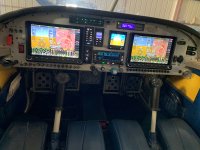
Yep - been flying with a fullly intergrated Dual SkyView and GTN-650 for ~15 years. The autopilot VNAV during an RNav approach is rock solid. I’m 90% IFR in the current ride (RV-8). It uses one large and one small screen. The RV-10 is identical except it has two large screens and a G5 instead of the analog airspeed instrument .

While many prefer to have the Garmin label I go with the superb Dynon after the sale service.

Carl
 

Attachments

  • 20210729_135426.jpeg
    20210729_135426.jpeg
    1.9 MB · Views: 39
Yep - been flying with a fullly intergrated Dual SkyView and GTN-650 for ~15 years. The autopilot VNAV during an RNav approach is rock solid. I’m 90% IFR in the current ride (RV-8). It uses one large and one small screen. The RV-10 is identical except it has two large screens and a G5 instead of the analog airspeed instrument .

While many prefer to have the Garmin label I go with the superb Dynon after the sale service.

Carl
Do you miss the Garmin capabilities that the user gsxr mentioned above?
 
Do you miss the Garmin capabilities that the user gsxr mentioned above?
Yep - and disagree. The ARINC interface between my SkyView and the GTN-650 does VNAV just fine, and I do not find it useful to run an autopilot in vertical nav before the Glide Slope Intercept point anyway.

I will admit I cannot load a flight plan from my iPad directly into the GTN-650 (without sending Garmin a big pot of money). The SkyView WIFI however does talk directly to the iPad without another box. So, I upload the flightplan to the SkyView (as a backup in case the 650 fails) while fat fingering the flight plan into the GTN-650. Typically I’m done long before ready to taxi. If Garmin did not make such stuff proprietary life would be easier. For the few minutes it takes to do this for the one flight plan I may not have in memory in the 650 it does not justify sending Garmin the pot of money to buy their $1300 or $1655 Flight Stream interface.

Why Garmin does not just include this (real cost I estimate at just a few dollars) in their $12,000 GPS navigators is example of why I always look at options other than Garmin - and only go Garmin when it provides the best value choice.

Carl
 
and let me tell you… that GFC500 autopilot is as good as the plane flying on rails. No other auto pilot comes close to it.
I have to disagree. I’ve flown behind a Garmin 500 AP system and it is, indeed, a very good AP. But I have a Trio Pro in my -10, usually controlled thru my GRT Hx EFIS, and it is every bit as good as the G500 system (but a lot less money). And of course, if the efis quits, the Trio still works. With the Garmin, if the efis quits (or the interconnects fail) the AP is useless.
 
I have to disagree. I’ve flown behind a Garmin 500 AP system and it is, indeed, a very good AP. But I have a Trio Pro in my -10, usually controlled thru my GRT Hx EFIS, and it is every bit as good as the G500 system (but a lot less money). And of course, if the efis quits, the Trio still works. With the Garmin, if the efis quits (or the interconnects fail) the AP is useless.

Which is why most panels with a Garmin G3X Touch efis also include a G5 which can also drive the AP.

For clarification;
The GMC507 is not an autopilot, it is an autopilot controller.
The flight director and autopilot software runs in the G3X Touch and G5 backup mini efis/adhars.
 
Last edited:
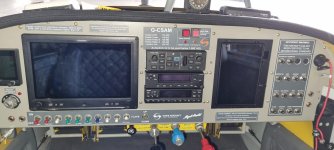
When I built my RV9A i wanted a good VFR panel that gave excellent situational awareness, and importantly would be desirable for when I eventually sell the aircraft at some stage in the future......... this is what I have and couldn't be more pleased:-


G-CSAM PANEL.JPG


Nige
 
If you’re going to do IFR go with Garmin. They integrate much better with the GTN navigators. The Garmin of Autopilot is for superior to anything Dynon or GRT offers.

Here is one example of where Garmin wins. If you are flying in approach using autopilot all the fixes before you capture the glide slope needs to be bugged in every other system. Garmin on the other hand, will read the altitudes from the navigator and you can just put the Autopilot in vertical NAV mode and it will fly all the step downs automatically and capture the glideslope flying the plane to minimums and let me tell you… that GFC500 autopilot is as good as the plane flying on rails. No other auto pilot comes close to it.

There are quite a few other advantages and redundancy benefits, you get from the Garmin ecosystem that the others just cannot offer.

Now, if you’re gonna fly VFR for the most part, they’re all capable systems
This works very well and flies the step down on rails. (VNAV) Maybe others are just as good, maybe.
 
The real answer is go with first (primary) with what fits your mission - and secondary which user interface fits you best. Go to the fly-in's, visit the booths, play with the simulators.

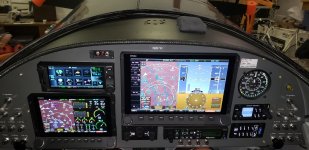
For my mission (lots of long IFR XC), this is what I chose. Dual Dynon and originally a Garmin 430W replaced later with Avidyne 440 (because their user interface is VASTLY superior).

panel 16gn.jpg
 
If your airplane is a lifetime aircraft, I say go with what your gut tells you. Try out all the systems. Attend Oshkosh or other venues that allows you to see the different makes. I think you would be happy with whatever you decide. I think the Garmin GFC autopilot is pretty hard to beat if you are auto-pilot centric. Now, if you have any interest in the resale value of your bird then it pains me to say, go with Garmin. It's just a market reality that buyers like to see Garmin in the panel. It's a comfort level thing, real or imaginary. Once they read Garmin they move right past worrying about the panel and go on to analyze the rest of the airplane.
 
Back
Top