Van's Air Force

The definitive Van's Aircraft support community! Buying, building or flying an RV? Join our exclusive family of mentors and enthusiasts!

Is the SL-00070 strainer inspection port worth the effort?

ymc9

Well Known Member
Patron
Hi guys,

I've already finished building the IS fuel tank and leak-tested it, and only noticed the inspection port kit afterwards. Installing it will require removing the plate, drilling the hole, resealing it, and performing a leak test again.

I'm not sure how hard it is to inspect the strainer (per 100hr) without installing the kit. If not too bad, I'll probably avoid the hassle and skip it. Do you regret not installing it when you had the chance?

Thanks!
 
I think if I had the tank out and sitting on the bench, with the port kit and fresh sealant on hand, I would put it in. It's not that big of a deal to remove and replace the sender plate and that's a lower risk seam since there is so much flange area.

I just did this on a customer tank that had unrelated leaks to fix so it made sense to add the port. I have not done my own, since it's in a flying plane and I don't want to mess with it.

People will point out that there are other ways to inspect the strainer, which is true. After doing one port, I would prefer to have it over not.
 
For what it’s worth: SL-00070 came out just before I built my tank; I went ahead and installed the port when I built it, figuring it’d be easier to install it then and I’d avoid risking metal shavings in my tank if I installed it later.

I’m still building my plane, but I did help a friend inspect his portless tank’s strainer by running my cheap Amazon borescope* down the fuel filler tube; it wasn’t hard to get a good view of the strainer, so if I had it to do over again, I probably wouldn’t install the port, to avoid having to poke an ugly hole in the carpet that covers the tank, which I haven’t done yet.

So, I’d recommend finding a friend with a completed -12iS and trying out the borescope trick before you decide.

* My $55 non-steerable “endoscope” uses an iPad as its display; the app lets me capture photos, which was nice for my friend’s condition inspection records. Also, the tip has a camera on the side of the tip in addition to the one on the end - the tip was hard to control and flopped around a lot, and it was useful to check what each camera “saw” as we tried to position the tip. As it happened, the best view we captured was with the side camera, so if I were buying a new one, I’d make sure it had two cameras, or get one of the “articulating” ones that are still <$100.
 
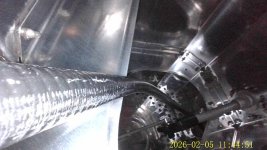
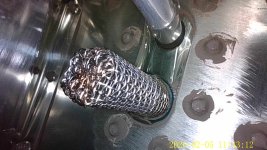
I purchased SL-00070 shortly after it was available. I intended to install it, but haven't done so yet. Since then I've inspected the fuel strainer twice. Getting the camera in the correct place without this port is possible, although is a bit of a pain. This last time probably took around 5 minutes with ten insertion attempts before I got it to go the correct way.

Here's the path that has to be threaded to get the camera in the correct place:
IMG_0041.JPG

Once in place it's easy to get a good picture of the strainer. If you get a camera with an articulating head, you can push past the strainer and turn back to get a good view of the other side as well.
IMG_0026.JPG

What I wonder is how much that inspection port gets in the way. I just finished an annual and replacing the servo rivets. I spent too much time stretched over the fuel tank reaching backwards. I would think that port sticking up in the middle of the tank would not only be very uncomfortable, but also would concentrate too much of my weight in one location on the tank.
 
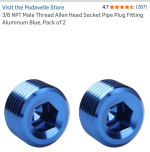
Like you, I purchased this kit for installation the next time I need to remove my tank and am concerned about the protrusion. I ordered these from Amazon to reduce the height and eliminate the sharp edges on the Van's supplied plug. Obviously haven't installed it yet, but don't see why they shouldn't work as well.

1771772778082.png
 
I am another one who purchased the SL-00070 kit but didn't install it. I was still building the aircraft at the time but the tailcone was already attached and I didn't want to remove the fuel tank. I had previously used a cheap USB boroscope (the type with both end and side cameras) inserted through the fuel filler port to inspect the fuel strainer. That was before the turtle deck skins and rear canopy were attached. It may be tricker now, I will find out at the 100 hour check.
 
I purchased SL-00070 shortly after it was available. I intended to install it, but haven't done so yet. Since then I've inspected the fuel strainer twice. Getting the camera in the correct place without this port is possible, although is a bit of a pain. This last time probably took around 5 minutes with ten insertion attempts before I got it to go the correct way.

Here's the path that has to be threaded to get the camera in the correct place:
View attachment 110657

Once in place it's easy to get a good picture of the strainer. If you get a camera with an articulating head, you can push past the strainer and turn back to get a good view of the other side as well.
View attachment 110658

What I wonder is how much that inspection port gets in the way. I just finished an annual and replacing the servo rivets. I spent too much time stretched over the fuel tank reaching backwards. I would think that port sticking up in the middle of the tank would not only be very uncomfortable, but also would concentrate too much of my weight in one location on the tank.
I am another one who purchased the SL-00070 kit but didn't install it. I was still building the aircraft at the time but the tailcone was already attached and I didn't want to remove the fuel tank. I had previously used a cheap USB boroscope (the type with both end and side cameras) inserted through the fuel filler port to inspect the fuel strainer. That was before the turtle deck skins and rear canopy were attached. It may be tricker now, I will find out at the 100 hour check.

Hi guys,

I've already finished building the IS fuel tank and leak-tested it, and only noticed the inspection port kit afterwards. Installing it will require removing the plate, drilling the hole, resealing it, and performing a leak test again.

I'm not sure how hard it is to inspect the strainer (per 100hr) without installing the kit. If not too bad, I'll probably avoid the hassle and skip it. Do you regret not installing it when you had the chance?

Thanks!
The SL-00070 kit wasn't out when I finished my fuel tank, or I would have installed it. I also have an inexpensive flexible borescope and was able to get a good look at the strainer coming in from the filler port. It took a few tries but wasn't too bad. I was concerned about sticking a cheap electrical device into an explosive atmosphere, so I purged the fumes and inerted the tank with nitrogen. That's what I plan to do on a go forward basis.
 
The SL-00070 kit wasn't out when I finished my fuel tank, or I would have installed it. I also have an inexpensive flexible borescope and was able to get a good look at the strainer coming in from the filler port. It took a few tries but wasn't too bad. I was concerned about sticking a cheap electrical device into an explosive atmosphere, so I purged the fumes and inerted the tank with nitrogen. That's what I plan to do on a go forward basis.
Thanks, @hhhenke. Do you know if, with the inspection port installed, you can visually inspect the strainer without using a borescope or draining fuel?
 
I was able to inspect the strainer though the inspection port using the borescope with the tank full. You might be able to see the strainer without the borescope, but I don't think you could say that you were able to verify that there was no debris.
I figured that full of fuel might be less dangerous than full of vapors as the fuel will cool the light.

However, one of the tapes/wires that control the head snapped shortly after the inspection. I then noticed that the instructions indicated that it was not oil resistant. I'm not sure that the fuel caused the tape to weaken, but I will be checking for oil resistance when I replace it.

I have not noticed much of an issue with the port sticking up other than ugly. To get to the back, I typically remove one seat back and lean over the tank from one side. The port is then resting against my side, which is not uncomfortable.
 
Back
Top