Van's Air Force

The definitive Van's Aircraft support community! Buying, building or flying an RV? Join our exclusive family of mentors and enthusiasts!

Need help bending fuel line

Chachi7565

Well Known Member
Friend
Hi, I'm replumbing my wing-root fuel filters to accommodate a larger filter with more surface area, as discussed in a previous thread.

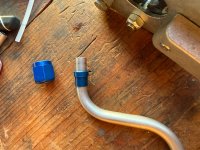
I am having trouble because I need to make a 90-degree bend in the line about an inch and a half from the flare.

If I flare the line first, then I can't bend it it the right place without the bending tool crushing the flare.
If I bend the line first, then I can't insert it far enough into the flaring tool to flare it.

I know it's possible - some of the lines that I removed had flares very close to bends - so I'm wondering if there is a technique or a tool that can help me do the same.

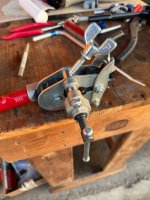
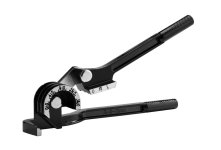
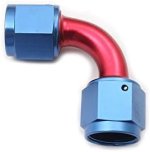
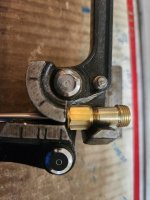
For reference, I'm putting a couple of pictures of the tube I need to flare, the type of flaring tool, and the type of bending tool I have.

Thanks in advance for your advice!

Matt
 

Attachments

  • Flare Needed.JPG
    Flare Needed.JPG
    2.1 MB · Views: 79
  • Short Flare Example.JPG
    Short Flare Example.JPG
    1.9 MB · Views: 81
  • Flaring Tool.JPG
    Flaring Tool.JPG
    2.1 MB · Views: 72
  • Bending Tool.jpg
    Bending Tool.jpg
    79.3 KB · Views: 80
You might succeed by putting a drill bit into the line before bending -- a bit sized to just fit into the line to just past where the fittings sit; base inwards, tip out. I've done that with the same tools you're using. Another trick is to slide a coil spring into the tube before bending. Obviously, try on some scrap first.
 
Last edited:
You might succeed by putting a drill bit into the line before bending -- a bit sized to just fit into the line to just past where the fittings sit; base inwards, tip out. I've done that with the same tools you're using. Obviously, try on some scrap first.
Use soft AL tubing, pack with sand and use your fingers.
 
If you are using 5052 tubing, generally the minimum bend radius of the tube is 3T or 1.125" - 1.25". The limiting factor though, is how much room you need for the bending tool.

As has been stated, you might be able to do it in progressive steps with a drill bit but that will likely deform the inside of the tubing.

If you are using 3003 tubing, put the flare and fittings on then use a spring of fill the tube with sand and bend it by hand.
 
On the RV12-IS, there are a couple spots where it is beneficial to use a sleeve that has had its tail cut off just past the nut. This will let it slide around a 1” radius.
 
Last edited:
Hi, I'm replumbing my wing-root fuel filters to accommodate a larger filter with more surface area, as discussed in a previous thread.

I am having trouble because I need to make a 90-degree bend in the line about an inch and a half from the flare.

If I flare the line first, then I can't bend it it the right place without the bending tool crushing the flare.
If I bend the line first, then I can't insert it far enough into the flaring tool to flare it.

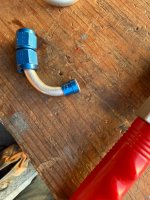
I know it's possible - some of the lines that I removed had flares very close to bends - so I'm wondering if there is a technique or a tool that can help me do the same.

For reference, I'm putting a couple of pictures of the tube I need to flare, the type of flaring tool, and the type of bending tool I have.

Thanks in advance for your advice!

Matt
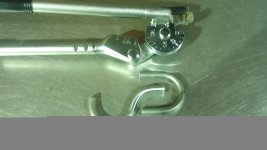
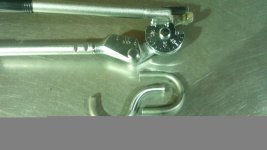
Matt----the Parker Roloflare tool has a flare die of about 1 inch. So thats a strike against your project. The bender has the bend fulcrum about an inch from the bend die. Strike 2. So using your tools, its impossible. You cant bend the tube after flaring it, and you cant flare it after bending it. There are a couple of solutions. Using your existing tools, ( I dont recommend packing it with sand, although alot of guys do that and then flush the tube), here was my solution before the CNC benders, Take your bender, and cut a slot at the "0*" mark, so the tube with a shortened sleeve and nut will fit between the bend die and the fulcrum. Using the nut as a guide, shorten the sleeve tail unit it just protrudes from the nut pilot hole. Flare the tube, install the sleeve and nut. Make a "flared mandrel"--I made one from a AN832 bulkhead fitting. The idea is to screw in the flare mandrel into the nut, and set the nut into the space between the bend die and the flucrum. Allow the mandrel to rest against the fulcrum. It effectively locks the tube in place, then you can bend it. As you can see from the pics, you can now get the bend MUCH closer to the flare. Tom
 

Attachments

  • hand bender close up.jpg
    hand bender close up.jpg
    12.1 KB · Views: 126
  • 364FHA modified bender.jpg
    364FHA modified bender.jpg
    189.1 KB · Views: 130
  • -2 3 4 modified hand bender.jpg
    -2 3 4 modified hand bender.jpg
    209.5 KB · Views: 131
A long time ago I saw a post here and I think it might have even been by Tom. The idea is to make a mandrel similar to Tom's earlier post. You use a piece of round bar stock that is the same diameter as the tubing you are trying to bend. Then you have to "turn" a portion that is a smaller diameter that goes inside the the tubing for support during bending. I think you could put a short piece of bar stock in a drill press and use a file to "turn" it to the diameter that you want. I think I made one of these a long time ago, but I'm not sure where I used it. Then you can use the outer bar as the portion that goes against the fixed portion of the bender instead of the actual tubing. So as an example you can do the flare then instead of the flare having to be outside of the bender the mandrel rod is and the distance to the bend can be shorter. I'm not sure if this is clear or not.
 
Thanks for all of the advice! I was able to trim the sleeve enough to put a flare at the distance I needed and get the filter installed. But, I'm banking all of those other ideas for when I need them in the future. Really appreciate the help!
 
Follow up question!

Now that I've burned through a dozen feet of aluminum tubing learning the hard way...is there a technique to use something easy to bend and similar in diameter to make a template from which to bend the aluminum? I'm thinking something that can be bent by hand, and trimmed with a scissors or snips. That would've saved me significant time and effort, and I was doing relatively simple routing - I can't imagine how difficult it is to do the vent tubes and other more complex routing.
 
Follow up question!

Now that I've burned through a dozen feet of aluminum tubing learning the hard way...is there a technique to use something easy to bend and similar in diameter to make a template from which to bend the aluminum? I'm thinking something that can be bent by hand, and trimmed with a scissors or snips. That would've saved me significant time and effort, and I was doing relatively simple routing - I can't imagine how difficult it is to do the vent tubes and other more complex routing.
I recently rebuilt several of my fuel lines. I would trace the old line on a piece of heavy card stock. Then my trick was to take some gas-type welding rod and bend it into the nearly exact route I wanted the gas line to take. Then from there transfer the lengths and bends to the much costlier fuel line. That worked very well. I had to make some minor adjustments when the line was in its final phases but that worked for me. YMMV. Consider the cost of your messed up tubing to be tuition in Tubing Bending Class 101! 😊
 
What would also work well for a test fit up is clear vinyl tubing in the same 3/8” or 1/4” OD with a piece of soft wire inside the tubing to hold the shape. With a band of tape around the feral / reinforcing sleeves you could temporarily attach the nut for a very accurate mockup.
 
What would also work well for a test fit up is clear vinyl tubing in the same 3/8” or 1/4” OD with a piece of soft wire inside the tubing to hold the shape. With a band of tape around the feral / reinforcing sleeves you could temporarily attach the nut for a very accurate mockup.
Matthew, try this----Since you burned through a bunch of tubing already, (gee at some point we all have) see if some of the bends are of a similar radius that you need. Use them for patterns, but mark where you want the flares. YES--it is an art that comes easy to some people, but it does take practice with the tools that you have. We cheat, with have a CMM laser scanner that transfers the dimensions to the CNC bender. But over course of the years, I bent all the tubing with hand benders---thus came up with the modified bender in the pics.
Tom
 
Thanks, all! After digging into this forum some more, I think I made my life a little harder, as I was using 6061T6 .035-walled tubing. I was wondering how some of you were talking about bending the tubing by hand!
 
Bend a piece of welding rod to whatever you desire, copy with the tubing on the bench with bending tool, then fine tune when tubing is close and almost insertable. If you don't go through a half a dozen renditions, it isn't good enough!

Zach
 
One of the things I found difficult was getting the length between bends to an accurate length. The L - R references on the bender were confusing for me so even if I knew what length I wanted I would still mess it up. If you have a bunch a scrap you should try to bend some fix length segments out of it. They can be any length as long as they aren't too short. It's good practice and it will help you learn to use the bender correctly.

Sometimes it can be difficult to measure ahead of time for an entire piece. I start at one end and do one or two bends and then make the next measurement and do that bend and repeat until you have it all bent. You can't always do this since there may not be space, but its easier than trying to get all the measurements in free space.
 
One of the things I found difficult was getting the length between bends to an accurate length. The L - R references on the bender were confusing for me so even if I knew what length I wanted I would still mess it up. If you have a bunch a scrap you should try to bend some fix length segments out of it. They can be any length as long as they aren't too short. It's good practice and it will help you learn to use the bender correctly.

Sometimes it can be difficult to measure ahead of time for an entire piece. I start at one end and do one or two bends and then make the next measurement and do that bend and repeat until you have it all bent. You can't always do this since there may not be space, but its easier than trying to get all the measurements in free space.
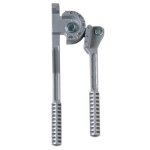
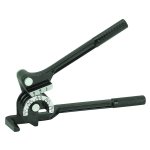
More $.02. Most hand benders work well on most types of tubing. Aluminum, copper (yuk), steel and even thin walled stainless. I have a selection of hand benders just for giggles. I really like the Imperial 364 FHA series, single bend versions. Why? well ever tried to bend 3/8 stainless .065 wall with an inexpensive bender? Yeah, I broke the handle on one. Stupid me for using a 12" piece of pipe for leverage. The Imperial benders ( Spruce and others have them) have a steel frame, and longer handles for more leverage. Yes, most of you wont need that, but they are nice to have. YES, I've modified mine to do some custom things for prototyping. Mainly for bends that are closer to the flares than normally possible with a hand bender.
 

Attachments

  • hand bender 2.jpg
    hand bender 2.jpg
    12.3 KB · Views: 20
  • HF tube bender.jpg
    HF tube bender.jpg
    60.8 KB · Views: 20
  • 364FHA modified bender.jpg
    364FHA modified bender.jpg
    189.3 KB · Views: 20
Back
Top