Van's Air Force

The definitive Van's Aircraft support community! Buying, building or flying an RV? Join our exclusive family of mentors and enthusiasts!

Sawtooth Climb Test

Gino230

Well Known Member
Patron
As I've mentioned my RV8 didn't come with a POH. So in my quest to create one, and get to know my airplane a little better I have been doing "tests" here and there and keeping notes. One thing I didn't have was VSpeeds.

My airplane is built pretty close to plans, BUT I have an IO-360 and Catto 3 blade which has some noticeable characteristics that are different and would probably make other RV8 VSpeeds not applicable to mine. So using the Kitplanes article as a guide https://www.kitplanes.com/sawtooth-climb-performance/ I decided to do my own.

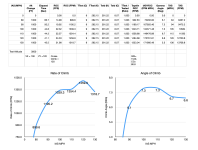
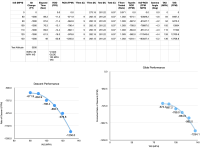
Yesterday I flew the test and built the spreadsheets and graphs. First thing I noted was that I probably could have gotten prettier graphs by adding more data points. But it seems I got the general idea with the data that was collected. The only one I'm not certain of is VMaxGlide, because you're actually using angles on the curve to get the correct number.

Some interesting points- The Catto barely makes 2100 RPM Static (66" prop 75 Pitch) and flat out at 6500 it turns 2750 RPM. I *think* that means I'm giving up performance (vs CS Prop) at lower speeds and during acceleration- however the prop does take a big bite so I'm not certain of this.

I *think* the reason some of the climb rates are the same (or very close) is that at the higher airspeed, Full Throttle generates more RPM, thus more HP or perhaps more efficiency from the engine / prop combo. I didn't record RPM for the various test phases.

Also, I was significantly lighter than Max Gross, being solo and not wanting to subject a passenger to my test flying.

I chose 3000-4000 MSL as the test altitude to give me the best idea of what the airplane is doing shortly after takeoff.

My primary airspeed indicator is in MPH, so I apologize in advance to the purists (myself included) who prefer Knots.

Any comments or corrections would be welcome. Fire away.Screenshot 2026-02-04 at 8.32.10 AM.pngScreenshot 2026-02-04 at 8.32.56 AM.png
 
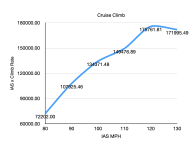
I forgot I also plotted the Cruise Climb table as directed in the article, interesting that it seems to come out the same as VY.

Screenshot 2026-02-04 at 8.50.02 AM.png
 
Good job doing the testing and getting real data for your airplane! Aside from that awful use of mph included of knots ……🤣

Generally speaking, the RV’s have a very broad range of airspeeds for best rate of climb - anywhere between 95 and 110 knots gives pretty close to the same ROC. This is really good to know on a hot day when you want to maximize cooling - climb at the higher speed, get more airflow, and you don’t give up that much percentage of max ROC.
 
Do you have correlating AOA information to the speeds you found? Such will be valid at any weight.

As your envelope is already known already expanded, if you decide to test further altitudes, consider the level accel. It will save you significant time. Same same for increased weight.


Note you’re also getting max range, max E, best glide, best glide time, optimum turn information in these. More than just climbs.

If you want to do something interesting, you can also do various bank angles and work a Ps curve.
 
When I had my RV-4 with the Cruise Prop that Swallowed Detroit, standard climbout was at 2,500 RPM. Enough RPM for power and let everything else take care of itself.
 
Do you have correlating AOA information to the speeds you found? Such will be valid at any weight.

As your envelope is already known already expanded, if you decide to test further altitudes, consider the level accel. It will save you significant time. Same same for increased weight.


Note you’re also getting max range, max E, best glide, best glide time, optimum turn information in these. More than just climbs.

If you want to do something interesting, you can also do various bank angles and work a Ps curve.
Is there anyway to get this article without going through Kitplanes?
 
Is there anyway to get this article without going through Kitplanes?

You could generate your own stuff. Just watch the units conversion. Idea is rate of total mechanical energy change. You’re trying to hold PE to zero but still gotta calculate it as you won’t be perfect, track the KE + PE, make your graphs, note the desired points. For setting the acceleration, you’ll want to climb into it while as slow as you can so start five hundred low. Note the accel generates an excess power graph. You can do a similar decel looking for a drag curve. Then it is a matter of converting power excess to thrust excess as well as drag to power required. Drag is thrust required and drag times speed yields Power Required, Power Excess divided by speed gives Thrust Excess. Availables are excesses plus requireds. There is good chance I flubbed something here in quick typing so, take it as general concept but take some time to think them through and plan what you can get then how you can use it to get what you want.
 
Do you have correlating AOA information to the speeds you found? Such will be valid at any weight.

As your envelope is already known already expanded, if you decide to test further altitudes, consider the level accel. It will save you significant time. Same same for increased weight.


Note you’re also getting max range, max E, best glide, best glide time, optimum turn information in these. More than just climbs.

If you want to do something interesting, you can also do various bank angles and work a Ps curve.
I don't have AOA so I didn't get that recorded.

This test looks interesting, I currently have a Dynon D10A, which does have a serial port for outputting data, and there's threads on here (approaching 20 years old) about how to record it with a laptop or data recorder. From what I gather, if you choose to output data for 1HZ the internal memory will overwrite by the time I land from any test.

Can you explain how getting these numbers also gets you max range, max E, etc? Is it because you can determine L/D Max and use known variances from that speed to determine the rest? Speak to me like a high schooler not an engineer. :ROFLMAO:
 
I don't have AOA so I didn't get that recorded.

I currently have a Dynon D10A

With that D10A, you do have AOA capability. It is intended to match their dual use pitot-AOA probe, but you could get clever and do your own AOA line hole. Options to consider though probably a back burner project for considering after this current effort.
 
With that D10A, you do have AOA capability. It is intended to match their dual use pitot-AOA probe, but you could get clever and do your own AOA line hole. Options to consider though probably a back burner project for considering after this current effort.
Yes, AOA Pitot is on the list of projects. Along with Pitch servo, flap position sensor, GPS Upgrade, etc.

But every time I go to the hangar I just end up flying. Tough life, I know.
 
Can you explain how getting these numbers also gets you max range, max E, etc? Is it because you can determine L/D Max and use known variances from that speed to determine the rest?

L/Dmax is minimum drag and is your still air best glide range; it is also still air maximum range flight for a propeller plane.
Minimum power is maximum glide time and maximum flight endurance. It is also optimum sustained turn for a propeller.
Vx is maximum thrust excess.
Vy is maximum power excess.

An interesting point is if propellers were 100% efficient, maximum excess power would occur at minimum power required, but they’re not and it doesn’t. Rather, instead, it tends to be just faster than L/Dmax. Such is empirical, I have no why to it.


Approximations you can use to cheat:

Onspeed, 1.3 times stall for a given configuration, in this case clean, for Vx, maximum endurance, optimum sustained turn, maximum glide time, optimum gliding turn. Onspeed will likely be faster than these others though not by much and with little performance cost yet plenty of stall margin gain for using it as proxy.

L/Dmax for Vy and maximum range if no wind and best glide. This one can be used both ways, if you have Vy, you can use it to approximate L/Dmax hence use Vy as max range and best glide.

Remember weight ROT, for every hundred pounds you’re below max gross, subtract a knot for the given speed value. This is a loose ROT but better than nothing. As you’re likely testing multiple altitudes and multiple weights, you can create tables for reference though likely you’ll just want one or two values. This is where correlating AOA becomes handy.
 
Back
Top