Van's Air Force

The definitive Van's Aircraft support community! Buying, building or flying an RV? Join our exclusive family of mentors and enthusiasts!

Fuel filter and fuel pump location and inspection

enigmakv

Well Known Member
In hunting down the source of a strong odor of fuel in the cockpit after sitting closed for overnight or longer periods (in addition to prepping for the condition inspection) I have removed the seats and most of the panels and covers in the cockpit. The good news is that no fuel leaks are evident in any of the cockpit fuel lines. In 2025 there was a -14A for sale that had "minor heat damage". My sig.other found the salvage listing which included the description that the pilot smelled fuel fumes in the cockpit and upon turning on the master switch a FIRE erupted.

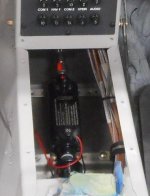
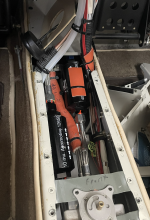
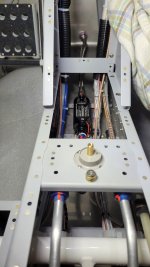
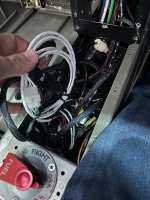
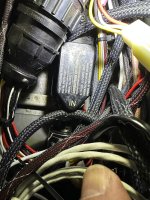
My questions are about the fuel filter and pump. These exist in the -14 in the tunnel under the control panel and in my plane they are BURIED under a rats nest of wiring (see photos).

Is it normal to have this much wiring shoved on top of the fuel filter, pump and fuel lines?

Isn't at least the fuel filter an inspection item on the condition inspection? How would that even be accomplished?
 

Attachments

  • IMG_9996.jpeg
    IMG_9996.jpeg
    1.8 MB · Views: 164
  • IMG_9990.jpeg
    IMG_9990.jpeg
    2.1 MB · Views: 164
In hunting down the source of a strong odor of fuel in the cockpit after sitting closed for overnight or longer periods (in addition to prepping for the condition inspection) I have removed the seats and most of the panels and covers in the cockpit. The good news is that no fuel leaks are evident in any of the cockpit fuel lines. In 2025 there was a -14A for sale that had "minor heat damage". My sig.other found the salvage listing which included the description that the pilot smelled fuel fumes in the cockpit and upon turning on the master switch a FIRE erupted.

My questions are about the fuel filter and pump. These exist in the -14 in the tunnel under the control panel and in my plane they are BURIED under a rats nest of wiring (see photos).

Is it normal to have this much wiring shoved on top of the fuel filter, pump and fuel lines?

Isn't at least the fuel filter an inspection item on the condition inspection? How would that even be accomplished?
For that reason, I and many others, installed fuel filters at each of the wing roots and deleted the filter in the cabin tunnel.
 
In hunting down the source of a strong odor of fuel in the cockpit after sitting closed for overnight or longer periods (in addition to prepping for the condition inspection) I have removed the seats and most of the panels and covers in the cockpit. The good news is that no fuel leaks are evident in any of the cockpit fuel lines. In 2025 there was a -14A for sale that had "minor heat damage". My sig.other found the salvage listing which included the description that the pilot smelled fuel fumes in the cockpit and upon turning on the master switch a FIRE erupted.

My questions are about the fuel filter and pump. These exist in the -14 in the tunnel under the control panel and in my plane they are BURIED under a rats nest of wiring (see photos).

Is it normal to have this much wiring shoved on top of the fuel filter, pump and fuel lines?

Isn't at least the fuel filter an inspection item on the condition inspection? How would that even be accomplished?
Kevin, you are right to track down this smell - it's not normal, and indicates something is not tight, or even worse, a crack in a tube. I'd get a wrench and give each B-nut a good check. It could be one was missed, and there are probably a dozen connections in the fuel flow path if your RV-14A is anything like my RV-8.

You are also right that each step of the way during your build you need to consider "how will I replace this when it fails?" and "how will I clean this regularly?" If it's hard to access, you will have a lot of pain when cleaning - and I can tell you that it needs to be cleaned yearly, and yearly comes around very fast.
 
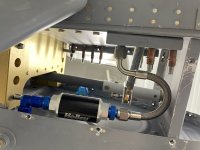
Here's quick shot of mine. Not the best picture, but you get the drift.

I have both the wing root filters and the filter shown in the picture. I've got the AFP upgraded pump and will remove this assembly at the next condition inspection. Why? Simplicity and de-clutter.

Tunnel.jpg
 
In hunting down the source of a strong odor of fuel in the cockpit after sitting closed for overnight or longer periods (in addition to prepping for the condition inspection) I have removed the seats and most of the panels and covers in the cockpit. The good news is that no fuel leaks are evident in any of the cockpit fuel lines. In 2025 there was a -14A for sale that had "minor heat damage". My sig.other found the sailvage listing which included the description that the pilot smelled fuel fumes in the cockpit and upon turning on the master switch a FIRE erupted.

My questions are about the fuel filter and pump. These exist in the -14 in the tunnel under the control panel and in my plane they are BURIED under a rats nest of wiring (see photos).

Is it normal to have this much wiring shoved on top of the fuel filter, pump and fuel lines?

Isn't at least the fuel filter an inspection item on the condition inspection? How would that even be accomplished?
I'm guessing you will need to unnest the wiring to access the filter. I smelled fuel (when I would get in the plane after it was sitting) for quite some time until I found a small leak in the suction side to the pump. When the pump was running (I have dual electric pumps that one is always running) the suction side is under almost no pressure (probably slight negative pressure) so did not leak when running but after sitting for a few days a very small amount of fuel would weep and one can smell it. It's interesting how we can smell traces of fuel especially getting into a cabin that was closed for a few days. I have fuel return lines in the tunnel also so makes it even more congested. Filters in the wing-root is the way to go just be sure to examine type of filter media and filter sq inches of media (Stainless steel) it uses. Your leak might even be pulling air (seems air is easier to find a path through a leak than gas) which you can see if you route a flex hose after the pump and into a bucket. That's how I knew for sure I had a leak "somewhere".

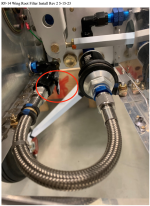
Pre and post filter:

Screenshot 2026-02-02 093624.png
 
For that reason, I and many others, installed fuel filters at each of the wing roots and deleted the filter in the cabin tunnel.
I spoke in person this weekend with a local pilot/builder of an RV-7 that did just that. And I really like the idea! While the plane is apart for the CI I am going to look into doing the same.

As far as the rats nest is concerned, the panel was a professional install by a fairly common, well-known company so I have to assume it is a fairly normal thing to have all that wiring stuffed in there.
 
I spoke in person this weekend with a local pilot/builder of an RV-7 that did just that. And I really like the idea! While the plane is apart for the CI I am going to look into doing the same.
Kevin, some of what we saw early in the RV14 days were small leaks at the filter outlet/pump inlet NPT threads. Any fuel leak isnt minor, but they werent dripping. Most were not getting the NPT threads tight. YES, there is alot of stuff in the pump area in a confined and generally closed area. One little spark and you have a real problem on your hands. (I have pics to prove it on a different aircraft model). This is the big reason Steve and I worked on the wing root filter install.
 
I think I have located the source of the fuel odors.

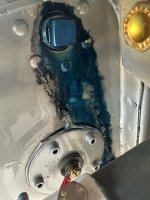
First, the builder informed me that the tanks were quickbuild (circa 2020) which I understand to have been problematic. He had to remove the left tank twice (after paint) to track down a small leak. That small leak seems to be back as I found a small amount of blue dye while under the wing. I think the tank is going to have come off again.

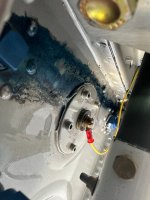
As I removed the top wing/fuselage fairing on both wings there was a fairly strong odor of fuel but interestingly more on the RIGHT wing. Looking into the "bay" there is a leak from the plug (square-head) above the fuel level sender. With the fairings open, the odor in the cockpit is not detectable any more. My hypothesis is that the leak at that plug was filling the "bay" with the odor and then it went through the aileron control rod cut-out into the flight control bay in the cockpit. From there I think the odor also travled through the cut-out on the left wing into that bay as well.

Bottom line is while the airplane is apart for CI the left tank will be removed, leak checked and repaired as necessary and that plug on the right tank will be cleaned and re-sealed.

The under-thigh flight control area (where the fuel lines enter the cockpit) is completey clean on both sides and the tunnel with the selector valve, filter and pump was clean as well. So at least that is a relief!
 
As far as the rats nest is concerned, the panel was a professional install by a fairly common, well-known company so I have to assume it is a fairly normal thing to have all that wiring stuffed in there.
Just an FYI- There are exceptions but the builder is responsible for getting all the wires up through the tunnel and under the panel. The professional companies will typically wire most of the devices together AT the panel.

I'm having Stein build my panel but I have dozens of loose wires (not part of a wiring harness) running up through the tunnel under the panel that I will terminate and connect myself.

Having said that, a builder could pay a company to do 100% of the wiring. If they did, I would expect better work than what I could do - meaning perfectly routed and bundled wires. Certainly not a rats nest!
 
Pretty sure the source of fuel fumes in the cockpit is the leaky plug on the right wing. With the fairings on that wing removed the plane sat overnight last night with the canopy closed. When I got there today there was no odor of fuel in the cockpit!
 

Attachments

  • IMG_0006.jpeg
    IMG_0006.jpeg
    2 MB · Views: 75
  • IMG_0005.jpeg
    IMG_0005.jpeg
    1.6 MB · Views: 74
Pretty sure the source of fuel fumes in the cockpit is the leaky plug on the right wing. With the fairings on that wing removed the plane sat overnight last night with the canopy closed. When I got there today there was no odor of fuel in the cockpit!
Yikes, not to be critical but how many CI 's did this get by or purchase inspection? (Seems at least 4 CI's) Loctite 567. Every QB 14 wing has this return fuel fitting. I'd be looking under every inspection panel for other possible builder issues.
 
Last edited:
Yikes, how did this get through a CI or purchase inspection? Loctite 567. Every QB 14 wing has this return fuel fitting. I'd be looking under every inspection panel for other possible builder issues.
I always top off the tanks, even when the plane is going to sit for a month. Not sure if the builder had the same mentality. That could be the difference. I was there for the pre-buy. Participated. And I know that fairing was off. Not sure how we missed it. There were a lot of notes so it might have just been human error. If there had been as strong a fuel odor as there is now, I definitely would have taken note.

I am not a builder or an A&P (but I am on the waiting lists for the LSRM programs). I have found a thorough A&P with a lot of RV experience and the CI will begin in early March. I have just about removed every panel (inspection or not) from the airplane in preparation and am demanding a VERY thorough CI.

Other than several stripped screw heads (topic for another thread) I have found nothing else that makes me say "yikes". And I am looking as thoroughly as I know how.
 
Can anyone provide some photos of their wing root fuel filters and part numbers if available?
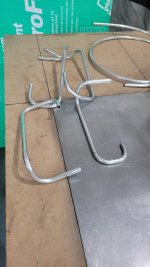
You can either buy the whole kit from AircraftSpecialty (https://www.aircraftspecialty.com/RV14 FUEL HOSE KITS.html) or put it together yourself if you are somewhat handy with these stuff.
I have put together my own and another friend's. I used the same Andair fuel filter that is used in the tunnel in my setup. While my wiring in my tunnel is pretty neat and completely out of the way of the fuel pump, I hated the removal each annual.
 
Well that is disappointing. I guess I have much work ahead.
Well, the connections are all made. You just need to organize them. It may take some time and patience but at the end you would be very happy you have done it.
 
It is NOT. This is probably one of the worse I have seen.
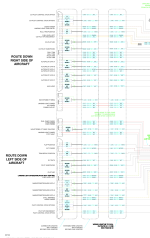
Probably worth looking at Vans document WH-00125. Good luck and applaud your effort to make this a safer airframe.

Screenshot 2026-02-02 230345.png
 
Last edited:
Can anyone provide some photos of their wing root fuel filters and part numbers if available?
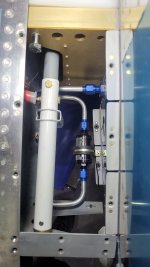
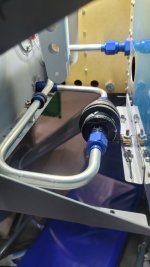
The fuel filters I used are similar to the oem one in the tunnel but the fittings on the ends are different to accept the flared tubing on both ends.
Filter part #s are Fuel-FX375-M. If you don’t do your own I would highly recommend the Kit from Steve and Tom at Aircraft Specialty. There’s pictures on their web site of the kit they sell.

Before and after pictures. Have extra tubing on hand…
20250730_183129.jpeg20250730_183011.jpeg20250730_182905.jpeg

Is it normal to have this much wiring shoved on top of the fuel filter, pump and fuel lines?
As others have said, no, that is not normal.
20240701_152647.jpeg
 
Probably worth looking at Vans document WH-00125. The majority of wiring should pass through on the left and right-side fuselage. Some through the tunnel but not a lot. Some antenna wiring of course. Good luck and applaud your effort to make this a safer airframe.

View attachment 108954

This statement is incorrect.

This cable is intended to route down the left and right sides of the fuselage, inside the tunnel. The tunnel is equipped with clips and holes cut through the spar carry through specifically for this purpose. The aft ends mate up with the aft fuselage wiring in the tunnel.

Using this harness results in a neat and uncluttered area around the fuel filter and pump. There is still ample room for adding additional wires and antenna cable runs when using this harness.
 
This statement is incorrect.

This cable is intended to route down the left and right sides of the fuselage, inside the tunnel. The tunnel is equipped with clips and holes cut through the spar carry through specifically for this purpose. The aft ends mate up with the aft fuselage wiring in the tunnel.

Using this harness results in a neat and uncluttered area around the fuel filter and pump. There is still ample room for adding additional wires and antenna cable runs when using this harness.
You are correct meant to say left and right-side of the fuselage tunnel. You can see some of the wiring in pic I posted earlier. Probably should not be commenting late at night just was a little surprised with the wiring OP was showing.

Panel builders seem to allow for fairly long service loops or at least both mine did. I guess better to be to long than to short. It appears that the builder possibly used the tunnel to coil up some of the harness wiring ? Possibly this could be pulled back under the panel ?

BTW highly recommend the Andair FX375-M filter mc607 used. It’s compact but has a very nice SS 62 micron pleaded filter media inside. The filters from Andair now use a C clip to insure it stays tight vs safety wire they used before.
 
Last edited:
If you don’t do your own I would highly recommend the Kit from Steve and Tom at Aircraft Specialty. There’s pictures on their web site of the kit they sell.
I found their website this morning and will definitley be ordering the drop-in replacement kit for my wing roots. Seems like the roots should have been the default location from Vans. Much easier to access on a yearly basis and gets one more potential for fuel leaks OUT of the cockpit.
 
Well that is disappointing. I guess I have much work ahead.
Well, the connections are all made. You just need to organize them. It may take some time and patience but at the end you would be very happy you have done it.
The fuel filters I used are similar to the oem one in the tunnel but the fittings on the ends are different to accept the flared tubing on both ends.
Filter part #s are Fuel-FX375-M. If you don’t do your own I would highly recommend the Kit from Steve and Tom at Aircraft Specialty. There’s pictures on their web site of the kit they sell.

Before and after pictures. Have extra tubing on hand…
View attachment 108958View attachment 108959View attachment 108960


As others have said, no, that is not normal.
View attachment 108961
How are you going to clean that filter, drain the tank empty? You might want to add a shut off valve which is very easy so the filter can be removed without having to drain the tank,
 
Well, the connections are all made. You just need to organize them. It may take some time and patience but at the end you would be very happy you have done it.

How are you going to clean that filter, drain the tank empty? You might want to add a shut off valve which is very easy so the filter can be removed without having to drain the tank,
Agreed, I added a valve pre-filter. Valve used in midget racing cars and seemed/felt more industrial. Up to you of course.
 
How are you going to clean that filter, drain the tank empty? You might want to add a shut off valve which is very easy so the filter can be removed without having to drain the tank,
Their website shows a shut-off as part of the drop-in assembly and the instructions are explicit about safety wiring the valve open for all ops except CI.

Overall an elegant and convenient solution.
 

Attachments

  • Screenshot 2026-02-03 at 19.52.18.png
    Screenshot 2026-02-03 at 19.52.18.png
    1 MB · Views: 60
How are you going to clean that filter, drain the tank empty? You might want to add a shut off valve which is very easy so the filter can be removed without having to drain the tank,
I lube the fuel cap orings, make sure the cap is well seated. Cap off the vent. Drain fuel from the tank drain until suction takes over. I’ve done it several times on different aircraft. Even changed a tank drain with that method. Didn’t see the point in adding extra complexity to the fuel system that’s not required.
 
I lube the fuel cap orings, make sure the cap is well seated. Cap off the vent. Drain fuel from the tank drain until suction takes over. I’ve done it several times on different aircraft. Even changed a tank drain with that method. Didn’t see the point in adding extra complexity to the fuel system that’s not required.
I am sure you know what you are doing and works for you. For me, the added danger mostly and the time to draining fuel and added back outweigh the complexity that you are referring to. This is what makes Experimental such great thing, we all can do what we like and feel it to be right.
 
I lube the fuel cap orings, make sure the cap is well seated. Cap off the vent. Drain fuel from the tank drain until suction takes over. I’ve done it several times on different aircraft. Even changed a tank drain with that method. Didn’t see the point in adding extra complexity to the fuel system that’s not required.
In addition to the safety wire, I added a dab of blue Loctite and star washer to the small screw that holds the valve handle in place. Should that screw comes off, the safety wire won't do us any good. But yeah, I have been happier with this setup than the stock version in the tunnel.
 
For me, the added danger mostly and the time to draining fuel and added back
The last time we did it there was about a red solo cup of fuel needed to be drawn out. I would say it’s as safe as the valve method because the fuel is all contained in the fuel sampler cup. Once it stops draining that’s it. Same amount of fuel spillage, possibly less, once you take the filter apart. When you do your CI I’m sure you remove your vent tubes to clean and check for obstructions. If you're curious, Simply put a cap on the vent outlet and drain off some fuel. May come in handy some day…
We always tape/placard the fuel cap so it won’t get inadvertently opened.
 
Well, the connections are all made. You just need to organize them. It may take some time and patience but at the end you would be very happy you have done it.
That is the problem with those afs wiring systems. The cables are way too long and the builders have to deal with it and don’t seem to come up with good practices. I had to do some work on a guys panel with dynon and that afs box. Would recognize those black sleeve bundles anywhere.w. This plane seemed like it had an extra mile of the stuff and the builder just bunched it all up and shoved up behind the panel. A real mess. It made adding the sds a real chore. I just touched his transponder coax and it fell right out of the bnc. I believe builders should either learn how to do it and complete themselves or farm the entire job out.
 
Their website shows a shut-off as part of the drop-in assembly and the instructions are explicit about safety wiring the valve open for all ops except CI.

Overall an elegant and convenient solution.
The big reason why we added the shutoff valve was a safety thing. We certainly did not want guys draining the tanks by pulling the drain valves and dumping fuel into a bucket. I had a nightmare about that scenario---draining fuel and some comes up and generates some static electricity and ignites the thing. So we were explicit about using a shutoff valve in our packages, and instructions on how to do it. Some may like the valve idea ( well the whole package I guess), some have even made their own modifications after the install. There is a well known selector valve manufacturer that has a root system diagram, we just took it and made it into a package, with a shutoff valve. Yes, we have had alot of flame wars over this, but it sure beats crawling in and out of the cabin to service a filter in close confines.
 

Attachments

  • install without shutoff.jpg
    install without shutoff.jpg
    250.7 KB · Views: 49
Back
Top