Van's Air Force

The definitive Van's Aircraft support community! Buying, building or flying an RV? Join our exclusive family of mentors and enthusiasts!

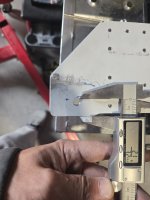
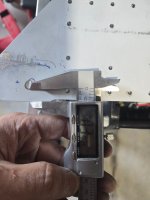
Wing rear spar hole edge distance

Thank you for sharing your approach.

As to other questions, I will have to figure out as I go. Fuel tank attachment bracket can be remade and redrilled so I don't think that will be a big challenge. As to wing incidence, maybe I'll be lucky to be within spec not to rework the fuselage part. Maybe the wing moved as I was drilling the hole in increments but the initial measurement was fine, or the initial measurement was wrong to begin with.
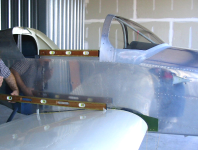
Has the other wing rear connect been drilled yet? And, was the aircraft leveled (cabin longeron reference) before measuring your wing angle-of-incidence -- this can make a big difference in measuring the wing angle-of-incidence because you're using a level on each wing to make that measurement. If both wings don't have the same angle-of-incidence, you will get a "heavy wing" during flight -- the same angle-of-incidence on both wings is highly critical.

1769454905784.png
 
Last edited:
Has the other wing rear connect been drilled yet? And, was the aircraft leveled (cabin longeron reference) before measuring your wing angle-of-incidence -- this can make a big difference in measuring the wing angle-of-incidence because you're using a level on each wing to make that measurement.
Yes, the other wing has both correct ED and incidence per spec, and longeron level when measured. I'll have to remeasure how the wing and the bad hole looks like with the correct measurements when I return to the hangar.
 
I hesitate to chime in but this may be helpful to the OP or others contemplating this challenge. I was faced with a similar dilemma on the rear spar attach fitting on my RV-4. In my case I had in irregular hole (edge of one side having a deformity) with the center having the 2 x diameter edge distance. I made the decision, a rash one as it turned out, to clean up the hole by enlarging it to .375" with a steel boring jig so I only removed material from the deformed edge of the hole. This left me with the min. called out .625" center of hole edge distance but with the 2x diameter of a 3/8" bolt it would have calculated to .750". I flew the 4 like this for several years and had even pulled 6 G's at one point but I always had that nagging doubt in the back of my mind.
During a refresh and extensive upgrade of my 4 at the 1000 hr milestone I became determined to get a definitive answer to what the actual strength of my attach fitting was in comparison to the per plans design thinking I might put a limit on my airframe of 4 or 5 G's instead of the Acro weight limit of 6G's. I consulted with a highly qualified engineer who I found here on VAF who had done work for Van's and he graciously agreed to run a structural analysis on my attach fitting .
In summary he determined: " That the larger bolt attachment is actually somewhat stronger due to the greater bearing surface area resisting shear tear-out." The per plans design ultimate-load safety factor calculated to 1.25 while my botched joint calculated to a 1.5 safety factor. This was a pleasant surprise to say the least.
I have the full analysis with calculations in my build book along with a summary card with signature in my airframe condition inspection record book. In my specific case I was left with .4375" edge of hole to edge of material and with a 3/8" bolt hole and that was stronger than the .4687" edge of hole distance with a 5/16" bolt hole.
Could the OP resolve his building error in the same way ? Thats a very personal decision he'll have to make. As for me If I was still in the building phase I would probably start drilling rivets.
An important detail to emphasize here is that after the bolt size was increased, there STILL REMAINED 0.625" (5/8") of edge distance from the center of the hole to the edge of the part. The actual amount of metal between the side of the hole and the edge of the part was only 1/32" less than the plans show, and the larger diameter hole has a lower stress concentration factor.

In the present case, there is less than the required 5/8" center-to-edge distance. Enlarging the hole will only make the situation worse. The spar part in the wing should be replaced.
If I were going to do this replacement, I would not use a standard part supplied by Vans. I would copy the part on a plain piece of 2024-T351 aluminum of the same thickness EXCEPT I would leave the area near where the bolt hole is going to be OVERSIZED by a 1/8" or so. It may hit the overhanging fuselage belly skin, flexing it out of position when the wing incidence is set properly. After installation, including final drilling, I would remove the wing and trim the part down just enough to allow the overhanging fuselage skin that covers the gap to lay flat the way it is supposed to, leaving as much metal on the spar part as possible. This should guarantee that you satisfy the 5/8" minimum center to edge distance so you don't have to re-do it again.
 
An important detail to emphasize here is that after the bolt size was increased, there STILL REMAINED 0.625" (5/8") of edge distance from the center of the hole to the edge of the part. The actual amount of metal between the side of the hole and the edge of the part was only 1/32" less than the plans show, and the larger diameter hole has a lower stress concentration factor.

In the present case, there is less than the required 5/8" center-to-edge distance. Enlarging the hole will only make the situation worse. The spar part in the wing should be replaced.
If I were going to do this replacement, I would not use a standard part supplied by Vans. I would copy the part on a plain piece of 2024-T351 aluminum of the same thickness EXCEPT I would leave the area near where the bolt hole is going to be OVERSIZED by a 1/8" or so. It may hit the overhanging fuselage belly skin, flexing it out of position when the wing incidence is set properly. After installation, including final drilling, I would remove the wing and trim the part down just enough to allow the overhanging fuselage skin that covers the gap to lay flat the way it is supposed to, leaving as much metal on the spar part as possible. This should guarantee that you satisfy the 5/8" minimum center to edge distance so you don't have to re-do it again.
Thank you Steve
Lesson learned. R&R it shall be.
 
Thanks for Chiming in Steve. Even if the OP shifted the centerline of a 3/8" hole away from the closet edge there is just not enough material left to support the connection as you pointed out. I had .4375 edge of hole to edge of material. While at 9/16" center to edge the OP would only have .4063" of edge of hole material. A difference of .0312".
I should have done the math on the OP's connection.
 
Maybe I missed it but did the OP post a measurement for the hole in the fuselage aft spar stub? I hope it isn't an ED issue as well.
 
An important detail to emphasize here is that after the bolt size was increased, there STILL REMAINED 0.625" (5/8") of edge distance from the center of the hole to the edge of the part. The actual amount of metal between the side of the hole and the edge of the part was only 1/32" less than the plans show, and the larger diameter hole has a lower stress concentration factor.

In the present case, there is less than the required 5/8" center-to-edge distance. Enlarging the hole will only make the situation worse. The spar part in the wing should be replaced.
If I were going to do this replacement, I would not use a standard part supplied by Vans. I would copy the part on a plain piece of 2024-T351 aluminum of the same thickness EXCEPT I would leave the area near where the bolt hole is going to be OVERSIZED by a 1/8" or so. It may hit the overhanging fuselage belly skin, flexing it out of position when the wing incidence is set properly. After installation, including final drilling, I would remove the wing and trim the part down just enough to allow the overhanging fuselage skin that covers the gap to lay flat the way it is supposed to, leaving as much metal on the spar part as possible. This should guarantee that you satisfy the 5/8" minimum center to edge distance so you don't have to re-do it again.
However, given that the OP said that the other wing's angle-of-incidence and edge margin were within tolerance, he's now going to recheck the angle-of-incidence on both wings again, thinking that this wing might have moved while match-drilling the hole. However, I do like you're possible approach, but more analysis is needed before applying a fix because both wings must have the same angle-of-incidence, or you end-up with a heavy wing -- right?
 
Maybe I missed it but did the OP post a measurement for the hole in the fuselage aft spar stub? I hope it isn't an ED issue as well.
A few posts ago, the OP said that the other wing was within tolerance and is now thinking that this wing might have moved during match drilling. Assuming everything is match-hole in this kit, expect for this hole, that makes the most sense to me!
 
Just as an add-on to Steve Smith’s comment…agreeing that using a new piece of raw material, rather than a Vans part…it is important to remember that grain direction matters on this piece. Raw material grain, needs to run with the length of the part, not perpendicular to it..

Just a reminder.
 
I remeasured the incidence on both wings and when clamped with the correct incidence, the holes don't line up and the hole on the wing spar part is lower than the fuselage hole, which has ED within spec. So a new hole in the new wing parts should move up at least 1/16, and should put it within minimum edge distance. So far, if things align as planned, I shouldn't have to repair the fuselage part.

I simulated bucking the rivets through the lightening holes and the holes witjin first two ribs are easy but harder after that. It feels like 12in backrivet set is still an viable option to reach on at an angle and ensure the ribs remain flat against the rear spar. Removing a few row of skin rivets to access seems also like a decent idea if backrivet can't be done.
 
I agree with your edge distance method as long as the edge distance on the newly drilled wing spar part has that same edge distance - which I think you’ve said it does.

As far as riveting the new aft spar bar, are cherry max structural rivets acceptable in that situation? Might be an option if it’s acceptable.
 
I remeasured the incidence on both wings and when clamped with the correct incidence, the holes don't line up and the hole on the wing spar part is lower than the fuselage hole, which has ED within spec. So a new hole in the new wing parts should move up at least 1/16, and should put it within minimum edge distance. So far, if things align as planned, I shouldn't have to repair the fuselage part.

I simulated bucking the rivets through the lightening holes and the holes witjin first two ribs are easy but harder after that. It feels like 12in backrivet set is still an viable option to reach on at an angle and ensure the ribs remain flat against the rear spar. Removing a few row of skin rivets to access seems also like a decent idea if backrivet can't be done.
Okay -- so you're saying that with the angle-of-incidence set correctly on both wings, the one with "good" edge margin is showing the holes lining-up correctly. But, on the other out-of-spec wing, it's showing the holes not lining-up, with the wing spar stub hole lower by 1/16 inch? Out of curiosity, how much edge margin are you seeing on the "good" wing spar stub?
 
The good wing, or the left wing, had the correct incidence and edge distance of exactly 5/8 so I bolted the spars and proceeded with other tasks. I didn't care what the edge margin was since that wasn't important to me then. If I have to guess, it would be 5/8 minus half of 5/16, or 15/32. I will have to remove the flap and the bolt to measure it, and I'll post it later when I do.
 
The good wing, or the left wing, had the correct incidence and edge distance of exactly 5/8 so I bolted the spars and proceeded with other tasks. I didn't care what the edge margin was since that wasn't important to me then. If I have to guess, it would be 5/8 minus half of 5/16, or 15/32. I will have to remove the flap and the bolt to measure it, and I'll post it later when I do.
The important thing is to have the correct angle-of-incidence on both wings while achieving at least that 5/8 inch minimum edge margin. So, your plan is both "sound" and doable by replacing the spar mounting materials on your right wing. I'm guessing that removing some lower skin rivets would greatly help in speeding-up the process while providing better results! And, having the wing on a table or in a wing cradle would be most helpful, too. Take your time, and best of luck! Once she's up and flying "straight and true", it will have been worth the effort -- we all experience some "low-times" while building an RV! (y):cool:(y)
 
Thank you for sharing your approach.

As to other questions, I will have to figure out as I go. Fuel tank attachment bracket can be remade and redrilled so I don't think that will be a big challenge. As to wing incidence, maybe I'll be lucky to be within spec not to rework the fuselage part. Maybe the wing moved as I was drilling the hole in increments but the initial measurement was fine, or the initial measurement was wrong to begin with.
I remember being afraid of that and clamped it up really tight to avoid slipping.
 
Okay -- then, by using that same hole that was drilled in the fuselage bar stock mount, this would mean that the wing angle-of-incidence would have to be increased by needing to drop the wing mounting stub down further to meet the 5/8 inch minimum ED -- right? I understand that the wing angle-of-incidence isn't as critical as the other wing mounting measurements as long as the wing angle-of-incidence is the same on both wings. But, how much additional angle-of-incidence are you actually allowed? And, wouldn't the forward wing connect also need to be redone if it were already drilled?

Question 2 -- has the other wing rear mounting hole already been drilled?

Question 3 -- how much wing alignment and mounting work has already been done?
Wi g incidence angle is relative only to the fuselage and h stab. You can be off by a lot and all that means is the fuse won’t be perfectly level in cruise and you need to make an effort to shim the stab to match. The important thing is both wings have the same angle.
 
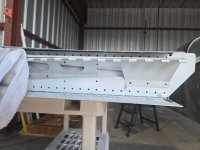
I decided to write in detail my repair for future builders. I was able to completely remove the wing spar parts without damage. By this stage of build, most builders should be able to drill out any rivet like a pro. Upper rows of rivets are easy since it's not blocked, simply drill off the head and punch through. The lower rows are blocked by the flap brace and hinge, so I drilled out the rivets on the skin but kept the rivets holding the flap brace to the spar. Reattaching them to the lower skin should be easy later. I ordered the parts almost 2 weeks ago but Vans hasn't sent them so I'll have plenty of time to plan out whether I should buck with a long/modified bucking bar or backrivet. I measured the parts that I messed up and I can reference it later to mark on new the parts so I don't accidentally drill it wrong again. I'll update/edit once the new parts arrive.
 

Attachments

  • 20260130_121222.jpg
    20260130_121222.jpg
    1.5 MB · Views: 64
  • 20260130_121126.jpg
    20260130_121126.jpg
    1.5 MB · Views: 64
  • 20260130_120956.jpg
    20260130_120956.jpg
    1.3 MB · Views: 64
Last edited:
I decided to write in detail my repair for future builders. I was able to completely remove the wing spar parts without damage. By this stage of build, most builders should be able to drill out any rivet like a pro. Upper rows of rivets are easy since it's not blocked, simply drill off the head and punch through. The lower rows are blocked by the flap brace and hinge, so I drilled out the rivets on the skin but kept the rivets holding the flap brace to the spar. Reattaching them to the lower skin should be easy later. I ordered the parts almost 2 weeks ago but Vans hasn't sent them so I'll have plenty of time to plan out whether I should buck with a long/modified bucking bar or backrivet. I measured the parts that I messed up and I can reference it later to mark on new the parts so I don't accidentally drill it wrong again. I'll update/edit once the new parts arrive.
Be sure to go in with a mirror or fingers and be sure none of the rib flanges got bent back when punching out rivets. Be sure Vans has that part in stock. Could be months before they make one for you if it is not. You can also ask vans if it is 2024 or 6061 and order the stock from Mcmaster and match it to the old one. That is what I did.
 
Back
Top