Van's Air Force

The definitive Van's Aircraft support community! Buying, building or flying an RV? Join our exclusive family of mentors and enthusiasts!

Fuel Senders Bad? Insufficient? Can’t Calibrate to Full

donmtt

Active Member
Patron
New to me RV-7 with Dynon HDX panel. Plane was built in 2006. The Dynon reports a mismatch between the fuel computer and tanks. Tanks are way off, so I started the sender calibration process by emptying the left tank and doing 2 gallon pours.

Unfortunately, when I went for the pour from 12 to 14, the sender voltage dint change. It never changed from there to full.

Any ideas?
 
New to me RV-7 with Dynon HDX panel. Plane was built in 2006. The Dynon reports a mismatch between the fuel computer and tanks. Tanks are way off, so I started the sender calibration process by emptying the left tank and doing 2 gallon pours.

Unfortunately, when I went for the pour from 12 to 14, the sender voltage dint change. It never changed from there to full.

Any ideas?
Sounds like the float is hitting the top of the wing so it can't measure fuel level above that. Some builders have installed a second sensor to compensate, but most don't bother. If you have a red cube (totalizer) it's not a big deal.
 
New to me RV-7 with Dynon HDX panel. Plane was built in 2006. The Dynon reports a mismatch between the fuel computer and tanks. Tanks are way off, so I started the sender calibration process by emptying the left tank and doing 2 gallon pours.

Unfortunately, when I went for the pour from 12 to 14, the sender voltage dint change. It never changed from there to full.

Any ideas?
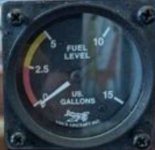
Dihedral in the wings. Fuel hits the top of the tank, and sender range, before the outboard part of the tank is full.
 
Sounds like the float is hitting the top of the wing so it can't measure fuel level above that. Some builders have installed a second sensor to compensate, but most don't bother. If you have a red cube (totalizer) it's not a big deal.
+1

I think most 7’s can read closer to 15 - 16. If yours is stopping at 12, something else maybe causing it to be lower than normal.
 
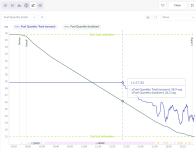
i don't know if 9A has the same problem, but my fuel sensors stay flat until tanks get below 14 and 15gal. They can be off by a few gallons as fuel shifts during descends, climbs, and slips. I don't use them much, but it's nice to have a backup to get home legally if the red cube decides to quit!

1769144586747.png
 
My 9A was doing the same thing. I removed the sender and found that the rod that the float is attached to was turning at the proximal end where it attaches to the plastic fitting.

It would work fine at lower fuel levels, but at higher levels it would slip and start to turn.

I cleaned it up good and reinstalled it into the fitting with a bunch of proseal and it's been good since.
 
I have an RV 7A. At full, the max reading on the Dynon is 16/side. I can fly for about an hour before getting any movement in the numbers. Like others have said, the floats hit the top and can't go any further. With that said, I ALWAYS keep up with fuel flow in GPH from the red cube... confirmed with EVERY fill up by comparing to gallons used. It's always within about a gallon per side accurate.
 
  • Like
Reactions: Mel
My 9A was doing the same thing. I removed the sender and found that the rod that the float is attached to was turning at the proximal end where it attaches to the plastic fitting.

It would work fine at lower fuel levels, but at higher levels it would slip and start to turn.

I cleaned it up good and reinstalled it into the fitting with a bunch of proseal and it's been good since.
This has always been a common problem - and in the early days it was becasue folks had missed the extra little bend on the tail end of the rod that keeps it from spinning in the sender unit’s plastic! It was so common that I think Van’s revised the drawing to highlight it - but that doesn’t mean folks still don’t miss it. If you had to proseal to keep it from spinning, I’d bet that yours doesn’t have that extra little bend….

Twenty (plus) years ago when I built my -8 I got it wrong and had to open the tank up to replace the sender wire….
 
My 9A was doing the same thing. I removed the sender and found that the rod that the float is attached to was turning at the proximal end where it attaches to the plastic fitting.
I’ve seen this more than once. The instructions on how to bend the float rod are not the best and some builders forget to do the additional 90 degree bend in the end to make the ~3/4” that goes into the hole at the sender end of the arm. This is what prevents the float rod from rotating in the plastic clip.

The fix is to replace the float and rod and do the proper bends.

Carl
 
You can replace the float if you want, but the dihedral of the tank fills it to the TOP from the fuse out. The float is submerged. For the same reason a tank fuel level dip stick has no gasoline to touch below about 6 gallons.

The important thing is to ensure you have accurate tank reading below 7 gal, so take several readings for calibration under 10.

If you really wanted to have full range accuracy you would need two fuel level sensing units. Some have done this. I use the digital fuel used and ensured it is accurate for inflight monitoring on cross country flights.
 
My -9A tank gauges as they display on my EFIS are only accurate after I hit about 12 gallons or so per tank. Therefore the tank fuel gauge is just one data point in my fuel management plan, and not the one that I rely on the most. Rather, I stick the tanks before any flight, and use that info to assure me that my fuel computer is accurate. About 1.5 hours into a flight, I expect to see that gauge display start to agree with the fuel computer.
 
Back
Top