Van's Air Force

The definitive Van's Aircraft support community! Buying, building or flying an RV? Join our exclusive family of mentors and enthusiasts!

Garmin G3X Touch

Av8torTom

Well Known Member
Hi, I always turn my G3X on before I start the engine. After start-up, I don't like that the LRUs go off line then reboot.
Do people start their engines without the avionics on? I was told you really want the G3X on first so you can see you oil pressure immediately upon start-up.
Thoughts?
 
Hi, I always turn my G3X on before I start the engine. After start-up, I don't like that the LRUs go off line then reboot.
Do people start their engines without the avionics on? I was told you really want the G3X on first so you can see you oil pressure immediately upon start-up.
Thoughts?
The G3X and GPS175 comes on with my master switch. There is no offline/reboot after start-up.
 
Not uncommon to see this, and it's caused by the bus voltage sagging when you engage the starter. There are two basic categories of solution:

1. Reduce the voltage drop: wound-field starter instead of permanent magnet, bigger/healthier battery, fatter battery cables, lower compression, etc.

2. Provide an alternate source of avionics power: boost converter /voltage stabilizer (GAD 27, TCW unit, etc) or a small backup battery (again TCW has a product, or you can roll a DIY solution using a little SLA battery and an appropriate diode).

#2 is easier and produces more reliable outcomes.
 
All my avionics come on with the master. I don't have a separate avionics master. If you have a backup avionics battery it will prevent the voltage sag thats causing your issue. If not, you might consider adding one.

I wouldn't even consider starting an engine without a way to immediately monitor oil pressure.
 
2. Provide an alternate source of avionics power: boost converter /voltage stabilizer (GAD 27, TCW unit, etc) or a small backup battery (again TCW has a product, or you can roll a DIY solution using a little SLA battery and an appropriate diode).

#2 is easier and produces more reliable outcomes.

Dual battery, dual buss with crossfeed diode allowing electrons to from main buss to aux.

Fire up panel on aux buss, then start engine on main buss------all the pretty glass stuff is happy.
 
+1 This works well.
+2 This is what I have - a small lithium backup battery that supplies the avionics - charged off of the buss. It's basically a "two-fer" - you get to see the EFIS and essential guages upon engine start AND you have a battery backup to the essential avionics should you loose the alternator enroute,
 
Hi, I always turn my G3X on before I start the engine. After start-up, I don't like that the LRUs go off line then reboot.
Do people start their engines without the avionics on? I was told you really want the G3X on first so you can see you oil pressure immediately upon start-up.
Thoughts?
And why do you need to see the oil pressure right after start up? How often do you lose oil pressure? Maybe that is more common for your buddies than the rest of us. I start with avionics off. If you had oil pressure at last shut down, there is an extremely high probability of having it at start up. Mechanical things do not tend to break when they are not being used.
 
Last edited:
Hence my low oil pressure annunciator lamp off the oil pressure switch for the hour meter.

My hour meter is the G3X Touch.

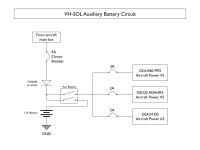
I have a small gel cell battery and aux bus like Mike S.

Aux bus is connected to POWER2 inputs on PFD, EIS and AHARS so it can run the essentials in flight if absolutely necessary.

(right-click "open in new tab" on the drawing if it shows up as black on a black background when you click it)

- mark
 

Attachments

  • VH-SOL Auxiliary Battery Circuit.png
    VH-SOL Auxiliary Battery Circuit.png
    32.5 KB · Views: 73
And why do you need to see the oil pressure right after start up? How often do you lose oil pressure? Maybe that is more common for your buddies than the rest of us. I start with avionics off. If you had oil pressure at last shut down, there is an extremely high probability of having it at start up. Mechanical things do not tend to break when they are not being used.
Recently, I started my airplane and, as normal, noted the increase in oil pressure as the engine came alive, but before I got to the runway, my oil pressure had dropped to 10 psi! Fortunately, I caught it before run-up and take-off. It took less than 5 minutes, according to the engine data collection. Discovered the braided oil pressure hose had worn an almost imperceptible hole through the braided oil cooler hose. Took a bit to find it, but under high pressure, it dumped a lot of oil. The oil cooler hose is now fire sleeved, thanks to TSFlightlines, and I have a flashing low pressure alert on my G3x.
 
And why do you need to see the oil pressure right after start up? How often do you lose oil pressure? Maybe that is more common for your buddies than the rest of us. I start with avionics off. If you had oil pressure at last shut down, there is an extremely high probability of having it at start up. Mechanical things do not tend to break when they are not being used.
I agree that the chance is pretty small. But it's also not zero. The engine is the single most expensive component in the airplane. In a lot of cases, it's worth more than the airframe. I'm taking every reasonable precaution to protect it.
 
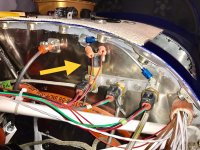
I have dual G3x and the GAD27 among other things, but will start up with the Avionics off. To confirm positive oil pressure after start I installed a 15 psi pressure switch and a separate idiot light on the panel. Start the Eng and if the light goes out all is well until the screens are up and running. Instead of a backup battery I went with a backup alternator on the vacuum pump pad.


Don Broussard
RV9 Rebuild in Progress
57 Pacer
 

Attachments

  • IMG_1321.jpeg
    IMG_1321.jpeg
    1.1 MB · Views: 55
I do not have a back-up battery. However, with the UL 520 engine, you wire a Large, I mean big (63V 68F) capacitor in parallel with battery.
Supposedly this is to prevent voltage drops, and will provide power in event of alternator failure.
Bonus: much lighter than second battery.
 
I do not have a back-up battery. However, with the UL 520 engine, you wire a Large, I mean big (63V 68F) capacitor in parallel with battery.
Supposedly this is to prevent voltage drops, and will provide power in event of alternator failure.
Bonus: much lighter than second battery.
68 farads??? That's 68,000,000 microfarads! I imagine that would be about the size of my hanger :oops:
Probably 68000 uF
 
Last edited:
I do not have a back-up battery. However, with the UL 520 engine, you wire a Large, I mean big (63V 68F) capacitor in parallel with battery.
Supposedly this is to prevent voltage drops, and will provide power in event of alternator failure.
Bonus: much lighter than second battery.

68 farads??? That's 68,000,000 microfarads!

It's there to clean up the ripple current from the dynamo/generator in the UL 520 and keep the ECU from "freaking out". It does not provide power in the event of an "alternator" failure.

and it's a 68KuF...
 
I agree that the chance is pretty small. But it's also not zero. The engine is the single most expensive component in the airplane. In a lot of cases, it's worth more than the airframe. I'm taking every reasonable precaution to protect it.
I am in no way advocating that folks ignore oil pressure. It just doesn't seem to me that having a 10 second period after engine start with no indication is real risk. One must also bear in mind risk of brown out damage to expensive electronics. Sure, modern electronics deal with it pretty well, but also a non zero risk IMO.
 
Recently, I started my airplane and, as normal, noted the increase in oil pressure as the engine came alive, but before I got to the runway, my oil pressure had dropped to 10 psi! Fortunately, I caught it before run-up and take-off. It took less than 5 minutes, according to the engine data collection. Discovered the braided oil pressure hose had worn an almost imperceptible hole through the braided oil cooler hose. Took a bit to find it, but under high pressure, it dumped a lot of oil. The oil cooler hose is now fire sleeved, thanks to TSFlightlines, and I have a flashing low pressure alert on my G3x.
Glad you caught that, but kind of confirms that missing the 10 seconds after start was not really a problem here. I'll reiteate that I feel it is very important to monitor oil pressure, including alarms to grab your attention. I just don't believe a missing 10 second period is really that critical. Just one mans opinion.
 
I am in no way advocating that folks ignore oil pressure. It just doesn't seem to me that having a 10 second period after engine start with no indication is real risk. One must also bear in mind risk of brown out damage to expensive electronics. Sure, modern electronics deal with it pretty well, but also a non zero risk IMO.

Help end this madness -- "brownouts" don't damage, or wear out "expensive electronics", unless we're talking about your Dad's McIntosh MC30 or Fisher 500C ;) Those VT heater elements don't take kindly to the thermal stress that the low-to-high voltage transition causes.

Overvoltage is bad -- think about your own blood pressure. High voltage, Surges, etc. will cause electrical aneurysms -- not good.
 
Could also wire the GDU 460 to the master … all other avionics on the Avionics Switch , my GameBird is wired this way
 
I am in no way advocating that folks ignore oil pressure. It just doesn't seem to me that having a 10 second period after engine start with no indication is real risk. One must also bear in mind risk of brown out damage to expensive electronics. Sure, modern electronics deal with it pretty well, but also a non zero risk IMO.
I agree. I guess I misunderstood what you were saying re: "Why do you need to monitor oil pressure right after startup?" in the post I was responding to.

According to Garmin, brownout damage to modern avionics isn't a thing. So it is indeed a zero risk.
 
Help end this madness -- "brownouts" don't damage, or wear out "expensive electronics", unless we're talking about your Dad's McIntosh MC30 or Fisher 500C ;) Those VT heater elements don't take kindly to the thermal stress that the low-to-high voltage transition causes.

Overvoltage is bad -- think about your own blood pressure. High voltage, Surges, etc. will cause electrical aneurysms -- not good.
I am sure things have changed much in the last 40 years, but I grew up in telecomm in the 80’s and brown out damage, while not common, was absolutely a threat to then modern electronics.

While i yield to those with more modern knowledge, i still cringe when i see screens go dark and then reboot due to voltage sags. Maybe unrealistic fear, but no more unrealistic than fear of not seeing oil pressure for 10 seconds.
 
Help end this madness -- "brownouts" don't damage, or wear out "expensive electronics", unless we're talking about your Dad's McIntosh MC30 or Fisher 500C ;) Those VT heater elements don't take kindly to the thermal stress that the low-to-high voltage transition causes.

Overvoltage is bad -- think about your own blood pressure. High voltage, Surges, etc. will cause electrical aneurysms -- not good.
Switch mode power supplies (universally used in all electronics these days) can indeed be temperamental or damaged when run at lower than specified voltages, most will have a some protection to guard against this by shutting down but it’s no guarantee. Input current increases as voltage drops, thereby stressing components in the power supply. Boot-up problems are also typical when voltage sags.

Bad analogy between blood pressure, your brain and switch mode power supplies.
 
Last edited:
Switch mode power supplies (universally used in all electronics these days) can indeed be temperamental or damaged when run at lower than specified voltages, most will have a some protection to guard against this by shutting down but it’s no guarantee. Input current increases as voltage drops, thereby stressing components in the power supply. Boot-up problems are also typical when voltage sags.

Bad analogy between blood pressure, your brain and switch mode power supplies.
I think we need to discuss this further -- your assertion seems to run counter to Ohm's law; Current is directly proportional to Voltage, inversely Proportional to Resistance --- V=IR and the other permutations.

So, what effect are you actually seeing if you hang a current clamp/loop on the input to a switcher and then reduce the input voltage?
 
I think we need to discuss this further -- your assertion seems to run counter to Ohm's law; Current is directly proportional to Voltage, inversely Proportional to Resistance --- V=IR and the other permutations.

So, what effect are you actually seeing if you hang a current clamp/loop on the input to a switcher and then reduce the input voltage?
WAYYY over my head here, but it would seem that things can't be as simple as just ohms law when dealing with chip based switching power supplies. You are oscillating things at a very high rate and there must be circuitry involved with that. I know some regulator chips specify very wide input voltage ranges and others do not, so there must be many ways to skin this cat. Why would a chip maker specify a narrow voltage range if it could easilly handle a wider range? Again, in the deep end of the pool knowledge wise here without skills, but seems there is more going on here.

Not trying to argue that brown outs are an issue, just trying to learn.
 
I think we need to discuss this further -- your assertion seems to run counter to Ohm's law; Current is directly proportional to Voltage, inversely Proportional to Resistance --- V=IR and the other permutations.

So, what effect are you actually seeing if you hang a current clamp/loop on the input to a switcher and then reduce the input voltage?
I think you answered your own question; lower voltage means higher currents to produce the same amount of power.
 
WAYYY over my head here, but it would seem that things can't be as simple as just ohms law when dealing with chip based switching power supplies. You are oscillating things at a very high rate and there must be circuitry involved with that. I know some regulator chips specify very wide input voltage ranges and others do not, so there must be many ways to skin this cat. Why would a chip maker specify a narrow voltage range if it could easilly handle a wider range? Again, in the deep end of the pool knowledge wise here without skills, but seems there is more going on here.

Not trying to argue that brown outs are an issue, just trying to learn.

Ohm's law describes the relationship of Voltage (Pressure), Current (Flow), Resistance (Resistance), and Power (Watts) -- no matter the complexity of the circuit. It's a law.

The device isn't oscillating (current moving forward and backwards), it's switching On and Off - the width(duration) of the On and Off pulses are is used to derive the output power from the device. The pulsing DC is driven into a transformer or voltage multiplier, capacitors and inductors smooth the output so it appears to be DC without any "ripple".

At the silicon device level, there are limits to how much voltage (pressure) and current (flow) it can handle -- this is determined by the chemical and physical makeup of the device.

In your Telephony days ( me too, 2600Hz and 3700Hz are your friends :) ), susceptibility to voltage sag/brown out conditions were related to the devices that used thermionic emissions from a "heater" element (tungsten) to function. The rapid cooling and subsequent heating of the element caused by the brown out would make the element break/fail. Suddenly, no more microwaves were coming out of the cavity (magnetron)... or if you were still running with VT's in your SxS or crossbar CO, they would fail for the same reason (1ESS, 5ESS were 100% solid state as I recall, although there may have been some huts along the way that still used VTs in their frames).

 
Well to keep this simple and aviation related, why do 28v systems use smaller wire sizes and breaker ratings than 14v systems to run the same devices?
Because P=IV or P=V^2/R.

The resistance *must* higher in a 28V system, otherwise it would "draw" 2X the amps at 28V vs 14V.
 
Hi, I always turn my G3X on before I start the engine. After start-up, I don't like that the LRUs go off line then reboot.
Do people start their engines without the avionics on? I was told you really want the G3X on first so you can see you oil pressure immediately upon start-up.
Thoughts?
I swear you guys could drift a thread from exhaust bolts to how to prep for a colonoscopy and then on to the use of chocolate to catch hangar mice.

Back to the OP's question. IMHO, the engine instruments dictate whether you can/will start with the avionics off. On my Bonanza, the engine instrutments (ex: oil pressure) do not require the avionics to be on. On my RV-8, the engine instruments are part of the G3X system so it is started with the avionics on.

My understanding is the newer solid state avionics do not require a avionics master as did the older equipment that was sensitive to flucations in voltages. When combined with battery backups, the additional filtration also adds addtional electrical protection by providing a stable voltage.
 
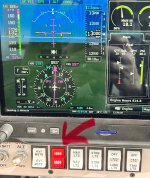
OP says “I don’t like…” as the key to his dilemma. That is one argument I agree with 100% and is exactly why I added a TCM backup after watching my Garmins intermittently reboot after engine start for almost 4 years. At some point you get tired of “good enough” when it comes to your pride and joy. So my 2-cents is to treat yourself to a wintertime project and add the standby battery. The G3X makes it sooooo easy to incorporate into an existing system and then you have a belt-and-suspenders solution to some electrical issues as well. I love it that my screens don’t reboot anymore and that’s really what matters IMHO.

The hardest part is cutting a square hole in your panel for the rocker switch.
 

Attachments

  • IMG_9562.jpeg
    IMG_9562.jpeg
    1.2 MB · Views: 30
Last edited:
Ohm's law describes the relationship of Voltage (Pressure), Current (Flow), Resistance (Resistance), and Power (Watts) -- no matter the complexity of the circuit. It's a law.

The device isn't oscillating (current moving forward and backwards), it's switching On and Off - the width(duration) of the On and Off pulses are is used to derive the output power from the device. The pulsing DC is driven into a transformer or voltage multiplier, capacitors and inductors smooth the output so it appears to be DC without any "ripple".

At the silicon device level, there are limits to how much voltage (pressure) and current (flow) it can handle -- this is determined by the chemical and physical makeup of the device.

In your Telephony days ( me too, 2600Hz and 3700Hz are your friends :) ), susceptibility to voltage sag/brown out conditions were related to the devices that used thermionic emissions from a "heater" element (tungsten) to function. The rapid cooling and subsequent heating of the element caused by the brown out would make the element break/fail. Suddenly, no more microwaves were coming out of the cavity (magnetron)... or if you were still running with VT's in your SxS or crossbar CO, they would fail for the same reason (1ESS, 5ESS were 100% solid state as I recall, although there may have been some huts along the way that still used VTs in their frames).

Thanks for the detail. I worked on the solid state stuff. cross bar and 1A2 stuff we replaced and didn't really support, though I remember the old timers teaching me about relays and even drum memory. I once designed a work around using E&M tie lines and needed a bunch of relays to do it. Didn't understand shunting diodes at the time and the service went down in a hospital (contacts melted and seized); All sorts of trouble from that learning experience. Remember, I am a sales guy that is self taught in all things technical. Much of that learning was via experimentation and mistakes.
 
I think we need to discuss this further -- your assertion seems to run counter to Ohm's law; Current is directly proportional to Voltage, inversely Proportional to Resistance --- V=IR and the other permutations.
Ohm's Law applies to resistors (and circuits that behave like resistors). Many things in the world are basically resistors, like wires, but a switching power supply distinctly does not behave like a resistor. A switching power supply with some device behind it is instead a constant-power load. If you change the input voltage, then the duty cycle of the switcher will change and therefore the current draw will change - but in the opposite direction, in order to maintain the same output voltage.

Remember, Ohm's Law only applies to ohmic materials. The voltage-current curve of a piece of wire or a resistor is a straight line; it's not a straight line for a diode, battery, capacitor, etc.

Because P=IV or P=V^2/R.

The resistance *must* higher in a 28V system, otherwise it would "draw" 2X the amps at 28V vs 14V.
Yes, a light bulb designed for 28V *must* have higher resistance than one designed for the same amount of power at 14V. But the wiring in the airplane is not the same as the load. The wiring can be thinner in a 28V system because the current is lower for the same power draw.
 
For many years, it's been advisable to turn the Avionics Switch ON after the engine is running, and also turn the Avionics switch OFF before shutting down. Inductive devises, such as starters and alternators, can potentially induce transients into your electrical system. If you don't believe this, then meet me at the ramp with an oscilloscope. Even though avionics have become more tolerant, spikes and ground bounces can still get through and damage delicate electronic components.
 
Last edited:
Switching power supplies are not resistors!
No, they are not Resistors....but they are a circuit, and they have resistance. (and they are not superconductors or anything else when the non-linearity of Ohm's law would apply.)

I'll scare up a Garmin GTR200 (heck, I'll use the one from my airplane), and my bench DC power supply -- I'll vary the input voltage and measure the amps --- will post the results Monday.

You good with that?
 
No, they are not Resistors....but they are a circuit, and they have resistance. (and they are not superconductors or anything else when the non-linearity of Ohm's law would apply.)

I'll scare up a Garmin GTR200 (heck, I'll use the one from my airplane), and my bench DC power supply -- I'll vary the input voltage and measure the amps --- will post the results Monday.

You good with that?
Might be easier to look in the install manual for CB rating for 14 vs 28 volts.
 
You all are making this way too hard.

Going back to the OP’s original question.
My setup:
- (2) PC-625 batteries.
- (2) “avionic like” busses. Each feeding half the panel. Example is left EFIS and Comm #1 on the left battery, right EFIS and Comm #2 on the right battery. XPDR, Flaps, Trim, Autopilot and such split between the two buses.
- These busses connect to the appropriate battery via 30 amp relays mounted at the battery, power input connected to the battery, not the output of the master solenoids.
- A master solenoid on each battery feeding the “non-vital” stuff; engine start, alternator Lights, pitot heat and such.
- No backup batteries on anything. The system provides “back modes” without adding backup batteries.

Normal start:
- Both master solenoids shut. Starter gets power from both batteries.
- Left avionics buss off, right avionics buss on. This gives me the EMS display on the right EFIS and keeps the overpriced and power hungry GTN-650 off.
- Left avionics buss on after engine start.

This set up is flying on five planes, soon to be seven over a 24 year period.

My experience is I never have a panel brown out, or a problem with startup buss voltage droop.

Carl
 
I have dual G3x and the GAD27 among other things, but will start up with the Avionics off. To confirm positive oil pressure after start I installed a 15 psi pressure switch and a separate idiot light on the panel. Start the Eng and if the light goes out all is well until the screens are up and running. Instead of a backup battery I went with a backup alternator on the vacuum pump pad.


Don Broussard
RV9 Rebuild in Progress
57 Pacer
I was considering doing the same - i.e., a pressure switch with a idiot light on the panel.
Do you have a source and part number for that pressure switch? Thanks
 
I should mention that I have a separate avionics bus that is energized by a switch on my panel through a relay.
Would it not be possible to add a back-up battery to that bus since that's where the GX3 and LRUs are getting their power?
 
I think we need to discuss this further -- your assertion seems to run counter to Ohm's law; Current is directly proportional to Voltage, inversely Proportional to Resistance --- V=IR and the other permutations.

So, what effect are you actually seeing if you hang a current clamp/loop on the input to a switcher and then reduce the input voltage?
Modern switching power supplies generally regulate current through an inductor to maintain a regulated voltage in an output storage capacitor. The input voltage is switched ON and OFF at higher frequency (12-100 kHz typically) using a solid-state switching device (Transistor, FET or IGBT) to maintain a current level through the inductor to maintain the desired regulated output volage across the output capacitor. Feedback is provided to the switching circuit to either increase or decrease the switching duty-cycle to maintain a constant regulated output voltage across the output capacitor.

Ohms law doesn't apply -- differential equations for inductors and capacitors describe voltage and current relationships.
However, Power In still equals = I x V

Inductor Voltage = L x di/dt, where L equals Inductance and di/dt is the differential for Current (i) with respect to Time (t)

Capacitor Current = C x dv/dt, where C equals Capacitance and dv/dt is the differential for Voltage (v) with respect to Time (t)

These equations are often combined with Kirchhoff's laws to form first-order or second-order Differential Equations for analyzing transient and steady-state behavior in electronic circuits containing inductors and capacitors, such as switching power supplies. It's common to transform such differential equations into Laplace transforms to make circuit analysis easier in complex circuits. (y):cool:(y)
 
Last edited:
I should mention that I have a separate avionics bus that is energized by a switch on my panel through a relay.
Would it not be possible to add a back-up battery to that bus since that's where the GX3 and LRUs are getting their power?
Tom, I went through this decision process about a year ago. Maybe this will help…

The G3X Installation Manual has examples of backup battery configuration on pages 24-6 and 24-7. Most of the boxes (and displays) have an alternate power input which can be used for backup purposes.
I also have an avionics bus but the TCW battery will automatically pick up my PFD, AHARS and GEA-24 if the bus voltage drops below about 11 volts so the screens don’t reboot. Once the regular bus voltage rises above 11V the G3X goes back on bus power automatically as well. The TCW manual has some helpful information to help figure out what all you want to power. You probably can do an alternate input to the whole avionics bus, but Garmin provided an easier way to send backup power to specific components.
 
Back
Top