Van's Air Force

The definitive Van's Aircraft support community! Buying, building or flying an RV? Join our exclusive family of mentors and enthusiasts!

O-360 mixture setting

adrianolsantos

Member
Friend
I have a RV6A with a O-360 A4M engine, MA4-5 carburator and whirlwind fixed pitch prop.

The engine runs normal in flight or high RPM on the ground.

My problem is the mixture setting at low RPM. Even with 6 turns in the mixture screw in the carburator I still don’t have any RPM rise when leaning at 1200 RPM on the ground.

I removed the carburettor I had and installed an overhauled unit but I still have to use 6 turns on the screw to have a reasonable smooth idle but not rich enough to cause RPM rising when leaning.

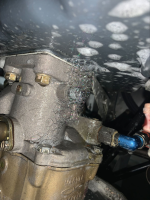
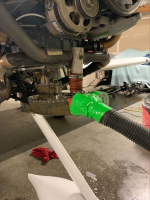
I 3d printed a plate to attach to the bottom of the carburetor and connected that to a regulated air pressure source (see photo). I injected 10 psi and cross checked that value connecting a manometer to the manifold pressure line in the engine. Spraying soap on the intake system I couldn’t find any leaks.

Suspecting I could have a hidden leak inside the sump, I swapped mine for a new one but it made no difference.

Now I am running out of ideas. Does anyone have any idea to help me?

CheersIMG_7378.jpeg
 
My MA4SPA carbed O-320 is very similar, and I've heard plenty of RVs with similar minimal rise before shutoff. I'm an APIA, and I built my engine for mybRV4 as well as overhauled the carb. I see no I'll side effects otherwise, and I typically lean way back shortly after start up and stay lean until run up to minimize plug load up. I do not consider myself an engine "expert", but find no smoking gun. I am running a wood fixed prop and it has very little inertia at start or shut down, so this can make a difference in the final moments before lean out shut down. I wouldn't over think it if all other parameters are good.
 
1200 rpm?
I roughly set idle as low as it will go, between 650 to 750. Than adjust the idle mixture screw to point where it runs smoothly & gets a 50 rpm rise towards idle cut off. Because idle speed usually increases after that adjustment I than re-set idle speed to as close to 650 as I can with it idling reasonably smooth.

Correct me if I’m wrong but ‘idling’ at 1200 may actually be too high to be running on the idle circuit.
 
I too have a 6A with O-360 A1A and MA4-5 10-4164-01 carb but with a constant speed prop. Purchased over a year ago, I’ve been chasing the same problem. I was out about 4 turns and most I could get was about 10 to 20 RPM rise and called it good. Only issue is CHTs would go above 400 on climb out until I reduced power significantly even with all the baffling redone. Then I changed from an ElectroAir to an E-Mag and the CHTs got much worse even with the timing reduced 2 teeth. E-Mag support (now Hartzell) said to get the RPM rise fixed first then we would troubleshoot any E-Mag issues. Checking again, I found the mixture screw had wiggled out over 7 turns!

I did the shop vac on blow taped to the air box inlet. Spraying A LOT of soapy water on all the intake tube joints showed nothing. I was sure there was a leak. Then I glanced at the side of the carb and it was making a huge amount of bubbles around the throttle body bushing. I mean it was a lot! I’ve always suspected the carb since day one so I bit the bullet and ordered a rebuilt from Spruce to be put on this weekend. I’m keeping my fingers crossed this is why I couldn’t get the RPM rise on shutdown (because it was already too lean from that significant air leak) and I’m guessing too lean on full power causing the higher than normal CHTs and EGTs – I hope.

You’ve already swapped your carb but maybe you still have an intake leak. I did the in-flight induction leak test and values were all over the place indicating I do have a leak but it wasn’t isolated to one cylinder. Maybe do the intake leak test again with the soapy water giving every connection on the intake tubes a serious soaking along with all the way around the carburetor and the gasket between the carb and the engine.

All the other O-360’s I’ve flown over the last 30 years have had a significant RPM rise on shut down. I don’t understand why it would be different with an RV other than an induction leak somewhere or a worn out carb.

1764636749344.png

1764636720833.png
 
1200 rpm?
I roughly set idle as low as it will go, between 650 to 750. Than adjust the idle mixture screw to point where it runs smoothly & gets a 50 rpm rise towards idle cut off. Because idle speed usually increases after that adjustment I than re-set idle speed to as close to 650 as I can with it idling reasonably smooth.

Correct me if I’m wrong but ‘idling’ at 1200 may actually be too high to be running on the idle circuit.
Idle is 750 RPM. I just did the cut off check at 1200.
 
1200 rpm?
I roughly set idle as low as it will go, between 650 to 750. Than adjust the idle mixture screw to point where it runs smoothly & gets a 50 rpm rise towards idle cut off. Because idle speed usually increases after that adjustment I than re-set idle speed to as close to 650 as I can with it idling reasonably smooth.

Correct me if I’m wrong but ‘idling’ at 1200 may actually be too high to be running on the idle circuit.
+1

At 1200, you are pretty much on the main circuit, not the idle circuit and this is why you can’t lean it via the idle mixture screw. Idle Mixture should be set at 800. Better to user the lowest map approach for more accurate results.
 
I too have a 6A with O-360 A1A and MA4-5 10-4164-01 carb but with a constant speed prop. Purchased over a year ago, I’ve been chasing the same problem. I was out about 4 turns and most I could get was about 10 to 20 RPM rise and called it good. Only issue is CHTs would go above 400 on climb out until I reduced power significantly even with all the baffling redone. Then I changed from an ElectroAir to an E-Mag and the CHTs got much worse even with the timing reduced 2 teeth. E-Mag support (now Hartzell) said to get the RPM rise fixed first then we would troubleshoot any E-Mag issues. Checking again, I found the mixture screw had wiggled out over 7 turns!

I did the shop vac on blow taped to the air box inlet. Spraying A LOT of soapy water on all the intake tube joints showed nothing. I was sure there was a leak. Then I glanced at the side of the carb and it was making a huge amount of bubbles around the throttle body bushing. I mean it was a lot! I’ve always suspected the carb since day one so I bit the bullet and ordered a rebuilt from Spruce to be put on this weekend. I’m keeping my fingers crossed this is why I couldn’t get the RPM rise on shutdown (because it was already too lean from that significant air leak) and I’m guessing too lean on full power causing the higher than normal CHTs and EGTs – I hope.

You’ve already swapped your carb but maybe you still have an intake leak. I did the in-flight induction leak test and values were all over the place indicating I do have a leak but it wasn’t isolated to one cylinder. Maybe do the intake leak test again with the soapy water giving every connection on the intake tubes a serious soaking along with all the way around the carburetor and the gasket between the carb and the engine.

All the other O-360’s I’ve flown over the last 30 years have had a significant RPM rise on shut down. I don’t understand why it would be different with an RV other than an induction leak somewhere or a worn out carb.

View attachment 103637

View attachment 103636
The throttle shaft bores are knurled and NOT airtight. Will always leak from there. It doesn’t matter at idle, as they are on the high pressure side of the throttle blade and will not impact idle mixture. Consider that leak point vs the massive wide open throat; it is meaningless . For leaks to impact idle mixture they need to be on the low pressure side of the throttle blade (i.e. manifold side).
 
Not sure where 50 rpm’s came from, but if you bring your engine to the lowest indicated manifold pressure which is usually around 750 rpm, then adjust your idle screw for a smooth reliable idle and then see a slight rise as you shut down, you’re good.

If you need to pull mixture a bit on hot days, no big deal to keep from loading up a bit.

Every engine and RV installation varies slightly…so don’t get too hung up on specifics. Like others have already said…at 1200, you are off the idle circuit and onto the main jet.
 
Not sure where 50 rpm’s came from, but if you bring your engine to the lowest indicated manifold pressure which is usually around 750 rpm, then adjust your idle screw for a smooth reliable idle and then see a slight rise as you shut down, you’re good.

If you need to pull mixture a bit on hot days, no big deal to keep from loading up a bit.

Every engine and RV installation varies slightly…so don’t get too hung up on specifics. Like others have already said…at 1200, you are off the idle circuit and onto the main jet.
My last 1,000 hours was in an IO360 (Fuel Injected) and always got 50 RPM rise or more on shutdown. Now that I have a O360 carb not getting 50 RPM and at most 10 RPM but usually nothing, along with other minor issues (higher than I like CHTs on take off despite new baffle seals and adjusted timing, some stumbling on adding power while on approach) keep pointing back to the carb - hopefully. As for where the 50 RPM rise came from - I've always been told that number by multiple reputable mechanics along with E-Mag support most recently. They didn't even want to troubleshoot further until I could get the 50 RPM rise siting a potential induction leak or carburetor issues and not the E-Mag.

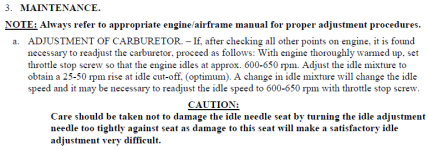
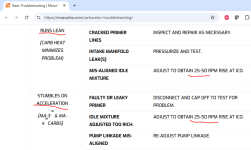
Additionally, it is in the Marvel-Schebler Troubleshooting manual and from their website directly. That I can't get more than 10 RPM rise regardless of where the idle mixture screw is adjusted is unsettling/confusing. I'll report back after spending the $1,500 on an overhauled carb from Spruce. But here's the two references I've used to additionally convince myself there should be a 50 RPM or at least more than a 10 RPM rise at idle cutoff. I'd love to see a 100 RPM rise on shutdown and then I'd know I'm too lean and need to richen down to 50 RPM. But that I can't get that more than 10 if I'm lucky keeps pointing in the direction that it is too lean no matter what.

CORRECTION: @lr172 pointed out I have this backwards and I wanted to correct the above statement. If I could get a 100 RPM rise, then I know finally I'm too rich and I could turn the screw in to lean. For my situation, it seems the idle screw has no impact on if I'm too rich. As I have other symptoms, I'm replacing the carb and if it doesn't make a difference, setting it 1.75 turns out and leaving it. I'll report back when that's done.

I'm always wanting to learn so if there is a reason this just isn't the case with an O-360, MA-4-5 10-4164-1, top Slick set at 25, bottom E-Mag 5 PTDC, in an RV6A I defiantly want to understand why. If I understood why then I could accept it and move on - a flaw in my nature that I can't!

1764697800029.png


1764697930478.png
 
Last edited:
My last 1,000 hours was in an IO360 (Fuel Injected) and always got 50 RPM rise or more on shutdown. Now that I have a O360 carb not getting 50 RPM and at most 10 RPM but usually nothing, along with other minor issues (higher than I like CHTs on take off despite new baffle seals and adjusted timing, some stumbling on adding power while on approach) keep pointing back to the carb - hopefully. As for where the 50 RPM rise came from - I've always been told that number by multiple reputable mechanics along with E-Mag support most recently. They didn't even want to troubleshoot further until I could get the 50 RPM rise siting a potential induction leak or carburetor issues and not the E-Mag.

Additionally, it is in the Marvel-Schebler Troubleshooting manual and from their website directly. That I can't get more than 10 RPM rise regardless of where the idle mixture screw is adjusted is unsettling/confusing. I'll report back after spending the $1,500 on an overhauled carb from Spruce. But here's the two references I've used to additionally convince myself there should be a 50 RPM or at least more than a 10 RPM rise at idle cutoff. I'd love to see a 100 RPM rise on shutdown and then I'd know I'm too lean and need to richen down to 50 RPM. But that I can't get that more than 10 if I'm lucky keeps pointing in the direction that it is too lean no matter what.

I'm always wanting to learn so if there is a reason this just isn't the case with an O-360, MA-4-5 10-4164-1, top Slick set at 25, bottom E-Mag 5 PTDC, in an RV6A I defiantly want to understand why. If I understood why then I could accept it and move on - a flaw in my nature that I can't!

View attachment 103679


View attachment 103680
When those criteria were set, I doubt e mags, automotive plugs and wires and so much more, were all considered… I could be wrong… but either way, everything in the world has tolerance.

No two RV’s induction systems, mags, spark plugs… nothing is built without some tolerance.

On my carbed, e mag’d, O-360 spinning a blended airfoil Hartzell… it gets maybe 20 degrees delta.

Idles perfect. Runs perfect. EGT’s perfect

Not sure more than that really matters.
 
My last 1,000 hours was in an IO360 (Fuel Injected) and always got 50 RPM rise or more on shutdown. Now that I have a O360 carb not getting 50 RPM and at most 10 RPM but usually nothing, along with other minor issues (higher than I like CHTs on take off despite new baffle seals and adjusted timing, some stumbling on adding power while on approach) keep pointing back to the carb - hopefully. As for where the 50 RPM rise came from - I've always been told that number by multiple reputable mechanics along with E-Mag support most recently. They didn't even want to troubleshoot further until I could get the 50 RPM rise siting a potential induction leak or carburetor issues and not the E-Mag.

Additionally, it is in the Marvel-Schebler Troubleshooting manual and from their website directly. That I can't get more than 10 RPM rise regardless of where the idle mixture screw is adjusted is unsettling/confusing. I'll report back after spending the $1,500 on an overhauled carb from Spruce. But here's the two references I've used to additionally convince myself there should be a 50 RPM or at least more than a 10 RPM rise at idle cutoff. I'd love to see a 100 RPM rise on shutdown and then I'd know I'm too lean and need to richen down to 50 RPM. But that I can't get that more than 10 if I'm lucky keeps pointing in the direction that it is too lean no matter what.

I'm always wanting to learn so if there is a reason this just isn't the case with an O-360, MA-4-5 10-4164-1, top Slick set at 25, bottom E-Mag 5 PTDC, in an RV6A I defiantly want to understand why. If I understood why then I could accept it and move on - a flaw in my nature that I can't!

View attachment 103679


View attachment 103680
Yes many bits of poorly thought out advice that just never goes away. Generally idle mixture should set at best power, unless dealing with emissions. 50 rise is richer than best power at idle and not at all related to best power. Highest vacuum/ lowest map is a direct correlation with best power mixture; hence the recommendation. I have posted in the past on how to do it. A simpler, but less precise method is to set the mixture to where you get the highest rpm. The 50 rise just really tells you how rich you are and does nothing to set best power.

You stated

I'd love to see a 100 RPM rise on shutdown and then I'd know I'm too lean and need to richen down to 50 RPM. But that I can't get that more than 10 if I'm lucky keeps pointing in the direction that it is too lean no matter what.

First, you have it backwards. A 100 rise is richer than a 50, which is richer than a 10 rise. Second, What makes you believe 10 rise is to lean, if you have never taken steps to see what the engine wants. That is done via the methods described above. Performance parameters can be used to know what the engine likes, or better said optimized.

 
It is an interesting subject, thanks for raising it @adrianolsantos

My old carbed 360 had a nice 40 RPM rise. Performed the "Mooney mod" as the engine was asking for more dino juice at TO and GAs. Same satisfying drop.

Recently installed a, lucky me, brand new TB YO-360, with a, lucky me again, brand new bigger carb.
200+ hours on the engine, not 1, not 50 RPM rise, nix, nada, niente, nothing.
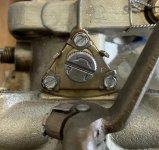
Searching the web and all the docs I have, I found different, and sometimes contradictory information... a good example is the picture of the mixture adjustment on my old carb (the new has no markings). The screw has the arrow showing L to enrich, which is correct. The engraved plate shows the letters L & R opposing the directions shown on the the screw itself. Maybe it's me, but that kind of beats my logic 🙈

Mix.jpg

My steed is hanging in the hangar, and using a long screwdriver I made, started giving it a 1/4 L (CCW) turn prior to each flight for the moment... we'll see how it goes (yep, spring tension to be kept, as loosing that mixture screw in flight would not be good news...).
 
Last edited:
It is an interesting subject, thanks for raising it @adrianolsantos

My old carbed 360 had a nice 40 RPM rise. Performed the "Mooney mod" as the engine was asking got more dino juice at TO and GAs. Same satisfying drop.

Recently installed a, lucky me, brand new TB YO-360, with a, lucky me again, brand new bigger carb.
200+ hours on the engine, not 1, not 50 RPM rise, nix, nada, niente, nothing.
Searching the web and all the docs I have, I found different, and sometimes contradictory information... a good example is the picture of the mixture adjustment on my old carb (the new has no markings). The screw has the arrow showing L to enrich, which is correct. The engraved plate shows the letters L & R opposing the directions shown on the the screw itself. Maybe it's me, but that kind of beats my logic 🙈

View attachment 103775

My steed is hanging in the hangar, and using a long screwdriver I made, started giving it a 1/4 L turn prior to next flight... we'll see how it goes (yep, spring tension to be kept, as loosing that mixture screw in flight would not be good news...).
Two types of adjustment for idle metering circuits. Most are adjusted with the screw metering fuel flow. In the other type, the screw meters the air bleed volume. In the former, CCW is richer, but in the latter, CCW is leaner. All of the aviation carbs that I have encountered have been fuel metered adjustment, but cannot say that is universal.
 
Yes many bits of poorly thought out advice that just never goes away. Generally idle mixture should set at best power, unless dealing with emissions. 50 rise is richer than best power at idle and not at all related to best power. Highest vacuum/ lowest map is a direct correlation with best power mixture; hence the recommendation. I have posted in the past on how to do it. A simpler, but less precise method is to set the mixture to where you get the highest rpm. The 50 rise just really tells you how rich you are and does nothing to set best power.

You stated

I'd love to see a 100 RPM rise on shutdown and then I'd know I'm too lean and need to richen down to 50 RPM. But that I can't get that more than 10 if I'm lucky keeps pointing in the direction that it is too lean no matter what.

First, you have it backwards. A 100 rise is richer than a 50, which is richer than a 10 rise. Second, What makes you believe 10 rise is to lean, if you have never taken steps to see what the engine wants. That is done via the methods described above. Performance parameters can be used to know what the engine likes, or better said optimized.
Shoot I did have that backwards! I'll correct my post so not to misslead. I totally get what you are stating. Unlike the original poster or your set up, I have other symptoms. For my situation, 2 turns out on the idle mixture screw, sometimes I'll get a 10 RPM rise but usually nothing smoothly idling at 800 RPM. 4 turns out the same. The last check it had wiggled back out 7 turns with the same once in a while 10 RPM rise on shutdown and smooth idle. Basically for my set up it doesn't seem to matter where that idle mixture screw is set. I've read that many others are having the same issue, some with other symptoms and others without. I'm replacing my carb for at least piece of mind as I don't have any real history on it. If this doesn't change the RPM rise or my other symptoms, we will continue the search focusing on the other symptoms.
 
Follow-up with my situation. While removing the existing carb for an overhauled from Spruce, I found the four nuts holding the carb on not very tight. Not finger loose but close and no way 204 in-lbs, I’d guess less than 100 in-lbs. The mixture bracket is sandwiched in-between the carb and the base of intake. The way the bracket sits makes it hard to see if bubbles were forming between the intake and the bracket when doing the induction leak check. Long story short, replacement carb installed, and 2.75 turns out on the idle mixture I have a 30-40 RPM drop. However, it idled better at 2.25 so screwed back in and now a clear 20-30 RPM drop and very smooth idle. Best part, CHTs are cooler in climb and cruise and in the pattern at lower power it seems to be much more consistent. What a relief.

I don’t know if the carb had issues or it was just the nuts were not tight enough to seal up the carb and bracket. Either way I’m quite happy to finally have some positive results overall. For the OP it could be worth it to check the torque on the carb nuts!
 
Last edited:
Follow-up with my situation. While removing the existing carb for an overhauled from Spruce, I found the four nuts holding the carb on not very tight. Not finger loose but close and no way 204 in-lbs, I’d guess less than 100 in-lbs. The mixture bracket is sandwiched in-between the carb and the base of intake. The way the bracket sits makes it hard to see if bubbles were forming between the intake and the bracket when doing the induction leak check. Long story short, replacement carb installed, and 2.75 turns out on the idle mixture I have a 30-40 RPM drop. However, it idled better at 2.25 so screwed back in and now a clear 20-30 RPM drop and very smooth idle. Best part, CHTs are cooler in climb and cruise and in the pattern at lower power it seems to be much more consistent. What a relief.

I don’t know if the carb had issues or it was just the bolts were not tight enough to seal up the carb and bracket. Either way I’m quite happy to finally have some positive results overall. For the OP it could be worth it to check the torque on the carb nuts!
Thanks for your post mate. I will check those bolts for sure
 
Back
Top