
Thanks! I will try the higher rpm setting and see what I can do with the TAS.Here's a real data point for you from a recent flight. At this altitude, it represents both "fast cruise", and "max speed" in LOP operation. Could probably get a few more knots in ROP.
168 KTAS
70% power (reported from G3X)
21" MAP (WOT)
10.1 GPH (lean of peak)
2680 RPM
9,200 ft Pressure Alt
9,500 ft Baro Alt

Van's Air Force
You are using an out of date browser. It may not display this or other websites correctly.
You should upgrade or use an alternative browser.
You should upgrade or use an alternative browser.
Plane slower than spec at maximum throttle forward
- Thread starter Mdragon
- Start date


Plenty of evidence to suggest that running up to redline reduces the efficiency of the Hartzell BA prop at cruise speeds.Thanks! I will try the higher rpm setting and see what I can do with the TAS.
That’s besides the point though as nobody cruises around at 2700rpm.
You should be getting book numbers at 2500.
Given airspeed increases with the cube of power you are either producing ALOT less power (like 30%) or more likely your pitot static is the culprit.
Got a photo of your static port?
Last edited:
At 10k feet? Sure they do....That’s besides the point though as nobody cruises around at 2700rpm.
Ok. Nobody with a constant speed prop I know does that.At 10k feet? Sure they do....
If they are running a Hartzell BA they’ll get a pleasant surprise if they wind it back 50-100rpm.

To me it’s clearly not an RPM problem. At 10k feet the rated horsepower difference between 2500 and 2700 is or the order of 10%. The OPs issue suggests a power deficiency of the order of 20-30%
I'll experiment with this!If they are running a Hartzell BA they’ll get a pleasant surprise if they wind it back 50-100rpm.
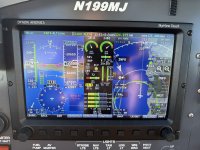
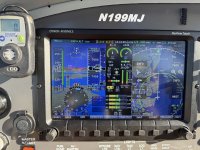
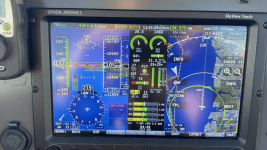
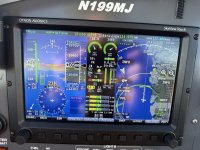
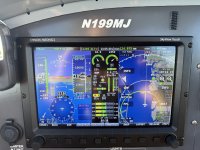
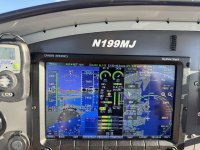
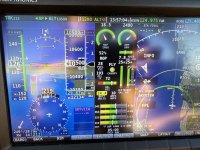
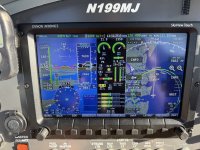

Taking a picture of inflight elevator incidence will be a bit harder for me...
Put the airplane on autopilot and use your iPhone. Or use a GoPro.
Notice that the reported winds aloft are all over the shop?
If your TAS was accurate then they’d all report more or less the same magnitude and direction regardless of your aircraft’s actual track.
I think you have a static position error. A 4 way GPS PEC test using the spreadsheet method Dan links above (and a photo of your static port ) would go a long way towards resolving this.
Edit: sry I see they are at different altitudes.
Really only one way to do this right. Stick it on autopilot. Do it early in the day with smooth air. Fly 4 cardinal headings. Make the legs about 3-4min each. Average the middle minute worth of data for each leg and plug it into the spreadsheet.
If your TAS was accurate then they’d all report more or less the same magnitude and direction regardless of your aircraft’s actual track.
I think you have a static position error. A 4 way GPS PEC test using the spreadsheet method Dan links above (and a photo of your static port ) would go a long way towards resolving this.
Edit: sry I see they are at different altitudes.
Really only one way to do this right. Stick it on autopilot. Do it early in the day with smooth air. Fly 4 cardinal headings. Make the legs about 3-4min each. Average the middle minute worth of data for each leg and plug it into the spreadsheet.
Last edited:

Taking a picture of inflight elevator incidence will be a bit harder for me...
Phone camera on selfie mode.

Some thoughts on the screen shots:
- The first at 10500’. Doing the math, atmospheric pressure was 20.22”. Your manifold pressure shows 19.6”
- The second at 7500’. Doing the math atmospheric pressure was 22.7”. Your manifold pressure shows 21.8.
Assuming your set you manifold pressure to read atomspheric pressure (engine off on the ground), this 0.5” to 0.9” loss on manifold pressure is a concern. If you have the old style snorkel this is example of its short coming - and why Van’s come out with replacements.
On my RV-8 (running the AFP FM-150C fuel manager, dual pMags on IO-360-M1B) I consistently measure 0.4” to 0.5” of manifold boost, not loss.
On your LOP numbers, you really need to balance the injectors. This is a simple operation if you use the data that you already have on your SkyView EMS log. Strive for a GAMI spread of 0.0 gph. Don at AirFlow performance sells replacement nozzels for your injectors at a very reasonable price. Take your data, all at altitude and WOT. Take to Don and he will recommend replacement nozzels for sizes. Always go smaller than the 0.028” nozzles. Typically it takes one or two replacements to get there.
From just looking at your screen shots I’d say #3 is too rich (but review of your EMS data will verify). If my assumption is right I’d start with that injector nozzle. Drop it down to 0.027” and take more data. For ~$30 this is an easy way to proceed.
For your data runs, I suggest 2500 RPM.
The SkyView manual will tell you how to calibrate your manifold pressure indication. It takes just a few minutes while you are hangar flying.
Carl
- The first at 10500’. Doing the math, atmospheric pressure was 20.22”. Your manifold pressure shows 19.6”
- The second at 7500’. Doing the math atmospheric pressure was 22.7”. Your manifold pressure shows 21.8.
Assuming your set you manifold pressure to read atomspheric pressure (engine off on the ground), this 0.5” to 0.9” loss on manifold pressure is a concern. If you have the old style snorkel this is example of its short coming - and why Van’s come out with replacements.
On my RV-8 (running the AFP FM-150C fuel manager, dual pMags on IO-360-M1B) I consistently measure 0.4” to 0.5” of manifold boost, not loss.
On your LOP numbers, you really need to balance the injectors. This is a simple operation if you use the data that you already have on your SkyView EMS log. Strive for a GAMI spread of 0.0 gph. Don at AirFlow performance sells replacement nozzels for your injectors at a very reasonable price. Take your data, all at altitude and WOT. Take to Don and he will recommend replacement nozzels for sizes. Always go smaller than the 0.028” nozzles. Typically it takes one or two replacements to get there.
From just looking at your screen shots I’d say #3 is too rich (but review of your EMS data will verify). If my assumption is right I’d start with that injector nozzle. Drop it down to 0.027” and take more data. For ~$30 this is an easy way to proceed.
For your data runs, I suggest 2500 RPM.
The SkyView manual will tell you how to calibrate your manifold pressure indication. It takes just a few minutes while you are hangar flying.
Carl
I think I have some insight... Your MP should be a bit higher, IMO, at full throttle. You should be at ~22.5" at 7,500 and ~20" at 10,500. Less than that means there's some pressure drop through your air filter, intake snorkel, fuel servo/throttle plate, and maybe plenum/intake pipes. Could be anything, but the throttle plate may not be fully open. My plane often sees a BOOST of 0.4inHg due to ram air pressure, but the above values are assuming no ram air pressure on a standard day.Here's some screenshots from last flight
It looks like your altimeter is set a bit lower than a standard day, so that may play a small role.
EDIT: Carl beat me to it.
I notice my throttle seems to not go fully forward by a 1/4 inch or so, i.e. won't go all the way to the tension screw stop in the plane when pushed in. I will pull off the bottom cowl next time at hangar and make sure I'm getting true full throttle and not almost full throttle. Think you guys are onto something here with the MAP pressures being a little low rather than a little high due to ram air pressure at 155 knots.I think I have some insight... Your MP should be a bit higher, IMO, at full throttle. You should be at ~22.5" at 7,500 and ~20" at 10,500. Less than that means there's some pressure drop through your air filter, intake snorkel, fuel servo/throttle plate, and maybe plenum/intake pipes. Could be anything, but the throttle plate may not be fully open. My plane often sees a BOOST of 0.4inHg due to ram air pressure, but the above values are assuming no ram air pressure on a standard day.
It looks like your altimeter is set a bit lower than a standard day, so that may play a small role.
EDIT: Carl beat me to it.
No matter how well built an experimental, there are always things to tidy up/correct. Hope this is a matter of a simple throttle adjustment.
Thanks to everyone for all of the ideas.
It's very useful to go through the whole troubleshooting process, and I think even when suggested solutions are not to this particular problem, it will help someone else out reading the thread in the future who has a similar problem.
The stop on the fuel servo? If so, this may be your problem. You aren't flying at full throttle. Not dangerous but leaving a little power on the table.I notice my throttle seems to not go fully forward by a 1/4 inch or so, i.e. won't go all the way to the tension screw stop in the plane when pushed in.
How hard to retrofit a new style snorkel. I do know this plane was one of the first one's built.Some thoughts on the screen shots:
- The first at 10500’. Doing the math, atmospheric pressure was 20.22”. Your manifold pressure shows 19.6”
- The second at 7500’. Doing the math atmospheric pressure was 22.7”. Your manifold pressure shows 21.8.
Assuming your set you manifold pressure to read atomspheric pressure (engine off on the ground), this 0.5” to 0.9” loss on manifold pressure is a concern. If you have the old style snorkel this is example of its short coming - and why Van’s come out with replacements.
On my RV-8 (running the AFP FM-150C fuel manager, dual pMags on IO-360-M1B) I consistently measure 0.4” to 0.5” of manifold boost, not loss.
On your LOP numbers, you really need to balance the injectors. This is a simple operation if you use the data that you already have on your SkyView EMS log. Strive for a GAMI spread of 0.0 gph. Don at AirFlow performance sells replacement nozzels for your injectors at a very reasonable price. Take your data, all at altitude and WOT. Take to Don and he will recommend replacement nozzels for sizes. Always go smaller than the 0.028” nozzles. Typically it takes one or two replacements to get there.
From just looking at your screen shots I’d say #3 is too rich (but review of your EMS data will verify). If my assumption is right I’d start with that injector nozzle. Drop it down to 0.027” and take more data. For ~$30 this is an easy way to proceed.
For your data runs, I suggest 2500 RPM.
The SkyView manual will tell you how to calibrate your manifold pressure indication. It takes just a few minutes while you are hangar flying.
Carl
Normal. All cockpit controls should be rigged with a little "cushion" so the actual stops in the engine compartment are hit before any control hits the panel or other limits in the cockpit.I notice my throttle seems to not go fully forward by a 1/4 inch or so, i.e. won't go all the way to the tension screw stop in the plane when pushed in.
I may be wrong but it sounds like he's describing the opposite situationNormal. All cockpit controls should be rigged with a little "cushion" so the actual stops in the engine compartment are hit before any control hits the panel or other limits in the cockpit.
we have mentioned a likely static error now 4+ times. I don’t think the op is interested in addressing that. More interesting to chase the ignition timing and speed diff between 2500/2700..
I think you have a static position error. A 4 way GPS PEC test using the spreadsheet method Dan links above (and a photo of your static port ) would go a long way towards resolving this.
.
Not my problem if he dosent want to address it.we have mentioned a likely static error now 4+ times. I don’t think the op is interested in addressing that. More interesting to chase the ignition timing and speed diff between 2500/2700.
The benefits of pointing out all these things accrue to many more than just the people who ask the question, ignore the advice and/or disappear.
I don’t know what is causing his problem, but I do know that static problems are absolutely rampant and unaddressed in much of the fleet.
It’s a dirt simple check. Why not do it?
Last edited:
Good pointNot my problem if he dosent want to address it.
The benefits of pointing out all these things accrue to many more than just the people who ask the question, ignore the advice and/or disappear.
Trying to understand how a static problem would make my gps calculated ground speed in all directions much lower than designed/predicted.we have mentioned a likely static error now 4+ times. I don’t think the op is interested in addressing that. More interesting to chase the ignition timing and speed diff between 2500/2700.
What is the underlying logic I'm missing here?
What could be wrong with my static system to cause the issue?
I'm thinking it's not likely an issue with the airspeed calibration, pitot tube, Ahars calibration , etc because if that were the case, the plane would have been showing a higher than expected speed by gps ground speed in at least one direction if winds aloft were affecting speed, and there was a calibration or setup problem with the pitot static system.
I will post a picture of my static ports for those who ask. They look to be where they are supposed to be by the build diagrams.
As mentioned earlier, the stall speeds are spot on to the knot flaps up and flaps down compared to the vans spec sheet. So it appears the calibration is accurate to 99+ percent level, at least at slow speeds.
In a nutshell the position and shape of the static port is crucial in order to have accurate airspeed and pressure altitude.Trying to understand how a static problem would make my gps calculated ground speed in all directions much lower than designed/predicted.
What is the underlying logic I'm missing here?
What could be wrong with my static system to cause the issue?
I'm thinking it's not likely an issue with the airspeed calibration, pitot tube, Ahars calibration , etc because if that were the case, the plane would have been showing a higher than expected speed by gps ground speed in at least one direction if winds aloft were affecting speed, and there was a calibration or setup problem with the pitot static system.
I will post a picture of my static ports for those who ask. They look to be where they are supposed to be by the build diagrams.
As mentioned earlier, the stall speeds are spot on to the knot flaps up and flaps down compared to the vans spec sheet. So it appears the calibration is accurate to 99+ percent level, at least at slow speeds.
I doubt your port is in the wrong place, but there is a rich history of PEC errors in RVs due to well meaning builders installing “better” static ports because they didn’t like the factory pop rivet port. It’s a well trodden path.
There’s a ton of info here. A search is your friend.
If you have the plans pop rivet or the factory equivalent or the Cleveland equivalent machined one then you can very quickly eliminate this as the source of your problem.
If you have a non standard port then it’s almost certainly the cause of your airspeed errors (and a large altitude error to go with it)
If it’s not then go looking for other reasons.
It might not be a PEC error but we can probably rule it in or out with one photo.
Like I said before to me it’s far too big an airspeed hit from power alone. It implies a large power deficiency or severe rigging or drag problem that’s rare in the days of pre punched everything.
WOT 2500 at 8k you should be truing about 170Kts depending on what you do with the red knob.
Thanks, I will get a picture up of the static ports soon.In a nutshell the position and shape of the static port is crucial in order to have accurate airspeed and pressure altitude.
I doubt your port is in the wrong place, but there is a rich history of PEC errors in RVs due to well meaning builders installing “better” static ports because they didn’t like the factory pop rivet port. It’s a well trodden path.
There’s a ton of info here. A search is your friend.
If you have the plans pop rivet or the factory equivalent or the Cleveland equivalent machined one then you can very quickly eliminate this as the source of your problem.
If you have a non standard port then it’s almost certainly the cause of your airspeed errors (and a large altitude error to go with it)
If it’s not then go looking for other reasons.
It might not be a PEC error but we can probably rule it in or out with one photo.
Like I said before to me it’s far too big an airspeed hit from power alone. It implies a large power deficiency or severe rigging or drag problem that’s rare in the days of pre punched everything.
WOT 2500 at 8k you should be truing about 170Kts depending on what you do with the red knob.
I did data reduction from the OP EFIS pictures. He did one single test flight at 7500 and 10500. At each altitude, he flew the same heading. There was a significant cross wind component during the flight and this made accurate IAS more difficult. The OP needs to read up the IAS calibration and to a 3-leg calibration run with constant altitude, and preferable in the very early morning instead of 2PM in the afternoon.
MP is consistent with the operation at 10500 at 19in, and at 7500 (21.8in)
Other significant observation, the airplane was not run at high power. This was economy cruise power or less. The Min CHT was in the range of 304 - 305deg at 7500 . The min CHT at 10500 was from 296-319. The engine was not run very hard. To get the high cruising speed, the OP need turn up the propeller RPM
The fuel burn was low but it wasn't out of line for lean of peak operation. However, the OP kept on fidgeting with the fuel lever and the propeller RPM lever and the fuel burn values were not consistent with the goal of calibration testing. The Fuel burn at 10500 started out from 11.3 gal/hr and dropped to 7.8 gal/hr. This is a wonderful number for fuel saving but not for high speed cruise. The test should be done with a constant power and fuel setting.
From my little RV8, the flight was almost a year ago, at 10,500 (11200DA), TAS was 172, fuel burn 8.8gal/hr, MP 19, CHT (360-374), OAT 38, RPM 2690. This was a fixed pitch prop and there was more speed if I have a constant speed propeller.
So at much lower OAT, I was getting a lot higher CHT temp. The OP engine was at low CHT, low power economy cruise mode. The airplane needs to be run at higher power setting to realize the higher TAS
Here is the spreadsheet I recorded from the OP screenshots. I separated them into two sections, 7500 and 10500 feet and the rows are ranked by time.
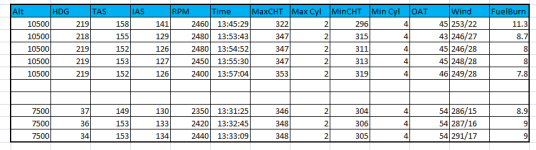
MP is consistent with the operation at 10500 at 19in, and at 7500 (21.8in)
Other significant observation, the airplane was not run at high power. This was economy cruise power or less. The Min CHT was in the range of 304 - 305deg at 7500 . The min CHT at 10500 was from 296-319. The engine was not run very hard. To get the high cruising speed, the OP need turn up the propeller RPM
The fuel burn was low but it wasn't out of line for lean of peak operation. However, the OP kept on fidgeting with the fuel lever and the propeller RPM lever and the fuel burn values were not consistent with the goal of calibration testing. The Fuel burn at 10500 started out from 11.3 gal/hr and dropped to 7.8 gal/hr. This is a wonderful number for fuel saving but not for high speed cruise. The test should be done with a constant power and fuel setting.
From my little RV8, the flight was almost a year ago, at 10,500 (11200DA), TAS was 172, fuel burn 8.8gal/hr, MP 19, CHT (360-374), OAT 38, RPM 2690. This was a fixed pitch prop and there was more speed if I have a constant speed propeller.
So at much lower OAT, I was getting a lot higher CHT temp. The OP engine was at low CHT, low power economy cruise mode. The airplane needs to be run at higher power setting to realize the higher TAS
Here is the spreadsheet I recorded from the OP screenshots. I separated them into two sections, 7500 and 10500 feet and the rows are ranked by time.
At 10K, 152 kts at 8 GPH is about 10 kts below what is expected when LOP. That could be an indication error. Would be helpfull to have known the wing aloft forecast to sanity check the GS. Unfortunately this data doesn't really explain WHY it is low. I often run low 300's at 75% power deep LOP in colder wx. Unsure where the OP is. If OATs were not cold, then yes, the low CHTs would indicate that power produced is less than what is expected. I did a flight the other day in my 10. OAT was 35 and was seeinf 320 CHTs at 65% power LOP. 8 GPH is pretty well LOP for a 360, so the CHTs don't seem out of line to me if OATs were below 40. 75% power in my 6, I would get 280-310 in the winter.I did data reduction from the OP EFIS pictures. He did one single test flight at 7500 and 10500. At each altitude, he flew the same heading. There was a significant cross wind component during the flight and this made accurate IAS more difficult. The OP needs to read up the IAS calibration and to a 3-leg calibration run with constant altitude, and preferable in the very early morning instead of 2PM in the afternoon.
MP is consistent with the operation at 10500 at 19in, and at 7500 (21.8in)
Other significant observation, the airplane was not run at high power. This was economy cruise power or less. The Min CHT was in the range of 304 - 305deg at 7500 . The min CHT at 10500 was from 296-319. The engine was not run very hard. To get the high cruising speed, the OP need turn up the propeller RPM
The fuel burn was low but it wasn't out of line for lean of peak operation. However, the OP kept on fidgeting with the fuel lever and the propeller RPM lever and the fuel burn values were not consistent with the goal of calibration testing. The Fuel burn at 10500 started out from 11.3 gal/hr and dropped to 7.8 gal/hr. This is a wonderful number for fuel saving but not for high speed cruise. The test should be done with a constant power and fuel setting.
From my little RV8, the flight was almost a year ago, at 10,500 (11200DA), TAS was 172, fuel burn 8.8gal/hr, MP 19, CHT (360-374), OAT 38, RPM 2690. This was a fixed pitch prop and there was more speed if I have a constant speed propeller.
So at much lower OAT, I was getting a lot higher CHT temp. The OP engine was at low CHT, low power economy cruise mode. The airplane needs to be run at higher power setting to realize the higher TAS
Here is the spreadsheet I recorded from the OP screenshots. I separated them into two sections, 7500 and 10500 feet and the rows are ranked by time.
View attachment 102633
Last edited:
Unknown wind speeds / directions. Alsoi cant compare ground speed to vans numbers. Need to compare ground speed to TAS. Once you have verified TAS accuracy, you can begin to work through why your power settings and production are not meeting expectations. You can't realistically work through these issues without reliable TAS ans the three pt test with SS analysis will do that. It is really step 1.Trying to understand how a static problem would make my gps calculated ground speed in all directions much lower than designed/predicted.
What is the underlying logic I'm missing here?
I like the keep my CHT above 350. I dug up data from my test flight. At 8500 (9400 DA), OAT 46, CHT (347 - 366), TAS(171), IAS(148), MAP (20.9), RPM 2660, Fuel 8.6gal/hr. This was very similar test condition as the OP. I was performing endurance testing and was on autopilot for over 2 hours to test the airplane in X/C performance and these are my typical X/C cruise number. I've since increased the propeller pitch by one number and the TAS is at the range 174-175 with similar engine performance.

What is the underlying logic I'm missing here?
You want logic eh?
Professionals follow a diagnosis tree, know full well most of the steps will not pinpoint the problem, but will confirm or deny facts. Even pros consider the process tedious at times, but they've experienced the alternative...confusion, shotgun parts replacement, calling tech hotlines, and yes, posting to forums.
Here the tree would start with Pitot-Static Check to establish system integrity. The tree branches would be Leak or No Leak. The Leak branch would say Fix He Leak. Both branches would then converge on Fly NTPS Three-Leg. The branches would be TAS Accurate and TAS Inaccurate.
TAS Accurate would lead to branches involving various powerplant and airframe checks.
TAS Inaccurate would lead to checks of the static port position and surface shape, and the OAT probe.
Note logical progression often finds and fixes multiple issues, each having made some small contribution to the problem.
I'm thinking it's not likely an issue with the airspeed calibration, pitot tube, Ahars calibration , etc because if that were the case, the plane would have been showing a higher than expected speed by gps ground speed in at least one direction if winds aloft were affecting speed, and there was a calibration or setup problem with the pitot static system.
It's perfectly ok to believe something, but unlike religion and politics, here we prove or disprove with logical diagnosis steps. Do the work.
I will post a picture of my static ports for those who ask. They look to be where they are supposed to be by the build diagrams.
That just leads to speculation...looks about right, doesn't look right, etc. Illogical effort.
As mentioned earlier, the stall speeds are spot on to the knot flaps up and flaps down compared to the vans spec sheet. So it appears the calibration is accurate to 99+ percent level, at least at slow speeds.
And what might be expected from a leak on the pitot side? The magnitude of the error would be proportional to available dynamic pressure, small at low speed, large at high speed.
Here's the thing. It's not necessary to agree or disagree with the proposal. Simply see Step 1 above to confirm or deny.
Last edited:

skylor
Well Known Member
Trying to understand how a static problem would make my gps calculated ground speed in all directions much lower than designed/predicted.
What is the underlying logic I'm missing here?
How do you know what your GPS ground speed should be? The wind data displayed in the lower left corner of your EFIS requires accurate true airspeed information as well as magnetic heading info. If those values are off, the wind information will be off and then you really have no idea what your ground speed should be. For example, on your 10,500 runs if your TAS is low, the wind velocity could actually be 40 instead of 28...
You need to validate and confirm the accuracy of your measurements before you can know what you should be troubleshooting.
Skylor
So, does the throttle go to the stop on the fuel manager or not?The stop on the fuel servo? If so, this may be your problem. You aren't flying at full throttle. Not dangerous but leaving a little power on the table.
Carl

OP is flying behind an angle valve engine. You are also? CHT's LOP for an angle valve are not nearly this high. (280-320 typical) I also never fly over 65% power LOP.I like the keep my CHT above 350. I dug up data from my test flight. At 8500 (9400 DA), OAT 46, CHT (347 - 366), TAS(171), IAS(148), MAP (20.9), RPM 2660, Fuel 8.6gal/hr. This was very similar test condition as the OP. I was performing endurance testing and was on autopilot for over 2 hours to test the airplane in X/C performance and these are my typical X/C cruise number. I've since increased the propeller pitch by one number and the TAS is at the range 174-175 with similar engine performance.
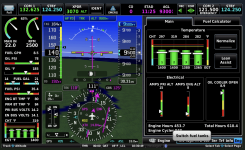
Last edited:
Thank you this is useful. I will try higher rpm again.I did data reduction from the OP EFIS pictures. He did one single test flight at 7500 and 10500. At each altitude, he flew the same heading. There was a significant cross wind component during the flight and this made accurate IAS more difficult. The OP needs to read up the IAS calibration and to a 3-leg calibration run with constant altitude, and preferable in the very early morning instead of 2PM in the afternoon.
MP is consistent with the operation at 10500 at 19in, and at 7500 (21.8in)
Other significant observation, the airplane was not run at high power. This was economy cruise power or less. The Min CHT was in the range of 304 - 305deg at 7500 . The min CHT at 10500 was from 296-319. The engine was not run very hard. To get the high cruising speed, the OP need turn up the propeller RPM
The fuel burn was low but it wasn't out of line for lean of peak operation. However, the OP kept on fidgeting with the fuel lever and the propeller RPM lever and the fuel burn values were not consistent with the goal of calibration testing. The Fuel burn at 10500 started out from 11.3 gal/hr and dropped to 7.8 gal/hr. This is a wonderful number for fuel saving but not for high speed cruise. The test should be done with a constant power and fuel setting.
From my little RV8, the flight was almost a year ago, at 10,500 (11200DA), TAS was 172, fuel burn 8.8gal/hr, MP 19, CHT (360-374), OAT 38, RPM 2690. This was a fixed pitch prop and there was more speed if I have a constant speed propeller.
So at much lower OAT, I was getting a lot higher CHT temp. The OP engine was at low CHT, low power economy cruise mode. The airplane needs to be run at higher power setting to realize the higher TAS
Here is the spreadsheet I recorded from the OP screenshots. I separated them into two sections, 7500 and 10500 feet and the rows are ranked by time.
View attachment 102633
Thanks this was helpful.I did data reduction from the OP EFIS pictures. He did one single test flight at 7500 and 10500. At each altitude, he flew the same heading. There was a significant cross wind component during the flight and this made accurate IAS more difficult. The OP needs to read up the IAS calibration and to a 3-leg calibration run with constant altitude, and preferable in the very early morning instead of 2PM in the afternoon.
MP is consistent with the operation at 10500 at 19in, and at 7500 (21.8in)
Other significant observation, the airplane was not run at high power. This was economy cruise power or less. The Min CHT was in the range of 304 - 305deg at 7500 . The min CHT at 10500 was from 296-319. The engine was not run very hard. To get the high cruising speed, the OP need turn up the propeller RPM
The fuel burn was low but it wasn't out of line for lean of peak operation. However, the OP kept on fidgeting with the fuel lever and the propeller RPM lever and the fuel burn values were not consistent with the goal of calibration testing. The Fuel burn at 10500 started out from 11.3 gal/hr and dropped to 7.8 gal/hr. This is a wonderful number for fuel saving but not for high speed cruise. The test should be done with a constant power and fuel setting.
From my little RV8, the flight was almost a year ago, at 10,500 (11200DA), TAS was 172, fuel burn 8.8gal/hr, MP 19, CHT (360-374), OAT 38, RPM 2690. This was a fixed pitch prop and there was more speed if I have a constant speed propeller.
So at much lower OAT, I was getting a lot higher CHT temp. The OP engine was at low CHT, low power economy cruise mode. The airplane needs to be run at higher power setting to realize the higher TAS
Here is the spreadsheet I recorded from the OP screenshots. I separated them into two sections, 7500 and 10500 feet and the rows are ranked by time.
View attachment 102633
Did you mean this for OP?So, does the throttle go to the stop on the fuel manager or not?
Carl

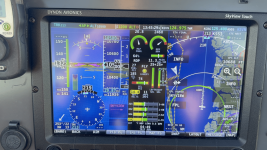
Just another point of reference. I've always been impressed with Dwight's 14A's performance. I just can't get there, but I'm close.OP is flying behind an angle valve engine. You are also? CHT's LOP for an angle valve are not nearly this high. (280-320 typical) I also never fly over 65% power LOP.
View attachment 102678
I agree about running cooler LOP. Dwight is cooler than I am, but I'm in the ballpark. Hottest CHT I've ever seen was 386 degrees. I too never fly LOP at more than 65%,
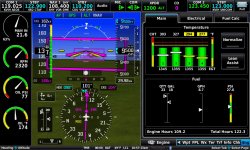
Odd thing is....I'm thinking mine is slow too. Yes, I'm calibrated. My multiple 3 and 4 leg runs show that my TAS reads about .3 kts slow.
Fred
Fred
Last edited:
Sorry - yes for the OP.Did you mean this for OP?
I didn't know the angle valve engine generates low CHT values. In my engine, I watch closely at the CHT when they drop below 300 during descend.OP is flying behind an angle valve engine. You are also? CHT's LOP for an angle valve are not nearly this high. (280-320 typical) I also never fly over 65% power LOP.
View attachment 102678
Has something to do with the piston squirters from what I was told. CHT's are lower but dam the oil gets hot quick.I didn't know the angle valve engine generates low CHT values. In my engine, I watch closely at the CHT when they drop below 300 during descend.
 My parallel valve 540 oil temp takes forever to increase. I normally depart with the oil flapper closed and open it after a few minutes to help keep CHT's lower. Someone more technical than me please help.
czechsix
Well Known Member
Fred is running an MT prop, Dwight is running a WW prop if I recall correctly? Historically, performance testing has shown MT props to be measurably slower than WW & Hartzell, although at Oskhosh this past summer I had a discussion at the DeltaHawk tent with the VP of MT who insisted that is 'old news' and claimed their newer blade designs are better. Fred and Dwight you guys oughta join up somewhere and do some side-by-side perf testingJust another point of reference. I've always been impressed with Dwight's 14A's performance. I just can't get there, but I'm close.
Fred

OP is flying behind an angle valve engine. You are also? CHT's LOP for an angle valve are not nearly this high. (280-320 typical) I also never fly over 65% power LOP.
View attachment 102678
My numbers are pretty much identical, % power, fuel burn, and speed.
Precautionary. On long cross countries I go up high and can't get over 65% even at full throttle and 2500 RPM. (I have O2 on both aircraft so why not) I've seen so many red triangle graphs that I can't remember when it's ok to exceed 65% PWR so just use this.Thread drift: Those who don't run LOP above 65% PWR - is this a limitation or it's purely precautionary with the angle valve variant having higher CR?
Yes, I have a WW300 3 blade prop, both airframes.
And yes, I've done multiple 4-ways (came within 1/2 knot delta) and the plane gets around 3-4 knots after paint as compared to before. FYI.
(Vans supplied pop rivet on the 14A and the new and improved Vans supplied improved pop rivet with a barb ($ 32.22 for 2 on the 10)
Last edited:
I've heard this interpretation, but someone else - forgot who - insisted that AV engines just have better cooling fins on the heads. The argument was that oil squirters can cool the piston and the barrel, but shouldn't have much if any effect on the head where the temp gauge is located. This makes sense to me given that all of the combustion is basically occurring between those two things and the squirters are really only able to affect the "bottom end" and not the "top end" of the engine. It doesn't matter how much heat you pull out of the bottom of the piston, the head is still getting full combustion temps and exhaust through it.Has something to do with the piston squirters from what I was told. CHT's are lower but dam the oil gets hot quick.
In my limited experience, angle valve cylinders cool amazingly well without any fancy business. Vans baffle kit, no mods, no plenum, stock cowling. Probably plenty of leaks to fix, honestly. And with a 13-row oil cooler I can basically have cool cylinders and cool oil (dial-a-temp with a TCW butterfly valve actuator) at the same time. We'll see how manageable it is for break-in, though...
Mark,My numbers are pretty much identical, % power, fuel burn, and speed.
Yes, from the research I've done, things have changed. At the risk of further thread drift, I don't believe the MT prop is remarkably slower or faster than anything else out there. If Dwight is right, and paint can or does add 3-4 kts, then I should be pretty close to his numbers once it's painted. Glenn's (Jetmart) numbers are very impressive too, but then he's in Canada and they use the metric system there

Supik - In my case, running LOP at 65% or less is purely precautionary.
Last edited:
Has something to do with the piston squirters from what I was told. CHT's are lower but dam the oil gets hot quick.
More fin area on an angle valve head.
The squirt nozzles push the oil temperature up.
Last edited:
Thread drift: Those who don't run LOP above 65% PWR - is this a limitation or it's purely precautionary with the angle valve variant having higher CR?
Precautionary. I'm not sure where 65% came from. Lycoming IO-390 manuals (all versions) are clear enough, and LOP is less stressful than either choice.

Dan,
In my case, the 65% comes from the instructions that came with my GAMI injectors. Also, Mike Bush talks about 65% being a magic number (my words not his). Lycoming also talks about 65% being recommended. I'm not saying this is correct, but it's how I decided on 65%.
Since I don't know engines like many of you here, I just set this is my personal guideline. Do I run more than 65%? Yes, frequently. But I'm 90-100 degrees ROP when I'm over 65%.
Again, not saying this is THE way.....just stating how I ended up deciding on 65% LOP.
In my case, the 65% comes from the instructions that came with my GAMI injectors. Also, Mike Bush talks about 65% being a magic number (my words not his). Lycoming also talks about 65% being recommended. I'm not saying this is correct, but it's how I decided on 65%.
Since I don't know engines like many of you here, I just set this is my personal guideline. Do I run more than 65%? Yes, frequently. But I'm 90-100 degrees ROP when I'm over 65%.
Again, not saying this is THE way.....just stating how I ended up deciding on 65% LOP.
Can you show us where they make that recommendation? Never seen that before. My knowledge is consistent with what Dan posted above.Lycoming also talks about 65% being recommended.
It wasn't really a Lycoming recommendation, as they haven't formally endorsed LOP ops to my knowledge. The 65% comes from the famous "red box", below which its pretty much impossible to induce detonation at any mixture setting. Google that for a lot of detail and opinions, and some religious infightingCan you show us where they make that recommendation? Never seen that before. My knowledge is consistent with what Dan posted above.

We've learned that with our airplane, LOP at any reasonable power setting is well tolerated and the benefits are obvious.
Same here. I am NOT a red box / fin / whatever disciple. Big believer in understanding the complete mix of variables that push an engine toward detonation, but something as simple as that box is really just over conservative and over simplified. Clearly safer, but a level of conservativeness that is unnecessary IMO and leaves a lot of flexibilkity on the table.It wasn't really a Lycoming recommendation, as they haven't formally endorsed LOP ops to my knowledge. The 65% comes from the famous "red box", below which its pretty much impossible to induce detonation at any mixture setting. Google that for a lot of detail and opinions, and some religious infighting
We've learned that with our airplane, LOP at any reasonable power setting is well tolerated and the benefits are obvious.
Lycoming DOES endorse 75% pwr at peak EGT and peak EGT is more detonation prone than anythging leaner than that. The big risk area is 100 ROP to peak and lyc has no issue with you moving across that range @ 75% pwr. Lyc says NOTHING about the need for a "big pull." Though I do agree with that approach when trying to lean from above 75%, which I have done many times.
I mostly just didn't want readers to think that lycoming actually has a recvommendation like that. It just adds more fuel to those running around telling us our engine will blow up at 75% power.
Last edited:
