Van's Air Force

The definitive Van's Aircraft support community! Buying, building or flying an RV? Join our exclusive family of mentors and enthusiasts!

Plane slower than spec at maximum throttle forward

Mdragon

Well Known Member
Patron
Hoping to trouble shoot this. I have a new to me rv14, and at maxium throttle, 7500 to 10500 feet, I'm only gettin 158 knots maximum TAS. This is with varied fuel flows, rich, lean, max power rich, and varied prop speeds, with 2480 RPM seeming to be optimal for max speed. Any suggestions? Wondering if timing is not quite right, though doubt it. Max throttle position not actual max throttle? Wheel pants and leg fairings seem to look by eye properly aligned. No excessvie drag items. The motor is smooth and has great takeoff power, just not seeing the top end and cruise the Vans website qoutes. It is an i0390 with 210 hp, dual p-mags set up.

Or is this in the ballpark for average? Looks like 167 knots is the expected max on this motor setup. It only 9 knots, but...it's 9 knots!
 
Did you calibrate the ASI with the 4 leg method? There's a chance you are just getting bad info.
+1. Caveat: it apparently needs to be pretty smooth air to get reliable results. I tried it when it was sort of bouncy and my data were... bad.
 
"Could be anything", but I understand that's not helpful, so I'll suggest something that hasn't been brought up yet:

How are your P-mags set? The default advance settings are, IMO, unreasonable and it's not clear to me how many people realize this. I don't know how far advanced you'd have to go before it would slow the plane down, but it's a thought.

Drag is a more likely culprit than power, but I had grossly worn cam lobes that would certainly explain my slow plane. How old is the engine? How many hours/year was it flown?
 
Did you calibrate the ASI with the 4 leg method? There's a chance you are just getting bad info.
Well the Garmin 650 ground speed seems to match exactly to the Dynon GS. It looked about right compared to the winds aloft. I will try to recalibrate the ASI and see if it makes a difference. Good idea thanks.
 
"Could be anything", but I understand that's not helpful, so I'll suggest something that hasn't been brought up yet:

How are your P-mags set? The default advance settings are, IMO, unreasonable and it's not clear to me how many people realize this. I don't know how far advanced you'd have to go before it would slow the plane down, but it's a thought.

Drag is a more likely culprit than power, but I had grossly worn cam lobes that would certainly explain my slow plane. How old is the engine? How many hours/year was it flown?
600 hours on engine that was installed new with very good history. Runs smooth like a sewing machine.
 
"Could be anything", but I understand that's not helpful, so I'll suggest something that hasn't been brought up yet:

How are your P-mags set? The default advance settings are, IMO, unreasonable and it's not clear to me how many people realize this. I don't know how far advanced you'd have to go before it would slow the plane down, but it's a thought.

Drag is a more likely culprit than power, but I had grossly worn cam lobes that would certainly explain my slow plane. How old is the engine? How many hours/year was it flown?
Talked to previous owner, set set 2 teeth past TDC, which sounds about right, as it's supposed to be 5 degrees past tdc when installed. Will double check this.
 
600 hours on engine that was installed new with very good history. Runs smooth like a sewing machine.
Mine ran smooth. Was probably down 40+hp. I can't say that's likely to be your problem but I'm more than a little suspicious of lycoming camshafts.
Talked to previous owner, set set 2 teeth past TDC, which sounds about right, as it's supposed to be 5 degrees past tdc when installed. Will double check this.
Jumper in or out? That could be 30+ degrees of timing jumper in, or 34+ degrees of timing jumper out. If it really is 2 teeth after top dead center and jumper in, likely not a large contributor to your problem.
 
Mine ran smooth. Was probably down 40+hp. I can't say that's likely to be your problem but I'm more than a little suspicious of lycoming camshafts.

Jumper in or out? That could be 30+ degrees of timing jumper in, or 34+ degrees of timing jumper out. If it really is 2 teeth after top dead center and jumper in, likely not a large contributor to your problem.
I will check the jumper when i have the cowl off. Talked to owner on the phone and he seemed to be confident it was timed right. It takes off and climbs like a scalded cat so at least at sea level power is there, lot's of right rudder on take off.
 
I will check the jumper when i have the cowl off. Talked to owner on the phone and he seemed to be confident it was timed right. It takes off and climbs like a scalded cat so at least at sea level power is there, lot's of right rudder on take off.
What is your maximum rpm and what is your fuel flow at take-off?
 
9 knots is a lot. Try this: Watching your gps ground speed, slowly turn until you find the heading where gps ground speed is the smallest. Fly this heading for 20 sec, record gps ground speed and IAS and, if your efis calculates it, the calculated TAS. Now turn exactly 180 deg. You should now see the highest gps ground speed. Fly 20 sec, record the same numbers. Go land. Average the two gps ground speeds. This should be the TAS. What is it? How does it compare to the efis-calculated TAS? Use the pressure altitude, temperature (I forgot - record these things in flight, too) and IAS to calculate TAS. How does it compare these all compare? If the averaged gps speeds are around 167 knots then you need to look carefully at your static port, where it is, what it is, etc. If the ground speed (gps average) is more like 158 knots then look for a power loss.
Don’t rely on forecast winds aloft to get the TAS right.
 
What injection system do you have?

Do you have the orginal Van's snorkel?

Your pMags should be set no more advanced than 20 degrees BTDC (the spec on your engine) and jumper in. To do this you set the crank at 5 degrees ATDC to set the pMags. I did not do the math but I don't think "two teeth ATDC" equals the needed 5 degrees ATDC.

Carl
 
Last edited:
Lots of good ideas in the posts above - definitely (since the airplane is new to you) do an accurate ASI calibration to make sure the indicated is correct. Then take a look at your OAT and see if that is close to accurate - OAT is used to calculate TAS and it doesn’t take much error in temperature to make an airspeed error.

Just plug away one thing at a time, but I’d start with an accurate airspeed calibration.
 
I wouldn’t stress too much about the flaps being the issue.
The flaps, ailerons and wingtip TE should all be in alignment when the flaps are in their uppermost position.
The leading edge of the flaps should be up against the rear spar in that position. If you can verify these two things then that will eliminate that quickly.
Unless everything is hanging down in cruise a long way (which is highly unlikely) then flaps aren’t causing your problem.
RV10s share the same airfoil and flaps and even 3deg down shows negligible performance difference.
 
One of the most common reasons for airspeed being off that much is using a non standard static port or location. Check that yours is standard. If unsure, post a picture.
 
I wouldn’t stress too much about the flaps being the issue.
The flaps, ailerons and wingtip TE should all be in alignment when the flaps are in their uppermost position.
The leading edge of the flaps should be up against the rear spar in that position. If you can verify these two things then that will eliminate that quickly.
Unless everything is hanging down in cruise a long way (which is highly unlikely) then flaps aren’t causing your problem.
RV10s share the same airfoil and flaps and even 3deg down shows negligible performance difference.
+1

Rigging errors need to be fairly significant to drop speed 9 knots. Possible, but not where i would start. See above.
 
Having not built it, what am I looking for? How to measure? It looks like they are not reflexes much full up.
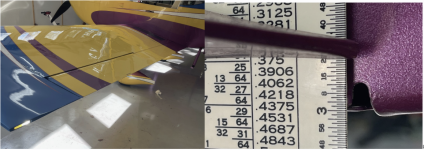
Reflex is just 3 deg. With flaps full up you shouldn’t be able to slip a heavy piece of paper behind them - they should be in contact with the aft spar. Or, if you have a digital level: With flaps full up, measure the angle from level of the top aft wing skin. Measure the angle for the flaps. Should see a 3 deg difference.
 
The best way to Chk IAS is to compare IAS etc is with another plane that’s known to be accurate in formation.
 
Having not built it, what am I looking for? How to measure? It looks like they are not reflexes much full up.
This will give you an idea of what flaps all the way up against the spare (reflex) ~ should look close to: (Provide a picture of the static ports, my guess is this is the issue but as others have mentioned could be a lot more) Are you seeing appropriate % power on take-off? (Altitude very dependent)

BTW after trying to find a performance difference in multiple conditions (altitudes, temps, etc.) over the last 6 years, I still do not see a difference in flaps in reflex and flaps in trail (down 3%) :unsure:

Screenshot 2025-11-19 051450.png
 
Well the Garmin 650 ground speed seems to match exactly to the Dynon GS. It looked about right compared to the winds aloft. I will try to recalibrate the ASI and see if it makes a difference. Good idea thanks.
I would like to point you back to basics. It clearly sounds like you don’t know what your static system error is. Comparing groundspeeds and winds alsoft from multiple devices is useless as they will show you the same errors. Also, the winds aloft is derived from the groundspeed and measured TAS and so includes any error in the TAS. I highly suggest that you research the 4 leg method of checking your static source errors, and fly it in smooth air. Then when you have good baseline data, you can worry about why you do not seem to be getting the speed that you expect.
 
Lots of good ideas in the posts above - definitely (since the airplane is new to you) do an accurate ASI calibration to make sure the indicated is correct. Then take a look at your OAT and see if that is close to accurate - OAT is used to calculate TAS and it doesn’t take much error in temperature to make an airspeed error.

Just plug away one thing at a time, but I’d start with an accurate airspeed calibration.

What Paul said. And use this: https://www.danhorton.net/Misc/NTPS_gps-pec.XLS

Record track and groundspeed from your GPS. Fly three legs roughly 120 degrees apart...exact doesn't matter. You can record four sets of data on the same page, to confirm repeatability. Fly it early in the AM when the world is calm. Use the autopilot.
 
Max rpm required for max speed! If the motor will only turn 2500rpm then adjust the governor to get 2700?
Excellent observation, I didn't pick up on that. At altitude you will need 2700 RPM to come anywhere near max speed. And I'm assuming you are talking about a 75% power cruise?
 
Max rpm required for max speed! If the motor will only turn 2500rpm then adjust the governor to get 2700?
Excellent observation, I didn't pick up on that. At altitude you will need 2700 RPM to come anywhere near max speed. And I'm assuming you are talking about a 75% power cruise?
I also assume we're talking about a cruise speed and not the absolute max here. 75% at 8k feet is supposed to be 170kts with that engine according to Vans. 158kts is well shy of that. I suppose the question becomes, is 75% power possible at 8k feet and 2500 rpm? I'm not terribly comfortable with interpreting Lycoming power charts, so I'm not sure how to answer this.

If we were talking about absolute max, that's ~178kts which is a 20kt discrepancy. I would assume that's at 2700 rpm, however that could be inefficient for the prop (high mach).
 
75% power at 8k requires full throttle and approximately full RPM (2700) as I recall. We rely on the %power indication on the G3X to fine tune.

Edit: The App AircraftPower on the ios app store is handy here. At 8k we see 22Hg (WOT) and 2700RPM = 76% power.
 
Last edited:
On our RV14A, brand new (red) Lycoming 390 had a wobbly valve and 1 push rod was too long. It was the thunderbold blueprinted motor (cost extra). Bought a new jug, replace the rod and it runs like a top.
If I were you I would check compression carefully
And check the PMag timing. PMags have an advance unlike some mags. Go back to spec for your p or e mag and make sure on timing.
Once you get it right the RV14 is truly amazing.
 
75% power at 8k requires full throttle and approximately full RPM (2700) as I recall. We rely on the %power indication on the G3X to fine tune.
so then why would there be a difference between Vans spec of 75% cruise @ 8k feet = 170kts vs. max being 178kts? What altitude would max speed be attained at - higher or lower? It sounds like OP has tried a range, mostly higher. I would be surprised if Vans was specifying a cruise speed based on max RPM and max MP, but I guess it's possible.
 
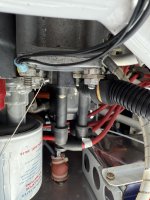
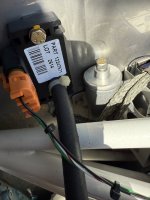
Looking at the pmags, neither has the MaP nipple plumbed into the MAP line. Is this an issue for retarded timing at altitude, or do they use ambient temp at altitude to use for calculating timing retard.

See in pic, MAP hose fitting not connected to anything.
 

Attachments

  • IMG_4069.jpeg
    IMG_4069.jpeg
    1.4 MB · Views: 85
Looking at the pmags, neither has the MaP nipple plumbed into the MAP line. Is this an issue for retarded timing at altitude, or do they use ambient temp at altitude to use for calculating timing retard.

See in pic, MAP hose fitting not connected to anything.

That effect will be to have the minimum dynamic advance provided to the ignition I think. Which isn't great for efficiency. Probably not a huge issue for power tho....? I think?
 
Looking at the pmags, neither has the MaP nipple plumbed into the MAP line. Is this an issue for retarded timing at altitude, or do they use ambient temp at altitude to use for calculating timing retard.

See in pic, MAP hose fitting not connected to anything.
Little practical difference, connected to manifold pressure or left open to ambient atmospheric pressure (at least for my typical cross country flying). At WOT manifold pressure is about the same as atmospheric.

From the pMag install instructions:
“With normally aspirated engines, the MAP tube is a fail-safe input. Meaning if the MAP plumbing fails the ignition will automatically retard to a flyable, but slightly less efficient, firing position.”

If connected, timing will only advance as engine vacuum increases (manifold pressure decreases).

Carl
 
Looking at the pmags, neither has the MaP nipple plumbed into the MAP line. Is this an issue for retarded timing at altitude, or do they use ambient temp at altitude to use for calculating timing retard.

See in pic, MAP hose fitting not connected to anything.
If connected, timing will only advance as engine vacuum increases (manifold pressure decreases).
I agree with Carl - this isn't hurting anything. Notably, max advance happens at relatively low altitude. The E-Mags are giving you almost all of the advance they will ever give by about 6000 feet. I have a problem with this for a number of reasons, but none of them are relevant to your issue.
 
Any tips on what fittings and tubing to get. I think I will plumb the mags into the manifold pressure loop, as that what the instructions say. However they are not very descriptive in how to do this.

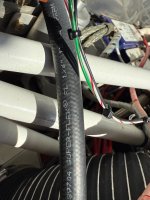
Anyone know where I can get a fitting that takes the 1/4 inch tubing down to 1/8 inch tubing, and maybe pics on how you have run those hoses to the pmags? My MAP sensor and hose are on the starboard side of firewall near the brake master.
 

Attachments

  • IMG_4070.jpeg
    IMG_4070.jpeg
    1.3 MB · Views: 26
  • IMG_4071.jpeg
    IMG_4071.jpeg
    2.1 MB · Views: 26
so then why would there be a difference between Vans spec of 75% cruise @ 8k feet = 170kts vs. max being 178kts? What altitude would max speed be attained at - higher or lower? It sounds like OP has tried a range, mostly higher. I would be surprised if Vans was specifying a cruise speed based on max RPM and max MP, but I guess it's possible.
There might be some wiggle room in the margins. For example ram rise in air pressure might allow a slightly higher MP at speed. I wouldn't worry much about Vans specs for speed, they lie as bad as Cessna ;) (sorry vans luv you guys)

However when compared to real world performance from other RVs including ours, his seems slow. But only if he has limited the RPM to 2480. It makes no sense that 2700 wouldn't produce more speed, but we don't yet know why he suggested 2480.
 
I agree with Carl - this isn't hurting anything. Notably, max advance happens at relatively low altitude. The E-Mags are giving you almost all of the advance they will ever give by about 6000 feet. I have a problem with this for a number of reasons, but none of them are relevant to your issue.
Yes it's interesting. Just talked to p-mag people and it sounded like the mags maximally retard at 25 inches map. So flying lower altitudes at partial throttle may be better to have them connected. The p-mag guy seemed a little unsure how much benefit plumbing into the MAP line actually is.
 
There might be some wiggle room in the margins. For example ram rise in air pressure might allow a slightly higher MP at speed. I wouldn't worry much about Vans specs for speed, they lie as bad as Cessna ;) (sorry vans luv you guys)

However when compared to real world performance from other RVs including ours, his seems slow. But only if he has limited the RPM to 2480. It makes no sense that 2700 wouldn't produce more speed, but we don't yet know why he suggested 2480.
What MAP and RPM are others seeing their max speed , best fast cruise speed at?
 
What MAP and RPM are others seeing their max speed , best fast cruise speed at?

Here's a real data point for you from a recent flight. At this altitude, it represents both "fast cruise", and "max speed" in LOP operation. Could probably get a few more knots in ROP.

168 KTAS
70% power (reported from G3X)
21" MAP (WOT)
10.1 GPH (lean of peak)
2680 RPM
9,200 ft Pressure Alt
9,500 ft Baro Alt
 
Last edited:
You seem to be concerned with MAP adjustment somehow while other fundamentals data are missing
Go fly a speed calibration pattern to verify you ASI is correct.
Fly at a set altitude, use the auto pilot as Dan suggested, and post a picture of the EFIS so the community can get a full picture of the performance of your airplane. The EFIS picture show us your engine performance as well

If you can post your empty weight, it will give the community another data point to help, rather than just standard.

Take a picture of the elevator to the horizontal at max cruise level to confirm my airplane incidence is correct. Mine was perfectly in-trail when trimmed at 9500DA at ~172KTAS at my cruise configuration. Post this picture so we know if your rigging is correct.

There are a lot of data you can post. More feedback will help others as well.
 
Looking at the pmags, neither has the MaP nipple plumbed into the MAP line. Is this an issue for retarded timing at altitude, or do they use ambient temp at altitude to use for calculating timing retard.

See in pic, MAP hose fitting not connected to anything.
Contact TSFlightlines. Tom and Steve will set you up properly.
 
Anyone know where I can get a fitting that takes the 1/4 inch tubing down to 1/8 inch tubing,

Throw away the heavy wall fuel line and plumb both the MAP sensor and the P-mags with soft silicone tubing.

and maybe pics on how you have run those hoses to the pmags? My MAP sensor and hose are on the starboard side of firewall near the brake master.

Ignition MAP lines are not always tee'd into the instrumentation MAP sensor. Can be, or tapped to another cylinder, or an intake plenum.

But first, calibrate your TAS indication. Timing will not lose the reported speed difference unless it's really, really wrong. Math says you would need to find about 55 HP to jump up from 158 to 171 TAS.

Might need a few flights to get data, mod the static port, fly again, etc. Each time note the EGT indications at full throttle, full rich, just off the end of the runway. No need to be exact, just a good ballpark, even just one cylinder.

What MAP and RPM are others seeing their max speed , best fast cruise speed at?

After you think you have things calibrated (indicated TAS agrees with the results on the spreadsheet), go to 8000 feet, set WOT and 2700, and lean to the EGT ballpark previously observed on takeoff at full rich. Or lean to 80~100 ROP, if that makes you more comfortable. When stabilized, take a picture of the EFIS and post it back here.
 
You seem to be concerned with MAP adjustment somehow while other fundamentals data are missing
Go fly a speed calibration pattern to verify you ASI is correct.
Fly at a set altitude, use the auto pilot as Dan suggested, and post a picture of the EFIS so the community can get a full picture of the performance of your airplane. The EFIS picture show us your engine performance as well

If you can post your empty weight, it will give the community another data point to help, rather than just standard.

Take a picture of the elevator to the horizontal at max cruise level to confirm my airplane incidence is correct. Mine was perfectly in-trail when trimmed at 9500DA at ~172KTAS at my cruise configuration. Post this picture so we know if your rigging is correct.

There are a lot of data you can post. More feedback will help others as well.
Will be a few days before I can take her up and do a calibration pattern, but will do. Did a hangar calibration today with the Dynon.
Empty weight 1247, me 230, gas 30 to 300 pounds depending how long I'm up...So 1597 to 1777lbs.
Taking a picture of inflight elevator incidence will be a bit harder for me...
 
Back
Top