

Van's Air Force
You are using an out of date browser. It may not display this or other websites correctly.
You should upgrade or use an alternative browser.
You should upgrade or use an alternative browser.
Final Report; N412JN, RV-12
- Thread starter Sam Buchanan
- Start date



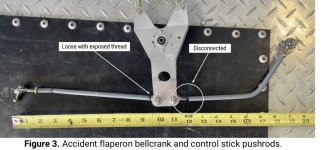
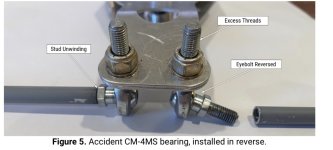

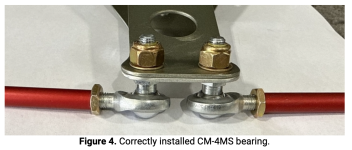
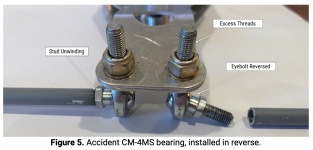

I see now, the "eye" should be in the vertical position in the lower picture, so the eye was able to rotate and both sides have that issue. If it was like the top picture, the eye holder can only rotate to the stops on the eye, so it can rotate, but not continuously, and that's why the threads are so different in length. Unless you really look and notice the eye position and the excess bolt length, hard to spot in just a quick glance.
I keep hearing stories about DARs that only check to see if the manufacturer, model, and S/N on the registration match the data plate on the tail of the airplane. And then there are DARs that carefully go through all of the control linkages among many other things and make sure everything is proper, safe, and airworthy. I'd rather have the latter kind of DAR.
The absence of jam (shear) nuts on the connection between the rod end bearing and the pushrod, as well as the excessive number of threads coming out of the stop nut should have been clues to anyone with experienced eyes to look more closely.I see now, the "eye" should be in the vertical position in the lower picture, so the eye was able to rotate and both sides have that issue. If it was like the top picture, the eye holder can only rotate to the stops on the eye, so it can rotate, but not continuously, and that's why the threads are so different in length. Unless you really look and notice the eye position and the excess bolt length, hard to spot in just a quick glance.

I've learned that if something doesn't look or feel right (like excessive or inadequate thread length) there's a good reason and you need to stop and check everything out against the drawings.

rv8bldr
Well Known Member
I am grateful for the process we have here in Canada. You need at least two inspections by the MD-RA (Ministers Delegate - Recreational Aviation) before you get a C of A; a pre-cover inspection where they look at every nut, bolts, rivet, etc before any structures are closed up; and a final before first flight. Your airplane has every cover and panel removed for the final inspection but otherwise ready for flight. I just had my final done last month and the inspector (who is also a member of these forums) found a list of things my eyes just didn't see anymore ... including several jam nuts not tight, possible interference problems, etc. The inspection itself can take a few hours to a whole day and only a small part of it is the documentation verification (although that is thorough as well)I keep hearing stories about DARs that only check to see if the manufacturer, model, and S/N on the registration match the data plate on the tail of the airplane. And then there are DARs that carefully go through all of the control linkages among many other things and make sure everything is proper, safe, and airworthy. I'd rather have the latter kind of DAR.
Last edited:


YEP! It's called "Murphy's Law"!When this came up originally, I had these comments:
If a part can be put in backwards, at some point it will be.
I remember a number of years ago (2013) someone installed the rate gyros in a Proton rocket carrying three GLONASS satellites upside down.YEP! It's called "Murphy's Law"!

Don’t ever depend on just one set of eyes (other than your own) to make sure things don’t get missed. Please plan on having MANY folks (EAA chapter members, other builders, EAA Tech Counselors….) look over your project long before your DAR gets there. A DAR will probably get to spend a couple of hours, and while my focus is always on the “killer items” when I inspect, there are many other things that you can get wrong that others will catch. In other words, don’t put ALL your faith in the DAR - ANY DAR!I know for sure that I couldn't make this particular mistake. But, I'm also pretty confident I've probably made dozens of other mistakes during my build. I sure hope my DAR takes a VERY close look at my airplane before signing off on it.


Thanks for the feedback PaulPlease plan on having MANY folks (EAA chapter members, other builders, EAA Tech Counselors….) look over your project long before your DAR gets there.
I've had four visits from two different EAA Technical Counselors during my build- so far. I also live at an airpark and have had neighbors stop by to look at what I'm doing. But I haven't seen anybody look really close at the "control actuation" parts and pieces - what I consider the "killer items". Maybe they just need a quick glance rather than a lengthy stare since they are so much more experienced than I am.
My assumption is that a Technical Counselor visit is more of a high level inspection where they are looking at overall build quality rather than looking for loose jam nuts, missing washers, etc. That's why I said I was hoping the DAR looked REALLY close as I'm not sure who else would.
BTW, if there are any Technical Counselors out there that would like to visit central Oregon and come check my build, I'd be happy to have the help. The more eyes the better! I think when I'm getting ready for the first flight I'm going to offer my neighbors $50 for every mistake they find. That will guarantee a close inspection if nothing else

Last edited:

Terrible. One other thing to note is that he had severe coronary artery disease yet was only 43. One artery 90% blocked.
It’s not as uncommon in younger people as you think and goes largely unnoticed as a result - usually with bad outcomes.
So if you feel ordinary, get checked out people.
It’s not as uncommon in younger people as you think and goes largely unnoticed as a result - usually with bad outcomes.
So if you feel ordinary, get checked out people.

I know a few builders at the local airport who are somewhat secretive about their RV project. The hangar door was kept only slightly open, allowing just barely adequate ventilation. Some even parked their big trucks in front to prevent spying eyes.
I took it differently. After moving the project to the airport, my hangar doors were wide open, everyone was welcome, opinions included. I just wanted as many people looking at the airplane when it was wide opened and hopefully someone could spot errors that I didn't see. The hangar visitors definitely provided many good advices. I keep the same habit today, the hangar doors are always opened except when the sun light was too uncomfortable.
I took it differently. After moving the project to the airport, my hangar doors were wide open, everyone was welcome, opinions included. I just wanted as many people looking at the airplane when it was wide opened and hopefully someone could spot errors that I didn't see. The hangar visitors definitely provided many good advices. I keep the same habit today, the hangar doors are always opened except when the sun light was too uncomfortable.
Or simply understanding how a heim joint is designed to handle load would make it obvious that the forces were in the wrong axis. Force is trying to pull the ball out off the joint vs pulling against the bearing surface. Heim joints are designed for radial load, not axial.The absence of jam (shear) nuts on the connection between the rod end bearing and the pushrod, as well as the excessive number of threads coming out of the stop nut should have been clues to anyone with experienced eyes to look more closely.
Yes many personalities don’t take criticism well and this trait often prevents them from getting good feedback. Often not a big deal when one is highly skilled, but very unfortunate when skills are limited.I know a few builders at the local airport who are somewhat secretive about their RV project. The hangar door was kept only slightly open, allowing just barely adequate ventilation. Some even parked their big trucks in front to prevent spying eyes.
I took it differently. After moving the project to the airport, my hangar doors were wide open, everyone was welcome, opinions included. I just wanted as many people looking at the airplane when it was wide opened and hopefully someone could spot errors that I didn't see. The hangar visitors definitely provided many good advices. I keep the same habit today, the hangar doors are always opened except when the sun light was too uncomfortable.
Norman CYYJ
Well Known Member
This is so true and even highly skilled builders can look at something and not realize there is a problem, for some strange reason they are also blind to obvious mistakes that others see instantly.Yes many personalities don’t take criticism well and this trait often prevents them from getting good feedback. Often not a big deal when one is highly skilled, but very unfortunate when skills are limited.
So true. Even experts occasionally get target fixation.This is so true and even highly skilled builders can look at something and not realize there is a problem, for some strange reason they are also blind to obvious mistakes that others see instantly.

rmartingt
Well Known Member
That's how my AW inspection went, too.the inspector (who is also a member of these forums) found a list of things my eyes just didn't see anymore ...
I definitely see your point, but I wouldn't necessarily attribute shady motives, though. Even well-meaning visitors can be an unwelcome interrution when you're working on something that requires concentration or is a time-sensitive process. Or perhaps they have limited/non-flexible time available for building and visitors mean lost progress for the day. Parking the truck to block the entrance is a more subtle "do not disturb".The hangar door was kept only slightly open, allowing just barely adequate ventilation. Some even parked their big trucks in front to prevent spying eyes.
Depending on your airport, an open hangar can also be a magnet to airport officials or FAA inspectors who are out looking to give someone a bad day.
And in the end some folks just arent "people people". I'm an engineer, and true to the stereotype, I tend to want to work in isolation most of the time. I was a heck of a lot more productive during the couple of years we were allowed to mostly work from home because I didn't have the visitors, kibbitzers, interruptions, distractions, etc. that are almost universal in an office environment, let alone the hours of my life back from not having to commute (sore subject
 ).
).A story in that regardI definitely see your point, but I wouldn't necessarily attribute shady motives, though. Even well-meaning visitors can be an unwelcome interrution when you're working on something that requires concentration or is a time-sensitive process. Or perhaps they have limited/non-flexible time available for building and visitors mean lost progress for the day. Parking the truck to block the entrance is a more subtle "do not disturb".
I don't usually miss all that much, but alway get 2nd opinions to be sure on large projects. I was in my hanger getting the 10 ready for first flight in a few days. It was the end of a long day and was putting the elevators when the guy across the way came by to BS or ask more questions of me about his build. I got them on while he was distrtacting me, but never put on the nuts. They were on and off so many times that it wasn't habit to install nuts. He went on for about an hour and by that time forgot to go back and put the nuts on. By the next morning I had forgotten that I hadn't done it.
While I am pretty sure I would have caught this on my preflight, it was caught by one of the two folks that I asked to do a first flight safety inspection for me. Sadly, one of the guys didn't catch it and he was an EAA tech counselor. So, fully agree that folks wandering into the shop can create dangerous distractions and one should ALWAYS get a 2nd set of eyes on critical work or at least the extensive stuff where the qty of work done is almost overwhelming..
Both times when I moved to the hangar I’d say 90% of the foot traffic past my door had zero to offer. They’re pilots not builders or mechanics.
Dosent stop them coming in for a chin wag.
I’m generally pretty happy to do show and tell but it can waste a ton of time and be distracting (which is dangerous in itself) so if I’m busy on something important the door was shut.
Obviously I’m very much in favor of as many eyes as possible too, but they need to be the right eyes.
Dosent stop them coming in for a chin wag.
I’m generally pretty happy to do show and tell but it can waste a ton of time and be distracting (which is dangerous in itself) so if I’m busy on something important the door was shut.
Obviously I’m very much in favor of as many eyes as possible too, but they need to be the right eyes.

RV7Guy
Well Known Member
When I built my first 7, my mentor was Robbie Attaway. He had built a couple of RV's. He would come by, ask for a note pad and pen and tell me to go away for a while. Usually his "finds" were very minor. And, he would teach me on various techniques and processes. He really preached the attention to detail. Never turn down another set of eyes looking at your project.

The chin waggers can get annoying, but sometimes the open-door policy pays off! A while back, we had a new hangar tenant stop by when he saw our project under construction, and it turns out that in addition to being a very nice guy, he is a seriously talented welder (works on nuclear submarine construction). Now he's helping us modify our exhaust! 

I have a slightly different perspective. This is experimental aviation; flying machines built from scratch or kits. A kit with instructions in this case. Vans does a really good job of making the build instructions pretty easy to understand. That being said, even the simplest of instructions can be misinterputed. The plans are designed so anyone, with very modest talents can assemble the plane so it will fly, and actually fly pretty well. But, they are still flying machines, ones that can be unforgiving of errors.The chin waggers can get annoying, but sometimes the open-door policy pays off! A while back, we had a new hangar tenant stop by when he saw our project under construction, and it turns out that in addition to being a very nice guy, he is a seriously talented welder (works on nuclear submarine construction). Now he's helping us modify our exhaust!
When I was building the fuselage of my RV7A, I was fortunate to have mentors that guided me, explained not only the plans and build guide, but the REASONS for doing things the way we do them. In some cases, I think that piece of the learning curve has faded. Yes we have EAA tech counselors, DARs, build assist centers, and THIS FORUM with all its members, who each bring something to the table for the collective good. Im certainly not against builders assembling their own planes, even if its their first one. But I do think that for a new builder, as a prerequisite to buying a kit, they should attend a builders workshop, to gain some necessary knowledge. I know thats not popular, but neither is reading an NTSB final report. Especially one like this one, where a simple error was the root cause of an accident. Even worse, the error was overlooked in several condition inspections, presumably by the original builder himself.
Like most of you have said, multiple eyes on the project can see something that we can easily miss. Its my wish that we all be safe and enjoy this wonderfull industry.
Tom

When I had my 9A ready for inspection, I was pretty certain I had done it right and there would not be any major issues - but I wanted the full inspection by a set of eyes that knew what to look for, so I hired Mel to come do it. There was no paint on the plane, so I was making notes on the fuselage with a Sharpie as he found things - and by the end of the inspection there were 17 of them, and I had already fixed 13 of those 17 as he was continuing to dig in the airplane.
None of us are capable of building the perfect airplane, I'm pretty sure. We all need a second (or third) set of competent eyes, and put your ego on the shelf. I'm fond of saying "My $100 butt is riding up front, it needs to be right."
None of us are capable of building the perfect airplane, I'm pretty sure. We all need a second (or third) set of competent eyes, and put your ego on the shelf. I'm fond of saying "My $100 butt is riding up front, it needs to be right."
