Van's Air Force

The definitive Van's Aircraft support community! Buying, building or flying an RV? Join our exclusive family of mentors and enthusiasts!

@ Aero Structures Engineers, am I OK?

Freemasm

Well Known Member
Patron
Calling aero-structures guys or any ME that remembers Mechanical of Materials.

The plans for wingtip attachment call for CS4 rivets. I'm going the hinge attach route.

Potential problem =
- Wasn't thinking (over a couple of days). Installed 3/32 AN426s instead of intended 1/8s. Besides, why look at a drawing detail you (think you've) memorized?

Assumptions =
- The CS4's could get a 2D edge difference on a good set; only 1/2 inch aluminum available past rib.
- Original calcs I'm sure assumed only 2D edge distance anyway.

Math =
- The Shear tear out load calculated for the 0.025 2024T3 I get is 234.4 lbf. No margin given for the dimpling.
- The shear load of the 3/32 AN426 = 180 lbs (using 26000 psi shear strength and area in bearing)
- The stated shear load of the CS4 = 162 lbs

Anecdote =
I've seen plenty of wingtips that utilized threaded or 1/4 turn fasteners that obviously have less than 2D ED which would significantly affect the allowable shear forces.

The relative strength of the blind 1/8 and solid 3/32 rivets would seem to indicate I'm OK. It's been too long since I've played with such and my component property numbers came from an internet search. Anybody?

@David Paule This sure sounds like your briar patch.

Thx.
 
I have no idea what the loads are, which makes it hard to figure out if one or another fastener is adequate. But given your strength for a CS4 (I think that's what you meant), I might be able to offer something comparative. How thick is the skin there?

Dave
 
No engineer here,
but suggest if you feel the 1/2” lip (.025 skin) might not be strong enough, you could add bent tabs & rivet in assembly with your CS4-4’s under the hinge, anchor the tabs to the outboard rib with another rivet.
 
I have no idea what the loads are, which makes it hard to figure out if one or another fastener is adequate. But given your strength for a CS4 (I think that's what you meant), I might be able to offer something comparative. How thick is the skin there?

Dave
@All.

IF I calculated the shear tear out force correctly, the 025 skin is not the weak link. I would have lost that bet and it still seems counter intuitive.

IF the internet values (first post) for ultimate shear strength for 2117 Al of the AN426 and the specified pull rivet are correct, the fastener is the weak link and the ultimate shear load of the solid AN426 (3/32) exceeds that of the CS4 (1/8). This seems off. Was hoping someone can verify the calcs, had familiarity with the hardware mentioned, etc.

The quick math says things are OK. It doesn’t feel like it. Worried I figured something wrong. Hopefully someone can verify or state otherwise.

Thx.
 
Out of MIL-HDBK-5H or later, for .025 and AN426AD rivets, the strength is

217 lb Dimpled -3 hole, e/D=2

389 lb Dimpled -4 hole, e/D=2

217 lb Dimpled -3 hole, e/D=1 1/2

244 lb Dimpled -4 hole, e/D=1 1/2

If the shear strength of the CS4 fastener is 162 lb, then that would govern.

Hope this helps.

Dave P.S. I am so retired that this will probably be my last comment on VAF for structural matters.
 
Thank you, @David Paule

I've pulled out my MIL-HDBK-5 (mine is rev D) maybe three times in the last decade. As you pointed out, looks like their empirical exceeds the theoretic. Not unusual as there's a little margin gained from dimpling, strain hardening, joint friction, etc. In any event, the sheet metal is not the limiting property and it comes down to the relative strength of the fasteners.

The CS rivet properties are a bit hard to find but all of the secondary info available points to the 3/32 AD's shear properties exceeding the those of the 1/8 CS's.

Most of this is contrary to what I had assumed but my installation appears to be good. Thanks again.

Hopefully this thread will get a few more looks and if someone has any related data/knowledge, they will chime in. Thx to all.
 
Honestly, I think you're overthinking this. Seems to me that if you're talking about the conventional wingtips that go on the side by side planes, the weak link isn't any of the stuff thats been discussed- it's the fiberglass of the wing tip. I can't prove this, but it seems likely that tip is going to pull out well before the skin does or the rivet sheers.

I'd imagine the reason that vans calls out a CS4 there is because they use already use those in a bunch of places and nobody makes a -3 structural pull rivet. They probably call out a -6 screw as an alternate because a -6 is traditionally the smallest threaded fastener you can get by with without almost guaranteeing that you're going to sheer some heads off when you're trying to get them back out after a few years living out in the breeze.

-Not an engineer, but I've been around airplanes a while :)
 
I am an AE and did structural design (a while back…). I agree with Terry Shortt.
How many rivets will you have along that joint? You could leave half (or more) of them out and still be OK :) (not recommended)

I recall a thread a while back where a builder was fretting over a single ‘bad’ rivet (of the many thousands on the airframe). One of the comments was: ‘wait until he find out the whole wing is held on by 4 bolts!’
 
Honestly, I think you're overthinking this. Seems to me that if you're talking about the conventional wingtips that go on the side by side planes, the weak link isn't any of the stuff thats been discussed- it's the fiberglass of the wing tip. I can't prove this, but it seems likely that tip is going to pull out well before the skin does or the rivet sheers.

I'd imagine the reason that vans calls out a CS4 there is because they use already use those in a bunch of places and nobody makes a -3 structural pull rivet. They probably call out a -6 screw as an alternate because a -6 is traditionally the smallest threaded fastener you can get by with without almost guaranteeing that you're going to sheer some heads off when you're trying to get them back out after a few years living out in the breeze.

-Not an engineer, but I've been around airplanes a while :)
I am an AE and did structural design (a while back…). I agree with Terry Shortt.
How many rivets will you have along that joint? You could leave half (or more) of them out and still be OK :) (not recommended)

I recall a thread a while back where a builder was fretting over a single ‘bad’ rivet (of the many thousands on the airframe). One of the comments was: ‘wait until he find out the whole wing is held on by 4 bolts!’
Going to basically disagree from my perspective. This isn't about a single fastener, bad quality, installation issue. There is much overthinking that occurs here and on builds but reassurance that comes with the backing reasoning/rationale is of great value.

Smaller fasteners were installed than was originally called out in a validated plan.

The fastener's properties themselves were determined to be the limiting factors in the joint. This is contrary to a lot of design philosophy though I have no idea for aero structures. One of the reasons I asked the respected Mr. Paule.

Available information suggests the substituted fasteners appear to be stronger than the ones they replaced; in stated & calculated values and empirical testing.
The saying is true. Ignorance can truly be blissful. We all know of examples in our lives. I'll keep it aviation related:
- The guy that ran MoGas in his low wing Mooney for years.
- The guy that installed auto-store, or even hardware store sourced fasteners in his airframe.
- The non-IFR pilot that would use his autopilot to get him through "the rough patches".

Bad fortune just never seems to bite these guys in the a$$ and there's no doubt they sleep more soundly than me.

I haven't lived without taking chances but why roll the dice when you don't have to? My nature is to be anal AF and engineering school/career didn't diminish that. We know there is (sometimes significant) margin in these designs. Why eat any of it if you don't have to?

All of the thoughts are greatly appreciated. Thx again and keep the thoughts coming.
 
Scott- Perhaps "overthinking" was a bad word choice on my part. I wasn't saying that you're wrong to question your situation, although in retrospect maybe it came across that way. I fully agree that information is power and that any time a guy goes off the reservation design wise, he has a duty to be well informed about potential unintended consequences.

After thinking about this for a bit, it occurs to me that the shear strength of whatever fastener you stick in there may not be the only metric to consider. As air loads twist that wing tip up and down, at what point does the rivet head start to work on the wing skin? I confess that I have no idea what that looks like for a AN426AD3 vs a AN426AD4, but it seems like in this installation you could have more potential for smoked rivets over time with the smaller ones.

Sorry to be waffly in my opinion. You were talking about shear strength and that's where my mind went in my initial response. The gripping strength of the smaller rivet head didn't occur to me until I thought about it for a while. Just something to ponder.
 
I don’t think it’s necessarily overthinking it if the OP was spacing the 3/32 rivets at 2.5”.
But I’ve never seen anyone do that. If you space them at the same pitch as the rib rivets then there’s twice as many fasteners and then there should be little reason for concern. What pitch are the rivets holding the hinges onto the wing?
 
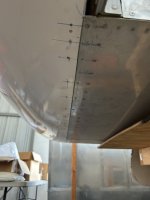
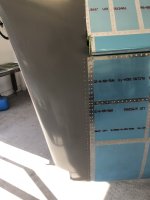
Pitch per plans @ 2.5”; aligned with every second rib rivet. View attachment 101872
Understood. Fair question.
If you were concerned about this then I’d just drill every second hole for AN3s. Then if you want to dimple the skins to match, drill off the hinge. Dimple the skins then re-rivet the hinge. It’ll all stay aligned well and it’s probably only 15 or so rivets per hinge half to do.
With the glass tips just add an extra rivet between each existing one.

IMG_0901.jpeg
 
I used the hinge method as well. Matched the rivet spacing of the last rib with 3/32 rivets. On the fiberglass wing tip the hinge was also adhesive bonded along with rivets. I have seen enough rivets smoking and pulling threw fiberglass parts over the years figured adhesive would help. Did the same on the engine cowl and adhesive bonded the hinge to the cowl. On the hinge wing tip method I also added a shim strip to the wing side edge to get the thicker fiberglass tip to sit flush.
 
Back
Top