Van's Air Force

The definitive Van's Aircraft support community! Buying, building or flying an RV? Join our exclusive family of mentors and enthusiasts!

Fuel Tank Repair Suggestions

Jav8or

Member
Good Day All!

My 1982/88 RV-4 developed a fuel leak in the LH tank at the Sump and near the Forward attach point. Skipping the interesting bits, we were able to remove the tank and confirm the location of the fuel leaks via the ballon/bubble test. I removed the Fuel sending unit cover panel, stuck a borescope and located a literal hole in the sealant exactly at the spot where the leak was evidenced near the FWD attach point. I scraped away the bad sealant, and now I’m ready to apply my B2 to the spots needing attention.

[REQUEST]

The Sump re-seal is a no brainer and should be extraordinarily easy to fix due to accessibility. But the FWD attach point internal to the tank is more tricky, as I’m doing this through the sender access hole. What are the best ways to get sealant to the location? My main limitation is that I would be limited to applying via feel, one dab at a time. How do I keep the mess down? Should I apply copious amounts of masking tape to areas I dont want to seal.

Appreciate any assistance.
 
I'm with you on hearing the responses. Several attempts to stop the leaks have failed using serious cleaning and sealing with the recommended material. Thanks
 
I just re sealed a leak in my RV9 at the fwd attach point and assume the 4 has the same bracket or similiar slide arrangement that SUPPORTS the tank. Mine leaked at the bracket attachment point where it was riveted to the end wall of the tank. A bit a detective work I found the bolt that attaches the tank bracket to the fuselage brackets was pulled up tight. The DWG notes call for this support bolt to be "loose" so that the washer will turn! My thinking is that being tight and not allowing the bolt to slide in the slot it loaded up the tank side bracket and caused the leak. I'm into 2 weeks and 3 hrs flying after the repair without any blue stains now!!!
 
Get one of the Van's tank repair access plates. Cut large round hole in the back baffle as per their instructions. Gives you a fighting chance.

Been in there, twice at least, still trying...
Next time I'm going to use the "adhesion promoter".
 
I just re sealed a leak in my RV9 at the fwd attach point and assume the 4 has the same bracket or similiar slide arrangement that SUPPORTS the tank. Mine leaked at the bracket attachment point where it was riveted to the end wall of the tank. A bit a detective work I found the bolt that attaches the tank bracket to the fuselage brackets was pulled up tight. The DWG notes call for this support bolt to be "loose" so that the washer will turn! My thinking is that being tight and not allowing the bolt to slide in the slot it loaded up the tank side bracket and caused the leak. I'm into 2 weeks and 3 hrs flying after the repair without any blue
Did you make any repairs internal to the tank?
 
Get one of the Van's tank repair access plates. Cut large round hole in the back baffle as per their instructions. Gives you a fighting chance.

Been in there, twice at least, still trying...
Next time I'm going to use the "adhesion promoter".
Appreciate the suggestion.

But I’m trying to avoid cutting holes in the rear baffle. From what I’m hearing some folks don’t even cut holes on the inboard chamber since the sender cover gives some access.

Trying to see how those guys did it.
 
Appreciate the suggestion.

But I’m trying to avoid cutting holes in the rear baffle.
Drill out all the rivets of the end (inboard) rib. Pull and replace the whole dang thing.
You wanted ideas... <shrug> I have seriously thought about doing this.
 
Did you make any repairs internal to the tank?
No , this was the first leak with 1000 hrs on airframe...I chose to make external repair ( proseal) the perimeter of and riveted surface of the bracket. I also added PS to the leading edge /end rib seal. I was not able to determine if leak source was fwd side of bracket or leading edge or both... most recommended that only way was to remove tanks and go with access in rear tank wall. Time will tell
 
Good Day All!

My 1982/88 RV-4 developed a fuel leak in the LH tank at the Sump and near the Forward attach point. Skipping the interesting bits, we were able to remove the tank and confirm the location of the fuel leaks via the ballon/bubble test. I removed the Fuel sending unit cover panel, stuck a borescope and located a literal hole in the sealant exactly at the spot where the leak was evidenced near the FWD attach point. I scraped away the bad sealant, and now I’m ready to apply my B2 to the spots needing attention.

[REQUEST]

The Sump re-seal is a no brainer and should be extraordinarily easy to fix due to accessibility. But the FWD attach point internal to the tank is more tricky, as I’m doing this through the sender access hole. What are the best ways to get sealant to the location? My main limitation is that I would be limited to applying via feel, one dab at a time. How do I keep the mess down? Should I apply copious amounts of masking tape to areas I dont want to seal.

Appreciate any assistance.
That is a difficult spot. Lots of leak pathes and usually a lot of sealant to remove. I would cut a hole in the rear baffle and go in through that.
 
Appreciate the suggestion.

But I’m trying to avoid cutting holes in the rear baffle. From what I’m hearing some folks don’t even cut holes on the inboard chamber since the sender cover gives some access.

Trying to see how those guys did it.
You need to be proficient with working via a mirror. Doable, but difficult. That area is difficult due to thr thick doubler. You need to get rid of all the old sealant first if you expect the repair to be successful. Have done 6 reseals now and short cuts generally won’t get the job done. See post above. He did it two times and still leaks. You really need to see what you are doing. Cutting the rear baffle is WAY less work in the long run.
 
Get one of the Van's tank repair access plates. Cut large round hole in the back baffle as per their instructions. Gives you a fighting chance.

Been in there, twice at least, still trying...
Next time I'm going to use the "adhesion promoter".
Shouldn’t be needed. Key is removing ALL existing sealant (nylon wire wheels on a drill work well), a quick scuffing and cleaning aggressively with mek. Also use mirrors to insure 100% coverage in hidden areas.
 
Last edited:
Shouldn’t be needed. Key is removing ALL existing sealant (nylon wire wheels on a drill work well as does old school paint stripper), a quick scuffing and cleaning aggressively with mek. Also use mirrors to insure 100% coverage in hidden areas.
Due to the placement up in the front, there's just no real way to get your arm in enough through the side. The job gets WAY easier and you will save time by making an access cover at the aft bulkhead.

I use my small dremel and get rid of 95% of the old goop with a razor blade and the dremel. I agree on MEK and usually also etch and Alodine, the whole area before applying adhesion promoter then start goopin.

I have also drilled one of the forward attaches off and re-assembled wet with oversize fasteners. That was an extreme case.

I don't think there's a right or wrong way...and if you fly enough and do any aerobatics you will typically see a leak at some point.

The key here is a little patience and I use gloves and a plastic bag taped to the bicep area, cuz simply put...you're gonna get messy.

Obviously buck all the rivets gooped to a silly level. I goop the rivet, the hole the inside.

Big mess. but then you clean up and you are done. !!!
 
It wouldn’t hurt to reseal ALL the joints in that bay while you have access, especially the rear upper & lower corners where leaks most commonly occur. A bit of pre-maintenance never hurts.
 
Thank you all for the replies. Was hoping to be able to get the repair done before an EAA event this weekend, but I’ll slow down and do it through the rear baffle.

Question:

Does MEK substitute work just as good or should I just use the MEK from ace hardware?

Also, what nylon wire wheel attachment are you using @lr172 ? I can imagine a drill fitting into the tank.
 
The DWG notes call for this support bolt to be "loose" so that the washer will turn! My thinking is that being tight and not allowing the bolt to slide in the slot it loaded up the tank side bracket and caused the leak.
Interesting theory - I'm told that the slot and the "loose" bolt was so that if you landed in a field and the wings hit, the forward attach bracket would not peel open the fuel tank - it would just slide off. Most of the stresses on that bracket are in the vertical direction, so the slotted attach doesn't reduce the support given to the wing in the normal flying situation. A friend of mine who's passed on got in a crash in his RV-4 and was covered in fuel before this slot was recommended. He told me he spoke to Van with this recommendation after his crash, which was subsequently included in the plans.
 
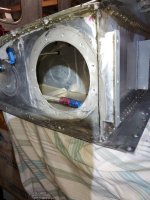
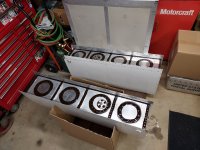
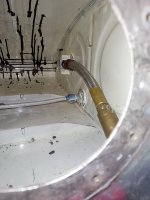
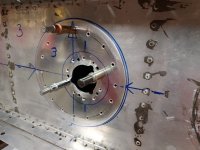
Here are few various shots of tanks I have re-sealed. Its easy to make a cut-out and repair plate. In one photo I incorporated a sender hole into an access cut-out. You'll aslo see what slosh looks like (white milk). The finished RV4 tanks I had to do a cut-out in each bay. I use MEK or Acetone to pre-clean, Coleman lantern fuel for final wipe down ( my go to cleaner). I use alot of Proseal at my dayjob, and we use MEK/Acetone for most.
 

Attachments

  • Tank end rib.jpg
    Tank end rib.jpg
    1.5 MB · Views: 96
  • Sealed baffle covers.jpg
    Sealed baffle covers.jpg
    1.7 MB · Views: 91
  • pickup.jpg
    pickup.jpg
    1.3 MB · Views: 96
  • cutout.jpg
    cutout.jpg
    1.8 MB · Views: 96
Here are few various shots of tanks I have re-sealed. Its easy to make a cut-out and repair plate. In one photo I incorporated a sender hole into an access cut-out. You'll aslo see what slosh looks like (white milk). The finished RV4 tanks I had to do a cut-out in each bay. I use MEK or Acetone to pre-clean, Coleman lantern fuel for final wipe down ( my go to cleaner). I use alot of Proseal at my dayjob, and we use MEK/Acetone for most.
I just bought a fresh can of acetone.

Do I need to buy MEK too?
 
Good Day All!

My 1982/88 RV-4 developed a fuel leak in the LH tank at the Sump and near the Forward attach point. Skipping the interesting bits, we were able to remove the tank and confirm the location of the fuel leaks via the ballon/bubble test. I removed the Fuel sending unit cover panel, stuck a borescope and located a literal hole in the sealant exactly at the spot where the leak was evidenced near the FWD attach point. I scraped away the bad sealant, and now I’m ready to apply my B2 to the spots needing attention.

[REQUEST]

The Sump re-seal is a no brainer and should be extraordinarily easy to fix due to accessibility. But the FWD attach point internal to the tank is more tricky, as I’m doing this through the sender access hole. What are the best ways to get sealant to the location? My main limitation is that I would be limited to applying via feel, one dab at a time. How do I keep the mess down? Should I apply copious amounts of masking tape to areas I dont want to seal.

Appreciate any assistance.
Try using vinyl electrical tape, it won't come apart on removal and is much easier to remove. a clean, scuffed surface will allow the Pro Seal to adhere and be sure to Allow to cure so you don't have a recurring leak, ( 70deg F for a week) longer if you can.
 
Last edited:
Interesting theory - I'm told that the slot and the "loose" bolt was so that if you landed in a field and the wings hit, the forward attach bracket would not peel open the fuel tank - it would just slide off. Most of the stresses on that bracket are in the vertical direction, so the slotted attach doesn't reduce the support given to the wing in the normal flying situation. A friend of mine who's passed on got in a crash in his RV-4 and was covered in fuel before this slot was recommended. He told me he spoke to Van with this recommendation after his crash, which was subsequently included in the plans.
Yes, most of the slot movement would be vertical and tank support is provided with a "loose" bolt. The tank leak issue comes when the bolt is torqued and the fwd & aft as well as vertical movement of normal flight is transmitted into that tank side bracket as well as the fuselage side bracket. Mine probably flew 1000 hrs pulled up tight. And yes the purpose of this slot and bolt arrangement is to allow the wing to slide out and not rupture the tank in the event of a crash.
 
@Jerry Fischer I was thinking of using Painters tape.

Too brittle?

Also, a week?
Read the data sheet, as it outlines timeframes. Full cure is at least a couple weeks, but they allow fuel contact in a day or two, based upon temp. Contact is not pressure though, so use caution if pressure testing.
 
Thank you all for the replies. Was hoping to be able to get the repair done before an EAA event this weekend, but I’ll slow down and do it through the rear baffle.

Question:

Does MEK substitute work just as good or should I just use the MEK from ace hardware?

Also, what nylon wire wheel attachment are you using @lr172 ? I can imagine a drill fitting into the tank.
I just use the softest nylon and usually the 2 or 3" ones. I put it on a die grinder (straight or angle). You can start by scrapping with plastic tools. Can use metal, but need to be proficient in doing so to avoid gouging the Al. Use the wheels to get down to metal. Assuming you don't have an uncured sealant problem, the key is getting the sealant off of everything that could leak (seams, joints, rivet heads, etc), so that you have good coverage. Leaving traces of old, properly cured sealant is not a problem assuming it is scuffed and CLEAN. I like to get it all off to be safe, but the new will stick to the old if cured and properly prep'ed. Key is getting 90% off to get proper coverage. You must fully cover any existing sealant contacting any leak path, as the leak path can be UNDER any of the old stuff.

If the proseal is gummy and can be scraped off with your fingernail, that is a whole different problem. It must be FULLY removed. If that is your case, recommend a complete reseal. I have done a couple of those and the leaks were pervasive.
 
Last edited:
I just use the softest nylon and usually the 2 or 3" ones. I put it on a die grinder (straight or angle). You can start by scrapping with plastic tools. Can use metal, but need to be proficient in doing so to avoid gouging the Al. Use the wheels to get down to metal. Assuming you don't have an uncured sealant problem, the key is getting the sealant off of everything that could leak (seams, joints, rivet heads, etc), so that you have good coverage. Leaving traces of old, properly cured sealant is not a problem assuming it is scuffed and CLEAN. I like to get it all off to be safe, but the new will stick to the old if cured and properly prep'ed. Key is getting 90% off to get proper coverage. You must fully cover an existing sealant contacting any leak path, as the leak path can be UNDER any of the old stuff.

If the proseal is gummy and can be scraped off with your fingernail, that is a whole different problem. It must be FULLY removed. If that is your case, recommend a complete reseal. I have done a couple of those and the leaks were pervasive.
Once you get down to light surface coating of the old stuff, methylene chloride will loosen it up. A bit dangerous, as if you get it on any paint it will take that off as well.
 
@Jerry Fischer I was thinking of using Painters tape.

Too brittle?

Also, a week?
Any masking tape is great for taping off sealant if you remove the tape before it dries.

For removing big chunks of sealant use a 3m sealant cutter on an 1/4 28 drill. 90 degree air drill is preferred. While not fully cured, the B2 sealant is ready for fuel after 2 hours.


I just use the softest nylon and usually the 2 or 3" ones. I put it on a die grinder (straight or angle). You can start by scrapping with plastic tools. Can use metal, but need to be proficient in doing so to avoid gouging the Al. Use the wheels to get down to metal. Assuming you don't have an uncured sealant problem, the key is getting the sealant off of everything that could leak (seams, joints, rivet heads, etc), so that you have good coverage. Leaving traces of old, properly cured sealant is not a problem assuming it is scuffed and CLEAN. I like to get it all off to be safe, but the new will stick to the old if cured and properly prep'ed. Key is getting 90% off to get proper coverage. You must fully cover any existing sealant contacting any leak path, as the leak path can be UNDER any of the old stuff.

If the proseal is gummy and can be scraped off with your fingernail, that is a whole different problem. It must be FULLY removed. If that is your case, recommend a complete reseal. I have done a couple of those and the leaks were pervasive.
Are you preparing the surface of the old sealant with anything to assist it coming off or just using muscle?

All the sealant in the tank is properly cured, just cracked at the seam (and the hole from god knows where). I assume the cracked formed from minor flexing of the attach point flange over time.
 
Any masking tape is great for taping off sealant if you remove the tape before it dries.

For removing big chunks of sealant use a 3m sealant cutter on an 1/4 28 drill. 90 degree air drill is preferred. While not fully cured, the B2 sealant is ready for fuel after 2 hours.


Is this available in non pneumatic form?
 
Sealant removal: check out this thing https://www.aircraftspruce.com/catalog/cspages/sealantcutter1.php
1762269261834.png
Fits into 90 degree air drill. We made up an extension for it so the air drill could go thru the back baffle access hole. Did a nice job removing the sealant so a fresh bead could be put on (this was on a different plane, still need to get to the project on mine).

Oh, I see I duped a prior post. Anyhow, good hint on how to get it into the tank to that spot :-)
 
Are you preparing the surface of the old sealant with anything to assist it coming off or just using muscle?

All the sealant in the tank is properly cured, just cracked at the seam (and the hole from god knows where). I assume the cracked formed from minor flexing of the attach point flange over time.
You can leave properly adhered cured sealant in place. We use Scotchbrite wheels and pads to abraid the old sealant, clean and apply sealant over the existing. I like removing what I can when access is easy, but there are times when it's not necessary. I'm in the middle of replacing a 12' section of a 50' wing stringer in a Boeing 737, so the similar scenario applies where we mate old to new.
 
You can leave properly adhered cured sealant in place. We use Scotchbrite wheels and pads to abraid the old sealant, clean and apply sealant over the existing. I like removing what I can when access is easy, but there are times when it's not necessary. I'm in the middle of replacing a 12' section of a 50' wing stringer in a Boeing 737, so the similar scenario applies where we mate old to new.
Haha, isn’t that contrary to @lr172 advice.
 
do not use black electrical tape. Choose bright colours like yellow, red, fluorescent green to reduce the chance of leaving tape in the tank after repairs are complete.
 
Haha, isn’t that contrary to @lr172 advice.
First, Bill is the expert on this subject! Nothing I say should counter his guidance. Second, I suggested complete removal, as it is the safest way to go if you don't have experience. If you understand what you are looking at and can identify critical areas and leak paths and can differerntiate between cured and uncured sealant, yes, you can get away without complete removal. CThis also requires abrasion and carefull cleaning. Not sure I recommend it for a beginner though; See post#4.
 
First, Bill is the expert on this subject! Nothing I say should counter his guidance. Second, I suggested complete removal, as it is the safest way to go if you don't have experience. If you understand what you are looking at and can identify critical areas and leak paths and can differerntiate between cured and uncured sealant, yes, you can get away without complete removal. CThis also requires abrasion and carefull cleaning. Not sure I recommend it for a beginner though; See post#4.
Sure thing.

I have a ton of maintenance experience but not in tank maintenance and limited sealant use.

Will scotch brite be safe for my newbie hands.

And do I soften old sealant with acetone?
 
Sure thing.

I have a ton of maintenance experience but not in tank maintenance and limited sealant use.

Will scotch brite be safe for my newbie hands.

And do I soften old sealant with acetone?
Scotchbrite does not hurt your hands, it's just a simple abrasive pad. Its used heavily in aviation and is the go to way to abrade..get the red color pads. You will not "soften" old Proseal with acetone, but you will clean it well. Any old sealant the softens with Acetone wasn't mixed correctly to start with.
 
Hey team!

Thanks for all the helpful advice.

Decided to cut a hole in the rear baffle for the repair. Not too hard and I only had to open the tank up twice, lol!

Tank has been full for two weeks on the plane and no leaks.

However, after having the plane sit there for a while with full tanks, the other tank appears to have some blue staining.

Does change in temperature (we’ve recently seen some temps below freezing) cause leaks to appear?
 
Back
Top