Van's Air Force

The definitive Van's Aircraft support community! Buying, building or flying an RV? Join our exclusive family of mentors and enthusiasts!

Weight & Balance Question

ColoradoSolar

Well Known Member
Patron
I am working on the paperwork to submit for my DAR inspection and I have a couple of questions.

First is about the arms for the gear. I measured 99.44" forward from the wing leading edges to get the datum and then I measured to the gear I got 48.25" for the nose and 122.5" for the left and right. Most of the arms I am finding online are about 2" farther aft than my numbers (around 50" and 124"). How could I be 2" off?

Second my DAR is requesting a few sample weight & balance calculation like most forward loading, most aft and first flight. I know how to calculate these but I was wondering if anyone had an example of their W&B they submitted so I can get an idea of the format of the document?

Thanks,
Eric
 
I am working on the paperwork to submit for my DAR inspection and I have a couple of questions.

First is about the arms for the gear. I measured 99.44" forward from the wing leading edges to get the datum and then I measured to the gear I got 48.25" for the nose and 122.5" for the left and right. Most of the arms I am finding online are about 2" farther aft than my numbers (around 50" and 124"). How could I be 2" off?

Second my DAR is requesting a few sample weight & balance calculation like most forward loading, most aft and first flight. I know how to calculate these but I was wondering if anyone had an example of their W&B they submitted so I can get an idea of the format of the document?

Thanks,
Eric
Are you certain you measured to the center of the tires, e.g., the axle? Weight on the wheels? All lines parallel to the fuselage centerline?
As to the documentation, I wrote an Excel program to calculate wt and balance. I ran a number of scenarios, printed out the results. DAR seemed happy with that. Quiz question: if you take off near a cg limit, what happens as you burn gas?
 
Are you certain you measured to the center of the tires, e.g., the axle? Weight on the wheels? All lines parallel to the fuselage centerline?
As to the documentation, I wrote an Excel program to calculate wt and balance. I ran a number of scenarios, printed out the results. DAR seemed happy with that. Quiz question: if you take off near a cg limit, what happens as you burn gas?
Was the aircraft leveled before measuring? A slight angle while measuring can throw all measurements out.
 
Try this.
Use a plumb bob, drop a line straight down from the leading edge of the wing, at a location barely outboard of the main LG tire. Mark this point. At the axle, drop another line to the floor. Mark this point. Measure the distance between points, Add this to 99.44”. What do you get?
 
Try this.
Use a plumb bob, drop a line straight down from the leading edge of the wing, at a location barely outboard of the main LG tire. Mark this point. At the axle, drop another line to the floor. Mark this point. Measure the distance between points, Add this to 99.44”. What do you get?
With the aircraft level ( door sills).
Easiest way is to let the air out of the nose wheel tire.
 
I am working on the paperwork to submit for my DAR inspection and I have a couple of questions.

First is about the arms for the gear. I measured 99.44" forward from the wing leading edges to get the datum and then I measured to the gear I got 48.25" for the nose and 122.5" for the left and right. Most of the arms I am finding online are about 2" farther aft than my numbers (around 50" and 124"). How could I be 2" off?

Second my DAR is requesting a few sample weight & balance calculation like most forward loading, most aft and first flight. I know how to calculate these but I was wondering if anyone had an example of their W&B they submitted so I can get an idea of the format of the document?

Thanks,
Eric
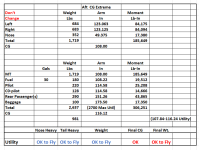
Here is an example of mine with CG aft. Did 3 like other posts. Had a DAR and 3 FSDO's (training for a new FSDO employee it seems) out and they all seemed happy. Make up a XLS (If you can't ask your children or grandchildren) and as you vary the load easy to just punch in the new numbers. Bottom row is just a series of if then else formulas. Not sure how your arms could be off that much but these where mine, plane leveled.

Screenshot 2025-11-03 005746.png
 
Most of the arms I am finding online are about 2" farther aft than my numbers (around 50" and 124"). How could I be 2" off?
Bob lists some great instructions for you above. Also be sure you are level in both directions. I remember using lumber and tweaking tire pressures to get it where I wanted it. Also, when setting the tires back down onto the lumber or scales, the leg will be unnaturally bound up. You either need to roll back and forth a bit or use wax paper or two floor tiles to get it into its natural state, as you would when doing a car alignment. You don't want differences left to right

The gear leg is long and the mount weldments are done by humans in a jig. A simple movement of 1/2 of a degree of angle of the socket can result in the kind of difference you are seeing. As long as you are doing the procedure correctly, I would not worry about variances from others.
 
Last edited:
Thanks for all the tips. I have a spreadsheet and I will just tweak it to capture the scenarios the DAR wants.

I leveled the plane when I weighed it but completely forgot to level it when measuring the arms. I will level it and measure the arms again when I am back out at the airport.
 
Thanks for all the tips. I have a spreadsheet and I will just tweak it to capture the scenarios the DAR wants.

I leveled the plane when I weighed it but completely forgot to level it when measuring the arms. I will level it and measure the arms again when I am back out at the airport.
While there is no prescribed format for the W&B documents that have to be in the airplane, as a DAR, I want to see the empty airplane arms and weights, the defined Gross, and some examples that show max forward and max aft cases. These help the pilot know at a glance where they are in the envelope - and if it is easy to eat out of the envelope. Lastly, I want a “blank” W&B worksheet for the pilot so that they can work out the loading for their flight. This is because even though you (as the builder, current owner) might be using an App to do the calculations, someone in the future might not have that same App - and the reason the W&B info has to be in the airplane is so that any random pilot of the craft can computer their CG position.

I know, I know….once we get use to an airplane and how we load it, we probably never look at it again, because we have learned what works and how to stay in the envelope. But some day, you might sell the airplane….or have to have someone ferry it for you….

I do a spreadsheet (“oooh…this calls for a spreadsheet!” 🤣) and print out my examples, sign and date it the printout, and put it in the airplane.

Paul
 
To bring a bit of closure to this thread. I measured again after leveling the plane and I got nose 49", left & right 123.94" which is much closer to other numbers I have seen and also make my empty CG not quite so far forward.
 
Back
Top