Van's Air Force

The definitive Van's Aircraft support community! Buying, building or flying an RV? Join our exclusive family of mentors and enthusiasts!

another sticky valve question

Ok thanks! I previously assumed this would work exactly as you just described. But other conversation lead me to think that this would only affect the PEAK oil pressure (i.e. keep PSI under 100) instead of adjusting cruise PSI.

TY,
G
 
Ok thanks! I previously assumed this would work exactly as you just described. But other conversation lead me to think that this would only affect the PEAK oil pressure (i.e. keep PSI under 100) instead of adjusting cruise PSI.

TY,
G
I guess you kinda have to look at the oil relief valve as the "maximum allowable" oil pressure during cruise with fully warmed-up oil, while realizing that the oil pressure will run lower during idle -- but hopefully remaining "in the green".
 
Yeah. My concern is more on the other end. Full power takeoff with "green" oil temps but on the low side. I don't want to exceed that limit all.
 
Yeah. My concern is more on the other end. Full power takeoff with "green" oil temps but on the low side. I don't want to exceed that limit all.
Right -- so, turning the oil pressure relief screw-in (clockwise) increases both the idle and cruise oil pressure values. So now, I'm running "in the green" at idle (just above 60 psi) and 75 psi during cruise. Oil pressure goes up until hitting the maximum adjusted pressure, then it stays put. (y):cool:(y)
 
Yes Sir. You’re right, as usual, regarding the original pick-up. I’m still asserting the pressure loss will be quite noticeable; if solely based on the anecdote alone.

My dyno sheet says at 2690 RPM, oil pressure was 78 psi, with an "OP Left" of 67 and an "OP right" of 64. I can't speak for the calibration, or even the exact measurement positions, but I can't be the only one with similar printouts.
 
My dyno sheet says at 2690 RPM, oil pressure was 78 psi, with an "OP Left" of 67 and an "OP right" of 64. I can't speak for the calibration, or even the exact measurement positions, but I can't be the only one with similar printouts.
No idea on position but Vegas odds for sensing positions would be both front galley (normally plugged) ports. I don't know where you could measure further downstream without some more involved surgery. Either way assuming accurate instrumentation, your "left" side has an ~7% flow loss and the "right" ~ 9.

If the aforementioned is accurate, I'd consider this system less than adequately manifolded. If the two sides have this delta, it would be very conceivable that further flow branching would create even more deltas especially considering the additional machining/process steps for the related oil supply passages.

Would any of this matter ultimately? Don't know but the fleet says there's a potential flow variation issue in the process branches. Cessna's (not Lycoming's) attempted remedy (ref post 41) may be warranted or may just be the only easy available thing to try. Related maintenance data from that particular fleet versus the remainder would be interesting.
 
Awesome, TY for the clarity.
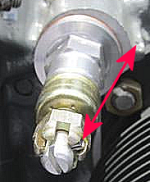
One more important thing -- after getting your oil pressure set, make sure to safety-wire it because these things tend to back-off under engine vibration and lower the oil pressure over time. The safety wire can be run through the hollow split pinion-pin, that holds the adjustment nut onto the adjustment screw, down to the safety-wire hole provided on the engine casting (near the base of the oil pressure relief valve mount).

1760727991962.png
 
I re tie my shoes before each flight and have not had a sticking valve in over 2000 hours across two planes.
I think I will add this to my routine, and even if I break a lace occasionally, it's still more economical than what I'm doing! 😊
 
I tried this today...and also have noted no sticking valves...we might be on to something here.... ( buying more laces on Amazon tonight)
 
I switched to wearing my boots instead of tennis-shoes with laces, have not had a sticking valve since I made that change over a thousand hours ago.
 
I fear that I may have added yet one more variable that we can't really quantify to the long list of potentials. :LOL: For my next attempt, I am going to add ceaser salad dressing to my oil and observe the effect on sticking valves; In tribute to Mike busch, I will also force my cylinders to 300 and note the relationship, with and without the dressing.
 
MMO, Tight Laces, and Boots. Oh my!

Tribal knowledge as a controlled experiment.

5 monkeys were placed in a cage as part of an experiment. In the middle of the cage was a ladder with bananas on the top rung. Every time a monkey tried to climb the ladder, the experimenter sprayed all of the monkeys with icy water. Eventually, each time a monkey started to climb the ladder, the other ones pulled him off and beat him up so they could avoid the icy spray. Soon, no monkey dared go up the ladder.

The experimenter then substituted one of the monkeys in the cage with a new monkey. The first thing the new monkey did was try to climb the ladder to reach the bananas. After several beatings, the new monkey learned the social norm. He never knew “why” the other monkeys wouldn’t let him go for the bananas because he had never been sprayed with ice water, but he quickly learned that this behaviour would not be tolerated by the other monkeys.

One by one, each of the monkeys in the cage was substituted for a new monkey until none of the original group remained. Every time a new monkey went up the ladder, the rest of the group pulled him off, even those who had never been sprayed with the icy water.

By the end of the experiment, the 5 monkeys in the cage had learned to follow the rule (don’t go for the bananas), without any of them knowing the reason why (we’ll all get sprayed by icy water). If we could have asked the monkeys for their rationale behind not letting their cage mates climb the ladder, their answer would probably be: “I don’t know, that’s just how its always been done.”
 
MMO, Tight Laces, and Boots. Oh my!

Tribal knowledge as a controlled experiment.

5 monkeys were placed in a cage as part of an experiment. In the middle of the cage was a ladder with bananas on the top rung. Every time a monkey tried to climb the ladder, the experimenter sprayed all of the monkeys with icy water. Eventually, each time a monkey started to climb the ladder, the other ones pulled him off and beat him up so they could avoid the icy spray. Soon, no monkey dared go up the ladder.

The experimenter then substituted one of the monkeys in the cage with a new monkey. The first thing the new monkey did was try to climb the ladder to reach the bananas. After several beatings, the new monkey learned the social norm. He never knew “why” the other monkeys wouldn’t let him go for the bananas because he had never been sprayed with ice water, but he quickly learned that this behaviour would not be tolerated by the other monkeys.

One by one, each of the monkeys in the cage was substituted for a new monkey until none of the original group remained. Every time a new monkey went up the ladder, the rest of the group pulled him off, even those who had never been sprayed with the icy water.

By the end of the experiment, the 5 monkeys in the cage had learned to follow the rule (don’t go for the bananas), without any of them knowing the reason why (we’ll all get sprayed by icy water). If we could have asked the monkeys for their rationale behind not letting their cage mates climb the ladder, their answer would probably be: “I don’t know, that’s just how its always been done.”
So, are the monkeys in this story representative of the VAF members or the Lycoming Engineers? :LOL:
 
If you are using the standard location for oil pressure gage connection, the oil pressure at the front of main oil gallery will be 8-10 psi lower. The oil pressure on the left gallery will likely be lower still.
Setting oil pressure relief for "high green" at cruise with oil temperature at 180 is very beneficial for valve lubrication. Cessna has been doing that on the Lycoming powered airplanes since restart of single engine production.
Minimum idle oil pressure at idle is a separate number and for a high time engine will likely be below the green arc.
 
If you are using the standard location for oil pressure gage connection, the oil pressure at the front of main oil gallery will be 8-10 psi lower. The oil pressure on the left gallery will likely be lower still.
Setting oil pressure relief for "high green" at cruise with oil temperature at 180 is very beneficial for valve lubrication. Cessna has been doing that on the Lycoming powered airplanes since restart of single engine production.
Minimum idle oil pressure at idle is a separate number and for a high time engine will likely be below the green arc.
Green arc(measured at rear) 55 to 95. Idle minimum 25. No need to worry about green arc for idle.
 
I wonder what it would be like if I could crawl inside the case with the engine running at 2300 rpm , and experience the oil that sprays out from those cam bearings with a pressure set at the low side of green like 65 and compare it with the volume of oil that sprays out at 85 psi.

Does a higher volume of oil shoots out from those gaps no matter the tolerances?

“Does oil volume flowing down the pushrod tubes increase?”-
Maybe however the oil down the pushrod (not the actual pushrod) tube is what helps cool the valve guides.

“ I don’t know where to go with creativity. Can we fabricate a clear cover and watch? “
If you did it would be a waste of time.
“Is this even the issue to sticky valves?
No - are far as oil delivery & pressure goes it all dependent on oil delivery to the correct location which is the valve guide - it’s no coincidence the the pushrod shroud tube stops directly above the valve guides, it’s there for a reason.

“I like data. It would be nice to collect 100,000 samples and see what oil and additives result in better performance.”
I think it’s more basic than that. Sure, oil additives & maybe bumped up oil pressure helps, especially if normal cruise flight pressures are at the lower end, however my system runs around 80-85 psi & I’ve always run LOP.

I feel my comment about the oil flow to the valve guide area needs clarification—-
What we did (around the same time as the new valve guides, with added chromium to make them harder) was to hang empty soda cans off each rocker box area drain points to determine the amount of oil collected with engine running over a period of minutes at varying rpm. After shutdown the collected oil results showed that #1 & #3 rocker box flows were way below #2 & #4, like about 80% less. The cam follower tolerances I mentioned in a previous post really shows that if you have a “tight” fit between it & the crankcase (but still within ‘service limits’) you most likely will have valve guides issues. And it’s not something that is serial number dependent.
Although this para is not totally about sticking valves it’s related & shows there can be more to engine/valves/valve guide issues that need to be known. Patch up work like making valve guides harder is just masking a problem that has never really been fixed. YMMV.
 
My theory:
The #2 cyl is the only one where the injector is forward facing and subject to high velocity cooling air from the cowl inlet. This potentially can cause the #2 injector to have a lower static pressure at its air inlet compared to the other cylinders. With lessened bleed air flow, atomization for that one injector suffers resulting in poor fuel burn etc.

At full throttle there is very little pressure differential between the intake manifold and the pressure in the upper deck of the cowl.

Easy fix would be closing the throttle a touch in cruise to restore fuel injector atomization by increasing bleed air thru the injector. Im guessing it would run a little smoother.
Great point about the #2 injector facing forward! I placed a "dam" in front of the #2 injector with the GAMI spread going from 0.6 GPH pre to 0.2 GPH post dam. My injectors are the "stock" injectors from Lycon. #2 always peaked peaked first before the dam was installed.
 
Great point about the #2 injector facing forward! I placed a "dam" in front of the #2 injector with the GAMI spread going from 0.6 GPH pre to 0.2 GPH post dam. My injectors are the "stock" injectors from Lycon. #2 always peaked peaked first before the dam was installed.
Can you post a picture of your damn?
 
The formatting of response #68 kind of hides really beneficial data. Below this line is a cut/paste of post #68 from jakej. Bold font is my question. Standard font is jakej's response.
________________________________________


I wonder what it would be like if I could crawl inside the case with the engine running at 2300 rpm , and experience the oil that sprays out from those cam bearings with a pressure set at the low side of green like 65 and compare it with the volume of oil that sprays out at 85 psi.

Does a higher volume of oil shoots out from those gaps no matter the tolerances?

“Does oil volume flowing down the pushrod tubes increase?”-
Maybe however the oil down the pushrod (not the actual pushrod) tube is what helps cool the valve guides.

“ I don’t know where to go with creativity. Can we fabricate a clear cover and watch? “
If you did it would be a waste of time.
“Is this even the issue to sticky valves?


No - are far as oil delivery & pressure goes it all dependent on oil delivery to the correct location which is the valve guide - it’s no coincidence the the pushrod shroud tube stops directly above the valve guides, it’s there for a reason.

“I like data. It would be nice to collect 100,000 samples and see what oil and additives result in better performance.”

I think it’s more basic than that. Sure, oil additives & maybe bumped up oil pressure helps, especially if normal cruise flight pressures are at the lower end, however my system runs around 80-85 psi & I’ve always run LOP.

I feel my comment about the oil flow to the valve guide area needs clarification—-
What we did (around the same time as the new valve guides, with added chromium to make them harder) was to hang empty soda cans off each rocker box area drain points to determine the amount of oil collected with engine running over a period of minutes at varying rpm. After shutdown the collected oil results showed that #1 & #3 rocker box flows were way below #2 & #4, like about 80% less. The cam follower tolerances I mentioned in a previous post really shows that if you have a “tight” fit between it & the crankcase (but still within ‘service limits’) you most likely will have valve guides issues. And it’s not something that is serial number dependent.
Although this para is not totally about sticking valves it’s related & shows there can be more to engine/valves/valve guide issues that need to be known. Patch up work like making valve guides harder is just masking a problem that has never really been fixed. YMMV
 
The formatting of response #68 kind of hides really beneficial data. Below this line is a cut/paste of post #68 from jakej. Bold font is my question. Standard font is jakej's response.
________________________________________


I wonder what it would be like if I could crawl inside the case with the engine running at 2300 rpm , and experience the oil that sprays out from those cam bearings with a pressure set at the low side of green like 65 and compare it with the volume of oil that sprays out at 85 psi.

Does a higher volume of oil shoots out from those gaps no matter the tolerances?

“Does oil volume flowing down the pushrod tubes increase?”-
Maybe however the oil down the pushrod (not the actual pushrod) tube is what helps cool the valve guides.

“ I don’t know where to go with creativity. Can we fabricate a clear cover and watch? “
If you did it would be a waste of time.
“Is this even the issue to sticky valves?


No - are far as oil delivery & pressure goes it all dependent on oil delivery to the correct location which is the valve guide - it’s no coincidence the the pushrod shroud tube stops directly above the valve guides, it’s there for a reason.

“I like data. It would be nice to collect 100,000 samples and see what oil and additives result in better performance.”

I think it’s more basic than that. Sure, oil additives & maybe bumped up oil pressure helps, especially if normal cruise flight pressures are at the lower end, however my system runs around 80-85 psi & I’ve always run LOP.

I feel my comment about the oil flow to the valve guide area needs clarification—-
What we did (around the same time as the new valve guides, with added chromium to make them harder) was to hang empty soda cans off each rocker box area drain points to determine the amount of oil collected with engine running over a period of minutes at varying rpm. After shutdown the collected oil results showed that #1 & #3 rocker box flows were way below #2 & #4, like about 80% less. The cam follower tolerances I mentioned in a previous post really shows that if you have a “tight” fit between it & the crankcase (but still within ‘service limits’) you most likely will have valve guides issues. And it’s not something that is serial number dependent.
Although this para is not totally about sticking valves it’s related & shows there can be more to engine/valves/valve guide issues that need to be known. Patch up work like making valve guides harder is just masking a problem that has never really been fixed. YMMV
Interesting thoughts here. I don't believe that excess flow from the lifter bore clearance flows to the rocker box. Yes, there is high pressure oil flowing to each lifter bore and clearances can be 3-4 thou. However, IIRC, that area has drains cast into the case to allow the excess flow to drain back to the sump. There would be a great deal of excess flow from that big of a clearance and that require drains. There is an area below the tube exit to collect this oil for the drain. It would be poor engineering if you allowed all that flow to go to the rocker box. Any blockage or leakage in that return sysem would quickly lead to serious issues. So, I don't believe that is a variable in this equation.

However, there is a clearance in the plunger assembly. There is a piston that goes into the body of the plunger. It is about a 1 thou clearance, maybe less. IIRC, these are all hand lapped for a very close slip fit. Oil flows into the case lifter bore and enters the lifter via a hole in it. That floods the lifter cavity. That oil then flows into the plunger assy via its bottom tube and past the check ball. The pressurized oil now in the plunger cylinder pushes up on the piston and removes any valve lash. There is also a clearance between the plunger body and the lifter bore. oil below the plunger is pressurized, so there will be some leakage via that clearance, but it is also slip fit and nowhere near .004'

While everyone else uses a bypass channel in the plunger assy to move some of the oil off to the pushrod, lyc only uses bleed past this plunger piston slip fit and past the plunger assy clearance to feed the pushrod. Therefore, tolerance differences will result in different flow rates. Then there is the plunger lifter bore clearance. Any oil bleeding past this area will also flow to the pushrod, as it is under the lifter cap riding in the lifter bore. Any leakage past the cap should flow back to the case drain, though a bit could be lung into the tube.

So, two clearance variables that will influence flow rate to the rocker box. Neither of those two interfaces really move much, so they don't wear.

 
Last edited:
Interesting thoughts here. I don't believe that excess flow from the lifter bore clearance flows to the rocker box. Yes, there is high pressure oil flowing to each lifter bore and clearances can be 3-4 thou. However, IIRC, that area has drains cast into the case to allow the excess flow to drain back to the sump. There would be a great deal of excess flow from that big of a clearance and that require drains. There is an area below the tube exit to collect this oil for the drain. It would be poor engineering if you allowed all that flow to go to the rocker box. Any blockage or leakage in that return sysem would quickly lead to serious issues. So, I don't believe that is a variable in this equation.

However, there is a clearance in the plunger assembly. There is a piston that goes into the body of the plunger. It is about a 1 thou clearance, maybe less. IIRC, these are all hand lapped for a very close slip fit. Oil flows into the case lifter bore and enters the lifter via a hole in it. That floods the lifter cavity. That oil then flows into the plunger assy via its bottom tube and past the check ball. The pressurized oil now in the plunger cylinder pushes up on the piston and removes any valve lash. There is also a clearance between the plunger body and the lifter bore. oil below the plunger is pressurized, so there will be some leakage via that clearance, but it is also slip fit and nowhere near .004'

While everyone else uses a bypass channel in the plunger assy to move some of the oil off to the pushrod, lyc only uses bleed past this plunger piston slip fit and past the plunger assy clearance to feed the pushrod. Therefore, tolerance differences will result in different flow rates. Then there is the plunger lifter bore clearance. Any oil bleeding past this area will also flow to the pushrod, as it is under the lifter cap riding in the lifter bore. Any leakage past the cap should flow back to the case drain, though a bit could be lung into the tube.

So, two clearance variables that will influence flow rate to the rocker box. Neither of those two interfaces really move much, so they don't wear.


Thanks Larry for your help here explaining about what happened with my reply to your earlier post. I’ll try harder to be clearer in future.
Further to my input -
The hydraulic lifters are the main source of the oil that squirts into the rocker arm/s. That oil only lubricates the rocker arm & the rotator cap on the valve stem - proven by removing a pushrod & using an oil can to squirt into the pushrod hole in the rocker - it is unable to get anywhere near the valve guide so no oil there = no lubrication or cooling of the valve stem.
We also selected some hydraulic lifters to make sure the bleed down rates were equal on each - made no measurable difference to oil delivery.
The valve guide lubricating/cooling oil comes from the gap between the cam follower & engine case. There’s a small hole in the case where the cam follower slides in/out & when the valve/s are closed that hole is ‘uncovered’ momentarily allowing a small quantity of oil to run down the shroud tube & on to the valve guide. (Have a look in an engine case if you get a chance & you’ll see it).
This brings us back to 1 of my data points - “if the cam follower to case is within limits but at the minimal clearance end then the reduced oil amount will have an impact on valves & guides” read , higher CHT’s, valve guide wear & the boogeyman - morning sickness.
IMO, the most cost effective way to determine IF you may have an issue is the do the ground runs, with soda cans collecting oil from the rocker box area as posted earlier.
All the above has nothing to do with lifters themselves, take a look at a cylinder & see where the pushrod ‘shroud’ tubes stop near the rockers. They stop directly above the valve guides. HTH, Jake
 
Thanks Larry for your help here explaining about what happened with my reply to your earlier post. I’ll try harder to be clearer in future.
Further to my input -
The hydraulic lifters are the main source of the oil that squirts into the rocker arm/s. That oil only lubricates the rocker arm & the rotator cap on the valve stem - proven by removing a pushrod & using an oil can to squirt into the pushrod hole in the rocker - it is unable to get anywhere near the valve guide so no oil there = no lubrication or cooling of the valve stem.
We also selected some hydraulic lifters to make sure the bleed down rates were equal on each - made no measurable difference to oil delivery.
The valve guide lubricating/cooling oil comes from the gap between the cam follower & engine case. There’s a small hole in the case where the cam follower slides in/out & when the valve/s are closed that hole is ‘uncovered’ momentarily allowing a small quantity of oil to run down the shroud tube & on to the valve guide. (Have a look in an engine case if you get a chance & you’ll see it).
This brings us back to 1 of my data points - “if the cam follower to case is within limits but at the minimal clearance end then the reduced oil amount will have an impact on valves & guides” read , higher CHT’s, valve guide wear & the boogeyman - morning sickness.
IMO, the most cost effective way to determine IF you may have an issue is the do the ground runs, with soda cans collecting oil from the rocker box area as posted earlier.
All the above has nothing to do with lifters themselves, take a look at a cylinder & see where the pushrod ‘shroud’ tubes stop near the rockers. They stop directly above the valve guides. HTH, Jake
EDIT; amended my opinions in next post

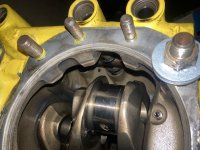
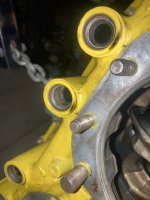
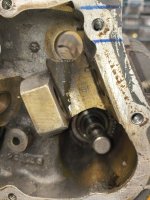
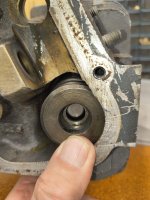
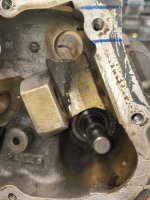
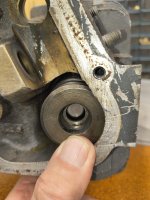
I think you are referring to a drain hole and not an oil feed hole. There is a large hole (exposed only when the lifter is down). This hole is drilled staight through the case. It is there to provide a drain source if the rocker box fills with oil, due to a drain blockage. Oil would back up in the tube and have nowhere to go without this in such an event. Have an engine sitting in my garage getting torn down tomorrow and took these pics. In the first pic, you see where the drilled passage enters the inside of the case. It is just left of the tappet face. In the second pic, you see the other side of that passage at the 9:00 position in the middle lifter bore. It is a little hard to see due to the camera angle. That drilled passage DOES NOT intersect with an oil galley. That passage way is HUGE for an oil feed source and would flow MASSIVE amounts of oil were it a supply with no restriction.

.
cpic10.jpgpic 11.jpg,
 
Last edited:
Thanks Larry for your help here explaining about what happened with my reply to your earlier post. I’ll try harder to be clearer in future.
Further to my input -
The hydraulic lifters are the main source of the oil that squirts into the rocker arm/s. That oil only lubricates the rocker arm & the rotator cap on the valve stem - proven by removing a pushrod & using an oil can to squirt into the pushrod hole in the rocker - it is unable to get anywhere near the valve guide so no oil there = no lubrication or cooling of the valve stem.
We also selected some hydraulic lifters to make sure the bleed down rates were equal on each - made no measurable difference to oil delivery.
The valve guide lubricating/cooling oil comes from the gap between the cam follower & engine case. There’s a small hole in the case where the cam follower slides in/out & when the valve/s are closed that hole is ‘uncovered’ momentarily allowing a small quantity of oil to run down the shroud tube & on to the valve guide. (Have a look in an engine case if you get a chance & you’ll see it).
This brings us back to 1 of my data points - “if the cam follower to case is within limits but at the minimal clearance end then the reduced oil amount will have an impact on valves & guides” read , higher CHT’s, valve guide wear & the boogeyman - morning sickness.
IMO, the most cost effective way to determine IF you may have an issue is the do the ground runs, with soda cans collecting oil from the rocker box area as posted earlier.
All the above has nothing to do with lifters themselves, take a look at a cylinder & see where the pushrod ‘shroud’ tubes stop near the rockers. They stop directly above the valve guides. HTH, Jake
Today I looked at the engine in my garage and you are correct that some of the oil bled from the case bore / lifter clearance that comes out on the cylinder side (some comes out on the case side and drains to sump) has no case drain, except for the one at 3:00 or 9:00. I knew there was a drain, but didn't realize it was half way up the bore at 9:00; Thought it was at the bottom. Therefore oil will be delivered via the shroud tube and the quantity of that oil would be dependant upon the clearance between the lifter body and the case bore. Yeyt another variable in the mix.

There is another, smaller hole in the case lifter bore that supplies oil and that one is tied to the galley. It, however, is never open. It just feeds the clearance like most oil supplies.

Its been too long since I had open cases in front of me.
 
Last edited:
Higher, but not by much, at least on my airplane. Values are inches of water, so the differences are very small. This is a bubble rock at #2. I had the same on all four.

View attachment 100107

View attachment 99628

Measure your local pressures to be sure. I'd be more inclined to look into the airflow issue Chris outlined above, with thermocouples.

A later photo, with turbo nozzle shrouds and a pitot rail. #2 and #4 are on the same rail, so nozzle bleed pressure will be very similar.

View attachment 99630


Given the issue is coking, reduced stem and guide temperature would be beneficial. That said, I've been running peak EGT cruise over 1000 hours now, and the recent wobble check was perfect. Sample of one of course.
Make that sample of 2. I also have been running peak EGT for 1000 hrs. I made the wobble test fixture and tested this year. Perfect.
 
.... when the valve/s are closed that hole is ‘uncovered’ momentarily allowing a small quantity of oil to run down the shroud tube & on to the valve guide.
....take a look at a cylinder & see where the pushrod ‘shroud’ tubes stop near the rockers. They stop directly above the valve guides.

Perhaps true with a parallel valve, but there doesn't appear to be any direct drip path with an angle valve.

1000001559.jpg

1000001561.jpg
 

Attachments

  • 1000001559.jpg
    1000001559.jpg
    2 MB · Views: 59
  • 1000001561.jpg
    1000001561.jpg
    2 MB · Views: 61
Last edited:
Can do.

Perhaps true with a parallel valve, but there doesn't appear to be any direct drip path with an angle valve.

View attachment 100560

View attachment 100561
Jake is referring to the drain hole drilled in the 9:00 or 3:00 position in the case bore containing the lifter body. And is only exposed when the lifter is low in the bore. He was incorrect that it was an oil supply line. I confirmed it is just a drain line. Pics in my earliervpost. I have a 360 torn down in my garage right now. He is on to something though. There will be bleed oil coming from the clearance between the case bore and lifter body and the quantity of bleed oil will be directly related to the clearance there, which is .001-.006”. Because the drain is half way up the side of the bore, most of that that bleed oil will run down the shroud tube and drip onto the valve spring which will then drip on the valve stem, at least on the PV engines. Looks like on the av engines the angle will kind of miss the spring. Can see in your pic the gravity induced oil drip line from the tube. However, that oil should hit the spring and get thrown around via the constant movement and should end up with some oil on the stem.
 
Last edited:
Jake is referring to the drain hole drilled in the 9:00 or 3:00 position in the case bore containing the lifter body.

Forget the hole.

most of that that bleed oil will run down the shroud tube and drip onto the valve spring which will then drip on the valve stem, at least on the PV engines. Looks like on the av engines the angle will kind of miss the spring. Can see in your pic the gravity induced oil drip...

Yep. For sure it doesn't drip on the valve stem.

However, that oil should hit the spring and get thrown around via the constant movement and should end up with some oil on the stem.

Yes, "some oil on the stem". It would be not be enough to qualify as a cooling flow for the stem.
 
Yes, "some oil on the stem". It would be not be enough to qualify as a cooling flow for the stem.
Fully agreed, but creates an interesting difference betrween PV and AV. What was enlightening for me in that dialog was the oil coming down the tube. I always thought the drain hole for the lifter bleed oil was at the bottom of the bore. Learning that is on the side means that some portion of that bleed oil will come down the tube and end up in the rocker box. Prior, I had always believed that the only oil getting to the rocker box was via the pushrod. This adds another dimension to the speculation as to the randomness of sticking valves and influence via oil cooling.
 
Forget the hole.


Yep. For sure it doesn't drip on the valve stem.


Yes, "some oil on the stem". It would be not be enough to qualify as a cooling flow for the stem.
And …..the other function of oil is lubricating obviously - hey, at least we’re having a good discussion on this.
A question - why did Lycoming have external oil lines going to the rocker box area on the turbo Mooneys ? and where was that flow directed ?
 
Aero shell 15w50 is a synthetic blend. Also it has the Lycoming additive mixed in. I wonder if a little more Lycoming additive or slightly higher percentage of synthetic base stock would help. We may never know
 
And …..the other function of oil is lubricating obviously - hey, at least we’re having a good discussion on this.

Jake, you mentioned hanging catch cans on the rocker box drains to compare oil quantity for each cylinder. What were the flow rates?
 
Jake, you mentioned hanging catch cans on the rocker box drains to compare oil quantity for each cylinder. What were the flow rates?
Hi Dan, I’m embarrassed to say I did not measure the flow rate (my troubleshooting was done in the mid 90’s when I knew a lot less than now in reference to aircraft engines) however from memory, after running the engine at various revs for approx 5 mins, there was about 1/2” of oil in the cans for #2 & #4 and about a teaspoon each for #1 & #3 that shocked me enough at the time.
Out “testing” is/was only with parallel valve engines. Do the angle valve types have similar issues ?
 
Aero shell 15w50 is a synthetic blend. Also it has the Lycoming additive mixed in. I wonder if a little more Lycoming additive or slightly higher percentage of synthetic base stock would help. We may never know
My understanding is that as long as there is mineral component in the oil it would cook up on the valve guide. Fully synthetic oil + unleaded fuel seems to be the ultimate solution as it's much more resistant to to high temperatures
 
....from memory, after running the engine at various revs for approx 5 mins, there was about 1/2” of oil in the cans for #2 & #4 and about a teaspoon each for #1 & #3 that shocked me enough at the time.
Out “testing” is/was only with parallel valve engines. Do the angle valve types have similar issues ?

I may fabricate a set of capture cans and have a go. Maybe send them around to owners who have stuck a valve, just to see if there is a flow variation.

The flow levels you describe are not enough to provide effective cooling.

Here on VAF we've seen both parallel and angle heads with stuck valves. The primary interest these days is the 390 in an RV-14.

My understanding is that as long as there is mineral component in the oil it would cook up on the valve guide. Fully synthetic oil + unleaded fuel seems to be the ultimate solution as it's much more resistant to to high temperatures

I'd like to poll oil choice vs sticking when Doug gets the poll function up and running.
 
My understanding is that as long as there is mineral component in the oil it would cook up on the valve guide. Fully synthetic oil + unleaded fuel seems to be the ultimate solution as it's much more resistant to to high temperatures
Agreed.. Mobil av1 failure was the lack of lead scavenging. Unleaded fuel would eliminate that aspect. New top tier autos are leaving factories with full synthetic now. Again, unleaded fuel
 
According to Ed of CamGuard, lead is not scavenged or held in suspension in oil - mineral or synthetic. Unleaded fuel will certainly help with sludge in the engine. The ashless dispersant additives hold in suspension the stuff that blows by the rings, mostly fuel, partially combusted fuel, water, and what he calls varnish precursors.

The Lycoming oil additive was mandated for the H2AD Lycoming engines to help with cam and lifter wear.

I'm not familiar with the Phillips lawsuit, but the operative word seems to be contamination. Phillips XC is not a semi synthetic. It's a mineral oil with AD additives.

Ed
 
According to Ed of CamGuard, lead is not … held in suspension in oil - mineral or synthetic.
i agree that oil is not a lead scavenger, but am struggling with lead not being held in suspension, as i have pulled a few engines apart with minimal to no sludge and if the lead was not being held in suspension, there should be a LOT of grey sludge at the bottom of the pan after a couple thousand hours. The fact that it is not there makes my question that claim. I do see a LOT of grey sludge in the forward crank core, where the force acts like a centrifuge and pulls the lead out of suspension and sticks to the wall. This stuff should be everywhere if unable to be held in suspension, yet it is not.
 
Last edited:
I read the Mobil 1 lawsuit and technical explanation regarding failures. They claim mineral oil AD rated helps keep the lead in suspension until it's drained. In relation to our sticky ex valves, I've seen black coking deposits when reaming the guide
 
Back
Top