Van's Air Force

The definitive Van's Aircraft support community! Buying, building or flying an RV? Join our exclusive family of mentors and enthusiasts!

I (didn't) give up

I put the CPS wires and knock wire back in the connectors and tied them with zip ties then put the fuel system and injectors back with new O-rings and lithium grease. I had a bit of a time with the pilot side heat shield and getting the shield between the fuel pressure regulator and case, and then getting both the banjo bolt and 50 mm Allen screw to line up but I worked through it.

I pressurized the system, turning on both fuel pumps and checked for leaks and did not find anything.

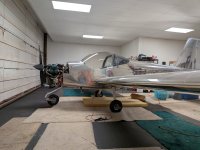
The weather wasn't great; the rain had stopped but it was still windy, but surmised the plane would be fine attempting an engine start. The engine started somewhat hesitantly but then smoothed out a bit. I didn't have headsets on so it was a bit of a racket. I was able to get it to 3900 rpm (Van's recommends 4000) for a few seconds. I did get a flashing Lane B so shut it down after a minute, feeling that I had accomplished what I set out to do: see if the cleaning of the injectors solved the problem.

No leaks discovered afterward and I confirmed that the 2/4 cylinders had finally come alive. I'm still tempted to replace all the spark plugs and just start fresh. Why not?

I didn't have a dongle to download the ECU file but I'll download the log and repeat the test with the laptop showing the health page and see what the flashing Lane B was all about. There might be other issues lurking about so I'm not declaring victory just yet.

I also got a warning via the G3X that there was a short in the pilot side headset jack that went out when I pulled the headset. I'll deal with that later.
 

Attachments

  • PXL_20251021_225117054.jpg
    PXL_20251021_225117054.jpg
    400.8 KB · Views: 74
The weather wasn't great; the rain had stopped but it was still windy, but surmised the plane would be fine attempting an engine start. The engine started somewhat hesitantly but then smoothed out a bit. I didn't have headsets on so it was a bit of a racket. I was able to get it to 3900 rpm (Van's recommends 4000) for a few seconds. I did get a flashing Lane B so shut it down after a minute, feeling that I had accomplished what I set out to do: see if the cleaning of the injectors solved the problem.
Congratulations Bob!! All that persistence paid off...

ds
 
When I get frustrated I usually have to leave, go home and drink a beer, and then within 24 hours the solution miraculously presents itself.
 
When I get frustrated I usually have to leave, go home and drink a beer, and then within 24 hours the solution miraculously presents itself.
See post #45, 46 suggesting rolling ones own cigarettes (which takes time and a subtle bit of talent) as a fix. Only not really rolling up a cigarette and smoking it.....just.....well, you know.........kinda like having a beer.......... :ROFLMAO:
 
Nate thinks there still might be a problem with the #4 injector. We'll see if it goes away with some more runs. If not, I'll have to pull the fuel rail again and I'll send them to Lockwood or APS.

His analysis, as usual, is excellent:

In the BUDS software that injector error just shows a bunch of garbage text so not a whole lot to offer in terms of the BUDS software specticially providing guidance on that code.

What I will say is that I think the “EGT” part of this error is a bit of a red herring. If the EGT sensor is playing a role it’s probably part of the ECU recognizing a problem more than part of the problem itself. What I think you have going on is still a cranky injector on cylinder #4. The fact that you cycled and this at least went away temporarily would tell me it’s worth seeing if this goes away over a few more run cycles. You may also want to re-seat the connections for the cylinder 4 injectors. Just take a very close look at #4 again.

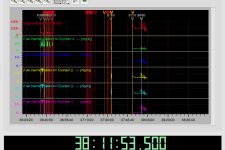
You can take a look at the screenshot I have here to see the injector mass during this event. The way I have this setup is so it will show you injector 4 for Lane A at the top in green. Below that is the injector mass for all 4 cylinders, in order, for lane B with cylinder 4 lane B at the very bottom in magenta. Notice that the injector identified is showing zero mass for a short period of time then the graph jumps up and looks more like the others. You can also see that there is some discrepancy on Lane A cylinder 4, but it was at least flowing. That jump with the injector 4 lane B is probably when you cycled the lane and it came back.
 

Attachments

  • Screenshot 2025-10-22 at 5.11.23 PM.png
    Screenshot 2025-10-22 at 5.11.23 PM.png
    505.4 KB · Views: 55
Last edited:
You can take a look at the screenshot I have here to see the injector mass during this event. The way I have this setup is so it will show you injector 4 for Lane A at the top in green. Below that is the injector mass for all 4 cylinders, in order, for lane B with cylinder 4 lane B at the very bottom in magenta. Notice that the injector identified is showing zero mass for a short period of time then the graph jumps up and looks more like the others. You can also see that there is some discrepancy on Lane A cylinder 4, but it was at least flowing. That jump with the injector 4 lane B is probably when you cycled the lane and it came back.

That comment about lane B coming up when you cycled was throwing out an 'educated guess' while I was digging through the log and had a number of ideas and questions floating around in my head. It's just what stood out to me based on your action report and video comments. Looking at it with fresh eyes this morning I realized I was looking past a more obvious correlation, the injector mass on #4 came alive as you increased RPM. This doesn't really change much in terms of what I would recommended, just a different turn on the path to getting there. Double check the electrical and rail connections to injectors #4 and run the engine some more and see if things change. Now that you are up and running, if you're ambitious enough you could also move injectors around and see if the problem moves with them. That's something to consider if this injector thing 'sticks' around.
 
Last edited:
That comment about lane B coming up when you cycled was throwing out an 'educated guess' while I was digging through the log and had a number of ideas and questions floating around in my head. It's just what stood out to me based on your action report and video comments. Looking at it with fresh eyes this morning I realized I was looking past a more obvious correlation, the injector mass on #4 came alive as you increased RPM. This doesn't really change much in terms of what I would recommended, just a different turn on the path to getting there. Double check the electrical and rail connections to injectors #4 and run the engine some more and see if things change. Now that you are up and running, if you're ambitious enough you could also move injectors around and see if the problem moves with them. That's something to consider if this injector thing 'sticks' around.
Question: if I move an injector around, am I still required to put new O Rings on?
 
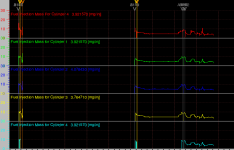
Doc pointed out that the scale for Lane A #4 was off which was making it a poor comparison to the risk. This is a good catch. The BUDS software defaults to autoscaling and it does it based on cursor location (a particular engine cycle) when you are choosing the parameters to display. This means if a the selected cycle was when 4 was firing and the others were lower it's going to get a Y axis that allows for a higher value. Below is the normalized version. This graph does not show engine speed in order to simplify.

What you see is Lane B number 4 injector mass of 0 until the RPMs are increased.

Screenshot 2025-10-23 at 10.59.12 AM.png
 
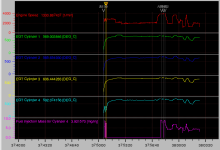
I wanted to also include another graph for anyone following along that may want to see EGT since it's commingled with the injector as far as the error code goes. Here you can see EGT for all 4 cylinders during these cycles, including cylinder 4. This serves as a good example of the redundant systems and lane architecture. The blinking lane B warning that Bob was viewing is explained in the documents as a condition where the ECU sees a problem, but the engine is making full power. #4 injector A was doing it's job even before lane B came back online.


Screenshot 2025-10-23 at 11.08.00 AM.png
 
Great explanation Nate. Guess I'll have to finagle my way into a Diagnosis class to get the software.
 
And Josh of JoshAir 😉
Right. That's someone that really knows something. I feel like I'm learning along with everyone else, maybe just a little bit further down the rabbit hole than others. What we have in common is the guts to lay it all out for criticism, Bob with his transparency with the problems and the data and the rest of us muddling through ideas to gets things squared away.

I'm just glad to be part of the team.
 
We all learn everyday. I think this thread though does point out how much of a bird of a different feather the Rotax engines are and how "smart" the 9 injected series is. The engineering and precision they are made with boggles my mind sometimes. Glad that DR keeps this community up and running because there are a lot of very helpful smart and experienced folks here. -JJR
 
One step back time:

My Rotax A&P came over last night to check the lifters to conclude the oil purge process, so we ran up the Rotax 912iS using Van's "engine check" procedure in its Production Acceptance Procedures, eventually bringing the oil to 130 and the RPM up to about 4,000.

He thought the fuel flow psi was a little lower than what he usually sees, even though it was in the green. And it was, in fact, lower than the fuel flow psi test per the PAP I had performed some months ago.

Subsequently, he downloaded the engine data and the only fault showing was "Cylinder 4 Injection Lane B" fail. This is consistent with data I downloaded on its previous engine check per the PAP last week.

He suggested I consult again with Dean at Lockwood (he hasn't responded to my previous email last week; this is one of the problems with being deaf and not being able to use the phone much) in order for the next steps. He recommends replacing the filters on the boost pumps and also opening the fuel pressure regulator and remove the offending injector(s) and, I suppose, sending it down to Lockwood for a more thorough cleaning than I was able to give it, apparently. He wonders why the injectors were clogged up to begin with, thus his recommendation on the filters.

My immediate question for Lockwood is whether I should just send all the injectors out or just the #4 cylinder?

I do not relish removing the fuel rail again (and the $200 in O Rings and parts to reinstall it) and I have some concerns about a possibly stripped bolt on the pressure regulator but we'll see.

It's not like the thing was going to be flying anytime soon, but I'll have to remove the interior carpeting etc and bulkhead cover I'd just installed in antcipation of weighing the airplane. Getting back there is tons of fun with bad knees.

So "recreation AND education" !!!!
 
Last edited:
One step back time:

My Rotax A&P came over last night to check the lifters to conclude the oil purge process, so we ran up the Rotax 912iS using Van's "engine check" procedure in its Production Acceptance Procedures, eventually bringing the oil to 130 and the RPM up to about 4,000.

He thought the fuel flow was a little lower than what he usually sees, even though it was in the green. And it was, in fact, lower than the fuel flow test per the PAP I had performed some months ago.

Subsequently, he downloaded the engine data and the only fault showing was "Cylinder 4 Injection Lane B" fail. This is consistent with data I downloaded on its previous engine check per the PAP last week.

He suggested I consult again with Dean at Lockwood (he hasn't responded to my previous email last week; this is one of the problems with being deaf and not being able to use the phone much) in order for the next steps. He recommends replacing the filters on the boost pumps and also opening the fuel pressure regulator and remove the offending injector(s) and, I suppose, sending it down to Lockwood for a more thorough cleaning than I was able to give it, apparently. He wonders why the injectors were clogged up to begin with, thus his recommendation on the filters.

My immediate question for Lockwood is whether I should just send all the injectors out or just the #4 cylinder?

I do not relish removing the fuel rail again (and the $200 in O Rings and parts to reinstall it) and I have some concerns about a possibly stripped bolt on the pressure regulator but we'll see.

It's not like the thing was going to be flying anytime soon, but I'll have to remove the interior carpeting etc and bulkhead cover I'd just installed in antcipation of weighing the airplane. Getting back there is tons of fun with bad knees.

So "recreation AND education" !!!!
Did you get Lane B flashing light? Are we sure your tech did not just see the prior fault because the data log was not erased/reset? Was the injector fault showing on health tab as red while engine running? All appropriate questions. If the fault is truly recurring, then yes the cylinder 4 injectors need to come out.

When you say fuel flow are you meaning pressure(psi) or flow(gph)? I don't understand the logic if its lower fuel flow as that varies with throttle position and I am not sure we have enough engine run time to figure out what flow is normal. Pressure on the other hand should go up if filter is clogged as the pressure transducer is on the line between pump and Rotax first filter. If filter is clogged to the point of bypass check valves opening you certainly should see high pressure. Again the fuel pressure regulator would effect pressure. The iS engines do not have a flow transducer per se, fuel flow is calculated from throttle position sensor and injection trigger counts by the ECU. The design of the system is each injector delivers a known quantity of fuel at a fixed pressure per trigger event. The fuel pressure regulator holds the fuel pressure in the rails at 43.5 psi +- 2.9 psi. Thus counting injector trigger pulses gives the flow rate.

To remove the pressure regulator is relatively easy, Coolant sensor is unplugged, pressure differential hose from airbox is unclamped and one end removed and then a snap ring holds the pressure regulator to the body and the regulator lifts straight up out of assembly. There is no serviceable parts in the regulator at the field level. So I am not sure what he means by "opening the fuel pressure regulator". See Heavy MM section 73-10-00 pg 13 in June-24 edition.

So I think further thought needs to go into this before fuel filter gymnastics are required. Nate any thoughts?
 
Did you get Lane B flashing light? Are we sure your tech did not just see the prior fault because the data log was not erased/reset? Was the injector fault showing on health tab as red while engine running? All appropriate questions. If the fault is truly recurring, then yes the cylinder 4 injectors need to come out.

When you say fuel flow are you meaning pressure(psi) or flow(gph)? I don't understand the logic if its lower fuel flow as that varies with throttle position and I am not sure we have enough engine run time to figure out what flow is normal. Pressure on the other hand should go up if filter is clogged as the pressure transducer is on the line between pump and Rotax first filter. If filter is clogged to the point of bypass check valves opening you certainly should see high pressure. Again the fuel pressure regulator would effect pressure. The iS engines do not have a flow transducer per se, fuel flow is calculated from throttle position sensor and injection trigger counts by the ECU. The design of the system is each injector delivers a known quantity of fuel at a fixed pressure per trigger event. The fuel pressure regulator holds the fuel pressure in the rails at 43.5 psi +- 2.9 psi. Thus counting injector trigger pulses gives the flow rate.

To remove the pressure regulator is relatively easy, Coolant sensor is unplugged, pressure differential hose from airbox is unclamped and one end removed and then a snap ring holds the pressure regulator to the body and the regulator lifts straight up out of assembly. There is no serviceable parts in the regulator at the field level. So I am not sure what he means by "opening the fuel pressure regulator". See Heavy MM section 73-10-00 pg 13 in June-24 edition.

So I think further thought needs to go into this before fuel filter gymnastics are required. Nate any thoughts?

We did not get any flashing light. I did see his fault list and the date matched but I will send you the log file later this afternoon for you to doublecheck. To my knowledge the health tab was fine but he didn't have the dongle attached during the engine run.

WRT fuel flow, I should have said fuel pressure. He is looking exclusively at the G3X. I am going to download the file out of there and see if I can see what he sees.

The only other concern he had is he thought the plane vibrated more than he's see on other 12's, but I reminded him the prop hasn't been balanced yet. Nonetheless, I will be doublechecking the prop pitch angle.

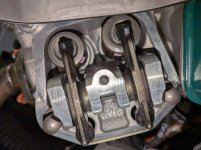
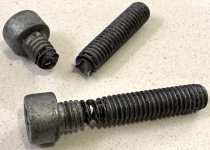
Oh, he overtorqued and broke the #2 valve cover bolt.
 
We did not get any flashing light. I did see his fault list and the date matched but I will send you the log file later this afternoon for you to doublecheck. To my knowledge the health tab was fine but he didn't have the dongle attached during the engine run.

WRT fuel flow, I should have said fuel pressure. He is looking exclusively at the G3X. I am going to download the file out of there and see if I can see what he sees.

The only other concern he had is he thought the plane vibrated more than he's see on other 12's, but I reminded him the prop hasn't been balanced yet. Nonetheless, I will be doublechecking the prop pitch angle.

Oh, he overtorqued and broke the #2 valve cover bolt.

The date of the log file is always going to be the date that it was extracted. From there, the reference is going to by cycles/engine time. It's easy enough for me to check for persistence of the warning for #4B if you want to send a new file. If you didn't have a flashing light on lane B, my guess is that you were seeing the old warnings.

I don't want to second guess a mechanic that has things right in front of him while I'm thousands of miles away on the internet, but I would have similar questions as Doc. Things don't exactly add up to there being a problem. What's described here is very subjective 'gut feeling' stuff, in contrast to data and ranges for things to either be in or out of spec. At least from where I'm sitting on the west coast, I do not see a reason to be taking things apart.

I'm also starting to get a little bit concerned or fatigued with the 'call Dean' strategy becoming a default answer to anything Rotax. I know that Lockwood is the most experienced and knowledgable Rotax shop in the US, but there's a long term problem developing if that's the answer to everything. That's a different rabbit hole and subject for another day. The point is that you have someone who can't point to a specific problem, telling you to call someone else and ask them how to solve it.
 
Very very low run time. Valve cover pulled off for lifter check per purge procedure and repair person snapped valve cover screw off. Then left.... Bob can't seem to catch a break.
Oh yeah, I remember reading that now. Bob has definitely had his share that’s for sure.
 
If that doesn’t work, you might try soaking it with penetrating oil and using a left-hand drill bit for a screw extractor. If there’s enough penetrating oil, the screw may back out with the left-hand bit alone.
 
If that doesn’t work, you might try soaking it with penetrating oil and using a left-hand drill bit for a screw extractor. If there’s enough penetrating oil, the screw may back out with the left-hand bit alone.
This -

Why? Because boogering up the top of the screw will make it more difficult to get a center punched starting point for the left handed drill bit , if the bit doesn't happen when drilling then use the easy out. Be sure the drill is a little smaller than the drill for tapping a new hole. This will give some error margin for straightness and centering of the hole. Breaking a bolt sounds . . . .unprofessional . . but could be one of several root causes unrelated to the mechanic.
 
The screw shouldn't be under tension, unless it hit bottom or was hydrolocked. I've had good luck, tapping the edge with a sharp punch. They usually rotate easily.
 
You should be able to back the screw out by using an awl or small prick punch and very lightly tapping the outer edge of the screw in a counter-clockwise direction, provided it wasn't cross threaded or installed with loctite.
The boys at the EAA Chapter said it probably wasn't under any tension and suggested that. But first I was able to grab a bit of the broken part with the tip of needle nose pliers and it spun easily and I was able to get it out lickity split.

I've ordered 4 new screws. I don't trust that the other three weren't similarly reinstalled or deficient so I'm going to replace them all.
 
Last edited:
Oh, he overtorqued and broke the #2 valve cover bolt.
Make sure you're working from the most recent documentation. I ended up breaking a few of these because I was referring to a printed version of the MMH that I had at the hangar. My printed version listed 12 Nm, while the most recent documentation has lowered this to 10 Nm.

I was told, at one point they switched to a higher quality bolt that allowed them to increase the torque spec. Unfortunately, this didn't account for bolts already out in the field. Once people started breaking bolts, they changed it back to the more conservative 10 Nm.

The newer, higher quality bolts are bright silver. The older bolts have a dull finish.
 
Make sure you're working from the most recent documentation. I ended up breaking a few of these because I was referring to a printed version of the MMH that I had at the hangar. My printed version listed 12 Nm, while the most recent documentation has lowered this to 10 Nm.

I was told, at one point they switched to a higher quality bolt that allowed them to increase the torque spec. Unfortunately, this didn't account for bolts already out in the field. Once people started breaking bolts, they changed it back to the more conservative 10 Nm.

The newer, higher quality bolts are bright silver. The older bolts have a dull finish.

Mine that was built about a year ago and it has dull bolts on the valve covers. Bright bolts on most other things.
 
Id agree with others in regards to the fault log showing a bad injector. Id say that when you switch on Lane A and B before engine start, both Lanes conduct basic continuity and heath checks for around 3 seconds. That's why you have to wait for the lights to extinguish before turning the key. The fault log will store ancient faults and may not represent the current state of your bird.

If the lights extinguish, then the engine is good to go... well technically its AT LEAST good enough to attempt a start! From an electrical/sensor perspective. If, after engine start or during engine start, the lights come back on or the engine fails to start and the lights come on, then and only then do you once again have a fault. If you have rectified the problems (servicing your injectors) and are running the engine without any Lane lights, then i agree that the old girl is good to go! Proceed with the next PAP checklist!

With respect to the the fuel pressure issue. You have to trust that (assuming the limits and ranges are programmed according to Vans/Rotax) "in the green" means in the green! In the Navy we'd shut the plane down and restart or shutdown systems and restart a dozen times until we were "in the green". once we were good it was time to rock and roll until we were out of the green again.

Unsolicited wisdom: As much as Vans has tried to make this process and every aircraft an exact factory production replica, EVERY SINGLE PLANE IS SLIGHTLY DIFFERENT. That goes for big wing Boeing and Airbus. Each plane has slightly different personalities and quirks. As the builder youll learn them, trouble shoot them, and figure out whats serious, and whats just a quirk. After a long enough time you run out of things to fix. Its all part of the journey brotha!
 
It's over! The nightmare is over. There was still some confusion in my mind about which ECU fault indicators went with which engine test, so I cleared out all the logs. I replaced two of the valve cover bolts and O-rings from the overtorquing episode because I didn't trust them, buttoned everything up, put the bottom cowl back on, attached all hoses and wheeled it out for a test.

It started smoothly with the ECU showing no warnings.


I have to figure out why Alt Amps is 0. Still a lot I need to learn about what's happening under the hood

I had only chocked the wheels so when I gave it takeoff power per the PAP, she jumped the chocks. So we taxiied down to the end of the lane and back. It also squished the chocks. Whoops. Those were pricey!

Let's review the number of people who made this happen and marvel anew at the kindness of the RV community.

The cast in the order of appearance in this drama:

Tony Kirk - Who called almost immediately back when the initial issue was the fuel leak at the bulkhead fitting, the only OTHER RV-12 builder I know who has actually replaced the line. You know, if those injectors hadn't been clogged, if that engine hadn't been obviously sick, it would've taken me a lot longer to find that fuel leak, perhaps with disastrous results. There were multiple conversations which no doubt delayed Tony in completed his aircraft. Tony will be my DAR next spring, I hope. Tony, by the way, offered to fly from Toledo to South St. Paul to do the work for me.

Pete Howell and his friend, Bill (I don't know his last name) - Again, typically, Pete was proactive in reaching out with an offer to fly over and help remove everything you need to remove to get at that fuel line. By then, I'd lost too much blood to continue. He later made another appearance to help reinstall the fuel tank.


Tony Scaglione - A major player in this. Came to my rescue early with ideas and contact information. Tony has been a handholder for me over the years. First ballot HOFer

Lockwood Aviation - Gave me some quick assurance that it wasn't unusual that all for injectors would be clogged on only one side of the engine (then ghosted me for the rest of the endeavor, unfortunately)

My wife, who kept my spirits up. During this debacle, we celebrated or 43rd anniversary.

John Melchert - Though he was knee deep in condition inspections, he took time to come try to talk to the ECU (which wouldn't talk because wires were reversed in the connector). He assisted in the lifter check and ECU log interpretation.

Multiple VAF/FB regulars - Helped identify why the ECU wasn't talking to BUDS.

Nate Holderbein, Bob Mowry, John Russell, and Rob Carsey - These were the big heroes of this. I'm not sure who started the conversation among them but I got multiple messages about the need for a dongle and Bob's was located. He sent it to me and helped with understanding the BUDS software. John Russell called me to talk me in off the ledge. One of these guys pulled Nate into the mix who agreed to analyze the data. Between the four of them I had everything I'd need to see likely culprits and they all just got together on their own to organize the relief effort. Nate and John spent countless amounts of time patiently exploring what the data was saying and although I didn't always understand what they were saying to each other, they were getting me where I needed to go without judgement. Dr. Russell, by the way, offered to drive up from Missouri to help me out. (I should add that I had a number of DMs on VAF offering to let me borrow a dongle.)

Josh Swenson - As indicated earlier, Josh saw the thread and on his own contacted me and practically insisted on letting him come to the hangar and check out the harness, which he did on a day his kid was sick, his wife couldn't take time off, and his dad was in a dentist's chair. Dad fled the dentist to stay with Josh's kid so Josh could come help.

Mark Shanahan - EAA Chapter 54 (Lake Elmo, MN) - a recent light sport training graduate helped me identify engine components and remove as necessary. The gang at Chapter 54 steadied me as I faced the broken bolt situation. Join your local EAA chapter.

All the VAFers on this thread.

Brantel, who solved, upstream on this thread, a nuisance headphone short warning on the G3X that cropped up in the middle of trying to solve a larger problem.

I know I am leaving someone out and I will edit as necessary to keep this updated for all of these folks' RV Hall of Fame induction ceremonies.

I feel truly blessed to be in the RV community still.

Now to the question, am I keeping or selling? I don't know. Functionally, I'm confident in the plane's ability and performance. The only problem I had yesterday is difficulty hearing someone on the radio. My deafness (Meniere's) remains a concern with regard to pilot performance. I have to evaluate whether I've aged out. I'll have a few months to do that now with knee replacement next week.

"Thank you" is remarkably insufficient to all of you, but "thank you."

Now, on to knee surgery!
 
Last edited:
Great news ! And congrats ! Good to hear this Saturday morning as I’m slowly getting ready to head to the hangar.

Have been following this saga, and impressed (but not surprised) by knowledge and helpfulness along the way.

Best of luck with knee and sorting way forward
 
"Congratulations. I’m on the other side of the ocean and still waiting for my '12' kit to arrive. I read this forum all the time. I saw the issues with the fuel line, and then this thread—with its tragic title—hit me hard. I saw how the community tried to help. Every time I saw a new post in that thread, I opened it with fear, thinking to myself, 'No, he didn’t give up, did he? Oh, it’s just new advice from the community.' And every time I closed the forum, I told myself (or maybe you), 'Hey man, don’t give up. You’ll make it. You’ve come such a long way, everything’s going to be fine.' I wish I had enough expertise to help or offer advice, but I really wanted everything to work out—and we all did. Thank you for your patience, and thanks to everyone else for your help!"
 
Back
Top