Van's Air Force

The definitive Van's Aircraft support community! Buying, building or flying an RV? Join our exclusive family of mentors and enthusiasts!

Ray Allen POS 12 Flap sensor. What does it really read?

claycookiemonster

Well Known Member
There's a lot of dimensionality (word?) in trying to get this little sucker to read correctly and not exceed the limits of the sensor. I'm not discussing the various FPS switches, only the flap position reading via the Ray Allen sensor.

Given that I'm attempting to get a reading on a rotary motion (the flap actuator weldment) via a linear switch, there doesn't seem to be any expectation that the switch will accurately read flap position at every part of it's extension range.

If I can get a valid reading at full UP and full DOWN, is that all I can expect? For example, 10% extension of the flap actuator will likely NOT extend the POS 12 switch 10% from fully UP. I doubt that 50% flap extension will extend the POS switch 50%.

Seems like a lot of work to get an UP or DOWN indication on the EFIS when I can just look out the window to confirm. Am I missing something?
 
My EFIS has the ability to calibrate each individual flap position, so the actual degree of travel of the sensor is more or less irrelevant as long as there is some measurable voltage change. Maybe yours is the same?
 
Seems like a lot of work to get an UP or DOWN indication on the EFIS when I can just look out the window to confirm. Am I missing something?

That’s pretty much the way I have always seen it with the RV’s - we have tape markings on the flaps of our three RV’s to show us intermediate flap positions - but the truth is, we generally fly with the flaps up or all the way down. It’s very rare when I want partial flaps - we drop to landing flaps at Low Key, and keep it simple. I have never found a reason to use increments of flaps on downwind, base, final - it just creates busy work.

If I want a small amount of flaps for take-off, I can always match them to the aileron deflection…by looking out of the canopy.

All that said, I am going to incorporate the Flap Position Sensor on the RV-8 in the next couple of months to install an AoA system (for testing) that wants to know flap position with more resolution that just the “up” or “down” I now have with a micro switch (which is actually a “flaps up/flaps not up” switch). You’re right that it is not going to match the flap position perfectly because of putting a linear sensor on a rotary motion - but that is so deep into the noise that its not going to make any real-world difference.

If you’re not integrating flap position into AoA….look out the window….
 
I have installed several POS-12 position indicators for both Garmin and Dynon /AFS. The POS-12 can be calibrated to display flap position on the EFIS, additionally this input also will turn the black AOA "donut" green indicating flaps are extended. The Dynon AOA calibration unlike Garmin requires calibration with both flaps up and flaps down. Both systems turn the black donut green with flaps extended. The Garmin calibration is performed with flaps up only. Does the Garmin NEED this input for proper operation of the AOA? The POS-12 I have used has 1.5" of travel, and can be installed in a variety of locations. These units do not tolerate over extension and if not careful you will break it. Full travel is not necessary to obtain a good calibration.
 
On the VP-X you simply calibrate the reading of the POS with a set point of degrees. The POS-12 is just a variable resistor. Five volts go in, and somewhere between 0V and 5V comes back from the sensor depending on position. The VP-X divides this up into 8 bit accuracy (0-255), so at full flaps, you might be seeing something like 235, and at zero flaps something like 12.
 
As others have said, most efis units can be calibrated to change ‘volts’ into ‘flap position’. I went one step further: I fly a -10, where the first two flap settings (full up (reflex), or in trail) are only 3 deg apart in rotation. I mounted the sensor on the flap actuator shaft and some structure with a hinge, to accommodate the rotary to linear motion. If you think about it you will see that one orientation will maximize the linear motion for each deg of rotation. I set the sensor up so that happens in the reflex to in-trail position. My GRT has no trouble distinguishing between the two.
 
What I have on my -4

I have the Ray Allen indicator (old wire type not LED) and electric flaps. In hind ight, I would have left it off, as I seldom look at it , but its fairly accurate. In the RV, flaps are just easy to see out the bubble and the lines on the LE trick are just fine. My typical flight profile doesnt even use mid positions..they are up, or they are down. I have my buttons on the stick, and abeam the numbers I usually roll them to full. For short field take off, I match the flaps to a full down aileron. Staring at an indicator is way to much time inside the aircraft...If you haven't flown your -8 yet, you will find out when you do. Just my 2 cents.
 
I am looking at the Ray Allen POS-12 sender unit only as a way to feed my Alpha AOA, so my AOA is still accurate in flaps configuration. I am installing an MVP50P, and I have the option of adding a flap position indicator in that very flexible beast, but I don't think I will bother. I am very fine with a glance out the window, and my use case for the flaps basically matches what fixnflyguy described, with the one exception of 10-15 degrees of flaps to lower the nose when flying very slowly.
Has anyone used the POS-12 with the to feed an Alpha AOA? Forgive me if this was already covered.

 
In simple terms, it is a sliding potentiometer. You put 5v on one end, and ground on the other, and you read a change in voltage on the slider. That is how it works.

Now, the EFIS engine monitor is calibrated to the sensor output voltage to display position of the flap, trim servo, etc, to show up, down and any position in between. Depending on how it is mounted, 5 volts might be up, and zero volts might be full down, and 3 volts might be 50%, or the other way around. It really doesn’t matter, just that you calibrate the system to your sensor, and position.

In simple term, it is a volt meter, using voltage to display a position.
 
I have installed several POS-12 position indicators for both Garmin and Dynon /AFS. The POS-12 can be calibrated to display flap position on the EFIS, additionally this input also will turn the black AOA "donut" green indicating flaps are extended. The Dynon AOA calibration unlike Garmin requires calibration with both flaps up and flaps down. Both systems turn the black donut green with flaps extended. The Garmin calibration is performed with flaps up only. Does the Garmin NEED this input for proper operation of the AOA? The POS-12 I have used has 1.5" of travel, and can be installed in a variety of locations. These units do not tolerate over extension and if not careful you will break it. Full travel is not necessary to obtain a good calibration.
FYI, the POS-12 sensor has only 1.2" of travel, hence the 12 in the part number. It is possible that it travels 1.5, but won't measure in that large of a range.
 
FYI, the POS-12 sensor has only 1.2" of travel, hence the 12 in the part number. It is possible that it travels 1.5, but won't measure in that large of a range.
Got it. So the custom mount and connecting linkage need to be clever enough to translate 0-40 degrees to 1.2" of travel, right?
 
Got it. So the custom mount and connecting linkage need to be clever enough to translate 0-40 degrees to 1.2" of travel, right?
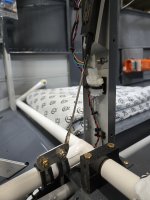
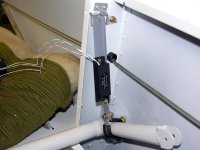
You don't have to get too complicated or clever. I just eyeballed the angle for the sensor and then played around with the length of the linkage and the location on the flap arm until my full up/down flap movement landed within the sensor's range of travel. Not the greatest picture, but the only one I can grab at the moment:

1760467538301.jpeg
 
Got it. So the custom mount and connecting linkage need to be clever enough to translate 0-40 degrees to 1.2" of travel, right?
correct. you just tweak the length of the connection point relative to the pivot point on the lever to translate 40* of rotation into 1.2" of linear travel. pic above is relatively typical for 2 seaters.
 
You don't have to get too complicated or clever. I just eyeballed the angle for the sensor and then played around with the length of the linkage and the location on the flap arm until my full up/down flap movement landed within the sensor's range of travel. Not the greatest picture, but the only one I can grab at the moment:

View attachment 99501
Enough of these things have been done now that the engineering is clear. I made one like this many years ago (-7). Key points: the sensor should be mounted to point to the pivoting attachment. Second is the pivoting point is located over that welded scarf joint of the flap tube to keep the travel within range, it is about 1/4" over the weld towards the torque tube. Then slide the pivot and adjust the linkage to be within the limits. I drew this up on a drafting board. measured the rotating radius and then calculated the angle to linear movement. Since the rotation of the torque tube is only ~40 deg the linearity was amazingly close. The drawing and calculation sheets are filed in a secret-to-me location so not readily available.
 
Back
Top