Van's Air Force

The definitive Van's Aircraft support community! Buying, building or flying an RV? Join our exclusive family of mentors and enthusiasts!

The Baffling Paradox……

Ironflight

VAF Moderator / Line Boy
Mentor
While that sounds like a clever word play of a title, it is literally a truism - let me explain!

We all know that good engine cooling (generally determined by good control of Cylinder head Temps) is dependent on a baffle system that develops nice high pressure above the engine and that forces every molecule of air to go through the cylinder cooling fins. Not a molecule can be wasted! We spend hours (and hundreds of posts on threads….) describing how to search out even the tiniest air leak between baffles and the engine, we talk about perfect baffle seal “sealing” against the upper cowl. And we build carefully-sealed plenums to guide every molecule down through the engine.

Then…we cut this HUGE honkin’’ hole in the back of the baffle to direct air to the oil cooler instead of going through the cylinder fins! This, my friends, is the paradox. Save every little bit of air so that we can then waste great gobs of it through a 3” x 3” (or often much larger!) hole to go through the fins on the oil cooler. OK - it’s not wasted….its cooling the oil. But very little science is given behind just how much air should be routed through the cooler instead of the cylinder fins.

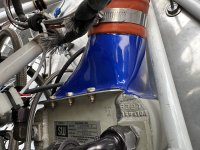
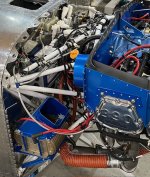
This thought occurred to me as I was flying the airline back from a Minnesota speaking engagement yesterday, because I am about to mount this monster 15-row oil cooler in the F1…somewhere….and am trying to decide if I am going to go with a round 4” flange/duct or build an aluminum (or maybe fiberglass) duct to come straight off the back of baffles behind the #5 cylinder. I’ve seen it done both ways. In all our four-banger RV’s, we have had excellent results direct-mounting the 7-row cooler directly to the back of #4, and in our Tundra, we used an RV-10 cooler and mount with the IO-360 (because it’s a slow airplane….) and have always had trouble getting the oil temp up without a big piece of aluminum blocking much of the flow.

So anyone got any science or engineering they have done to determine the required opening in the baffle to get good oil cooling and not waste those precious molecules used to cool the cylinders?

Paul
 
While that sounds like a clever word play of a title, it is literally a truism - let me explain!

We all know that good engine cooling (generally determined by good control of Cylinder head Temps) is dependent on a baffle system that develops nice high pressure above the engine and that forces every molecule of air to go through the cylinder cooling fins. Not a molecule can be wasted! We spend hours (and hundreds of posts on threads….) describing how to search out even the tiniest air leak between baffles and the engine, we talk about perfect baffle seal “sealing” against the upper cowl. And we build carefully-sealed plenums to guide every molecule down through the engine.

Then…we cut this HUGE honkin’’ hole in the back of the baffle to direct air to the oil cooler instead of going through the cylinder fins! This, my friends, is the paradox. Save every little bit of air so that we can then waste great gobs of it through a 3” x 3” (or often much larger!) hole to go through the fins on the oil cooler. OK - it’s not wasted….its cooling the oil. But very little science is given behind just how much air should be routed through the cooler instead of the cylinder fins.

This thought occurred to me as I was flying the airline back from. Minnesota speaking engagement yesterday, because I am about to mount this monster 15-row oil cooler in the F1…somewhere….and am trying to decide if I am going to go with a round 4” flange/duct or build an aluminum (or maybe fiberglass) duct to come straight off the back of baffles behind the #5 cylinder. I’ve seen it done both ways. In all our four-banger RV’s, we have had excellent results direct-mounting the 7-row cooler directly to the back of #4, and in our Tundra, we used an RV-10 cooler and mount with the O-360 (because it’s a slow airplane….) and have always had trouble getting the oil temp up without a big piece of aluminum blocking much of the flow.

So anyone got any science or engineering they have done to determine the required opening in the baffle to get good oil cooling and not waste those precious molecules used to cool the cylinders?

Paul
Just anecdotal but with my -10, I used the 0007X cooler in the stock location; it use a 4" duct off of the #6 baffle. I have the TCW butterfly valve installed.

In the Indiana summer when temps are 90+ degrees, the TCW valve is wide open for WOT climb to around 8000'. Oil temps never get much above 190. Stting up for cruise, I can close the valve to between 25% and 50% to keep the oil temp at 190.

In the winter, when temps are down near or below freezing, I usually leave the valve at around 75% for climb, closing it down during the climb to maybe 20%. This keeps the temp around 190.

The only time I have had temps above 215 was when I was during continuous touch and goes in the pattern with a couple of 172s (matching their speed). An extended downwind letting the airspeed build to 135 takes care of the temp.

I can tell you that there is a direct and proportional relationship between the #6 CHT and the position of the TCW valve. Open the valve and oil temp decreases while #6 CHT increases. Close the valve and the oil temp increases while the #6 CHT decreases. It really hasn't been a problem but the results are consistent and repeatable.
 
Just anecdotal but with my -10, I used the 0007X cooler in the stock location; it use a 4" duct off of the #6 baffle. I have the TCW butterfly valve installed.

In the Indiana summer when temps are 90+ degrees, the TCW valve is wide open for WOT climb to around 8000'. Oil temps never get much above 190. Stting up for cruise, I can close the valve to between 25% and 50% to keep the oil temp at 190.

In the winter, when temps are down near or below freezing, I usually leave the valve at around 75% for climb, closing it down during the climb to maybe 20%. This keeps the temp around 190.

The only time I have had temps above 215 was when I was during continuous touch and goes in the pattern with a couple of 172s (matching their speed). An extended downwind letting the airspeed build to 135 takes care of the temp.

I can tell you that there is a direct and proportional relationship between the #6 CHT and the position of the TCW valve. Open the valve and oil temp decreases while #6 CHT increases. Close the valve and the oil temp increases while the #6 CHT decreases. It really hasn't been a problem but the results are consistent and repeatable.
This is a logical outcome, but does not match what we were taught that the flow past the fins is based upon a pressure delta. If that was what was actually happening, it would seem that all of the chts should be affected in the above example, as the diverted air should have lowered the upper pressure and / or increased the lower pressure . So if we take the above example as reflective, there has to be a component of velocity or ram air involved, as the only cyl where cooling flow is reduced is the one next to the area where air is diverted away. Possibly the area around the 4” hole has a localized reduced pressure not seen in other parts of the cowl. I didn’t think it worked that way, but not an aero engineer or physicist.
 
Last edited:
.... I’ve seen it done both ways. In all our four-banger RV’s, we have had excellent results direct-mounting the 7-row cooler directly to the back of #4, and in our Tundra, we used an RV-10 cooler and mount with the O-360 (because it’s a slow airplane….) and have always had trouble getting the oil temp up without a big piece of aluminum blocking much of the flow....
Something you already know but I'll regurgitate anyway. It's not about available pressure, it's about available delta P. Sounds like the "remote" cooler is in an area with a lower back pressure. Within reason, I'll take that condition any day versus the opposite. I assume you're trying to stay away from any flow control type of device? Experimenting with cooler location would be painful.

Another F1 desert rat here, @Toobulider, is a big viscosity valve proponent. Could be a viable option for you.
 
Just anecdotal but with my -10, I used the 0007X cooler in the stock location; it use a 4" duct off of the #6 baffle. I have the TCW butterfly valve installed.

In the Indiana summer when temps are 90+ degrees, the TCW valve is wide open for WOT climb to around 8000'. Oil temps never get much above 190. Stting up for cruise, I can close the valve to between 25% and 50% to keep the oil temp at 190.

In the winter, when temps are down near or below freezing, I usually leave the valve at around 75% for climb, closing it down during the climb to maybe 20%. This keeps the temp around 190.

The only time I have had temps above 215 was when I was during continuous touch and goes in the pattern with a couple of 172s (matching their speed). An extended downwind letting the airspeed build to 135 takes care of the temp.

I can tell you that there is a direct and proportional relationship between the #6 CHT and the position of the TCW valve. Open the valve and oil temp decreases while #6 CHT increases. Close the valve and the oil temp increases while the #6 CHT decreases. It really hasn't been a problem but the results are consistent and repeatable.
Cool idea!

Some of the Red Bull Air racers did similar. They would run wide open mixture when staged for the track to get as cool as possible. Then when they entered the track they would use an actuated block off that would reduce the cowling inlet size down to the minimum possible to reduce drag. They offset the cooling as much as possible by spraying water on the external surfaces of the engine during the track run. They weren't allowed to spray in the engine inlets by the rules, but the gray area definitely existed with those spraying on the engine. Crazy that one letter changes the intent so significantly; on versus in. Those teams aimed to be as near as possible to the temperature limits at the end of their run; that was their way of ensuring they reduced their cooling to the maximum amount possible to decrease drag.

To contribute because this is a fun thought. It also matters what engine you decide your using as it drastically changes the requirements for heat rejection through the oil. Most of the angle valve engines have piston squirts, whilst only some of the parallels do. If those squirts are installed, the oil picks up a lot more heat that you have to find a nice cool fined home for. So your theoretical size of the tube would have to be bigger for worst case scenarios. That is, of course, unless you do a variable set up like rocketman.

There's so many variables and some of it depends on what you prioritize with regards to goals. You can size cowling inlets and outlets so that it doesn't matter how big the cooler is, you'll be creating enough pressure for both the engine and the cooler. I think Patey's Scrappy is a good example of this. But that will cost you oh so precious airspeed in the form of drag. Even the Gamebird solution may reduce cooling through the engine because it increases the pressure below the engine, decreasing the delta P. Rocketman's solution offsets some of that, my only concern is that you have two systems trying to control the same variable; that could create a control system issue. Ideally you would want to have one or the other, the vernatherm or the air valve. As long as he can stay within limitations though, it is a cool idea.
 
Doesn't good oil cooling = lower CHTs?

My read of things is that it is important to create the right path of flow, the right pressure gradient. High pressure upper, low pressure down low.
 
The Game Bird Design works extremely well for its intended purpose. Probably too much flow for a speed plane but for ACRO it’s perfect.

On my 8 (built for speed ) I used a 17 row cooler behind #3 . Mounted on a firewall mount
IMG_7032.jpeg
 
Hey Paul- I think that unfortunately there isn't going to be a one size fits all answer.

Does your engine have piston oil squirters? My experience so far with my squirter equipped 390 has been that I need as much air through the cooler as possible and the CHT's will take care of themselves.
 
15 Row!? 17 Row!!??!? Yikes...

My IO-360-A1B6 (Angle Valve, Squirter Equipped) is "getting by" with a 3" SCEET Duct & 6" diffuser feeding a SW 10599R (8 row) -- Of course it's a bar & plate design...

Cruise temps are right at the Vernatherm closing point -- 86°C (187°F) w/OAT's in the 20°Cs range.

 
The Game Bird Design works extremely well for its intended purpose. Probably too much flow for a speed plane but for ACRO it’s perfect.

On my 8 (built for speed ) I used a 17 row cooler behind #3 . Mounted on a firewall mount
View attachment 98918
Holy cow... That cooler must make other coolers feel... inadequate. I don't think I've ever seen one that large, even big turbos usually aren't that big. Do you ever fly in real cold weather? I'm curious if you see any gelling especially on the bottom side of that cooler.
 
Watching this with great interest. Thanks for posting the question.

Rocketmann's setup works for his RV10 but for some reason, it does not work the same for my 10. As far as I remember in my conversation with him, our installation are the same, minus the valve.

RV14 has a 5" duct from the rear of the baffle to a firewall mounted cooler. I spoke with one RV14 guy and he told me he has oil cooling issues. Did not get a chance to dig into details.

It is all a mystery to me!
 
So anyone got any science or engineering they have done to determine the required opening in the baffle to get good oil cooling and not waste those precious molecules used to cool the cylinders?

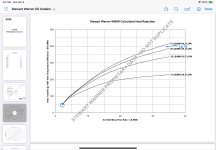
There is good Stewart Warner cooler data: https://www.danhorton.net/Misc/SW Oil Cooler Specifications.pdf

However, the available deltaP for the particular airframe/cowl combination is usually unknown, so in the end the best approach to ducting is probably iterative. And then we get to detail design. Consider a single factor, the duct inlet. A nicely radiused inlet will flow more than a sharp edged inlet of the same tube diameter.

BTW, the molecules into the oil cooler are not a free-flowing waste. There is a pressure drop across the cooler fins, just like the cylinder fins with wraps. If it helps conceptually, think of the cooler as a seventh cylinder.
 
There is good Stewart Warner cooler data: https://www.danhorton.net/Misc/SW Oil Cooler Specifications.pdf

However, the available deltaP for the particular airframe/cowl combination is usually unknown, so in the end the best approach to ducting is probably iterative. And then we get to detail design. Consider a single factor, the duct inlet. A nicely radiused inlet will flow more than a sharp edged inlet of the same tube diameter.

BTW, the molecules into the oil cooler are not a free-flowing waste. There is a pressure drop across the cooler fins, just like the cylinder fins with wraps. If it helps conceptually, think of the cooler as a seventh cylinder.

I’ve been staring at this chart all morning hoping you would chime in.
The y axis shows heat transfer in BTU/min with a 100F delta T. Does that mean the cooler will maintain a 100F delta with 5 lb/min of flow?
Is the flow through the cooler the 8gpm total flow?
 

Attachments

  • IMG_0583.jpeg
    IMG_0583.jpeg
    369.7 KB · Views: 26
The 100F difference refers to oil temperature being 100 more than air temperature. Oil mass at 2400 would be about 45 lbs/min, so draw your own curve between the 35 and 55 curves and then project up from the air mass flow rate (obtained from another chart) to find the BTUs rejected.

It's been quite a while, but I seem to remember a decent Kitplanes article in which the author sized a cooler by calculation.
 
Last edited:
Hey Dan:
In your research did you look at having a variable inlet? It sounds complicated and probably not easy to execute, but I’m curious.
 
The 100F difference refers to oil temperature being 100 more than air temperature. Oil mass at 2400 would be about 45 lbs/min, so draw your own curve between the 35 and 55 curves and then project up from the air mass flow rate (obtained from another chart) to find the BTUs rejected.

It's been quite a while, but I seem to remember a decent Kitplanes article in which the author sized a cooler by calculation.


A WAG But a 45 lb/min flow, .5 btu/lb-f specific heat, 100f temperature difference suggests a 2250 btu/min heat rejection. The chart says 350.
What is the temperature difference of the oil cooler output-input?
 
Last edited:
2250 might be true if the cooler could reduce the oil temperature 100 degrees between the inlet port and the outlet port.
 
2250 might be true if the cooler could reduce the oil temperature 100 degrees between the inlet port and the outlet port.

Have you ever measured the temp difference of the oil out-in?
Edit google says 10-30 degrees. At 15 it matches the SW data.
 
Last edited:
Hey Dan:
In your research did you look at having a variable inlet?
Nope.

Consider cooling drag = mass x loss of momentum.

Throttling either the inlet or the exit would reduce mass. But which one has higher exit velocity?
 
Preparing for my RV10 firewall front installation I did some back of the napkin calculations on the oil cooler inlet size. The benchmark was RV14 exp119 with IO390 and 5 inch "hole" in the baffling. The question: what size of "hole" would be needed for RV10 in order to achieve as good oil cooling capacity as in RV14.

Lycoming data give the oil flow and cooler capacity at maximum power.
For the IO-390, the full-flow oil cooler sees about 7.5 gallon/min (≈28.4 L/min) of oil and can reject up to 925 Btu/min of heat. Converting units, 925 Btu/min ≈ 16.3 kW.
For the IO-540, oil flow is about 9.5 gallon/min (≈36.0 L/min) and heat rejection ≤ 1800 Btu/min (≈31.7 kW).

In formula terms, with oil density ≈0.88 kg/L and specific heat ≈2.0 kJ/kg·K, a 7.5 gpm flow (≈0.42 kg/s) requires only ~20 K temperature drop to carry 16.3 kW (consistent with the IO-390 spec).
The 9.5 gpm flow (≈0.53 kg/s) needs roughly a 30 K drop to carry 31.7 kW (consistent with the IO-540 spec)
IO-390: Oil flow ≈7.5 gpm (28.4 L/min); heat removal ≤925 Btu/min ≈ 16.3 kW
IO-540: Oil flow ≈9.5 gpm (36.0 L/min); heat removal ≤1800 Btu/min ≈ 31.7 kW

These values assume oil around 100 °C and full-cooler flow. (Lycoming notes the cooler bypass closes around 85 °C, routing nearly all oil through the cooler at high power
IO-540 must remove ~94% more heat via its oil (nearly double) than the IO-390. Oil flow is also about 127% higher (9.5 vs 7.5 gpm). In other words, to handle full power the IO-540’s oil cooler must have roughly twice the capacity of the IO-390’s.

If the calculations are correct then the "hole" in the baffling of IO540 would need to be in the range 5,5 - 6 inches
 
Lycoming data give the oil flow and cooler capacity at maximum power.
For the IO-390, the full-flow oil cooler sees about 7.5 gallon/min (≈28.4 L/min) of oil and can reject up to 925 Btu/min of heat. Converting units, 925 Btu/min ≈ 16.3 kW.
For the IO-540, oil flow is about 9.5 gallon/min (≈36.0 L/min) and heat rejection ≤ 1800 Btu/min (≈31.7 kW).

Could you direct us to the source please?
 
for IO390:
"Oil flow through the cooler system will be approximately 7.5 gallons
per minute (28.4 liters minute) and heat rejection will not exceed 925 Btu per minute."
page 14,

for IO540:
"Oil flow through the cooler system will be approximately 9.5 gallons per minute (36.0 liters minute) and heat rejection will not
exceed 1800 Btu per minute.
page 14
 
Heat balance is the friendly, linear, equation in the heat xfer regime. Inside/outside film coefficients (both effected greatly by turbulation), fin efficiency , (logarithmic) mean temperature difference, etc. are needed to calculate the real heat transfer. Unless you know these, there's no real confidence that the air flow needs can be calculated. In fact, most would be surprised how little any changes in air flow will effect the overall heat xfer. Air sucks as a heat xfer medium but it's usually plentiful and free.
 
The fuel injected 260hp 540 on my Comanche has a front baffle floor mounted 9-row SW oil cooler, which one would think is undersized. There is a rigid aluminum structure bolted to the engine that the oil cooler is mounted to.

Oil temp never goes above 180. It perplexes me how well it works, despite being the same oil cooler used on O-320s and O-360s.

Seems like a forward mounted oil cooler can get more air flowing thru it, thus working efficiently despite the long hoses to/from the oil cooler.
 
These values assume oil around 100 °C and full-cooler flow. (Lycoming notes the cooler bypass closes around 85 °C, routing nearly all oil through the cooler at high power
IO-540 must remove ~94% more heat via its oil (nearly double) than the IO-390. Oil flow is also about 127% higher (9.5 vs 7.5 gpm). In other words, to handle full power the IO-540’s oil cooler must have roughly twice the capacity of the IO-390’s.

If the calculations are correct then the "hole" in the baffling of IO540 would need to be in the range 5,5 - 6 inches
The 390 uses piston squirters, so collects a LOT more heat via oil, compared to an engine without them. I don't think your logic that a PV 540 will produce more heat via oil than a 390 is sound. Lots of us using the stock cooler and setup with PV 540's and easilly keeping OT in line.
 
My engine will be a CAI thunderbolt IO-540. I've confirmed with Chris at Lycoming, that the engine would be equipped with piston squirters
Again, those are very simple calculations, based on simplistic assumptions
 
But probably not an -AG1A5.

Check me, but IIRC, many 540s use the same impellers as the 390, while others (like the AG1A5) use a larger pump.
Correct. The pump gears on the cold air Thunderbolt 540 for a Van's is the same as the 390. The flow would be the same at a given RPM.

Oil heating will be higher on any engine with piston squirts, though I don't have any specific experience with how piston squirts on a parallel head cylinder differs from an angle valve. So I don't know how the maximum BTU requirement quoted above would compare to the parallel engine vs the angle AG1A5. Remember the parallel, cold air, 10:1 engine was made originally for the Red Bull Air Race series, it's not a certified configuration. I can't point towards certified data that gives you that exact data point.
 
Lots of really good input here. Back to Paul's original question, How to determine how much air is really needed for a given installation.

My RV-8 has an angle-valve IO-360. It has a firewall mounted 20006A cooler, mounted to a plenum box rather similar to the Vans RV-10 mount. I originally supplied it with a 3.5" scat tube off of the #4 rear baffle. It was not quite enough air, as evidenced by 215--220F oil temps on a long climb on a hot day. (by long climb on a hot day, I mean sea level to 10,000 ft at Vy with temps in the 90F range on the ground.)

So I did two things. I increased the scat tube to 4", and I made a good diffuser adapter from the scat tube to the box that mounts the cooler.
Now the same long climb on hot days results in oil temp about 205F.

With both installations, oil temps would quickly drop to 180F once cruise flight was set up. So apparently the 3.5" scat tube with abrupt transition into the box was adequate flow for cruise conditions, but not quite enough for a hard climb. The 4" scat with good diffuser transition seems to be 'enough' air through the cooler.

Just one data point, but the idea is to build in some expansion capability and start out a little bit small. Or go the other way and follow the iterative approach DanH used in "the shrinking exit", i.e. start out big and slowly reduce the flow capacity until its not enough.

Thanks Brian (BJDecker) for posting the Kitplanes article. Really fun to see what they look like inside. If I get the chance, I would swap coolers.
 
Last edited:
could you post a photo of the diffuser please?
Here is one from Brian Decker:
Brian Decker's oil cooler diffuser.jpg


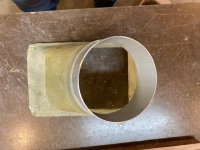
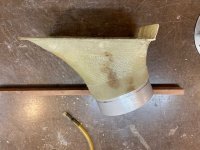
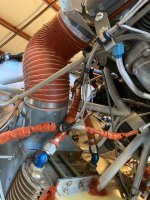
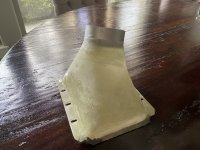
And here is mine, in a couple of views, plus installed (a little hard to see in there)

oil cooler diffuser:adapter_2.jpgoil cooler diffuser:adapter_1.jpgoil cooler install.jpg


Not visible in the installation picture is that there is a butterfly in the 4" flange duct on the back of the baffle, so I can restrict the oil cooler flow if I want.

I thought I was going to use Scott McDaniels' trick of using a 600x6 inner tube as a duct instead of scat, but it turned out to be a compound bend. Next time I will position the cooler better so that I can put a cooler exhaust channel down to the cowl exit so the oil cooler exit flow is isolated from the cowl lower plenum. This allows you to independently adjust the oil cooler exit duct area and the engine cooling exit area, as well as providing a lower local pressure at the exit of the oil cooler exhaust channel.
 
Last edited:
Steve,
Have you seen the Vans provided oil cooler diffuser they provide in the firewall forward kit for the 14? If so, do you have any thoughts on its performance compared to yours?
 
Steve,
Have you seen the Vans provided oil cooler diffuser they provide in the firewall forward kit for the 14? If so, do you have any thoughts on its performance compared to yours?
@RVbySDI

I think @DanH has a drawing of "The Optimal Shape (tm)" somewhere on VAF; it's ~7° or 9° from the longitudinal axis, which makes for a very long (relatively speaking) transition from round to rectangular.

The idea is to get all of the air in the SCEET/SCAT transitioned onto the rectangular "face" of the oil cooler without trips, burbles, eddys, etc. So, the longer the transition, the better.

Answering the original question a little more directly -- it's not great, but it's better than the old round-duct-into-a-box affair (https://www.aircraftspruce.com/catalog/eppages/coolerductsys.php) that some used...
 
You won’t know till it’s put to the test. My 7 had a plenum set close to the engine (IO360) and oil ran hot. My 8 has the plenum much higher and ran so cool I had to put a restrictor on the cooler. The only thing I can think of is Bernoulli’s principal was at work allowing the air to slow down and the higher pressure allowed the air to be pushed through the cooler more efficiently.

The 7 plenum was set close to the engine per instruction from Sam James. The original built did not have a plenum and oil temp was perfect. I added the plenum later and the oil temp was much hotter and required a larger cooler to bring the oil temp back down.

Just based on my experience, if you don’t have a plenum, it will ok with the plan design. YMMV. IF you have a plenum, how high you set it will influence efficiency of cooling oil ability.
 
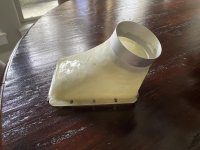
Here is a pic of the Vans RV14 oil cooler diffuser on the IO390 EXP 119.

IMG_7631.jpeg
 
Last edited:
Spend a little time making a nice diffuser. How-to here: https://www.vansairforce.net/threads/tip-small-fiberglass-parts.44856/

Maybe more than you want to know: https://www.danhorton.net/Articles/Diffusers.pdf

Dan,
I believe this is the article you refer to above. Cool Runnings - Kitplanes 2009 06 by Norm Ellis

That's the one.


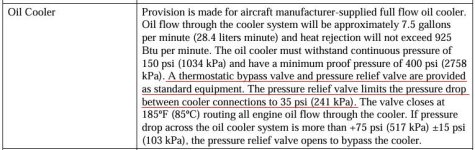
ScreenHunter_2960 Oct. 07 18.05.jpg

This sentence (above) is a bit curious: "A thermostatic bypass valve and pressure relief valve are provided as standard equipment." The thermostatic bypass valve is the vernatherm. However, a 35 psi relief valve across the cooler circuit would be an old school viscosity valve and spring, and best I know, they are not provided as standard equipment.

Chris, you there? Is the factory sneaking 62415's into 390C's?

BTW folks, if using the factory oil filter adapter, you can indeed run a plunger and a vernatherm at the same time.

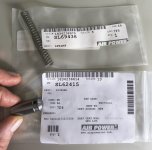
Part Numbers.jpg


The last two sentences again refer to the vernatherm. The respective Rosta specs are "Valve must close against seat between 183F and 187F", something we all know. Less known is "Cracking pressure to be 60 to 90 psi with oil temp at 195F", the purpose of the spring and sliding tip:

Vernatherm Spring.jpg
 
Spend a little time making a nice diffuser. How-to here: https://www.vansairforce.net/threads/tip-small-fiberglass-parts.44856/

Maybe more than you want to know: https://www.danhorton.net/Articles/Diffusers.pdf


That's the one.


View attachment 99084

This sentence (above) is a bit curious: "A thermostatic bypass valve and pressure relief valve are provided as standard equipment." The thermostatic bypass valve is the vernatherm. However, a 35 psi relief valve across the cooler circuit would be an old school viscosity valve and spring, and best I know, they are not provided as standard equipment.

Chris, you there? Is the factory sneaking 62415's into 390C's?

BTW folks, if using the factory oil filter adapter, you can indeed run a plunger and a vernatherm at the same time.

View attachment 99085


The last two sentences again refer to the vernatherm. The respective Rosta specs are "Valve must close against seat between 183F and 187F", something we all know. Less known is "Cracking pressure to be 60 to 90 psi with oil temp at 195F", the purpose of the spring and sliding tip:

View attachment 99078
Hey Dan,

Great question. I don't see that in the 390 data. Let me inquire more and see. I don't know of anywhere Lycoming uses the viscosity valve on the regular anymore. There may be some low running 235, 320, or something but most of the mainstream builds are the vernatherm only.

P.S. I'll try not to hold it against you that you bought SL parts! ;)
 
Spend a little time making a nice diffuser. How-to here: https://www.vansairforce.net/threads/tip-small-fiberglass-parts.44856/

Maybe more than you want to know: https://www.danhorton.net/Articles/Diffusers.pdf


That's the one.


View attachment 99084

This sentence (above) is a bit curious: "A thermostatic bypass valve and pressure relief valve are provided as standard equipment." The thermostatic bypass valve is the vernatherm. However, a 35 psi relief valve across the cooler circuit would be an old school viscosity valve and spring, and best I know, they are not provided as standard equipment.

Chris, you there? Is the factory sneaking 62415's into 390C's?

BTW folks, if using the factory oil filter adapter, you can indeed run a plunger and a vernatherm at the same time.

View attachment 99085


The last two sentences again refer to the vernatherm. The respective Rosta specs are "Valve must close against seat between 183F and 187F", something we all know. Less known is "Cracking pressure to be 60 to 90 psi with oil temp at 195F", the purpose of the spring and sliding tip:

View attachment 99078
Dan,

I confirmed that Lycoming doesn't look to have built a 390 with the visc valve installed. I think that answers your question. I also don't see anywhere where Lycoming installed both a visc valve and a vernatherm; only one or the other.

Hope that helps,
 
P.S. I'll try not to hold it against you that you bought SL parts! ;)

Those belong to a friend. Yeah, yeah, that's it, a friend...

I confirmed that Lycoming doesn't look to have built a 390 with the visc valve installed.

Didn't think so. Having the new guys write the manuals, are we? ;)

I also don't see anywhere where Lycoming installed both a visc valve and a vernatherm; only one or the other.

As noted previously, some of us are currently experimenting with running a viscosity valve and a vernatherm at the same time. Inserting a viscosity valve appears to be an excellent cross-check on vernatherm operation.

Caveat; Lycoming horizontal filter/vertical vernatherm adapter only. Can't run both at the same time if using any oil filter adapter with a horizontal vernatherm, all the 45 angle adapters for example.
 
Pubs are a tough job, one that I definitely do not want. Lycoming has been around for approaching 100 years and have thousands of pages of publications. The tech pubs are usually one of the last hurdles to certification and they are tasked with pulling all of the pertinent information from all the publications. They do a great job and I don't think this statement is technically wrong if a visc valve were installed. It just hasn't been.

So I understand you concept, are you using the dual install as a troubleshooting method or as a pseudo back-up to the vernatherm in case it fails? I'm not saying you should or shouldn't do it for either reason, just trying to understand. I subscribe to the Elon Musk, "The best part is no part" theory, and I don't see a ton of issues with vernatherms that would indicate you need a back-up for it. That's the reason I ask.

Since it's your friend, and I don't like him as much as you, I'll hold the SL parts against him; for sure. Tell him to support American made and American owned! ;)
 
Dan,
I believe this is the article you refer to above.

Cool Runnings - Kitplanes 2009 06 by Norm Ellis

Thanks for that. It has the clues you need to use the SW charts referenced earlier.

Thanks glider_rider for the oil flow and heat rejection data for the 540 and 390.

The author of the Kitplanes article shows the Lycoming data for the angle valve 360 too. 7 GPM, 750 BTU/min.

He used the Lycoming data with the SW chart and it indicated the largest cooler to achieve 190F oil in 80F air even with the 360.

I did it for the 540. Even with the10886A cooler the available cooling is not sufficient to reject 1800BTU at any reasonable temperature.

Something must be wrong with my assumptions
 
Thanks for that. It has the clues you need to use the SW charts referenced earlier.

Thanks glider_rider for the oil flow and heat rejection data for the 540 and 390.

The author of the Kitplanes article shows the Lycoming data for the angle valve 360 too. 7 GPM, 750 BTU/min.

He used the Lycoming data with the SW chart and it indicated the largest cooler to achieve 190F oil in 80F air even with the 360.

I did it for the 540. Even with the10886A cooler the available cooling is not sufficient to reject 1800BTU at any reasonable temperature.

Something must be wrong with my assumptions
You didn't have an NPT pipe plug jammed into one of the oil cooler AN fittings by any chance?
 
So I understand you concept, are you using the dual install as a troubleshooting method or as a pseudo back-up to the vernatherm in case it fails?

Mostly a troubleshooting method. If the vernatherm isn't extending and sealing the bypass port, oil temperature runs higher. Installing the plunger blocks flow to the port. If oil temp then drops, it puts a finger on the VT.
 
You didn't have an NPT pipe plug jammed into one of the oil cooler AN fittings by any chance?

My post is in response to the OP’s question about theoretical cooler/duct sizing and the Stewart Werner charts posted earlier. No real oil coolers or engines were harmed.
 
Back
Top