While that sounds like a clever word play of a title, it is literally a truism - let me explain!
We all know that good engine cooling (generally determined by good control of Cylinder head Temps) is dependent on a baffle system that develops nice high pressure above the engine and that forces every molecule of air to go through the cylinder cooling fins. Not a molecule can be wasted! We spend hours (and hundreds of posts on threads….) describing how to search out even the tiniest air leak between baffles and the engine, we talk about perfect baffle seal “sealing” against the upper cowl. And we build carefully-sealed plenums to guide every molecule down through the engine.
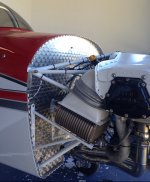
Then…we cut this HUGE honkin’’ hole in the back of the baffle to direct air to the oil cooler instead of going through the cylinder fins! This, my friends, is the paradox. Save every little bit of air so that we can then waste great gobs of it through a 3” x 3” (or often much larger!) hole to go through the fins on the oil cooler. OK - it’s not wasted….its cooling the oil. But very little science is given behind just how much air should be routed through the cooler instead of the cylinder fins.
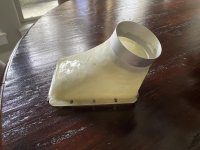
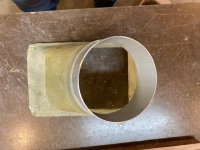
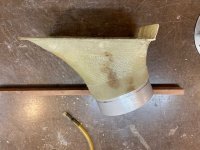
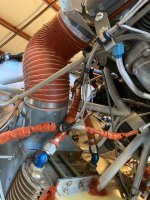
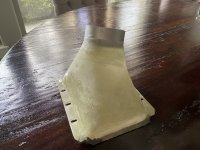
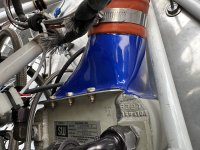
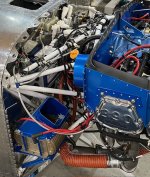
This thought occurred to me as I was flying the airline back from a Minnesota speaking engagement yesterday, because I am about to mount this monster 15-row oil cooler in the F1…somewhere….and am trying to decide if I am going to go with a round 4” flange/duct or build an aluminum (or maybe fiberglass) duct to come straight off the back of baffles behind the #5 cylinder. I’ve seen it done both ways. In all our four-banger RV’s, we have had excellent results direct-mounting the 7-row cooler directly to the back of #4, and in our Tundra, we used an RV-10 cooler and mount with the IO-360 (because it’s a slow airplane….) and have always had trouble getting the oil temp up without a big piece of aluminum blocking much of the flow.
So anyone got any science or engineering they have done to determine the required opening in the baffle to get good oil cooling and not waste those precious molecules used to cool the cylinders?
Paul
We all know that good engine cooling (generally determined by good control of Cylinder head Temps) is dependent on a baffle system that develops nice high pressure above the engine and that forces every molecule of air to go through the cylinder cooling fins. Not a molecule can be wasted! We spend hours (and hundreds of posts on threads….) describing how to search out even the tiniest air leak between baffles and the engine, we talk about perfect baffle seal “sealing” against the upper cowl. And we build carefully-sealed plenums to guide every molecule down through the engine.
Then…we cut this HUGE honkin’’ hole in the back of the baffle to direct air to the oil cooler instead of going through the cylinder fins! This, my friends, is the paradox. Save every little bit of air so that we can then waste great gobs of it through a 3” x 3” (or often much larger!) hole to go through the fins on the oil cooler. OK - it’s not wasted….its cooling the oil. But very little science is given behind just how much air should be routed through the cooler instead of the cylinder fins.
This thought occurred to me as I was flying the airline back from a Minnesota speaking engagement yesterday, because I am about to mount this monster 15-row oil cooler in the F1…somewhere….and am trying to decide if I am going to go with a round 4” flange/duct or build an aluminum (or maybe fiberglass) duct to come straight off the back of baffles behind the #5 cylinder. I’ve seen it done both ways. In all our four-banger RV’s, we have had excellent results direct-mounting the 7-row cooler directly to the back of #4, and in our Tundra, we used an RV-10 cooler and mount with the IO-360 (because it’s a slow airplane….) and have always had trouble getting the oil temp up without a big piece of aluminum blocking much of the flow.
So anyone got any science or engineering they have done to determine the required opening in the baffle to get good oil cooling and not waste those precious molecules used to cool the cylinders?
Paul