Van's Air Force

The definitive Van's Aircraft support community! Buying, building or flying an RV? Join our exclusive family of mentors and enthusiasts!

Wonky RPM indication

vas4vans

Well Known Member
Friend
As I have mentioned in other threads, the engine in my RV-10 was overhauled and (re)installed a few weeks ago which resulted in a few issues for which this group has been extremely helpful.

Ever since the plane started flying again after the engine install (last 4 weeks or so), I had noticed that once I turned the masters on but before the starting the engine, the RPM indicator would show random non-zero values. Once the engine was started, the RPM indications seemed fine.

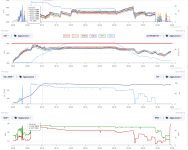
On a flight last weekend, I started to see wonky RPM indications after the engine was started (see attached image - RPM is in green in the chart at the bottom). When the engine was at what I thought was around 1000 RPM, it was showing 1300-1400. Idle was showing about 1000-1100 (it normally idles at 750), run-up was showing 2300 (vs. 1800-1850) and even on takeoff it was showing above 2700 (vs. a normal indication of 2670). It was obvious that it was an indication issue since the prop sounded fine and wasn't surging and also, things seem to settle down a couple of min after takeoff so I chose to continue the flight.

I had dual PMags installed about a year ago and was closely involved in the wiring and configuration. The RPM indication comes from one of the PMags and I suspect that may be providing a bad indication.

I wanted to get some ideas from the group on what I should be looking for (or steps I should take) as I troubleshoot this issue. Could it also be a failure on the Pmag? I guess one easy thing to do would be to get the RPM indication from the other PMag. Any other ideas would be much appreciated.

Thanks.
 

Attachments

  • Screenshot 2025-10-06 at 9.41.41 AM.png
    Screenshot 2025-10-06 at 9.41.41 AM.png
    216.1 KB · Views: 17
As I have mentioned in other threads, the engine in my RV-10 was overhauled and (re)installed a few weeks ago which resulted in a few issues for which this group has been extremely helpful.

Ever since the plane started flying again after the engine install (last 4 weeks or so), I had noticed that once I turned the masters on but before the starting the engine, the RPM indicator would show random non-zero values. Once the engine was started, the RPM indications seemed fine.

On a flight last weekend, I started to see wonky RPM indications after the engine was started (see attached image - RPM is in green in the chart at the bottom). When the engine was at what I thought was around 1000 RPM, it was showing 1300-1400. Idle was showing about 1000-1100 (it normally idles at 750), run-up was showing 2300 (vs. 1800-1850) and even on takeoff it was showing above 2700 (vs. a normal indication of 2670). It was obvious that it was an indication issue since the prop sounded fine and wasn't surging and also, things seem to settle down a couple of min after takeoff so I chose to continue the flight.

I had dual PMags installed about a year ago and was closely involved in the wiring and configuration. The RPM indication comes from one of the PMags and I suspect that may be providing a bad indication.

I wanted to get some ideas from the group on what I should be looking for (or steps I should take) as I troubleshoot this issue. Could it also be a failure on the Pmag? I guess one easy thing to do would be to get the RPM indication from the other PMag. Any other ideas would be much appreciated.

Thanks.
Did you do any output programing of the mag? 2 pulse per Rev to 1 pulse? or add a diode to go from 12 to 5 volts? i think step one would be to swap tach signals like you said and see if its fixed or stays the same.
 
How do the wires going into the green plug look (Phoenix Contact)? Are they still stranded, or did you put crimp terminations on the wires?
I ordered the units with the potted plug. I haven't had a chance to do any troubleshooting yet so I haven't looked at the wires yet. I don't remember the color of the potted plug - is that what you mean by the Phoenix Contact?

Did you do any output programing of the mag? 2 pulse per Rev to 1 pulse? or add a diode to go from 12 to 5 volts? i think step one would be to swap tach signals like you said and see if its fixed or stays the same.
I stayed with the default which I believe is 3 ppr. When we first installed it, I was also getting some wonky RPM indications and it turned out that I had connected the 12V tach output from the Pmag to the 5V tach input on the AFS EFIS. Once I changed that and connected it to the 12V tach input on the AFS, things were fine. So, there is no diode in that circuit currently.

Thanks.
 
Ever since the plane started flying again after the engine install (last 4 weeks or so), I had noticed that once I turned the masters on but before the starting the engine, the RPM indicator would show random non-zero values. Once the engine was started, the RPM indications seemed fine.
Usually the tach is a square wave. 0V, then 12V for a bit as the metal or magnet passes the sensor then back to 0. The fact that you get something other than 0 rpm with the engine still would seem to point to an issue in the pmag. Loose bearings are a notorious issue with them and this could cause the sensor to get too close or too far from the magnet or ferrous metal. not familiar wth these, so don't know how they sense rotational poisition - VR or hall effect.

Try moving the RPM feed from one pmag to the other and see if the problem disappears.
 
Usually the tach is a square wave. 0V, then 12V for a bit then back to 0. The fact that you get something other than 0 rpm with the engine still would seem to point to an issue in the pmag. Loose bearings are a notorious issue with them and this could cause the sensor to get too close or too far from the manet or ferrous metal.

Try moving the RPM feed from one pmag to the other and see if the problem disappears.
did the 6 cyl have loose bearings too? thought it was just the 4 cyl versions.
 
Usually the tach is a square wave. 0V, then 12V for a bit as the metal or magnet passes the sensor then back to 0. The fact that you get something other than 0 rpm with the engine still would seem to point to an issue in the pmag. Loose bearings are a notorious issue with them and this could cause the sensor to get too close or too far from the magnet or ferrous metal. not familiar wth these, so don't know how they sense rotational poisition - VR or hall effect.

Try moving the RPM feed from one pmag to the other and see if the problem disappears.
You can also remove the pmag. put a volt meter on the tach output and spin the gear while looking for altering between 0V and 12V while looking for anomolies.
 
did the 6 cyl have loose bearings too? thought it was just the 4 cyl versions.
Sorry, but know little about pmags. Just reiterating what I see in posts here. I am not a big fan of them. I do believe that they finally addressed many of the design flaws in the 6 cyl version, but maybe created new ones also.
 
I’ve had this issue on the 4 cylinder version. I tried everything and traced it to one of the 2 Pmags. I tried checking the green plug, those wires can get loose in the set screw. I tried wiggling the plug on the circuit board. After all the trouble shooting I removed it off the engine and checked the gear run out. It was more than I’m comfortable with and sent it off to EMAG for rebuild. When it came back problem went away.
 
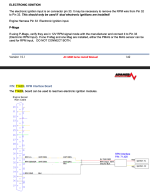
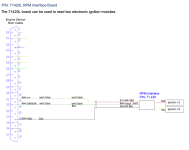
I went and looked at what I had done when we replaced the dual Lightspeeds with dual Pmags a year ago. When I first installed them, I was also getting some wonky RPM indications. It turns out that I had taken the 12V tach output from the Emag and connected it to the 5V tach input on the AFS5600 (pin 32). When the Lightspeeds were in, the previous owner had installed AFS 71420 RPM interface board (see the image) since both the Lightspeeds needed to have tach outputs connected to the EFIS (in case one fails). Rather than redo the wiring at the AFS end, we decided to put the 74120 back in (with both the Emag tach outputs connected to it) and the tach started reading correctly.

Fast forward 12 months - now that I have wonky RPM indications again, my thought is that perhaps this 71420 board was failing so we removed it and connected the 12V tach output from one of the Emags to the 12V input on the AFS (pin 33). I did an engine start after we did the change and unfortunately, things have regressed - the tach essentially shows 0 (with some disturbances) :-(!

I am pretty sure all the connections were correct but we'll go back and recheck them. Any suggestions from the group on other things I could do?

Thanks.


1759882848121.png
 
Move the tach lead from the current pmag to the other one. If that works, then pmag is likely the problem. If not, wiring is possible, as is something with the afs. Former more likely.

Did you verify that the pmag is setup in 12v mode, as outlined in the manual you referenced?
 
At some point you are going to have to put the vom on pin 33 on the connector and slowly spin the prop while observing the voltage. If that is concerning, as it probably should be with a pmag, either remove the pmag and spin by hand or pull all the spark plug wires off or pull all the top plugs out.

May need to confirm with emag folks if you will get tach pulses at very low rpm. Some do and some don’t.

With the engine running, you will never see the pulses on your average meter. Would need a scope. Can get one for $50 on amazon that would serve this purpose.
 
Last edited:
I am a fan of P-mags, but that's another issue...

The RPM display just counts pulses, nothing more involved. If it is unreliable the pulse generator, or the wiring that takes the pulses to the counter, is broken. If you have any soldered connections replace with crimped stranded wire, it will be almost impossible to tell if there are any small fractures in the solder joints. The solder can wick up the wire which the fatigues and gives unreliable contacts - and produces pulses at unreliable intervals for the pulse counter to count.
 
I had noticed that once I turned the masters on but before the starting the engine, the RPM indicator would show random non-zero values. Once the engine was started, the RPM indications seemed fine.
Want to go back to this point again. As mentioned, should get 0V on tach lead with the engine still and then start getting 12V pulses 1-3 times per engine revolution. The AFS counts these and calculates an RPM for display. If you show ANY RPM other than 0 with the engine still, that means the voltage is moving around on the tach lead or the circuitry inside the AFS is going bad and seeing things that don't exist or voltage is leaking across the board somewhere. Struggle to see how this can be wiring. Wiring issues can't really make 0V appear as 12V. I suppose there are fringe cases where this is possible, but not likely. This looks and feel like an issue in a circuit board - PMG or AFS,

If you can replicate this scenario (random RPM with engine off), you can put a VOM on the tach lead and see what is happening. If things are a nice steady 0V, then the AFS is the likely culprit. If you see the volts bouncing around, the Pmag is the likely culprit.
 
Last edited:
Want to go back to this point again. As mentioned, should get 0V on tach lead with the engine still and then start getting 12V pulses 1-3 times per engine revolution. The AFS counts these and calculates an RPM for display. If you show ANY RPM other than 0 with the engine still, that means the voltage is moving around on the tach lead or the circuitry inside the AFS is going bad and seeing things that don't exist or voltage is leaking across the board somewhere. Struggle to see how this can be wiring. Wiring issues can't really make 0V appear as 12V. I suppose there are fringe cases where this is possible, but not likely. This looks and feel like an issue in a circuit board - PMG or AFS,

If you can replicate this scenario (random RPM with engine off), you can put a VOM on the tach lead and see what is happening. If things are a nice steady 0V, then the AFS is the likely culprit. If you see the volts bouncing around, the Pmag is the likely culprit.

It looks like we fixed the issue. We tried the diode solution with the Emag (stepping the tach output down to 5V) and the connected it back to the 5V input on the AFS. It initially didn't work. We went back and looked at all the wiring and it turns out that my A&P (who did the splicing work) had mistakenly connected the tach output from the Emag to the wrong wire going to the AFS yesterday :rolleyes:! Once we fixed that, it started working! If the wiring had been right, yesterday's solution (connecting the Emag tach output directly to the 12V input on the AFS) would likely have worked!
I haven't had a chance to fly the plane to verify that it works across the full RPM range but I started the engine and the tach readings on the ground looked fine.

So, it looks like the original issue was likely caused by a failure of the 74120 RPM Interface board. Removing the board and connecting the 12V tach output from one of the Emags to the 12V input on the AFS should have fixed it except it didn't work because of the wiring mistake :rolleyes:!

On a different note, when I bought my Emags/Pmags a year ago, I was extremely pleased with the support that I received from the EmagAir team (mainly Brad and Trent). Over the last 3-4 weeks, I have reached out to them by email and phone a couple of times with some questions after the engine (re)install and have been rather disappointed that I have not got any response back. I know they were acquired by Hartzell a few months ago. Does anyone know what's happening with them? I am now very concerned about their support if I were to have a real issue with my Emags.

Thanks to everyone for their input.
 
I believe Trent is holding the fort pending transfer of operations to a Hartzell facility toward the end of the year
 
It looks like we fixed the issue. We tried the diode solution with the Emag (stepping the tach output down to 5V) and the connected it back to the 5V input on the AFS. It initially didn't work. We went back and looked at all the wiring and it turns out that my A&P (who did the splicing work) had mistakenly connected the tach output from the Emag to the wrong wire going to the AFS yesterday :rolleyes:! Once we fixed that, it started working! If the wiring had been right, yesterday's solution (connecting the Emag tach output directly to the 12V input on the AFS) would likely have worked!
I haven't had a chance to fly the plane to verify that it works across the full RPM range but I started the engine and the tach readings on the ground looked fine.

So, it looks like the original issue was likely caused by a failure of the 74120 RPM Interface board. Removing the board and connecting the 12V tach output from one of the Emags to the 12V input on the AFS should have fixed it except it didn't work because of the wiring mistake :rolleyes:!

On a different note, when I bought my Emags/Pmags a year ago, I was extremely pleased with the support that I received from the EmagAir team (mainly Brad and Trent). Over the last 3-4 weeks, I have reached out to them by email and phone a couple of times with some questions after the engine (re)install and have been rather disappointed that I have not got any response back. I know they were acquired by Hartzell a few months ago. Does anyone know what's happening with them? I am now very concerned about their support if I were to have a real issue with my Emags.

Thanks to everyone for their input.
Well, it looks like I celebrated a bit too early :-(! I went for a flight after the last fix a couple of weeks ago and the issue showed up on takeoff again. I was traveling most of the last couple of weeks so I finally got a chance to work on it again today. I removed the diode and connected one Emag tach output directly to the 12V tach input on the AFS and the issue showed up right after engine start. I ran out of time to try the other Emag tach output but I have a feeling the outcome is going to be the same. Regardless, I will do that next.

I have ordered a scope from Amazon and will try some of the other suggestions from Larry and others to see if the Emag(s) is (are) outputting the expected 12V square wave. If the behavior with the other Emag output is the same and the wave looks good, it would point the finger at the AFS unit. Has anyone seen a failure mode in an AFS (or other) EFIS where the circuit for reading the tach doesn't work properly? I am wondering if that's something that can possibly be repaired. I will try calling the AFS folks on Monday to see if they have any ideas. Any other ideas from the group are welcome!

Thanks.
 
On a different note, when I bought my Emags/Pmags a year ago, I was extremely pleased with the support that I received from the EmagAir team (mainly Brad and Trent). Over the last 3-4 weeks, I have reached out to them by email and phone a couple of times with some questions after the engine (re)install and have been rather disappointed that I have not got any response back. I know they were acquired by Hartzell a few months ago. Does anyone know what's happening with them? I am now very concerned about their support if I were to have a real issue with my Emags.

Thanks to everyone for their input.
I am guessing by this point you are going to need to be calling hartzell for support. I doubt that they intend to run pmag as an idependant company, as all the others were integrated. It will be interesting to see how they handle an issue like yours.
 
I did some more troubleshooting:

- Connected the tach output from the other Pmag to the AFS 12V input - it made no difference

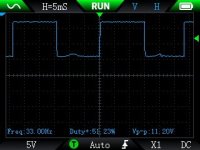
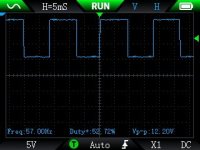
- Connected a scope to the Pmag output. Attached are the images from the scope.
- One was at idle RPM (around 650 RPM) and the scope image shows the square wave at 11.2V and 33 Hz which correctly maps to 660 RPM (33x60/3 ppr). The AFS was showing 900-950 RPM.
-the other one was at around 1100 RPM for which the scope image shows a square wave at 12.2VV and 57 Hz which also correctly maps to 1140 RPM (57x60/3). The AFS was showing 1350-1400 RPM.

From this test, it would seem like the Pmag is behaving as expected with clean square waves with the right frequency and above 10V.

We also tried a test with a signal generator to see if we could feed a signal to the AFS and see what it showed but unfortunately, the signal we were using did not work on the AFS at all (RPM stayed at zero). Any ideas about what kind of a signal would be required for it to work with the AFS (and what kind of signal generator).

When I reached out to the AFS guys a few days ago, they opined that it may be an EMI issue. At this point, based on the scope data, it would seem like the AFS is the issue.

The behavior of the tach is a interesting. On the first leg of my flight to refuel 2 days ago, the tach read 200-300 RPM high on the ground and on takeoff but it "settled down" in 1-2 minutes and started to read accurately for the rest of the flight until after landing when it again started reading high. After refueling, the tach was high on the ground but it was absolutely fine on takeoff and for the entire flight. It started reading high only after landing.

Does anyone have any possible explanation for this behavior on the AFS where it reads high on the ground but is (mostly) fine in the air?

I would like to be able to do the test with the signal generator to confirm that the AFS is the issue. Regardless, my thought is to call the AFS guys and if they agree that the EFIS is likely the issue based on the data from the scope, maybe I can send the unit to them to get it repaired.

Thanks.
 

Attachments

  • Emag output at idle AFS reads 950-1000.jpg
    Emag output at idle AFS reads 950-1000.jpg
    19.6 KB · Views: 5
  • Emag output 1100 RPM AFS reads 1350-1400.jpg
    Emag output 1100 RPM AFS reads 1350-1400.jpg
    20.1 KB · Views: 4
I did some more troubleshooting:

- Connected the tach output from the other Pmag to the AFS 12V input - it made no difference

- Connected a scope to the Pmag output. Attached are the images from the scope.
- One was at idle RPM (around 650 RPM) and the scope image shows the square wave at 11.2V and 33 Hz which correctly maps to 660 RPM (33x60/3 ppr). The AFS was showing 900-950 RPM.
-the other one was at around 1100 RPM for which the scope image shows a square wave at 12.2VV and 57 Hz which also correctly maps to 1140 RPM (57x60/3). The AFS was showing 1350-1400 RPM.

From this test, it would seem like the Pmag is behaving as expected with clean square waves with the right frequency and above 10V.

We also tried a test with a signal generator to see if we could feed a signal to the AFS and see what it showed but unfortunately, the signal we were using did not work on the AFS at all (RPM stayed at zero). Any ideas about what kind of a signal would be required for it to work with the AFS (and what kind of signal generator).

When I reached out to the AFS guys a few days ago, they opined that it may be an EMI issue. At this point, based on the scope data, it would seem like the AFS is the issue.

The behavior of the tach is a interesting. On the first leg of my flight to refuel 2 days ago, the tach read 200-300 RPM high on the ground and on takeoff but it "settled down" in 1-2 minutes and started to read accurately for the rest of the flight until after landing when it again started reading high. After refueling, the tach was high on the ground but it was absolutely fine on takeoff and for the entire flight. It started reading high only after landing.

Does anyone have any possible explanation for this behavior on the AFS where it reads high on the ground but is (mostly) fine in the air?

I would like to be able to do the test with the signal generator to confirm that the AFS is the issue. Regardless, my thought is to call the AFS guys and if they agree that the EFIS is likely the issue based on the data from the scope, maybe I can send the unit to them to get it repaired.

Thanks.
Unfortunately your problem seems intermittent. The test confirms that the Pmag is not sending a marginal quality signal that would ocassionally cause the AFS to mis-interpret the signal, nor is the afs struggling to read a quality signal and properely represent it. So, something unique is happening either on the ground or at low RPM; Maybe a vibration related issue? EMI doesn't make a lot of sense with your symptoms (not much reason for this to only happen in very isolated conditions), though wiring could - certain vibration patterns affecting a crimp or connector or even soldered connections on a board. pmag likely has one.

I struggle to see how the AFS could be affected only in your troubled scenarios. But can see how possibly the Pmag could. Its got a big mass spinning around, with circuit boards and connectors, and therefore could have an RPM or vibration related issue. Clearly your testing scenario did not show failure, so the specific problem condition was not present during the test. A worthwhile test would be to swap the tach lead to the other pmag and go fly. If the problem disappears you know the source is the pmag. If it doesn't, you have eliminated the pmag as the source.

Another option is to rig up your scope and have a buddy observe it while you fly. You can then observe the signal wave while the problem is happening. If the wave turns to garbage, you can rule the AFS out (pmag issue or EFI). If it doesn't, rule it in. If the waves are clean, compare the freq. Either pmag sends it wrong or afs interprets it wrong. If you get a flat zero, that could be either pmag OR wiring.
 
Last edited:
Unfortunately your problem seems intermittent. The test confirms that the Pmag is not sending a marginal quality signal that would ocassionally cause the AFS to mis-interpret the signal, nor is the afs struggling to read a quality signal and properely represent it. So, something unique is happening either on the ground or at low RPM; Maybe a vibration related issue? EMI doesn't make a lot of sense with your symptoms (not much reason for this to only happen in very isolated conditions), though wiring could - certain vibration patterns affecting a crimp or connector or even soldered connections on a board. pmag likely has one.

I struggle to see how the AFS could be affected only in your troubled scenarios. But can see how possibly the Pmag could. Its got a big mass spinning around, with circuit boards and connectors, and therefore could have an RPM or vibration related issue. Clearly your testing scenario did not show failure, so the specific problem condition was not present during the test. A worthwhile test would be to swap the tach lead to the other pmag and go fly. If the problem disappears you know the source is the pmag. If it doesn't, you have eliminated the pmag as the source.

Another option is to rig up your scope and have a buddy observe it while you fly. You can then observe the signal wave while the problem is happening. If the wave turns to garbage, you can rule the AFS out (pmag issue or EFI). If it doesn't, rule it in. If the waves are clean, compare the freq. Either pmag sends it wrong or afs interprets it wrong. If you get a flat zero, that could be either pmag OR wiring.

I already checked with the other Pmag tach output connected to the AFS tach input (on a previous test) and the result was the same.

What may not have come through on my previous post is that I connected the "free" Pmag tach output to the scope so the AFS was still getting the tach output from the other Pmag and the AFS tach reading was wrong (on the ground) so the problem was happening when the scope images were captured. It wouldn't be difficult to do it in the air but I don't think it would prove anything since I was able to reproduce the problem on the ground and see on the scope that the Pmag output looked good.
 
What may not have come through on my previous post is that I connected the "free" Pmag tach output to the scope so the AFS was still getting the tach output from the other Pmag and the AFS tach reading was wrong (on the ground) so the problem was happening when the scope images were captured. It wouldn't be difficult to do it in the air but I don't think it would prove anything since I was able to reproduce the problem on the ground and see on the scope that the Pmag output looked good.
If I reading this right, you had the tach output of one pMag to your scope (that had not connection to the your EMS), the other pMag was sending the tach signal to your EMS. Correct?

Assuming your wiring is correct, and your EMS has separate tach inputs for each pMag (typical). This is normal. As long as your pMag is turning it will provide a tach output to your EMS if even if your ignition switch for the pMag is off.

Not sure what is going on, but normal EMS pMag tach connections have separate inputs for each pMag. By chance did the person installing these pMags combine the two tach outputs into one EMS input?

Did you remove the Lightspeed RPM interface board?

Carl
 
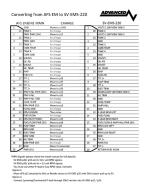
There's a bit of history with the context that my setup has the legacy AFS EM which has one 5V tach input (pin 32) and one 12V tach input (pin 33). Based on the image below, it looks like the SV-EMS-220 has two tach inputs.

When I switched the the Pmags, I kept the wiring that was with the old dual Lightspeed ignition setup which used the 71420 RPM Interface board as shown in the other image below - both 12V inputs are combined and produce a 5V output which went into pin 32 on the AFS EM. That worked fine till a few weeks ago when the tach started misbehaving so something changed. It was even working fine after the engine came from the OH for the first 5-7 flights.


1762026287359.png
1762026530854.png
 
I already checked with the other Pmag tach output connected to the AFS tach input (on a previous test) and the result was the same.

What may not have come through on my previous post is that I connected the "free" Pmag tach output to the scope so the AFS was still getting the tach output from the other Pmag and the AFS tach reading was wrong (on the ground) so the problem was happening when the scope images were captured. It wouldn't be difficult to do it in the air but I don't think it would prove anything since I was able to reproduce the problem on the ground and see on the scope that the Pmag output looked good.
Sorry, misunderstood. So, you are saying that with one unique pmag connected to afs AND to the scope, that you observed the scope freq different than than the afs rpm indications. Or was the scope connected to pmag a and afs connected to pmag b?
 
Sorry, misunderstood. So, you are saying that with one unique pmag connected to afs AND to the scope, that you observed the scope freq different than than the afs rpm indications. Or was the scope connected to pmag a and afs connected to pmag b?
To be more clear, you need to have only one pmag connected to the afs AND the scope must also be connected to same. THEN you can compare scope to afs, assuming you can force it to be in error, which is a challenge as you don’t know the actual rpm. Or do you?

With both pmags connected, the afs will choose one or the other and have no idea which one the afs is displaying.
 
It was the second scenario - pmag A connected to the AFS and Pmag B connected to the scope.

I had tried Pmag B with the AFS previously and the AFS behaved the same.
 
It was the second scenario - pmag A connected to the AFS and Pmag B connected to the scope.

I had tried Pmag B with the AFS previously and the AFS behaved the same.
So, you have pmag a connected to afs give a different rpm indication than pmag B connected to the scope? Problem is this doesn’t really tell you which one is wrong. Man with two watches.;)

I really think you need to individually connect each pmag to the scope and the afs at the same time, but then need an actual rpm indication for testing, which i think you need to sort this out. You can buy a mini battery operated tachometer for $8 from amazon. Has a little wire that wraps around a spark plug wire. Setup for 1 pulse for 2 revolutions . This will be the voice of truth in your testing, maybe you have neighbor that is an old school car guy. We all have test rigs that clamp on to a plug wire and giva a tach reading

or follow your original plan but swap the pmags back and forth and see what happens with the disparity.
 
Last edited:
I am a bit embarrassed to close the loop on this issue (since it turned out to be simple and self-inflicted!) but in the interest of furthering the knowledge in the forum, it needs to be done :-)!

Based on a clue from Rob at AFS, I looked at my log data again and I discovered that during the run-up, the RPM reading was wonky when running on both or just the left and it was normal when running on just the right ignition (see image below - the rpm drops to a normal level in the 2nd half of my ignition check when running on just the right ignition). Armed with the information that it was likely something to do with the bottom plugs (which are all on the left ignition) , I went looking for a bad connection to a spark plug and sure enough, I discovered that the ignition wire connected to the bottom #2 was not all the way in and it was likely causing the spark to jump in certain conditions causing significant EMI.

Part of why I missed it is that during my run-up, I have been focusing on the EGT rise on all cylinders to confirm that each ignition was ok and I had stopped paying much attention to the RPM. Moving forward, I will be changing that and ensuring that I pay attention to the RPM too.

Looking at possible things that could have caused it, I realized that I had done an oil change just before it started happening and at that time, I had pulled all the plugs to look at them so it looks like when the plugs were reinserted, that particular ignition wire did not get seated properly. It's still a bit unclear why it would show up only on the ground and the first few minutes of a flight (and be normal after that until after landing). Any ideas on that would be welcome!

Thanks to Rob at AFS for for putting me on the right troubleshooting path. Part of what he said is that the old AFS-EM module (which was built into the earlier generation AFS screens) is not very resistant to EMI. He said the new Dynon SV-EMS-220 is more tolerant to EMI, but it requires an AF-5600 with Rev 7 or later hardware to use it.

Thanks to everyone for their help.


1763608051948.png
 
Back
Top