Van's Air Force

The definitive Van's Aircraft support community! Buying, building or flying an RV? Join our exclusive family of mentors and enthusiasts!

Filling Pop Rivet Mandrel Holes Before Paint

Tony Kirk

Well Known Member
Patron
This is how you take your build to the next level. If you don't have a pop-riveted kit you should probably click the back button now.

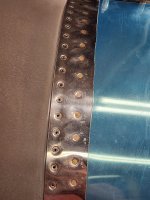
If you've ever looked closely at a Sling TSi built by Midwest SkySports you will notice that they fill EVERY pop rivet mandrel hole before they paint the plane. I've issued A/W Certificates to a few Slings they've built (assisted building ;)) and I'm always amazed at how great their paint jobs look.

So I got a few pointers from them to share if you want to take your pop-riveted RV-12 (or 15) to the next level of perfection. Maybe you don't need to use flush solid rivets on the RV-15 to get a beautiful paint job after all.

Here is the list of items that I'm using to fill all of the exposed rivet holes on the exterior of my RV-12 before John Stahr comes up to paint it later this month.

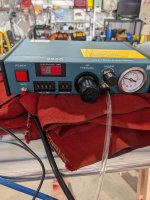
Automatic glue dispenser controller https://amzn.to/3Vyo3Z1 This thing is amazing once you get it set up!
10cc syringes, https://amzn.to/45TCBZi buy a couple packs.
10cc syringe air tube https://amzn.to/3Ib6n2D get 1.
14ga plastic dispenser needles https://amzn.to/489mXua get 1 (box of 100 will be plenty)
Epoxy gun https://amzn.to/4mNGHYO get 1.
extra mixing nozzles https://amzn.to/46nGO7E 1 or 2 packs should be enough
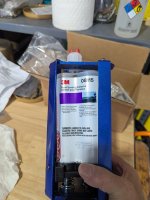
and finally, the 3M 08115 Panel Bonding Adhesive used to fill the rivet holes, https://amzn.to/47p6xxE I bought 1 but may need another.

I have to warn you, this is a tedious, time consuming and wasteful endeavor. But the results after painting will be your reward!

I first tried doing this using only a syringe and soon found out that when the epoxy starts setting up it takes a ton of effort to push it out of the 14ga needle! My hands were killing me after only a couple syringes of sealant. I also discovered that the pot-life is only about 25 to 30 minutes before it gets too thick to dispense, and most of what I put in the syringe was wasted. So I regrouped and looked for a better, less wasteful (and less painful) application solution.

I've been using this automatic dispenser for a couple days and this thing ROCKS! It's hard to believe how well it works and it was only about $70!

You can precisely control the dispense time with a couple clicks of the timer control, and I adjust it up a couple tenths of a second about every 3 or 4 minutes as the sealant in the syringe starts to get thicker. When the sealant is fresh it only takes a 0.1 second pulse, and by the end of the pot life I'm up to about 1.5 seconds per pulse. I also use the back-suction vacuum feature that pulls a little suction after the dispense pulse to prevent oozing between rivets.

I also use smaller 10cc syringes, not the big 30cc syringes that come with the dispenser, because you only need a tiny squirt of sealant for each rivet, and even with the dispenser you only need to put 1 or 2 CCs of sealant in the syringe.

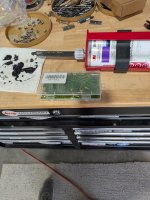
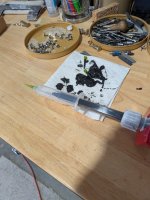
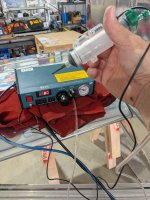
The epoxy also sets up in the mixing nozzle while you are filling rivets, so when you go to fill a new syringe you will need to pump out a big glob (scientific term) of sealant to flush out the mixing nozzle. Notice the globs on the paper towel in the photos. Once you get fresh epoxy coming out of the mixing nozzle you only need to put a couple CCs in the syringe. This is the wasteful part, as is putting too much sealant in a syringe because it will set up before you can use all of it.

You quickly get into a rhythm and I can fill a rivet about every 2 to 3 seconds with a single click of the dispense button attached to the syringe. It's harder to explain it than it is to do it!

One side of a wing only takes about an hour and I did the upper surfaces of the tailcone, stabilator, VS and rudder in about two hours. All my parts are attached to the plane and it was gusting to 40 kts today, so I stayed in the hangar and filled rivet holes all afternoon.

This stuff sets up hard so try not to get it where you don't want it. I'll sand all the filler down flush with the rivet head with a few swipes of 120 grit on a long sanding block.

I'm more than half done and I'm trying to be less wasteful but I still may need to buy another tube of sealant. YMMV.

Let us know if you find this useful.
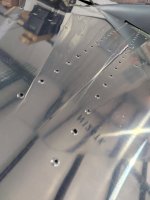
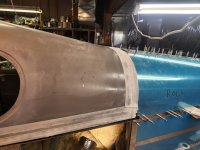
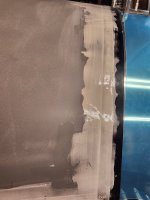
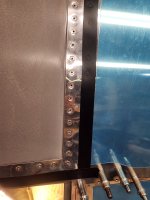
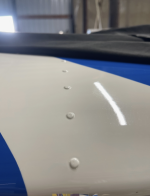
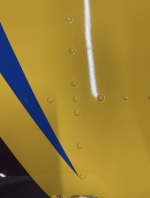
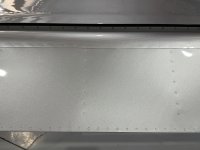
PXL_20250905_193520641.jpg PXL_20250905_193515917.jpg PXL_20250824_215606231.jpg PXL_20250905_194601181.jpg PXL_20250905_195613380.jpg PXL_20250905_194839681.jpg PXL_20250905_194909651.jpg
 
The step I wonder about is getting the mandrel hole clean enough to get a reasonable bond with the filler. Over the time of a build, let alone during the time the rivet has been sitting around prior to use, that cavity has got to fill with dust, dirt, oils? and surface oxidation/passivation that inhibits bonding.

I don't want to spend hard-earned treasure on a nice paint job and then have the little plugs of epoxy jump out of those cavities.

Is a good, wet acetone wipe enough?
 
Same approach was applied to my Mooneys paint job. Lots of STC speed mods utilize fairings and close outs. Majority were blind riveted

All of the “holes” were filled with fast setting body filler. They got a solvent wipe at best for prep. No issues with those locations in the decade before it was sold.
 
This is how you take your build to the next level. If you don't have a pop-riveted kit you should probably click the back button now.

If you've ever looked closely at a Sling TSi built by Midwest SkySports you will notice that they fill EVERY pop rivet mandrel hole before they paint the plane. I've issued A/W Certificates to a few Slings they've built (assisted building ;)) and I'm always amazed at how great their paint jobs look.

So I got a few pointers from them to share if you want to take your pop-riveted RV-12 (or 15) to the next level of perfection. Maybe you don't need to use flush solid rivets on the RV-15 to get a beautiful paint job after all.

Here is the list of items that I'm using to fill all of the exposed rivet holes on the exterior of my RV-12 before John Stahr comes up to paint it later this month.

Automatic glue dispenser controller https://amzn.to/3Vyo3Z1 This thing is amazing once you get it set up!
10cc syringes, https://amzn.to/45TCBZi buy a couple packs.
10cc syringe air tube https://amzn.to/3Ib6n2D get 1.
14ga plastic dispenser needles https://amzn.to/489mXua get 1 (box of 100 will be plenty)
Epoxy gun https://amzn.to/4mNGHYO get 1.
extra mixing nozzles https://amzn.to/46nGO7E 1 or 2 packs should be enough
and finally, the 3M 08115 Panel Bonding Adhesive used to fill the rivet holes, https://amzn.to/47p6xxE I bought 1 but may need another.

I have to warn you, this is a tedious, time consuming and wasteful endeavor. But the results after painting will be your reward!

I first tried doing this using only a syringe and soon found out that when the epoxy starts setting up it takes a ton of effort to push it out of the 14ga needle! My hands were killing me after only a couple syringes of sealant. I also discovered that the pot-life is only about 25 to 30 minutes before it gets too thick to dispense, and most of what I put in the syringe was wasted. So I regrouped and looked for a better, less wasteful (and less painful) application solution.

I've been using this automatic dispenser for a couple days and this thing ROCKS! It's hard to believe how well it works and it was only about $70!

You can precisely control the dispense time with a couple clicks of the timer control, and I adjust it up a couple tenths of a second about every 3 or 4 minutes as the sealant in the syringe starts to get thicker. When the sealant is fresh it only takes a 0.1 second pulse, and by the end of the pot life I'm up to about 1.5 seconds per pulse. I also use the back-suction vacuum feature that pulls a little suction after the dispense pulse to prevent oozing between rivets.

I also use smaller 10cc syringes, not the big 30cc syringes that come with the dispenser, because you only need a tiny squirt of sealant for each rivet, and even with the dispenser you only need to put 1 or 2 CCs of sealant in the syringe.

The epoxy also sets up in the mixing nozzle while you are filling rivets, so when you go to fill a new syringe you will need to pump out a big glob (scientific term) of sealant to flush out the mixing nozzle. Notice the globs on the paper towel in the photos. Once you get fresh epoxy coming out of the mixing nozzle you only need to put a couple CCs in the syringe. This is the wasteful part, as is putting too much sealant in a syringe because it will set up before you can use all of it.

You quickly get into a rhythm and I can fill a rivet about every 2 to 3 seconds with a single click of the dispense button attached to the syringe. It's harder to explain it than it is to do it!

One side of a wing only takes about an hour and I did the upper surfaces of the tailcone, stabilator, VS and rudder in about two hours. All my parts are attached to the plane and it was gusting to 40 kts today, so I stayed in the hangar and filled rivet holes all afternoon.

This stuff sets up hard so try not to get it where you don't want it. I'll sand all the filler down flush with the rivet head with a few swipes of 120 grit on a long sanding block.

I'm more than half done and I'm trying to be less wasteful but I still may need to buy another tube of sealant. YMMV.

Let us know if you find this useful.
View attachment 96809 View attachment 96808 View attachment 96807 View attachment 96810 View attachment 96812 View attachment 96811 View attachment 96813
The beauty of building our pop-riveted Zenith 801 is that the aircraft is so ugly, the holes in the rivets just add character! 🤣

I tell people it isn’t going to fly - instead, it’s so hideous the ground is going to repel it.
 
That is a slick process Tony!

I watched the guys at Sling in Johannesburg fill rivets when I was there a couple of years ago. Young fellow on a little stool sitting next to the fuselage with a scrap of thin plywood in one hand, a pointed popsicle stick in the other. Polyester body filler mixed on the “pallet”. H’d take a drop, put it on the rivet, while it flat, then go to the next one. The set time on the body filler was long(ish) - not fast setting. I asked how long t took to do an airplane, and was told he’d do a whole fuselage in an eight-hour day. Seems like a lot of work, but in a typical mult-year build? Not a big deal f you’ve got the TV on in the background…..

I asked about prep, and was told that they just wipe with acetone and blow it al with compressed air - and they’ve never had any filler pop out. Finish paint provides another layer of retention.

I’m going to suggest to Louise that after she finishes her RV-15 wing, and she’s waiting on the next kit, she fill some rivets…but will have to look into your process - it looks more sophisticated….

Paul
 
I’ve been using Superfill reduced with Acetone to get the right consistency. #10 needle fits the mandrel hole perfectly. I think the dispenser will speed up the process and cut down on the hand fatigue. Guess I need to order one..
 
I have to warn you, this is a tedious, time consuming and wasteful endeavor. But the results after painting will be your reward!
[...]
You quickly get into a rhythm and I can fill a rivet about every 2 to 3 seconds [...]
There are no published #rivets yet for the RV-15 but taking the -7 for comparison, it's 16,000. Three seconds per comes out to 13.3 hours. Double that for setup and cleanup and rounding up, call it 30 hours. Over the course of a project, that's nothing.
I probably won't ever build a -7 but if I do I will definitely do something like this!
 
That is a slick process Tony!

I watched the guys at Sling in Johannesburg fill rivets when I was there a couple of years ago. Young fellow on a little stool sitting next to the fuselage with a scrap of thin plywood in one hand, a pointed popsicle stick in the other. Polyester body filler mixed on the “pallet”. H’d take a drop, put it on the rivet, while it flat, then go to the next one. The set time on the body filler was long(ish) - not fast setting. I asked how long t took to do an airplane, and was told he’d do a whole fuselage in an eight-hour day. Seems like a lot of work, but in a typical mult-year build? Not a big deal f you’ve got the TV on in the background…..

I asked about prep, and was told that they just wipe with acetone and blow it al with compressed air - and they’ve never had any filler pop out. Finish paint provides another layer of retention.

I’m going to suggest to Louise that after she finishes her RV-15 wing, and she’s waiting on the next kit, she fill some rivets…but will have to look into your process - it looks more sophisticated….

Paul
Are we sure at this point that the RV-15 wing uses pulled rivets?
 
On my RV-9A, there aren't too many pull rivets - mostly on the empennage tips. I mixed up some West system epoxy and micro into a thick slurry, put that into a small syringe and went around and filled all of the little holes. Probably added a few grams of weight, but at least they are sealed tight from any weather. An easy bit of sanding after it hardened and they looked great. Eleven years later, still looking great.
 
I hate the look of pop rivets. I really hate the look of pop rivets used to hold fiberglass to something (like the RV-8 canopy skirt or the multitude of pop rivets used on the RV-10 cabin top).

What I do for pop rivets in fiberglass:
- Skim coat of micro over the rivets. Let it set and sand smooth. This yields a flat surface.
- A bid or to of fiberglass over the pop rivets. I’m careful to tape boundaries so that I don’t get glass over the nice standard rivets in the adjacent aluminum skin. Use some peal ply over the glass.
- Once set, another skim coat of micro over the glass to fair it in with rest of the piece. Then of course sand, sand and sand again.

Attached photos are “in process” for the RV-10 cabin top.

Side note. I do the same process for flush rivets in fiberglass, like the cowl to cowl hinge rivets. I’ve seen older RVs where these rivets work free and screw up a paint job. The glass over the top ends the problem.

Carl
 

Attachments

  • 20250618_161451.jpeg
    20250618_161451.jpeg
    3.1 MB · Views: 233
  • 20250617_170744.jpeg
    20250617_170744.jpeg
    1.6 MB · Views: 216
  • 20250617_162352.jpeg
    20250617_162352.jpeg
    1.6 MB · Views: 224
  • 20250617_161838.jpeg
    20250617_161838.jpeg
    2 MB · Views: 238
Are we sure at this point that the RV-15 wing uses pulled rivets?
Great question. The prototype shown at OSH used pulled rivets. Van's has said that it will be builder's choice whether to use pulled or solid rivets (and I assume that means either universal or flush) - but nothing definitive has been published that I have seen.

I really hope we will be able to build the RV-15 with flush, solid rivets. My painter does too...
 
Great question. The prototype shown at OSH used pulled rivets. Van's has said that it will be builder's choice whether to use pulled or solid rivets (and I assume that means either universal or flush) - but nothing definitive has been published that I have seen.

I really hope we will be able to build the RV-15 with flush, solid rivets. My painter does too...

Watch the video linked in my post in the RV-15 thread about this subject. https://vansairforce.net/threads/anyone-planning-on-bucking-rivets-for-the-rv-15.232818/post-1861856
 
Are we sure at this point that the RV-15 wing uses pulled rivets?
What Steve - you decided to troll the forums? 😉

They’re selling wing kits and making lots of parts based on the final wing design that they displayed at Airventure this year, and yes, i can assure you that the version on display had pulled rivets - they even put out a video showing the employees making that wing using rivet pullers. The question was asked at the RV-15 forum about the option for solid rivets, and while they didn’t say “no”, they said you’d have to figure that out on your own (if I recall correctly….). The actual response was that you probably wouldn’t gain much performance going solid, and everything is drilled #30….
 
What Steve - you decided to troll the forums? 😉

They’re selling wing kits and making lots of parts based on the final wing design that they displayed at Airventure this year, and yes, i can assure you that the version on display had pulled rivets - they even put out a video showing the employees making that wing using rivet pullers. The question was asked at the RV-15 forum about the option for solid rivets, and while they didn’t say “no”, they said you’d have to figure that out on your own (if I recall correctly….). The actual response was that you probably wouldn’t gain much performance going solid, and everything is drilled #30….
Ah, OK. Wasn't trolling, it was a sincere question. I had thought that they might switch to solid for the kits even though the display was pulled. I guess drilling #30 pretty much seals it, doesn't it.

So that kind of heightens the questions about sealing up the mandrel holes. Hopefully a good acetone wipe is enough prep. Epoxy does not bond very well to aluminum, but hopefully the shape of the hole provides lots of grip. Many aluminum pull rivets use a steel mandrel 'nail', and if not sealed and painted, those are going to rust. (I don't know what particular rivet Vans specs. The RV-15 is more likely to be exposed to harsh environments than other RVs, so filling the mandrel holes would seem to be pretty important.
 
Hi Steve, I signed up for the ‘15 bandwagon. Have wing and 390/prop on order.

As you probably remember, I painted my ‘12 earlier this year , tried filling the top of wing rivet mandrel holes before painting with good results and no fails so far. I used thicken epoxy and vet syringes, was tedious but no fails so far.

After this results, I’m inclined to stay with the rivet installation ease and speed on the ‘15 installation. Do you have any comments on durability and speed impact?

Deene.


Ah, OK. Wasn't trolling, it was a sincere question. I had thought that they might switch to solid for the kits even though the display was pulled. I guess drilling #30 pretty much seals it, doesn't it.

So that kind of heightens the questions about sealing up the mandrel holes. Hopefully a good acetone wipe is enough prep. Epoxy does not bond very well to aluminum, but hopefully the shape of the hole provides lots of grip. Many aluminum pull rivets use a steel mandrel 'nail', and if not sealed and painted, those are going to rust. (I don't know what particular rivet Vans specs. The RV-15 is more likely to be exposed to harsh environments than other RVs, so filling the mandrel holes would seem to be pretty important.
 

Attachments

  • IMG_1197.jpeg
    IMG_1197.jpeg
    4 MB · Views: 28
Many aluminum pull rivets use a steel mandrel 'nail', and if not sealed and painted, those are going to rust. (I don't know what particular rivet Vans specs. The RV-15 is more likely to be exposed to harsh environments than other RVs, so filling the mandrel holes would seem to be pretty important.
This is a fair point. I left a couple pop rivets unfilled on my 6. Due to surface tension and air back pressure, The paint covers the visible part of the rivet well, but does not penetrate into the cavity. If that mandrel is plain steel, that could be an issue in some cases. That said, my 6 sits on the ramp and have seen no visible corrosion coming from those rivets.
 
The paint shop that did a buddy's Sling (and both of my RV’s) uses lightweight filler in the rivet holes after they alodine and primer the surfaces with a light scuffing of the rivet heads. The filler sands easily after it dries. 73153339183__40496EAC-C470-4B12-A5EC-7D4F86CCEC85.HEIC.jpeg
 
Just not quite the same look as a solid flush rivet with just a faint outline of the rivet showing, but better than not filling I guess :oops:

Screenshot 2025-09-07 131030.pngScreenshot 2025-09-07 131102.pngScreenshot 2025-09-07 131124.png
 
I think flush, solid rivets just look better.
 

Attachments

  • IMG_9960.jpeg
    IMG_9960.jpeg
    5.6 MB · Views: 120
  • IMG_9961.jpeg
    IMG_9961.jpeg
    3.9 MB · Views: 119
I get it, this is an aesthetics issue. How does it look issue. Structurally the LP4-3 pulled rivets (Pop rivets is a brand and is not used in Vans planes), are stronger than the CS4-4 counter sunk flush rivets. There are RV-12's held together with LP4s that are going on 20 years old and doing fine without rusting mandrels or wing skins falling off. Pulled rivets are not inferior to solids when the correct rivet is specified for the structure. So ok Van's decided to use pulled rivets, there is not a significant performance penalty. It speeds build time and is less prone to costly errors. Some folks don't like the looks, some folks fill mandrel holes, some don't, some will decide not to build a plane that has pulled rivets because of the appearance. But its about looks, not safety, longevity, or performance.
 
So here's the follow up...

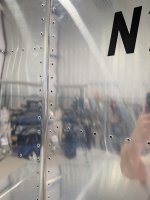
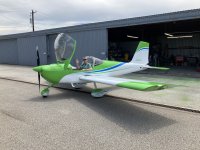
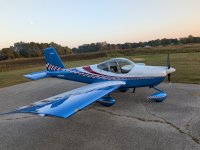
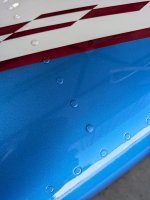
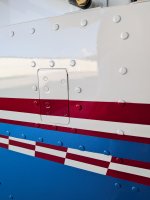
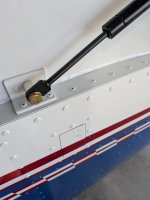
John Stahr and I painted my 12 in my hangar this past week. He was here for a week and I think the paint job came out spectacularly!!!

Was filling the mandrel holes worth a couple of day's of work? Absolutely! I would do it again in a heartbeat!

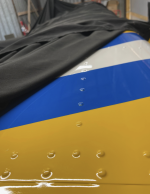
In one of the photos you can see some rivets on the canopy deck that I intentionally left un-filled as a point of reference. They are unseen when the canopy is closed.

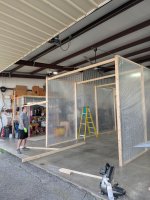
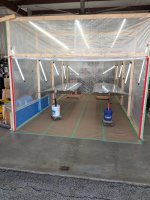
My son and I built this 12' x 24' paint booth in my hangar in about 6 hours. It only took 3 hours to tear it down.

PXL_20251003_225008880.jpg

PXL_20251004_172852424.jpg

PXL_20251004_172921397.jpg

PXL_20251004_184056669.jpg

PXL_20250920_135317124.jpg

PXL_20250920_183715662.jpg
 
Last edited:
Looks very nice but I wonder the extra time taken to make the plane look beautiful would have been the equivalent to using solid rivets in the first place.
Registration shows it as light sport, therefore, solid rivets is not an option.
 
Looks very nice but I wonder the extra time taken to make the plane look beautiful would have been the equivalent to using solid rivets in the first place.
The skins are .020" and the holes are all pre-punched to .128" for a 1/8" rivet. Good luck if you can pound thousands of 1/8" solid rivets without damaging the thin skins! Plus, many areas are not accessible because it was not designed to be put together with solid rivets.

Like I said, it was only a few days of work to fill and sand all the rivets once I found the automated application device shown in the first post.
 
The skins are .020" and the holes are all pre-punched to .128" for a 1/8" rivet. Good luck if you can pound thousands of 1/8" solid rivets without damaging the thin skins! Plus, many areas are not accessible because it was not designed to be put together with solid rivets.

Like I said, it was only a few days of work to fill and sand all the rivets once I found the automated application device shown in the first post.
It can be done. I did it on a Moni Motor-glider, but it is a lot of work. The wing skins were .020", one piece, trailing edge-to-trailing edge, but I did pulled rivets on the bottom.
 
So here's the follow up...

John Stahr and I painted my 12 in my hangar this past week. He was here for a week and I think the paint job came out spectacularly!!!

Was filling the mandrel holes worth a couple of day's of work? Absolutely! I would do it again in a heartbeat!

In one of the photos you can see some rivets on the canopy deck that I intentionally left un-filled as a point of reference. They are unseen when the canopy is closed.

My son and I built this 12' x 24' paint booth in my hangar in about 6 hours. It only took 3 hours to tear it down.

View attachment 98792

View attachment 98793

View attachment 98794

View attachment 98795

View attachment 98797

View attachment 98798
It looks like it turned out really well Tony, including filling the rivets. About the paint booth (asking because I also built a temp booth to paint my 6A). How did you deal with extracting the overspray and also with reducing dust and filtering the incoming air? I found that dust was the biggest challenge, followed by getting enough lighting inside the booth.

Nice work and all done in a week!
 
Looks very nice but I wonder the extra time taken to make the plane look beautiful would have been the equivalent to using solid rivets in the first place.
He said it took a couple days. It would be allot more for solid rivets BUT, the 12 was not designed for solid rivets so there are many places where it would be impossible to build it with solid rivets.
 
Didn't realize it was a light sport. As for setting 1\8 on .020 skins is not all that difficult as long as you can get at them.
That’s the issue. Many places are not accessible.

I would love to see a plane full of 1/8” solid rivets on .020 skins that looks as nice as using pulled 1/8 or 3/32 solid rivets. Not saying that a master riveter couldn’t do it but I would love to see it!
 
Last edited:
That’s the issue. Many places are not accessible.

I would love to see a plane full of 1/8” solid rivets on .020 skins that looks as nice as using pulled 1/8 or 3/32 solid rivets. Not saying that a master riveter couldn’t do it but I would love to see it!
Well if you can find an old issue of Sport Aviation, I believe it was May 1985.......There's an article on my Moni.
 
Last edited:
I’m planning to fill the pulled rivets on my RV-15. I watched a video of a guy doing a similar process on a sling and he was using superfill thinned with isopropyl alcohol instead of epoxy. It looked a little easier to deal with, thoughts on that?
 
I’m planning to fill the pulled rivets on my RV-15. I watched a video of a guy doing a similar process on a sling and he was using superfill thinned with isopropyl alcohol instead of epoxy. It looked a little easier to deal with, thoughts on that?
That sounds like a back breaker, filling all those holes.
 
I’m planning to fill the pulled rivets on my RV-15. I watched a video of a guy doing a similar process on a sling and he was using superfill thinned with isopropyl alcohol instead of epoxy. It looked a little easier to deal with, thoughts on that?
Like I said up in Post #5 (above), the SLing guys can do a fuselage in a day - it’s just tedious, not hard. If it takes a couple years to build a plane, what’s a couple (or a few) more days to fill the rivets?
 
Last edited:
Like I said up in Post #5 (above), the SLing guys can do a fuselage in a day - it’s just tedious, not hard. If it takes a couple years to build a plane, what’s a couple (or a few) more to fill the rivets?
I would have a rivet head filling party (with BBQ & Beer at the end) - a couple hours for each wing, really not a big deal ...

HFS
 
What I do..I fill my pop rivets (not many on a -4) with Proseal. I install the rivets "wet", then finger smear the hole with Proseal, and final wipe clean with MEK or Acetone. It fills well and is fully paintable.

 
As fixnflyguy said, ProSeal works well, but not everyone has that stuff readily available.

Another thing that works well is JB Weld, available at any Walmart, Autozone, etc. Just fill the rivet, wipe off the excess with acetone, and forget about it.
 
Back
Top