Van's Air Force

The definitive Van's Aircraft support community! Buying, building or flying an RV? Join our exclusive family of mentors and enthusiasts!

EarthX mounted in the cabin

TaylorL

I'm New Here
I’m curious if folks have been mounting EarthX batteries in the cabin and what has been done about the unlikely event of thermal runaway and the associated smoke? It looks like EarthX only has one vented option, and it’s not cheap.

The original design rv6 battery box is mounted to the forward most area of the floor right behind the firewall. My 6 was built with a smaller box mounted to the engine mount with adel clamps for a pc680. My pc680 died after only 2 years, EarthX now on order. I’ll put it back in the existing box, for temperature and battery longevity it would be nice to move it to the cabin floor area.

Thoughts?

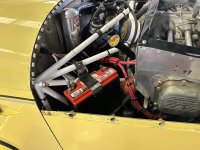
IMG_5372.jpeg
 
Recently made the change from a PC680 to ETX900, and its smaller companion for alternate ignition, a ETX5G.
I retained the original battery box, but installed a vent fitting (blue alu visible on the pic) exiting to the bottom of the fuselage, right aft of the cowl opening. The outlet shape of that fitting is canted so an eventual smoke should be extracted from the box. I also RTVed the lid of the box to make it air tight.
The last I did was to wire the BMS to my 3GX, and amend all my checklists to have any kind of battery fault point me to the planet ASAP.

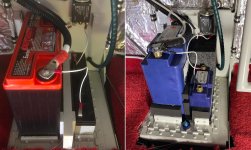
batt.jpg
 
RV-6A and I used the ETX900 VNT which has the vents that can be routed overboard. The other approach is to make a case that is pretty airtight and vented overboard. The vapors are noxious and you don’t want to breathe them. They are also flammable when exposed to an ignition source.
 
I just put one (ETX900-VNT) in my -6 in the standard battery box location behind the firewall in the middle of the floor. Used their hold down bracket and their vent fitting to go through the floor. Sealed up the fitting really well since it’s just aft of the tailpipes. I’m not terribly concerned about it, lithium iron-phosphate batteries are way less hazardous and more resilient than older lithium battery tech.
 
I do like the vented idea, the EarthX vent fitting looks good, didn’t realize that existed. If temps prove to be too high up front the vented model in the cabin may be in my future.
 
I do like the vented idea, the EarthX vent fitting looks good, didn’t realize that existed. If temps prove to be too high up front the vented model in the cabin may be in my future.
Earth X rates their ETX series batteries at an operating temp up to 140 F, Odyssey battery 113 F. Mine are FWF no issues. RV-14A.
 
I've learned over the years not talk bad about any product and only state the facts as I know them and have experienced them. With that said, I have personally experienced EarthX melting due to overcharging. They know about it and I'm sure have done everything to correct it, but at the end of the day you are relying on a chip to shut down overcharging. Just think twice about putting it in a cabin with no ventilation. I think they make a great battery in regards to performance. I have one in my Carbon Cub and it spins the prop beautifully. It sits under the front seat but I can open the door and/windows of my Cub in flight incase of smoke. You have to accept that something may go wrong and if it does, what will be the likely outcome. Sometimes, in order to mitigate risk, we have to choose something safer over better performance. If possible, just put them FWF.
 
I've learned over the years not talk bad about any product and only state the facts as I know them and have experienced them. With that said, I have personally experienced EarthX melting due to overcharging. They know about it and I'm sure have done everything to correct it, but at the end of the day you are relying on a chip to shut down overcharging. Just think twice about putting it in a cabin with no ventilation. I think they make a great battery in regards to performance. I have one in my Carbon Cub and it spins the prop beautifully. It sits under the front seat but I can open the door and/windows of my Cub in flight incase of smoke. You have to accept that something may go wrong and if it does, what will be the likely outcome. Sometimes, in order to mitigate risk, we have to choose something safer over better performance. If possible, just put them FWF.
In order for an EarthX to melt due to overcharging:
The alternator voltage regulator would have to fail
The over voltage circuit would have to fail
The BMS would have to fail.
Virtually impossible in a well constructed RV.
Perhaps you can provide more details so it doesn’t sound like you are not just talking bad about a product.
 
In order for an EarthX to melt due to overcharging:
The alternator voltage regulator would have to fail
The over voltage circuit would have to fail
The BMS would have to fail.
Virtually impossible in a well constructed RV.
Perhaps you can provide more details so it doesn’t sound like you are not just talking bad about a product.
Add to the list Earth X built-in flashing warning light (5 secs on and 5 secs off at 15.2 volts) and ignoring your EFIS alarm system warning providing audible ques at 14.6 volts. Not trying to pile on just want to understand this type of failure mode. How long did it take going from 14.2 volts to smoke?
 
Perhaps you can provide more details so it doesn’t sound like you are not just talking bad about a product.
Hey I'm just glad it's someone who actually had a failure, versus the endless repetition of "I knew a guy who..." That said, I agree it would be good to know specifics.
 
In order for an EarthX to melt due to overcharging:
The alternator voltage regulator would have to fail
The over voltage circuit would have to fail
The BMS would have to fail.
Virtually impossible in a well constructed RV.
Perhaps you can provide more details so it doesn’t sound like you are not just talking bad about a product.
To be complete and open an old wound there is one other failure mode. The alternator field wire on an B&C externally regulated alternator making a connection to the B lead effectively bypassing the regulator and OVP. Supposedly this did happen possibly with hardware store wire. I offered up a $50 contribution (standing offer) to VAF if anyone could provide photographic proof of two mil spec Tefzel insulated wire routed in parallel that made contact with each other. This resulted in a very well known expert to announce he would no longer contribute to VAF. The probability of this and a BMS failure simultaneously??
 
To be complete and open an old wound there is one other failure mode. The alternator field wire on an B&C externally regulated alternator making a connection to the B lead effectively bypassing the regulator and OVP. Supposedly this did happen. I offered up a $50 contribution (standing offer) to VAF if anyone could provide photographic proof of two mil spec Tefzel insulated wire routed in parallel that made contact with each other. This resulted in a very well known expert to announce he would no longer contribute to VAF. The probability of this and a BMS failure simultaneously??
This would explain why B&C recommends routing the B-lead separate from the field wire. Hadn't considered that failure mode but it makes sense.
 
I've learned over the years not talk bad about any product and only state the facts as I know them and have experienced them. With that said, I have personally experienced EarthX melting due to overcharging. They know about it and I'm sure have done everything to correct it, but at the end of the day you are relying on a chip to shut down overcharging. Just think twice about putting it in a cabin with no ventilation. I think they make a great battery in regards to performance. I have one in my Carbon Cub and it spins the prop beautifully. It sits under the front seat but I can open the door and/windows of my Cub in flight incase of smoke. You have to accept that something may go wrong and if it does, what will be the likely outcome. Sometimes, in order to mitigate risk, we have to choose something safer over better performance. If possible, just put them FWF.
Can you share the EarthX make/model and installation configuration? Also, the EMS data around (before, during and after) this event - plus photos, videos, whatever you have.

Seriously, I'd rather have MOSFETs + uController in a very well designed energy storage system turn the current off than just have the battery melt down through the cabin floor.

And to clarify a bit, it's overvoltage, which is why we have crowbar protections in the alternator, trench FET's, and other overvoltage protections in our electrical systems ( if you don't....well...).

Unfortunately, the electrical systems in our aircraft (Loads, Storage, Supply) do not typically contain a separate battery charging "system."

The battery is charged and discharged by virtue of the difference between the buss voltage and battery cell voltage (state of charge) -- if the buss voltage is higher than the battery, the battery will "charge"; the rate (amps) is determined by the deltaVoltage and internal resistance (impedance) of the battery. Additionally, the electrical supply (alternator) is constant Voltage -- not current -- so it will deliver as many Amps as the resistance in the circuit will allow at a given voltage (ed. there are other limiting factors at work too; flux saturation, heat, domain wells, etc.)

It's good practice to vent batteries, no matter the type, to the outside air (light reading -- https://iestbattery.com/case/analysis-gas-production-behavior-of-lfp-cell/).

@Mikeyb I am all in favor of opening old wounds and killing old wives tales... Otherwise we'd still believe the earth was flat, witches were made of wood, and so on :)
 
Last edited:
I’d also be interested to hear what caused the EarthX failure.

Our phones use a much more volatile lithium chemistry than the EarthX’s lithium iron phosphate. It’s not often you hear about an iPhone burning the house down while charging over night.
 
I’d also be interested to hear what caused the EarthX failure.

Our phones use a much more volatile lithium chemistry than the EarthX’s lithium iron phosphate. It’s not often you hear about an iPhone burning the house down while charging over night.
An iphone is fed by a controlled and throttled power source - 5V at an amp or two, so even if their BMS circuitry failed there is a limit to how quickly things could happen. When things go wrong in your plane, you can get voltage in the 20's and/or 60-80 amps of current. A typical USB power supply is far more safe than a vehicle charging system with a regulation failure. Failures like this are uncommon, but they can produce significant amounts of energy when they do.
 
I’m curious if folks have been mounting EarthX batteries in the cabin and what has been done about the unlikely event of thermal runaway and the associated smoke? It looks like EarthX only has one vented option, and it’s not cheap.

The original design rv6 battery box is mounted to the forward most area of the floor right behind the firewall. My 6 was built with a smaller box mounted to the engine mount with adel clamps for a pc680. My pc680 died after only 2 years, EarthX now on order. I’ll put it back in the existing box, for temperature and battery longevity it would be nice to move it to the cabin floor area.

Thoughts?

View attachment 98518
Side topic -- get rid of the plastic zip ties on the motor mount. Use adel-adel to stand off the wires/hoses from the mount.
 
I’m curious if folks have been mounting EarthX batteries in the cabin and what has been done about the unlikely event of thermal runaway and the associated smoke? It looks like EarthX only has one vented option, and it’s not cheap.

The original design rv6 battery box is mounted to the forward most area of the floor right behind the firewall. My 6 was built with a smaller box mounted to the engine mount with adel clamps for a pc680. My pc680 died after only 2 years, EarthX now on order. I’ll put it back in the existing box, for temperature and battery longevity it would be nice to move it to the cabin floor area.

Thoughts?

View attachment 98518
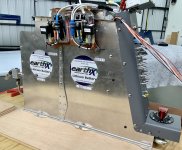
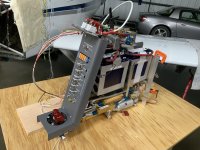
You want the EarthX ETX900-VNT. These have been certified for in-cabin installation in certified aircraft and have provision of overboarding noxious gases, though you really don’t need to worry about runaway events with a properly regulated installation. I've been flying two of these squawk free for almost 500 hours and will be publishing a comprehensive report on VAF soon. (see pics of my center console for a sneak preview) Mine are set up in a bilaterally symmetrical configuration such that you randomly select one as primary using the on-off-on master switch and the other is kept charged through a heafty schottkey diode. I also have dual electric fuel pumps in The cabin to supply Aiflow Performance FI, NO engine driven fuel pump, and two Lightspeed Plasma III ignitions. The two batteries NEVER see one another nor the same conditions making a simultaneous BMS failure nearly impossible. I fly routinly IFR over rugged mountains in the Western US and over largish bodies of water in complete confidence.
 

Attachments

  • IMG_7564.jpeg
    IMG_7564.jpeg
    2.1 MB · Views: 38
  • IMG_7561.jpeg
    IMG_7561.jpeg
    2.2 MB · Views: 39
Back
Top