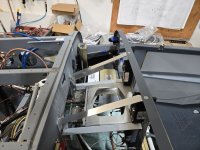
It's time to cut the panel! I've already cut off my sub-panel to panel support ribs to relocate them to either side of my center stack. Anybody care to share pictures of how you supported your center stack trays? I actually only have one tray (audio panel) to put in now, but I think I will go ahead and cut the panel opening for a future IFR GPS. I'd like to create a setup that makes it relatively easy to add the GPS tray when that day comes. Having never done this before, I'm not even quite sure what the "normal" method is for supporting everything in a typical center stack.

Van's Air Force
You are using an out of date browser. It may not display this or other websites correctly.
You should upgrade or use an alternative browser.
You should upgrade or use an alternative browser.
Panel Center Stack Structure - Tip-Up
- Thread starter skelrad
- Start date

Tip Up or Slider? I'm guessing it might make a difference.
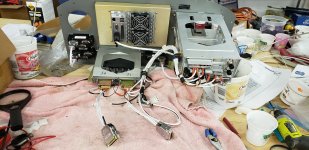
Anyway, here's how I did it on my slider. Just some angle around the hole I cut in the sub panel and more angle attached to the racks, which are also screwed to together at the back so they all make one big stiff box. Ignore that box on the bottom- that's the remote xponder mounted sideways under the radio rack behind the panel.
Anyway, here's how I did it on my slider. Just some angle around the hole I cut in the sub panel and more angle attached to the racks, which are also screwed to together at the back so they all make one big stiff box. Ignore that box on the bottom- that's the remote xponder mounted sideways under the radio rack behind the panel.
Attachments
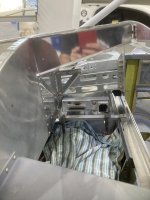
Oops, it's a tip-up, but seeing how you did yours still gives me some ideas. So are your racks dimpled to accept a screw head on the inside then, or am I not seeing it quite right?Tip Up or Slider? I'm guessing it might make a difference.
Anyway, here's how I did it on my slider. Just some angle around the hole I cut in the sub panel and more angle attached to the racks, which are also screwed to together at the back so they all make one big stiff box. Ignore that box on the bottom- that's the remote xponder mounted sideways under the radio rack behind the panel.
You're seeing it right. The Garmin racks come with bunch of holes pre-dimpled so you can screw them together a bunch of different ways. The fiber lock nuts on the top and bottom of the diagonal brace are on screws that are common to both the bracing and the racks. If you look close you can see through the rack and see a screw head thats doing the same thing on the other side.Oops, it's a tip-up, but seeing how you did yours still gives me some ideas. So are your racks dimpled to accept a screw head on the inside then, or am I not seeing it quite right?
Last edited:

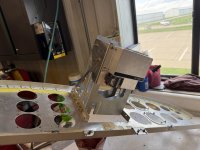
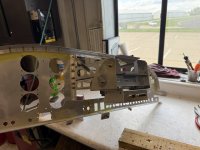

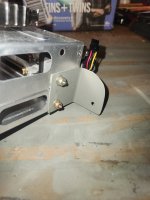
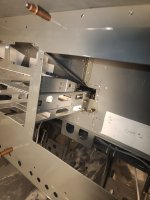
If you need to extend a long tray (e.g. GTN-650) through the next forward bulkhead as is common on the RV-10, you can add a forward support to the tray by adding a couple of nut plates.
Take the two screws out and the tray assembly comes out with rest of the panel in just a few minutes.
Carl
Take the two screws out and the tray assembly comes out with rest of the panel in just a few minutes.
Carl
Attachments

That’s quite a bit of unsupported weight on a tip up panel, suggest you install a support on the sub panel.Here’s how I did mine, just two aluminum angles to screw the trays to and a diagonal brace on each side. This is pretty typical of certified installations also. I also made a shelf to mount my GADs to.
Define "unsupported". The panel is 0.063", fastened to the structure with a vertical rib on either side of the stack, plus the center column to the floor. I've seen way heavier radio stacks mounted the same way in certified training airplanes that have endured thousands of hard landings without issue. I don't know what kind of loads you think it will be subjected to, but from my personal experience, it's more than adequate.That’s quite a bit of unsupported weight on a tip up panel, suggest you install a support on the sub panel.
While Walt and I rarely agree on anything, I suggest he has a point. See if you can fashion an anchor point on the foreward side of the stack. While the angle you have will most likely be fine, the stack acting like a pendulum could promote cracking over time. This is the same reason I never hang an oil cooler off the baffles.Define "unsupported". The panel is 0.063", fastened to the structure with a vertical rib on either side of the stack, plus the center column to the floor. I've seen way heavier radio stacks mounted the same way in certified training airplanes that have endured thousands of hard landings without issue. I don't know what kind of loads you think it will be subjected to, but from my personal experience, it's more than adequate.
I have cantilevered one install, a single GTN-650 on an RV-8 panel, but not a multiple radio stack. Trying to anchor the forward side of the 650 tray and still make it easy to remove the panel as an assembly proved problematic.
Carl
Attachments
Last edited:
Unsupported as in able to flex around the limited panel attachments to the airframe. The arm/weight of the radios will tend to bend the panel.Define "unsupported". The panel is 0.063", fastened to the structure with a vertical rib on either side of the stack, plus the center column to the floor. I've seen way heavier radio stacks mounted the same way in certified training airplanes that have endured thousands of hard landings without issue. I don't know what kind of loads you think it will be subjected to, but from my personal experience, it's more than adequate.
Try installing the panel and placing a 30lb weight on the radio stack and see what it does. (5lbs x 6G's)
Having worked in the certified world a bit myself, panels are always supported at the top and/or sides somehow.
Last edited:
Continuing in the theme of "I'm brand new to this," do you cut the panel openings the same size as the racks so they slide in from the front, or do you cut the panel opening to the size of the units themselves, meaning essentially the same size as the internal dimensions of the racks so the units themselves are all that slide through the panel face?

nilberg
Well Known Member
I used the ribs i cut out tomato room for the 2 10" Garmion GDUs: https://eaabuilderslog.org/?blprojentry&proj=7mmMuKEgA&e=7mmQ7SQvO&listcat=&sid=
The racks need to be flush with the panel, so that the bezel of the radios seat against the rack, not the panel face.Continuing in the theme of "I'm brand new to this," do you cut the panel openings the same size as the racks so they slide in from the front, or do you cut the panel opening to the size of the units themselves, meaning essentially the same size as the internal dimensions of the racks so the units themselves are all that slide through the panel face?
Yes, I make it so racks can be removed from the front, if you ever need to pull a rack out, you'll regret not making that opening large enough.Continuing in the theme of "I'm brand new to this," do you cut the panel openings the same size as the racks so they slide in from the front, or do you cut the panel opening to the size of the units themselves, meaning essentially the same size as the internal dimensions of the racks so the units themselves are all that slide through the panel face?
It's time to cut the panel! I've already cut off my sub-panel to panel support ribs to relocate them to….
I hope you have researched your potential “future IFR GPS” units for dimensional interference with the subpanel and things like canopy release mechanisms & such before cutting holes in your panel for the stack. Could be embarrassing if the future stuff won’t physically fit.I actually only have one tray (audio panel) to put in now, but I think I will go ahead and cut the panel opening for a future IFR GPS. I'd like to create a setup that makes it relatively easy to add…,
Yep, that's all been taken care of. At least as much as it can be not knowing what other options might exist in a few years (although the GPS market moves relatively slowly, so I'm not too worried about huge changes). The subpanel is cut and reinforced and will be able to accommodate just about any of the units I'd realistically use.I hope you have researched your potential “future IFR GPS” units for dimensional interference with the subpanel and things like canopy release mechanisms & such before cutting holes in your panel for the stack. Could be embarrassing if the future stuff won’t physically fit.
So others in the future have yet another picture to look at to sort out the options, here's what I ended up doing to support my center stack. Aluminum angle riveted to the panel and subpanel to support braces for my audio panel tray, as well as room in the future to support a future brace for my IFR GPS below. I also added a top angled support from the subpanel to the top of the panel to provide more rigidity. It ended up being a great place to adel clamp wire bundles going from the left to right side of the panel (because it's a tipup, I had to drop it down on the subpanel to clear the tipup frame).