
No.Here's a question to through into the mix. After you take the 2 day course, you have to go to FSDO to register with them, correct? So now you can sign off the plane you own. What if you sell that plane and get another EAB plane, do you need to back to the FSDO and reregister of are you good for any EAB you would own in the future?

Van's Air Force
You are using an out of date browser. It may not display this or other websites correctly.
You should upgrade or use an alternative browser.
You should upgrade or use an alternative browser.
Mosaic Rule and Repairman Certificate
- Thread starter SATCFI
- Start date

- Status
- Not open for further replies.

FlyingBanker
Well Known Member
Yes, you will be able to do the condition inspection on your purchased RV-14 with the LSRI certificate, presuming the RV-14 is owned by you (and not by an LLC or any other entity). If not owned by you, you would need the LSRM certificate to do the CI.I come to this thread with a high level of ignorance and I don’t have the patience to parse the regulations given I’m not confident I will reach correct conclusions.
I didn’t even know Sport Pilot is a pilot certificate whereas LSA is category of aircraft, AI taught me that. Yea, FAA defines seven “Categories” of aircraft… Airplane, Rotorcraft, Powered Lift, Glider, Lighter-Than-Air, Powered Parachute, or Weight-Shift Control,,, but EAA uses the lower-case term “category” here.
I just wanna know if I can do condition inspections on my purchased RV-14A. Reading this EAA page it seems the answer is yes, when MOSAIC takes effect October 22 2025, if I take a two-day LSRI (Light Sport Repairmen with an Inspection rating) course. If I take a “roughly three-week” LSRM (Light Sport Repairmen with a Maintenance rating) course I can do condition inspections on EAB aircraft I don’t own.
At present, I’m assuming EAA knows what they’re talking about.
You have to go back and register the next plane you buy.Here's a question to through into the mix. After you take the 2 day course, you have to go to FSDO to register with them, correct? So now you can sign off the plane you own. What if you sell that plane and get another EAB plane, do you need to back to the FSDO and reregister of are you good for any EAB you would own in the future?

It’s by tail number so back to the fsdoHere's a question to through into the mix. After you take the 2 day course, you have to go to FSDO to register with them, correct? So now you can sign off the plane you own. What if you sell that plane and get another EAB plane, do you need to back to the FSDO and reregister of are you good for any EAB you would own in the future?

I suspect that is the way it has been…do you know for a fact that once all of the FSDO procedures get caught up, that is the way it will be under MOSAIC? There is so much behind-the-scenes work for the FAA to do to make MOSAIC workable, that my guess it has been figured out yet. But I could be wrong!It’s by tail number so back to the fsdo
I'm not a lawyer but I think this is a very tricky question. The FAA treats non-profit flying clubs as if they are simply 100 man partnerships. So the 100 person partnership can own an EAB, and have its own internal rules about how the costs are shared. But I do not think the average EAB owner can lease his airplane to someone else, 1 person or 100 person partnership. In this case, however, it's tricky. The EAA is the owner, not unlike a LLC. It makes the plane available to its employees thru the employee flying club. The EAA cannot make any profit off the airplane because it is incorporated as a non-profit!! So I think it all depends on the details of the contract. If club members pay for all gas, maintenance, hangar fees, etc., and EAA corporation receives nothing, then I think it's okay. (the typical person leasing his airplane would never settle for no compensation. But maybe EAA does.)Skylor,
No, that is not correct. The regulation, and the operating limitations, prohibit "Carrying persons or property for compensation or hire". Leasing the aircraft to a flying club or other entity is perfectly legal. EAA does it themselves with the One Week Wonder RV-12. That airplane is amateur-built and is leased to the EAA Employee Flying Club. In fact, this is the reason EAA certificated that aircraft as amateur-built rather than ELSA, which it was also eligible for. An ELSA cannot be leased, but an amateur-built can.

You lost me there. Not really my area, and I’m ready to sit corrected, but:The EAA cannot make any profit off the airplane because it is incorporated as a non-profit!!
“Nonprofit” is a misleading term. In the US, nonprofits are absolutely allowed to make a profit (and most of them need to do so to survive). They just can’t pay that profit out to private parties, other than as reasonable compensation or salary for services etc. Basically, the profit needs to be put back into the nonprofit enterprise.
In fact, I’m on the board of a nonprofit that actually owns a for-profit company. This is allowed; the reverse not so much, apparently.

After the MOSAIC rule goes into effect, your certificate will no longer be N number specific and will apply to any experimental you own.It’s by tail number so back to the fsdo
I think bobs main point was that the eaa cannot be receiving any monetary compensation from the employees for the use of the plane. I can let anyone use my plane as long as I don’t charge them for such us. If only they are flying it, they can pay all of the expenses for that flight. If i am flying with them, they can only pay for 1/2 of the expenses.You lost me there. Not really my area, and I’m ready to sit corrected, but:
“Nonprofit” is a misleading term. In the US, nonprofits are absolutely allowed to make a profit (and most of them need to do so to survive). They just can’t pay that profit out to private parties, other than as reasonable compensation or salary for services etc. Basically, the profit needs to be put back into the nonprofit enterprise.
In fact, I’m on the board of a nonprofit that actually owns a for-profit company. This is allowed; the reverse not so much, apparently.
I think bob was suggesting that the club was non profit in the sense that if it is not charging employees for the plane usage, just expenses, then perfectly legal. Because no one is paying for the plane usage, it is like a partnership.
I suppose that could be true, but my guess is just like today, it's any LSA you own *and* the repairman's cert has the n number of... Can't see why it would be any different, just because it's also e-ab and lsaAfter the MOSAIC rule goes into effect, your certificate will no longer be N number specific and will apply to any experimental you own.
It’s redundant to put the N number on your certificate as your name is on the registration. Once you’re issued a repairman’s certificate , you won’t need another, ever, regardless of what experimental you buy/sell. Saves the FAA (and you) a few nickels.I suppose that could be true, but my guess is just like today, it's any LSA you own *and* the repairman's cert has the n number of... Can't see why it would be any different, just because it's also e-ab and lsa
Not at all sure that's true. Just looked at my Repairmans Cert. On the back it has: XIII Limitations: Inspection Certificate For Experimental Aircraft Make 2020 Finn Lassen, Model RV-4, Serial Number 2495 ...It’s redundant to put the N number on your certificate as your name is on the registration. Once you’re issued a repairman’s certificate , you won’t need another, ever, regardless of what experimental you buy/sell. Saves the FAA (and you) a few nickels.
I suspect it will be similar on the certs you get when you go to the FSDO with your completed 2-day course completion cert in hand. Time will prove me wrong or not.

I asked the original question but seems with the (stated as fact contradictory comments) no one knows for sure. I hope Paul's assumption is correct. I guess I will find out when I take my course in November.Not at all sure that's true. Just looked at my Repairmans Cert. On the back it has: XIII Limitations: Inspection Certificate For Experimental Aircraft Make 2020 Finn Lassen, Model RV-4, Serial Number 2495 ...
I suspect it will be similar on the certs you get when you go to the FSDO with your completed 2-day course completion cert in hand. Time will prove me wrong or not.
This is what I have found regarding this question. From https://www.faa.gov/newsroom/MOSAIC_Final_Rule_Issuance.pdf page 439:Here's a question to through into the mix. After you take the 2 day course, you have to go to FSDO to register with them, correct? So now you can sign off the plane you own. What if you sell that plane and get another EAB plane, do you need to back to the FSDO and reregister of are you good for any EAB you would own in the future?
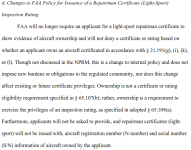
This is good news!This is what I have found regarding this question. From https://www.faa.gov/newsroom/MOSAIC_Final_Rule_Issuance.pdf page 439:
View attachment 95491
Let me answer/ask this way there are TWO LSA maintenance and inspection privilege's you gain by taking courses, one 3 days the other 15 days. There are still E-LSA's and S-LSA's. That has not changed. There are still EAB and Standard Certified planes, that is still the same, except now Sport Pilots can fly them. Sport pilot were limited to E-LSA and S-LSA before MOSAIC. The definition of what Sport Pilot can fly has expanded but that does not mean those planes with Vso 59kts (limit for Sport Pilot) are "LSA's".
BUT WHO CAN MAINTAIN and INSPECT WHAT?
One LSA maintenance course is Light Sport Repairman (LSR-I), 16 hours allows you to maintain and do condition inspection on any LSA you own (not others plane) but it is not necessarily you built the E-LSA or the S-LSA. Great that has been around, not new. Does that now extend to EAB's and Std Certified Planes? Don't think so.
The other LSA Repair and Inspection course II costs $4500, 15 days 120 hours and allows a person to repair and inspect (condition inspection) all LSA's, even ones they don't own or have built. Again it is a course to be a repairman / inspector of LSA's not EAB's or Std Certified Planes. This is the domain of A&P's.
Does the LSR-I privilege's include planes that Sport Pilot can now fly? Does LSR-I privlage now extend to EAB/Std Certified planes like a RV-6 or C-172 or C-182? No, at least not the Cessna's. That is A&P and AI only.
OP asked what about the EAB RV-6? An RV-6 is NOT an LSA but can be flown by a Sport Pilot formally limited to LSA's before MOSAIC, due to increase of Vso from 45kts to 59kts for Sport Pilots, 61kts for Pvt pilots can fly an RV-6. The RV-6 is still an EAB (experimental amateur built) airplane not an LSA. Yes? So who can maintain it now? Has that changed?
Before MOSAIC the RV-6 could ONLY be maintained and inspected (condition) by the Repairman (builder), or if not the builder with Repairman certificate, ONLY an A&P can do a condition inspections and major repairs.
So the answer is? The ONLY answer that counts is from "The Administrator". That is the FAA in DC or more spacific their lawyers. If they can't work it out it will go to judges. It may result in regulation amendments if needed.
(NOTE: LSA is no longer 1320lbs max gross, 120kts max speed, 45 kts Vso but 61 kts, however it is still not a RV-6 or C-182. To be an S-LSA or E-LSA it still has to be built under the auspices of the ASTM steering group. They have spacific engines for example. That has not changed. LSA's are NOT approved, certified or blessed by FAA. ASTM (American Society for Testing and Materials) sets light sport aircraft (LSA) specifications through consensus standards. When a LSA deviates, for example non approved engine, it becomes a EAB. RV-12 with an automotive engine is not an LSA, it is an EAB. LSA's now can be more complex to be sure but they have to go through the ASTM process.)
BUT WHO CAN MAINTAIN and INSPECT WHAT?
One LSA maintenance course is Light Sport Repairman (LSR-I), 16 hours allows you to maintain and do condition inspection on any LSA you own (not others plane) but it is not necessarily you built the E-LSA or the S-LSA. Great that has been around, not new. Does that now extend to EAB's and Std Certified Planes? Don't think so.
The other LSA Repair and Inspection course II costs $4500, 15 days 120 hours and allows a person to repair and inspect (condition inspection) all LSA's, even ones they don't own or have built. Again it is a course to be a repairman / inspector of LSA's not EAB's or Std Certified Planes. This is the domain of A&P's.
Does the LSR-I privilege's include planes that Sport Pilot can now fly? Does LSR-I privlage now extend to EAB/Std Certified planes like a RV-6 or C-172 or C-182? No, at least not the Cessna's. That is A&P and AI only.
OP asked what about the EAB RV-6? An RV-6 is NOT an LSA but can be flown by a Sport Pilot formally limited to LSA's before MOSAIC, due to increase of Vso from 45kts to 59kts for Sport Pilots, 61kts for Pvt pilots can fly an RV-6. The RV-6 is still an EAB (experimental amateur built) airplane not an LSA. Yes? So who can maintain it now? Has that changed?
Before MOSAIC the RV-6 could ONLY be maintained and inspected (condition) by the Repairman (builder), or if not the builder with Repairman certificate, ONLY an A&P can do a condition inspections and major repairs.
So the answer is? The ONLY answer that counts is from "The Administrator". That is the FAA in DC or more spacific their lawyers. If they can't work it out it will go to judges. It may result in regulation amendments if needed.
(NOTE: LSA is no longer 1320lbs max gross, 120kts max speed, 45 kts Vso but 61 kts, however it is still not a RV-6 or C-182. To be an S-LSA or E-LSA it still has to be built under the auspices of the ASTM steering group. They have spacific engines for example. That has not changed. LSA's are NOT approved, certified or blessed by FAA. ASTM (American Society for Testing and Materials) sets light sport aircraft (LSA) specifications through consensus standards. When a LSA deviates, for example non approved engine, it becomes a EAB. RV-12 with an automotive engine is not an LSA, it is an EAB. LSA's now can be more complex to be sure but they have to go through the ASTM process.)
Last edited:

That’s just not accurate. EAB that you own can be inspected by you, even if you didn’t build it given that you have completed the 16hr inspection course from one of the FAA approved schools (pre or post MOSAIC taking effect) and the proper paperwork submitted to the FSDO after MOSAIC taking effect in October.Let me answer/ask this way there are TWO LSA maintenance and inspection privilege's you gain by taking courses, one 3 days the other 15 days. There are still E-LSA's and S-LSA's. That has not changed. There are still EAB and Standard Certified planes, that is still the same, except now Sport Pilots can fly them. Sport pilot were limited to E-LSA and S-LSA before MOSAIC. The definition of what Sport Pilot can fly has expanded but that does not mean those planes with Vso 59kts (limit for Sport Pilot) are "LSA's".
BUT WHO CAN MAINTAIN and INSPECT WHAT?
One LSA maintenance course is Light Sport Repairman (LSR-I), 16 hours allows you to maintain and do condition inspection on any LSA you own (not others plane) but it is not necessarily you built the E-LSA or the S-LSA. Great that has been around, not new. Does that now extend to EAB's and Std Certified Planes? Don't think so.
The other LSA Repair and Inspection course II costs $4500, 15 days 120 hours and allows a person to repair and inspect (condition inspection) all LSA's, even ones they don't own or have built. Again it is a course to be a repairman / inspector of LSA's not EAB's or Std Certified Planes. This is the domain of A&P's.
Does the LSR-I privilege's include planes that Sport Pilot can now fly? Does LSR-I privlage now extend to EAB/Std Certified planes like a RV-6 or C-172 or C-182? No, at least not the Cessna's. That is A&P and AI only.
OP asked what about the EAB RV-6? An RV-6 is NOT an LSA but can be flown by a Sport Pilot formally limited to LSA's before MOSAIC, due to increase of Vso from 45kts to 59kts for Sport Pilots, 61kts for Pvt pilots can fly an RV-6. The RV-6 is still an EAB (experimental amateur built) airplane not an LSA. Yes? So who can maintain it now? Has that changed?
Before MOSAIC the RV-6 could ONLY be maintained and inspected (condition) by the Repairman (builder), or if not the builder with Repairman certificate, ONLY an A&P can do a condition inspections and major repairs.
So the answer is? The ONLY answer that counts is from "The Administrator". That is the FAA in DC or more spacific their lawyers. If they can't work it out it will go to judges. It may result in regulation amendments if needed.
(NOTE: LSA is no longer 1320lbs max gross, 120kts max speed, 45 kts Vso but 61 kts, however it is still not a RV-6 or C-182. To be an S-LSA or E-LSA it still has to be built under the auspices of the ASTM steering group. They have spacific engines for example. That has not changed. LSA's are NOT approved, certified or blessed by FAA. ASTM (American Society for Testing and Materials) sets light sport aircraft (LSA) specifications through consensus standards. When a LSA deviates, for example non approved engine, it becomes a EAB. RV-12 with an automotive engine is not an LSA, it is an EAB. LSA's now can be more complex to be sure but they have to go through the ASTM process.)

That’s just not accurate. EAB that you own can be inspected by you, even if you didn’t build it given that you have completed the 16hr inspection course from one of the FAA approved schools (pre or post MOSAIC taking effect) and the proper paperwork submitted to the FSDO after MOSAIC taking effect in October.
You are unfortunately correct, and the thread can only go further downhill from here. Jack is not here to learn and discuss rules as they are written, or how to manage them safely, or even to disagree from a reasonable perspective. He just wants to rant from a fog of confusion, and believes he is right about whatever he imagines because he's a CFII-MEL-ATP-DEP-FAA-GOD-ABCDEFG. It takes things way off track, then he stalks you in pages of DMs that continue to be full of nonsense. At some point it's no longer worth trying to discuss because he makes up new regs each step along the way.
Most people here have come to understand that the LSRM-(I or M) will be able to do inspections on EAB. It took a number of posts but it's good that someone posted clarifying language that the intention will be that an I does not need to list each owned aircraft on their certificate, relieving FSDO of some paperwork. This is good news.
Last edited:
Jack,Let me answer/ask this way there are TWO LSA maintenance and inspection privilege's you gain by taking courses, one 3 days the other 15 days. There are still E-LSA's and S-LSA's. That has not changed. There are still EAB and Standard Certified planes, that is still the same, except now Sport Pilots can fly them. Sport pilot were limited to E-LSA and S-LSA before MOSAIC. The definition of what Sport Pilot can fly has expanded but that does not mean those planes with Vso 59kts (limit for Sport Pilot) are "LSA's".
BUT WHO CAN MAINTAIN and INSPECT WHAT?
One LSA maintenance course is Light Sport Repairman (LSR-I), 16 hours allows you to maintain and do condition inspection on any LSA you own (not others plane) but it is not necessarily you built the E-LSA or the S-LSA. Great that has been around, not new. Does that now extend to EAB's and Std Certified Planes? Don't think so.
The other LSA Repair and Inspection course II costs $4500, 15 days 120 hours and allows a person to repair and inspect (condition inspection) all LSA's, even ones they don't own or have built. Again it is a course to be a repairman / inspector of LSA's not EAB's or Std Certified Planes. This is the domain of A&P's.
Does the LSR-I privilege's include planes that Sport Pilot can now fly? Does LSR-I privlage now extend to EAB/Std Certified planes like a RV-6 or C-172 or C-182? No, at least not the Cessna's. That is A&P and AI only.
OP asked what about the EAB RV-6? An RV-6 is NOT an LSA but can be flown by a Sport Pilot formally limited to LSA's before MOSAIC, due to increase of Vso from 45kts to 59kts for Sport Pilots, 61kts for Pvt pilots can fly an RV-6. The RV-6 is still an EAB (experimental amateur built) airplane not an LSA. Yes? So who can maintain it now? Has that changed?
Before MOSAIC the RV-6 could ONLY be maintained and inspected (condition) by the Repairman (builder), or if not the builder with Repairman certificate, ONLY an A&P can do a condition inspections and major repairs.
So the answer is? The ONLY answer that counts is from "The Administrator". That is the FAA in DC or more spacific their lawyers. If they can't work it out it will go to judges. It may result in regulation amendments if needed.
(NOTE: LSA is no longer 1320lbs max gross, 120kts max speed, 45 kts Vso but 61 kts, however it is still not a RV-6 or C-182. To be an S-LSA or E-LSA it still has to be built under the auspices of the ASTM steering group. They have spacific engines for example. That has not changed. LSA's are NOT approved, certified or blessed by FAA. ASTM (American Society for Testing and Materials) sets light sport aircraft (LSA) specifications through consensus standards. When a LSA deviates, for example non approved engine, it becomes a EAB. RV-12 with an automotive engine is not an LSA, it is an EAB. LSA's now can be more complex to be sure but they have to go through the ASTM process.)
Your info is incorrect.
Gasman is correct after Oct 22.
From the Federal Register:
This final rule is effective October 22, 2025, except for amendatory instructions 3, 8, 9, 13, 15, 17, 21, 23 through 26, 71, 72, 75, 76, and 80, which are effective July 24, 2026.
Amendatory instruction 66:
66. Add § 65.109 to subpart E to read as follows:
§ 65.109 Repairman certificate (light-sport): Privileges and limitations.
(a) The holder of a repairman certificate (light-sport) with an inspection rating may perform the annual condition inspection on an aircraft:
(1) That is owned by the holder;
(2) That has an experimental airworthiness certificate issued in accordance with § 21.191(g), (i), (k), or (l) of this chapter; and
(3) That is in the same category, and class as applicable, of aircraft for which the holder has completed the training course specified in § 65.107(c).
10. Repairman Certificate (Light-Sport) Privileges and Limitations
b. Expand Repairmen (Light-Sport) Privileges To Include EAB Aircraft Under § 21.191(g)
The 6th paragraph under 10. b. https://www.federalregister.gov/d/2025-13972/p-996
The changes adopted in § 65.109(a) and (b) of this final rule do not impose additional restrictions but rather expand the privileges of a light-sport repairman. Specifically, § 65.107(c) will allow a light-sport repairman with an inspection rating to perform the annual condition inspection on an EAB aircraft that is owned by the repairman and that is in the same category of aircraft for which the certificate holder was trained.271
My opinion from reading the Federal Register:
No where are specific tail numbers mentioned. Your Repairman certificate is valid for any EAB "that is owned by the holder"
Last edited:

There's a lot wrong in this post, but this one, all bolded and in-your-face, jumped out at me, and I'm sure others, who will point it out as well.Before MOSAIC the RV-6 could ONLY be maintained and inspected (condition) by the Repairman (builder), or if not the builder with Repairman certificate, ONLY an A&P can do a condition inspections and major repairs.
ANYONE can work on an EAB. ANYONE can do ANY work on it (except for prop work, I believe, but that's a nit).
Jack is absolutely incorrect in the statements that only the person with the Repairman cert or an A&P can do maintenance or repair on an EAB.
So, having made such a basic error, I'm not sure I would accept as fact the rest of the post(s).
After it goes into effect, the two day corse certificate will net you a repairman’s certificate and you won’t even need to own an aircraft. No more aircraft being identified on the certificate.Not at all sure that's true. Just looked at my Repairmans Cert. On the back it has: XIII Limitations: Inspection Certificate For Experimental Aircraft Make 2020 Finn Lassen, Model RV-4, Serial Number 2495 ...
I suspect it will be similar on the certs you get when you go to the FSDO with your completed 2-day course completion cert in hand. Time will prove me wrong or not.
After it goes into effect, the two day corse certificate will net you a repairman’s certificate and you won’t even need to own an aircraft. No more aircraft being identified on the certificate.
This is not true. It's unfortunate that people just keep throwing out incorrect information and causing confusion on the simple parts. This is covered about 100x on this forum by now.
With the 2 day course, you get the Inspection rating, and you must own the aircraft. The aircraft must be registered to the same name, an individual, on the LSRM-I certificate signing off the inspection.
"After it goes into effect, the two day corse certificate will net you a repairman’s certificate and you won’t even need to own an aircraft. No more aircraft being identified on the certificate."
"With the 2 day course, you get the Inspection rating, and you must own the aircraft. The aircraft must be registered to the same name, an individual, on the LSRM-I certificate signing off the inspection."
You two are both right.... Just understand what each other is saying.
"With the 2 day course, you get the Inspection rating, and you must own the aircraft. The aircraft must be registered to the same name, an individual, on the LSRM-I certificate signing off the inspection."
You two are both right.... Just understand what each other is saying.
I think I understand what they are both saying, and I think only N8DAV8R is correct. But this is MOSAIC, so I could be wrong."After it goes into effect, the two day corse certificate will net you a repairman’s certificate and you won’t even need to own an aircraft. No more aircraft being identified on the certificate."
"With the 2 day course, you get the Inspection rating, and you must own the aircraft. The aircraft must be registered to the same name, an individual, on the LSRM-I certificate signing off the inspection."
You two are both right.... Just understand what each other is saying.

Fair enough, if that's what he meant then it is technically correct....my post and your clarification should remain to avoid misinterpretation by the masses in case it was not just me. I did not think that ownership not being a prerequisite to get the LSRM was even a question but I see how it could be."After it goes into effect, the two day corse certificate will net you a repairman’s certificate and you won’t even need to own an aircraft. No more aircraft being identified on the certificate."
"With the 2 day course, you get the Inspection rating, and you must own the aircraft. The aircraft must be registered to the same name, an individual, on the LSRM-I certificate signing off the inspection."
You two are both right.... Just understand what each other is saying.
In the case of someone shopping around and looking at EAB or ELSA aircraft that are near or out of annual, there could be some value in taking the course ahead of time. It is true that you do not need to be an aircraft owner to get the certification. You also don't need to be a pilot. Or a citizen of the USA. The requirements for the certificate are fairly low. With the I rating you do absolutely need to own the aircraft you are signing off.
Other than the inherent risk with applying the inspection privileges after only a two day class, I'm curious what it would do to the resale value when the logs state that CIs were signed off by the NBO as opposed to the original builder or an A&P. seems like the FAA is giving enough rope and even some soap to get into trouble..
If you read the entire document you will see the FAA agrees with you. Their stated reason for easing the requirements for inspectors is that it is not logical to impose stringent requirements (e.g., A&P) on the inspector when the EAB airplane itself was built and given an AW certificate with zero evidence that its design or construction was safe or reasonable. We RV owners are spoiled, in that Vans has always produced quality products.….. seems like the FAA is giving enough rope and even some soap to get into trouble..
{heavy sigh}. You will get a repairman’s certificate after the two day course once MOSAIC goes into effect and the FAA won’t even ask you for registration information. To clarify, yes! You must own the aircraft you are inspecting but, that aircraft’s information WILL NOT be on your repairman’s certificate. Any ELSA,This is not true. It's unfortunate that people just keep throwing out incorrect information and causing confusion on the simple parts. This is covered about 100x on this forum by now.
With the 2 day course, you get the Inspection rating, and you must own the aircraft. The aircraft must be registered to the same name, an individual, on the LSRM-I certificate signing off the inspection.
Last edited:
{heavy sigh}. You will get a repairman’s certificate after the two day course once MOSAIC goes into effect and the FAA won’t even ask you for registration information. To clarify, yes! You must own the aircraft you are inspecting but, that aircraft’s information WILL NOT be on your repairman’s certificate. Any ELSA, SLSA, or EAB YOU OWN will be covered by that certificate.
Sorry for the misstep earlier.
Still some corrections though. On the minor end of things because maybe your wording is just unclear, but you can get the repairman certificate now there is no need to wait until MOSAIC is in effect. You also won't have the Repairman certificate after the class. You will still have to go through FDSO for it, there is just no need to list an aircraft. Like I said, little things but details matter to the people reading.
More importantly the I rating does not apply to SLSA. Only ELSA or EAB.
I think some terms are being used imprecisely:
Repairman's cert is what you get when you build the plane and go though the process of obtaining such.
LSRM is what you get from a 15 day class, distinct from the above.
LSRI is what you get from a 2 day class, distinct from above.
The LSR classes do not get you the repairmen cert but do offer similar privileges for an owned experimental plane.
I might be wrong, but the interchangeability of these in the discussions is getting under my crawl, better precision is in order.
Repairman's cert is what you get when you build the plane and go though the process of obtaining such.
LSRM is what you get from a 15 day class, distinct from the above.
LSRI is what you get from a 2 day class, distinct from above.
The LSR classes do not get you the repairmen cert but do offer similar privileges for an owned experimental plane.
I might be wrong, but the interchangeability of these in the discussions is getting under my crawl, better precision is in order.
I think some terms are being used imprecisely:
Repairman's cert is what you get when you build the plane and go though the process of obtaining such.
LSRM is what you get from a 15 day class, distinct from the above.
LSRI is what you get from a 2 day class, distinct from above.
The LSR classes do not get you the repairmen cert but do offer similar privileges for an owned experimental plane.
I might be wrong, but the interchangeability of these in the discussions is getting under my crawl, better precision is in order.
Sorry it bothers you, but Repairman is the correct terminology the light sport certificates. LSRM is kind of a screwy initialism that is used colloquially, but it is a Repairman certificate. Repairman is used as a distinction from Mechanic which applies to A&Ps.
65.107
+1If you read the entire document you will see the FAA agrees with you. Their stated reason for easing the requirements for inspectors is that it is not logical to impose stringent requirements (e.g., A&P) on the inspector when the EAB airplane itself was built and given an AW certificate with zero evidence that its design or construction was safe or reasonable. We RV owners are spoiled, in that Vans has always produced quality products.
The faa approach with eab seems to be you built it and only you will fly it, therefore we give you all the rope you want under the impression that you won’t take short cuts and kill yourself. So seems logical to do the same with ci’s. The big difference imo is that builders go through years of mistakes and learning with many chances to go back and address things. Very humbling and cannot possibly exit the process without a whole bunch of knowledge. Here we are letting folks who possibly don’t know what end of a screwdriver to use to jump right in and declare the plane as safe. Most are smart enough to do the work and get the help, but not everyone is like that. As a builder you eventually get the concept that my life depends upon me getting this right. Now a guy who buys an eab after taking his 172 to a mechanic for 10 years can sign it off tomorrow. Are we sure he is going to develop the concept that his mistakes can result in his death.
Maybe i am way overthinking this, as we give new eab owners the rights to do their own maintenance and oversight is only once a year. This doesn’t seem to hurt the safety stats, so maybe this is a logical extension with no issue. I guess time will tell us whether this was a good idea.
Last edited:
Time and fatality statistics.I guess time will tell us whether this was a good idea.
I half agree with you. “Repairman” is part of the correct terminology for everything we’re talking about. But the regs and terminology still differ.Sorry it bothers you, but Repairman is the correct terminology the light sport certificates. LSRM is kind of a screwy initialism that is used colloquially, but it is a Repairman certificate. Repairman is used as a distinction from Mechanic which applies to A&Ps.
65.107
65.104 - “repairman certificate (experimental aircraft builder).” What everyone previously called a “repairman certificate.”
65.107(b) - “repairman certificate (light-sport aircraft) with an inspection rating.” What is currently being colloquially referred to as the new “LSRI”. The short course. Note the terminology for this basic certificate is a bit weird because in A&P land an “inspection” authorization is the harder thing to get.
65.107(c) - “repairman certificate (light-sport aircraft) with a maintenance rating.” What is currently being colloquially referred to as the new “LSRM.” The long course. Another terminology foul by the FAA, since this cert confusingly gives you something equivalent to “IA” authority for EABs, on which literally anyone, regardless of education, can do “maintenance.”
In my perfect OCD world things would be different!
- we’d describe these as something like “104 certificates, 107b certificates, and 107c certificates”
- we’d refer to “LSAs” as “Part 22 Aircraft” (avoiding the FAA’s confusing continued use of the word “sport”), and
- we’d never, ever use the phrase “light sport pilot” (which was never actually a thing), saying only “sport pilot.”
But I am good-naturedly howling into the wind,—and because this is MOSAIC, I may be wrong. Seriously, there's a good chance I’m wrong about something in this post. But I do try.
Last edited:
Here we are letting folks who possibly don’t know what end of a screwdriver to use to jump right in and declare the plane as safe. Most are smart enough to do the work and get the help, but not everyone is like that. As a builder you eventually get the concept that my life depends upon me getting this right. Now a guy who buys an eab after taking his 172 to a mechanic for 10 years can sign it off tomorrow. Are we sure he is going to develop the concept that his mistakes can result in his death.
Maybe i am way overthinking this, as we give new eab owners the rights to do their own maintenance and oversight is only once a year. This doesn’t seem to hurt the safety stats, so maybe this is a logical extension with no issue. I guess time will tell us whether this was a good idea.
Maybe. This is all perfectly reasonable, yet still were left with the fact that we're all humans doing this and with a base level of training the attention of the individual performing the inspection is what really matters.
I got this yesterday from a friend regarding an annual performed by an IA on his certified aircraft, the highest of GA standard.
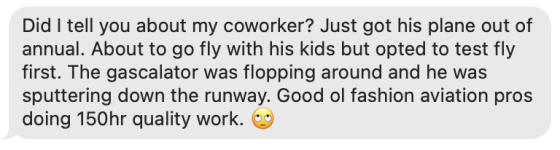
Agree 100%. Some of the worst work I have seen performed across many planes I have inspected or helped to repair have been by A&Ps. However, great effort was exerted to educate these folks, mentor them and even test them, so it is mostly down to the individual being ill suited to the profession. If any old guy can walk into a 2 day course and start signing off planes, well the safety net is removed and we allow lack of knowlege to the list of what can make a bad mechanic. If we are not doing all those things, a much larger percentage of bad mechanics are the result.Maybe. This is all perfectly reasonable, yet still were left with the fact that we're all humans doing this and with a base level of training the attention of the individual performing the inspection is what really matters.
I got this yesterday from a friend regarding an annual performed by an IA on his certified aircraft, the highest of GA standard.
View attachment 95645
I feel the maintenance aspect is different. The unskilled guy looks at the plane and say "Wow, I just don't know what I am doing here, so I'll bring in someone to do it." For CI's, the temptation to say "I got this" is much higher, as there is no overwhelming task in front of them scaring them away from doing. This could be an insidious danger. We are expecting them to know that hidden dangers, capable of killing, them could be lurking below and that they need a whole bunch of knowledge and experience to find them. Certainly many will figure that out and seek help, but fear a decent portion may not. I sure hope that level of caution is served in a heavy dose at the 2 day class.
There's a lot wrong in this post, but this one, all bolded and in-your-face, jumped out at me, and I'm sure others, who will point it out as well.
ANYONE can work on an EAB. ANYONE can do ANY work on it (except for prop work, I believe, but that's a nit).
Jack is absolutely incorrect in the statements that only the person with the Repairman cert or an A&P can do maintenance or repair on an EAB.
So, having made such a basic error, I'm not sure I would accept as fact the rest of the post(s).
Well no. NOT anyone can work on it. You need a pilot licensed if you want to be picky... I mean CONDITION INSPECTION.
I NEVER said MAINTENACE... Pilot can do "Maintenance" on a Cesena. Not my first Rodo. You are making Strawman arguments.
The FAR's are clear about preventative maintenance. Not even an A&P can sign off annuals for a Cessna (Need to be an IA).
Be very careful about your broad ANYONE can do anything to and EAB.... (My words but if you are going to put words in my mouth).
YOU CAN NOT KEEP AN EAB AIRWORTHY... MEANING CONDITION INSPECTION, UNLESS YOU BUILT IT OR YOU ARE AN A&P. Oil changes, tires, brakes go for it. Now major repair or modification, that is a different story. You better get the mother ship approval.
Be spacific. I will rebut with, you are wrong. Now prove it. Ha ha.Jack,
Your info is incorrect.
So you can apply for the Repairman (to do Condition inspection, anyone can work on a plane with a pilots license) If you take the weekend course AND apply for it with your local FAA FSDO... Great.
Last edited:
Be spacific. I will rebut with, you are wrong. Now prove it. Ha ha.
I heard from RV7A flyer who thinks I was talking about "maintenance" like oil changes, brakes, tires. That is a strawman.
I am talking CONDITION INSPECTION, continued airworthiness. Say you are a 2nd hand RV owner, you can NOT sign that off the required every 12 months Condition Inspection. Period. Does not matter if you have your LSA repair/inspector ticket. RV's are NOT LSA's (except the RV-12 S-LSA/E-LSA). You have to have BUILT it or be an A&P to maintain airworthiness. Nuff said. If I am wrong give me the reference in writing from FAA.
To muddy waters there is a LSA repair/inspect course as I mention you can take and do the condition inspections even though you did not build the LSA. That is OK! It has been before MOSAIC. As far as I know the LSA course for repair/inspect does not apply to EAB Aircraft, which are NOT LSA's and likely never will be. Sorry. LSA can become an EAB (change out the approved engine for one not approved). EAB can not be an LSA UNLESS it was built per the ASTM standards at the time (which just changed LSA standards). Otherwise it is an EAB.
Huh? Did you read the forum?
p1: https://vansairforce.net/threads/mosaic-rule-and-repairman-certificate.236607/post-1859811
Thank you for the reference. I found the reference as well and was coming back to correct my mistake... That is breathtaking... Basically all our planes for all intents and purposes (stall below 61kts in landing config) are INDEED like an LSA... So why have LSA's? Anyway that is great for selling my RV in the future. It increases the value.Huh? Did you read the forum?
p1: https://vansairforce.net/threads/mosaic-rule-and-repairman-certificate.236607/post-1859811
FlyingBanker
Well Known Member
This is correct today, but won’t be correct after Oct 22. If you take and pass the two day (16 hr) LSR-I course you will get an LSR-I completion certificate. After Oct 22 you can then take that completion certificate to the FSDO and they will issue you an LSR-I Certificate. That certificate WILL authorize you to conduct and sign off on the condition inspection for any EAB aircraft you own. That certificate will not list any specific N-number on it but does only authorize you to complete the CI for an EAB you own (must be titled in the name on your LSR-I certificate).YOU CAN NOT KEEP AN EAB AIRWORTHY... MEANING CONDITION INSPECTION, UNLESS YOU BUILT IT OR YOU ARE AN A&P. Oil changes, tires, brakes go for it. Now major repair or modification, that is a different story. You better get the mother ship approval.
YOU CAN NOT KEEP AN EAB AIRWORTHY... MEANING CONDITION INSPECTION, UNLESS YOU BUILT IT OR YOU ARE AN A&P. Oil changes, tires, brakes go for it. Now major repair or modification, that is a different story. You better get the mother ship approval.
Since you insist that words are important (and I agree with you on that) No EAB is ever AIRWORTHY in the eyes of the FAA - the best they can be is “in a condition for safe operation”.
And anyone - including Joe the Janitor who just wandered into the hangar from the office wing - can make all the modifications they want to an EAB - no certificate required. Don’t confuse the owner-allowed maintenance tasks for certified aircraft with the EAB world. The ONLY thing you need a Repairman’s certificate or A&P for in the EAB world is the Condition Inspection.

False. No need to be a pilot to wrench an EAB.Well no. NOT anyone can work on it. You need a pilot licensed if you want to be picky...
It's not worth arguing with him...he just keeps getting so many things wrong while insisting he's right, then ducking into what he thinks is clever wordplay (it's not) when his gross misstatements are pointed out.False. No need to be a pilot to wrench an EAB.
understand your point in this particular discussion and is dead on. However, The faa does issue an airworthiness certificate to eab’s, so can’t really say they never classify or consider an eab as airworthy. Yes that cert is issued based upon someone attesting only to it being in a safe condition, but a certificate of airworthiness is legally required. We just document the ongoing requirements of maintaining that certificate with terminology that doesn’t include “airworthiness.”Since you insist that words are important (and I agree with you on that) No EAB is ever AIRWORTHY in the eyes of the FAA - the best they can be is “in a condition for safe operation”.
.
What they teach at the Academy in OKC s that while there is an unfortunate coincidence in the terms “Airworthy” and “Airworthiness Certificate”, they are actually terms being used in two different contexts. A certified Aircrfat has a Standard Airworthiness Certificate, and therefor the common meaning (and understanding) of the term “Airworthy” applies. Experimental (and a few other flying vehicles) have a Special Airworthiness Certificate, which has nothing to do with the word “Airworthy” the way it applies to certified aircraft. The truth is that the term (and certificate) exists before the “special” category was created, and scene yes, all Aircrfat must have an Airworthiness Certificate, they created the Special certificate….but it means something entirely different.understand your point in this particular discussion and is dead on. However, The faa does issue an airworthiness certificate to eab’s, so can’t really say they never classify or consider an eab as airworthy. Yes that cert is issued based upon someone attesting only to it being in a safe condition, but a certificate of airworthiness is legally required. We just document the ongoing requirements of maintaining that certificate with terminology that doesn’t include “airworthiness.”
And now you can go have two shots of tequila and see if it soothes your aching head……

I will skip the shots and just take comfort in the fact that I don’t have to deal with govt agencies on a regular basis.What they teach at the Academy in OKC s that while there is an unfortunate coincidence in the terms “Airworthy” and “Airworthiness Certificate”, they are actually terms being used in two different contexts. A certified Aircrfat has a Standard Airworthiness Certificate, and therefor the common meaning (and understanding) of the term “Airworthy” applies. Experimental (and a few other flying vehicles) have a Special Airworthiness Certificate, which has nothing to do with the word “Airworthy” the way it applies to certified aircraft. The truth is that the term (and certificate) exists before the “special” category was created, and scene yes, all Aircrfat must have an Airworthiness Certificate, they created the Special certificate….but it means something entirely different.
And now you can go have two shots of tequila and see if it soothes your aching head……

I recall 21-years ago when my local FSDO inspector came out and spent 6-hours pouring over my newly completed RV-9A--it's first inspection! And then, he awarded the airplane it's airworthiness certificate--okay, now it's considered "airworthy". So next, I test fly the airplane, and it proves to be "airworthy". After 25-hours of test flying it within 25nm of the home airport, my local FSDO inspector comes out again. He spends another 6-hours going over how to keep my airplane "airworthy" (his own words) through the annual condition inspection using a checklist I made for that. He said when he first arrived "if I don't feel your capable of holding a Repairman's certificate, I'm not obligated to issue one". The process essentially felt like a practical and oral test, and then he awarded the Repairman's certificate. I had many years of owner assisted maintenance and annual inspections on other airplanes I owned, which was helpful. And, it's a really good idea to work with an A&P to gain some practical experience before maintaining any airplane for the first time, including your newly completed experimental, which really means "unique airworthiness certificate"--not "type airworthiness certificate". 
Last edited:
My post was wrong and was corrected, that taking a LSA course (weekend) will allow you to now to sign off the annual condition inspection on a EAB you did not build (but now own). OK.
NOW a person with no experience building a plane, maintaining or inspecting can buy a complex high performance EAB (not a simple LSA) they did not build, take a weekend LSA class, then do Condition Inspections? OK.
Here is my observation:
I helped a Gent who built a beautiful Van's RV-12 E-LSA, I am EAA Tech advisor, did final inspection report and found some issues, helped him through correcting things, his registration, FAA PPW, flight test.... Etc. Phase 1 was done, showed him how to maintain log books. He was not sure what FAA told him about repairman certificate. I got him connected with one of only a few companies/schools that teaches the LSA classes. He signed up, had to wait many months, took class (out of state), applied for his repairman. Done. He was on his own at this point. Remember he also built it. Great!
Jump forward a year, he has flown it a good bit, calls me and asks how to do a condition inspection, what to write in the Log book, what is a compression test, how to do it basically. I explain it all to him and give him all the references. Here is my observation and point....
LSA is a simple thing (or was) fixed prop (or gnd adjust), fixed gear and one of a handful of approved LSA engines: Continental (O-200, Cessna Sky Catcher, Vashon Ranger ), Jabiru, and ULPower and Lyc IO-233 (I never heard of it but it has been made, flies in the Renegade LSA). Engines must meet certain ASTM standards for LSA to be used. LSA (past) limited engine choices, fixed gear and prop. This two day LSA course was for these simplex LSA airplanes. Will the LSA course now include EAB's, constant speed props, retract gear?
NOW Mosaic: A person with no experience building a plane, maintaining or inspecting an airplane or anything, can buy a complex high performance EAB, take the LSA class for two days and do the Condition Inspections on a complex and high performance plane? Really? LSA classes, two days, are not full of exams and practical test. They are from what I see, at least for the short two day course, a very general superficial seminar with no real bench mark in competency. One graduate was not taught about compression test? Log book entries?
I'm seriously thinking of taking the longer 150 hr LSA course that cost about $4,500 (plus travel, lodging, food). It is only offered 4 times a year at the school nearest me (420 miles). I am after completion of course, for all intents and purposes an equivalent to an A&P and IA for LSA's and EAB's! The longer course does not restrict you to a plane you own. You can work on anyone's LSA or EAB? Really?
FAA really thought about this? Who is the FAA today? Do they have experience? I'm a tiny bit worried plane safety due to poor maintenance and inspections might take a hit? Accidents? I hope not. However if it does, expect more regulations. Add to this health (medicals) optional now for all intents and purposes for GA in light planes, and inexperienced Sport Pilots taught by inexperienced CFI-S (sport) instructors flying complex or high performance planes? I am frankly a little gobsmacked. In 40 yrs never seen anything this sweeping affecting so many things ostensibly contradicting the intents of long held principles and regulations (like the whole Sport Pilot LSA things which was outgrowth of ultralights.)
My complaint is those who have built EAB's know you learn a lot. Repairman meant something. Even though building does not necessarily make you a great maintainer or inspector out the box, having built the plane is a bonus in knowledge and experience to build on. FAA threw that out the window for a generic cursory 2 day course. OK. This is an amazing loosing or expanding of Sport Pilot Privilege's, Medicals (not required) and Inspection privilege's (with little experience/training required).
NOW a person with no experience building a plane, maintaining or inspecting can buy a complex high performance EAB (not a simple LSA) they did not build, take a weekend LSA class, then do Condition Inspections? OK.
Here is my observation:
I helped a Gent who built a beautiful Van's RV-12 E-LSA, I am EAA Tech advisor, did final inspection report and found some issues, helped him through correcting things, his registration, FAA PPW, flight test.... Etc. Phase 1 was done, showed him how to maintain log books. He was not sure what FAA told him about repairman certificate. I got him connected with one of only a few companies/schools that teaches the LSA classes. He signed up, had to wait many months, took class (out of state), applied for his repairman. Done. He was on his own at this point. Remember he also built it. Great!
Jump forward a year, he has flown it a good bit, calls me and asks how to do a condition inspection, what to write in the Log book, what is a compression test, how to do it basically. I explain it all to him and give him all the references. Here is my observation and point....
LSA is a simple thing (or was) fixed prop (or gnd adjust), fixed gear and one of a handful of approved LSA engines: Continental (O-200, Cessna Sky Catcher, Vashon Ranger ), Jabiru, and ULPower and Lyc IO-233 (I never heard of it but it has been made, flies in the Renegade LSA). Engines must meet certain ASTM standards for LSA to be used. LSA (past) limited engine choices, fixed gear and prop. This two day LSA course was for these simplex LSA airplanes. Will the LSA course now include EAB's, constant speed props, retract gear?
NOW Mosaic: A person with no experience building a plane, maintaining or inspecting an airplane or anything, can buy a complex high performance EAB, take the LSA class for two days and do the Condition Inspections on a complex and high performance plane? Really? LSA classes, two days, are not full of exams and practical test. They are from what I see, at least for the short two day course, a very general superficial seminar with no real bench mark in competency. One graduate was not taught about compression test? Log book entries?
I'm seriously thinking of taking the longer 150 hr LSA course that cost about $4,500 (plus travel, lodging, food). It is only offered 4 times a year at the school nearest me (420 miles). I am after completion of course, for all intents and purposes an equivalent to an A&P and IA for LSA's and EAB's! The longer course does not restrict you to a plane you own. You can work on anyone's LSA or EAB? Really?
FAA really thought about this? Who is the FAA today? Do they have experience? I'm a tiny bit worried plane safety due to poor maintenance and inspections might take a hit? Accidents? I hope not. However if it does, expect more regulations. Add to this health (medicals) optional now for all intents and purposes for GA in light planes, and inexperienced Sport Pilots taught by inexperienced CFI-S (sport) instructors flying complex or high performance planes? I am frankly a little gobsmacked. In 40 yrs never seen anything this sweeping affecting so many things ostensibly contradicting the intents of long held principles and regulations (like the whole Sport Pilot LSA things which was outgrowth of ultralights.)
My complaint is those who have built EAB's know you learn a lot. Repairman meant something. Even though building does not necessarily make you a great maintainer or inspector out the box, having built the plane is a bonus in knowledge and experience to build on. FAA threw that out the window for a generic cursory 2 day course. OK. This is an amazing loosing or expanding of Sport Pilot Privilege's, Medicals (not required) and Inspection privilege's (with little experience/training required).
Last edited:
- Status
- Not open for further replies.
