
I'm interested in manipulating the CG of my 8A a bit and I believe the original builder used tail ballast and then later removed it due to feeling heavier in pitch. With an AV 360 and a CS prop, it's always nose-heavy. As it sat when last flying, I need 40-50 pounds of ballast in the baggage compartment to get inside the envelope for solo flight, and my perception is that this increases stall speed enough that it lands a hair fast at typical solo loading. I'd like to see pictures of what others may have done to add a little ballast somewhere in the empennage. Which structures support it? How is it attached? Thanks!

Van's Air Force
You are using an out of date browser. It may not display this or other websites correctly.
You should upgrade or use an alternative browser.
You should upgrade or use an alternative browser.
Photos of Tail Ballast
- Thread starter skirting_virga
- Start date



Jjackh10
Well Known Member
There's an older thread that discusses different methods of tail ballast for an rv-8. Some pretty clever solutions too.
Don't know how to insert links, hope that works haha.
Optimizing Center of Gravity for Aerobatics
Did you ever wonder why two-seat aerobatic airplanes like the Extra 330LX, the Pitts S2 or the Decathlon are flown solo from the rear seat? It’s all about managing the center of gravity (CG) for optimum aerobatic performance. Since the passenger seats in the above examples are located almost...
vansairforce.net
Don't know how to insert links, hope that works haha.
Honestly, not confident, but it's the W&B done by the original builder 4 years ago. It was pre-paint and I suspect there may have been a couple of minor other changes since it was done. I can't do another until the plane has an engine on it, but it's definitely something that's on my radar. The 8/8A has the pitfall of tending to end up with a forward CofG that is exacerbated by AV engines and CS props (as mine has). This one purports to have a basic empty CG of 75.6" and a basic empty weight of 1051#. I assume the tricycle gear model (which this is) may tend to be a little more forward vs. the taildragger.How confident are you in the W&B measurements that you are using? 50lbs in the baggage compartment sounds like a lot.
Of note, I believe limiting the nosewheel weight is most of the reason for so much ballast. The oxygen tank in the forward baggage doesn't help - I would prefer it go in the back but for the time being I need access to the valve to turn it on before flight.
I get this but read Daveflier's post below. I'd say that level of routine, real-world testing is a lot more than I'd be willing to do. I do respect the unknown generally because aero engineering is likely a minefield of unintended consequences.Adding ballast in the tail could have a negative impact on spin recovery, I've read.
I only saw the one solution with a picture. It's good but probably more involved than I'd want to do and I'm really looking for details on the attachment of the load, which that picture lacks.There's an older thread that discusses different methods of tail ballast for an rv-8. Some pretty clever solutions too.
This is incredibly useful but I would love to see photos of your ballast configuration if you have any from when it was done. I'm wondering what station 224.88 aft corresponds to in terms of what part of the empennage it's attached to. When I was playing around with the idea of doing this, I estimated 218" aft so it's nice to know there's a little more lever arm available.I have flown the last 400 hours in my RV-8 with 18,8 lbs of ballast (divers weights) fastened with heavy duty zip tie at station 224.88I mainly fly my aircraft solo for mainly aerobatic flights. If I do take a passenger..and that is rare, I have to remove the ballast if the pax weighs over 175lbs so as not to exceed the aft c.g. Limitations. I perform 1 turn,11/2 turn completion spins numerous times a week. The most number of turns I have done is 4, but I have no need to go past 11/2 turns. In 400 hours of solo flight I have never experienced any recovery anamolies .I have never flown aerobatics with a passenger as that would exceed the aircraft weight limits.
Ron Shreck one of the members here who was quite involved with aerobatics had a small maybe 1” PVC pipe with a screw on cap/plug on each end to allow for filling and emptying of lead shot to adjust CG. He had it located in inboard area of the horizontal stabilizer with the filler hole through the fiberglass flaring and the emptying hole on the underside.
Maybe he’ll chime in with a picture, I thought it was very ingenious putting the lest weight possible as far aft as possible to get the desired results.
Maybe he’ll chime in with a picture, I thought it was very ingenious putting the lest weight possible as far aft as possible to get the desired results.
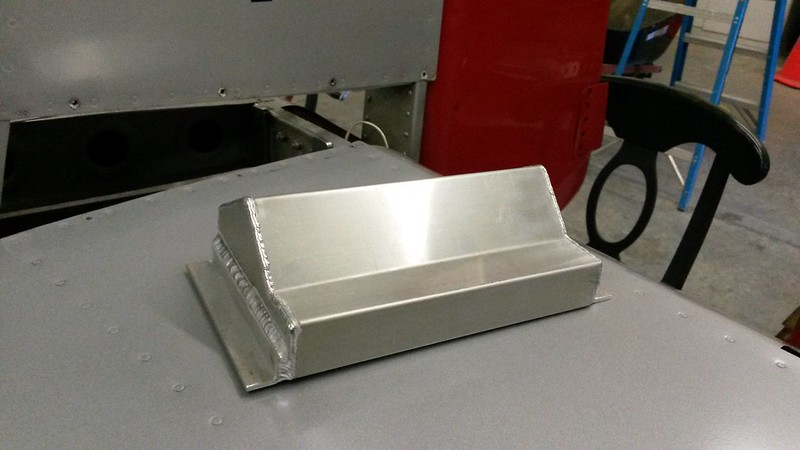
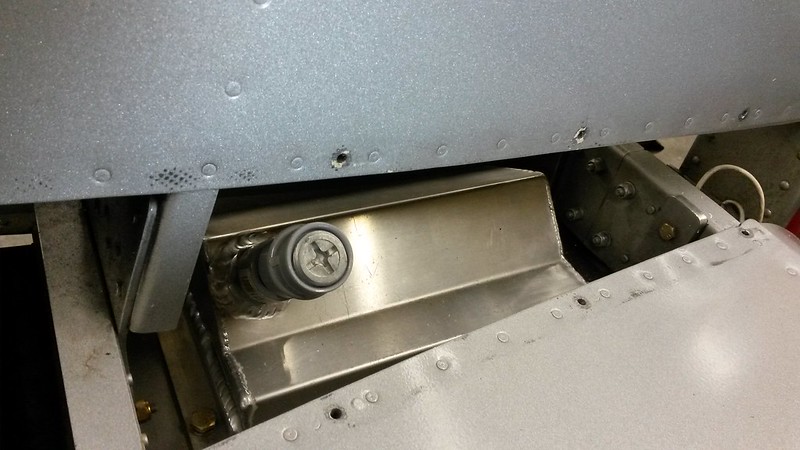
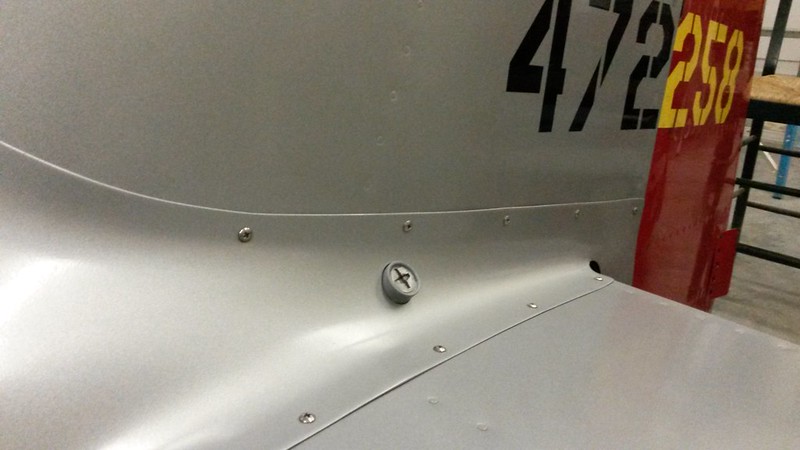

Cool setup! How do you empy it if you need to carry a heavy passenger?Here they are......
BALLAST BOX AFTER WELDING SEAMS
FILLER NECK INSTALLED WITH BOX MOUNTED
FAIRING INSTALLED
FILLING BALLAST BOX WITH #9 LEAD SHOT
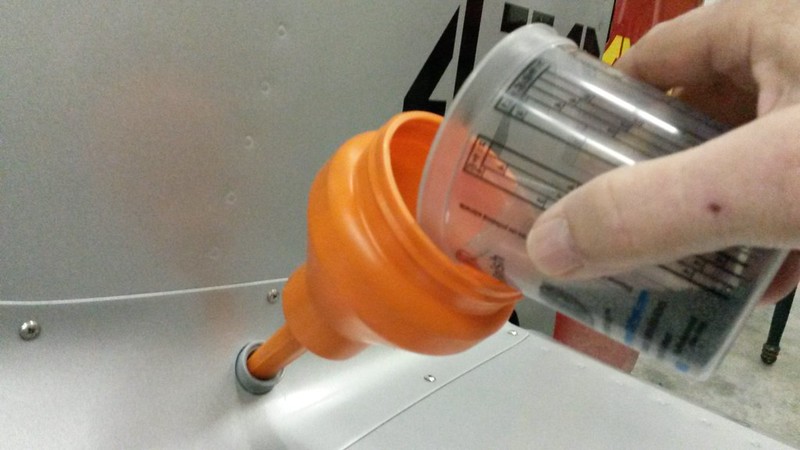
Mine had 10 pounds of ballast in the tail to help it balance better with the nose heavy characteristic by the builder. It worked quite well. I’m looking at reinstalling them to help with moving the CG aft to make it like spins instead of trying to go into spiral’s. It shouldn’t be too hard to do considering the mounting points are already back there. I just have to get the dimensions for the lead ingots. They worked before, I don’t see why they wouldn’t now! If I was carrying someone heavy, I just took the fairing off and pulled them out. Not nearly as fast as the box that Ron built but it worked.

I use these bags filled with sand in the rear baggage area when flying solo. Keeps the stick forces lighter, and I don't get lazy on landing.
I filled each with 15 pounds of play sand, marked the weight with a paint marker, and usually fly with four back there. Easy to add or remove bags.
I initially used them during phase 1 to explore the CG envelope.
Once when I had them in there, I was preparing to fly back from a trip and added a last-minute passenger, so I just emptied the sand out of a couple so I wasn't aft CG.
ballast bags
I filled each with 15 pounds of play sand, marked the weight with a paint marker, and usually fly with four back there. Easy to add or remove bags.
I initially used them during phase 1 to explore the CG envelope.
Once when I had them in there, I was preparing to fly back from a trip and added a last-minute passenger, so I just emptied the sand out of a couple so I wasn't aft CG.
ballast bags

The other option is to mount a battery in the aft location behind the baggage compartment and not carry around ballast.
I suggest for an angle head engine and aluminum CS prop, mounting the battery aft is required. For my plane (IO-360-M1B with Hartzell BA prop) I mount one PC-625 battery in the forward baggage well, the second PC-625 is in the standard aft location. The resulting W&B came out as well as can be expected for an RV-8 where you want to fly both solo and with passenger plus baggage.
Carl
I suggest for an angle head engine and aluminum CS prop, mounting the battery aft is required. For my plane (IO-360-M1B with Hartzell BA prop) I mount one PC-625 battery in the forward baggage well, the second PC-625 is in the standard aft location. The resulting W&B came out as well as can be expected for an RV-8 where you want to fly both solo and with passenger plus baggage.
Carl

I have a program that will automatically calculate both Normal and Aerobatic CG...if you send me your nose wheel weight, main weights and empty weight of the plane I will modify the program specific to your aircraft and send it to you.I'm interested in manipulating the CG of my 8A a bit and I believe the original builder used tail ballast and then later removed it due to feeling heavier in pitch. With an AV 360 and a CS prop, it's always nose-heavy. As it sat when last flying, I need 40-50 pounds of ballast in the baggage compartment to get inside the envelope for solo flight, and my perception is that this increases stall speed enough that it lands a hair fast at typical solo loading. I'd like to see pictures of what others may have done to add a little ballast somewhere in the empennage. Which structures support it? How is it attached? Thanks!
I'm really interested in this but my plane needs a re-weigh and the engine is off at the moment so I don't have any of these final numbers. Is it a spreadsheet or executable code?I have a program that will automatically calculate both Normal and Aerobatic CG...if you send me your nose wheel weight, main weights and empty weight of the plane I will modify the program specific to your aircraft and send it to you.
its an excell spreadsheet. pretty simple to use. it calculates values once variables are enteredI'm really interested in this but my plane needs a re-weigh and the engine is off at the moment so I don't have any of these final numbers. Is it a spreadsheet or executable code?

I'm interested in manipulating the CG of my 8A a bit and I believe the original builder used tail ballast and then later removed it due to feeling heavier in pitch. With an AV 360 and a CS prop, it's always nose-heavy. As it sat when last flying, I need 40-50 pounds of ballast in the baggage compartment to get inside the envelope for solo flight, and my perception is that this increases stall speed enough that it lands a hair fast at typical solo loading. I'd like to see pictures of what others may have done to add a little ballast somewhere in the empennage. Which structures support it? How is it attached? Thanks!
A new W&B would be a good idea. I'm not saying it's impossible, but the reported empty weight is very light for an angle valve and constant speed, in particular a metal CS. And 50 lbs of rear baggage ballast moves the CG about two inches. Seems odd that the solo CG would be 2" forward of the limit when loaded in a solo configuration, without ballast.
As you say, an O2 tank in the forward baggage doesn't help. Perhaps you should move it to the rear baggage. And is the battery in an aft mount?
100% agree. The W&B was pre-paint and I honestly don't believe it myself. Even with paint estimates, it comes up light. Once it's in the "final configuration" (i.e. I put the engine back on), I'll redo it for sure.A new W&B would be a good idea. I'm not saying it's impossible, but the reported empty weight is very light for an angle valve and constant speed, in particular a metal CS. And 50 lbs of rear baggage ballast moves the CG about two inches. Seems odd that the solo CG would be 2" forward of the limit when loaded in a solo configuration, without ballast.
Battery is aft-mounted. Honestly I want to put a 2nd battery there but I would have to change the battery tray/mount to do so. I'm considering a remote mount transponder near the pitch bellcrank.As you say, an O2 tank in the forward baggage doesn't help. Perhaps you should move it to the rear baggage. And is the battery in an aft mount?
I want to put the D-cylinder in back but couldn't find a good place to put it without eating up baggage volume. I have the Hotel Whiskey baggage extension, if I can ever figure out how I want to secure it (no instructions and I don't love the included Tinnerman studs).
The goal would be to find a W&B that requires either zero rear ballast to fly solo with full fuel, or includes a standard tool kit and spares as the ballast.
Finally got some numbers today after starting engine break-in. As you observed 1050# (estimated 1070# with paint) sounds light for an angle valve. The plane was clearly heavier than that, and probably a bit heavier still after 6 years. My basic empty weight is now:A new W&B would be a good idea. I'm not saying it's impossible, but the reported empty weight is very light for an angle valve and constant speed, in particular a metal CS. And 50 lbs of rear baggage ballast moves the CG about two inches. Seems odd that the solo CG would be 2" forward of the limit when loaded in a solo configuration, without ballast.
1128.3 lbs @ 75.84"
Not great, not terrible. More bothered by CG location than empty weight. Full fuel + me in the front seat is way forward. There's a separate line for nosewheel weight that I worked into the chart, and with full fuel it's always too heavy on the nosewheel. I need to revisit ballast in the tail.
I figure it's time to make a contribution to my own thread. I installed 10.7# of tail ballast last week, and took 40# of shot bags out of the baggage (still some tools back there, and I added a heavier PC925 battery).
The lead ingots sit on top of a 0.100" thick 6061 plate. If you're going to use a doubler with ballast, might as well make it stupid-thick. The lower plate is 0.050" aluminum. Both are spray-can primered. The bolts are grade 8, 3/8-16 x 1.75", and the nuts are locking flange nuts. I was trying to make use of two holes the builder drilled for this purpose, while adding two of my own, so they aren't perfectly symmetrical. I would have put the plate over the whole thing, but I needed a way to reach the underside to tighten the bolts. Even with the remaining hole and good dexterity, this was a contortionist feat.
Drilling lead is unpleasant.
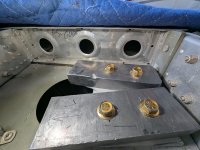
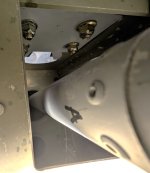
The lead ingots sit on top of a 0.100" thick 6061 plate. If you're going to use a doubler with ballast, might as well make it stupid-thick. The lower plate is 0.050" aluminum. Both are spray-can primered. The bolts are grade 8, 3/8-16 x 1.75", and the nuts are locking flange nuts. I was trying to make use of two holes the builder drilled for this purpose, while adding two of my own, so they aren't perfectly symmetrical. I would have put the plate over the whole thing, but I needed a way to reach the underside to tighten the bolts. Even with the remaining hole and good dexterity, this was a contortionist feat.
Drilling lead is unpleasant.
