Van's Air Force

The definitive Van's Aircraft support community! Buying, building or flying an RV? Join our exclusive family of mentors and enthusiasts!

Weighing (W&B)

wirejock

Well Known Member
Patron
I hesitated to post this till I confirmed.
7A. Standard main gear. Elastomeric Nose gear.

I bought three postage scales from the big company. They are branded with the swish. Rated to 600lbs ea.

First weigh, I was very meticulous. Airplane level. Scales Tared. Multiple numbers recorded. Pretty happy with the results, but they are internet scales so there was always a bit of doubt.

My hangar neighbor (aka rockitdoc) was a racer and has a set of race car scales. We discussed weighing and decided it should be done again. I'll explain why shortly.

Round two the aiplane was rolled up, checked for level and multiple numbers recorded. OMG! She gained weight. We talked about it. He is an engineer and even knew how much she would gain to the pound.

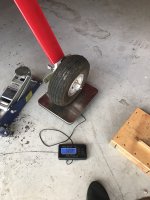
The problem was my initial weigh was done by lifting the airplane. I didn't know this was a thing. Google it. When the airplane is lowered on the scales, the sensors are under side load and read incorrectly. If you do it this way, use something slippery to allow the gear to relax.

So now I have a good weigh, but what about my scales? Others have borrowed them. I did warn them about this issue and made it clear they have to roll the plane on the scales. I still wondered if they were correct.

Round three, I performed another weigh yesterday. This time with my scales to validate them. I even rolled the airplane off and back on. All three scales went back to zero when the airplane was rolled off. Weight was within ounces of his racing scales.

I'll sleep better knowing someone else using the scales isn't flying with an inaccurate W&B.

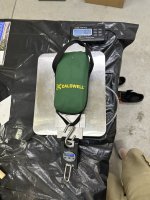
It may or may not help to add something slippery. I used two sheets of 4mil plastic with oil between. The plastic sandwich was slipped between two of the shims on each scale.

Thanks to RockitDoc for his help, scales and insight.
 
I hesitated to post this till I confirmed.
7A. Standard main gear. Elastomeric Nose gear.

I bought three postage scales from the big company. They are branded with the swish. Rated to 600lbs ea.

First weigh, I was very meticulous. Airplane level. Scales Tared. Multiple numbers recorded. Pretty happy with the results, but they are internet scales so there was always a bit of doubt.

My hangar neighbor (aka rockitdoc) was a racer and has a set of race car scales. We discussed weighing and decided it should be done again. I'll explain why shortly.

Round two the aiplane was rolled up, checked for level and multiple numbers recorded. OMG! She gained weight. We talked about it. He is an engineer and even knew how much she would gain to the pound.

The problem was my initial weigh was done by lifting the airplane. I didn't know this was a thing. Google it. When the airplane is lowered on the scales, the sensors are under side load and read incorrectly. If you do it this way, use something slippery to allow the gear to relax.

So now I have a good weigh, but what about my scales? Others have borrowed them. I did warn them about this issue and made it clear they have to roll the plane on the scales. I still wondered if they were correct.

Round three, I performed another weigh yesterday. This time with my scales to validate them. I even rolled the airplane off and back on. All three scales went back to zero when the airplane was rolled off. Weight was within ounces of his racing scales.

I'll sleep better knowing someone else using the scales isn't flying with an inaccurate W&B.

It may or may not help to add something slippery. I used two sheets of 4mil plastic with oil between. The plastic sandwich was slipped between two of the shims on each scale.

Thanks to RockitDoc for his help, scales and insight.
Interesting
What was the value of the error?
 
Larry, this isn't anything to do with your amazon scales. It's been a thing ever since we were weighing airplanes with scales that looked like they came out of the general store on Little House on the Prairie.

Thanks for bringing it up, because it seems like a lot of people don't know about it.

FYI- Roll on or drop on, you still should really have some way for the mains to slide around a little. On a tricycle gear its probably not that big a deal, but on a taildragger even if you roll it on, when you raise the tail to get it level, the gear will splay a little bit.

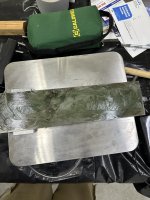
An easy way to do this is to shear aluminum plates about 8" square, then make a sandwich with the plates as the bread and a thin smear of axle grease as the filling. They become part of your tare weight and prevent side loading the scales. After you're done they can be stored in a gallon ziplock bag for next time.

What did your weights and CG end up being? Curious how you faired with the full vinyl wrap.
 
What’s the delta between drop on and roll on weight?
Also do you think could you negate the roll on difference if you dropped on and then rolled back and forth before weighing?
 
How did you lift it?
There was very little error introduced lifting it from the wheel using the Flyboy lug.
 

Attachments

  • IMG_4107.jpeg
    IMG_4107.jpeg
    2 MB · Views: 33
Larry, this isn't anything to do with your amazon scales. It's been a thing ever since we were weighing airplanes with scales that looked like they came out of the general store on Little House on the Prairie.

Thanks for bringing it up, because it seems like a lot of people don't know about it.

FYI- Roll on or drop on, you still should really have some way for the mains to slide around a little. On a tricycle gear its probably not that big a deal, but on a taildragger even if you roll it on, when you raise the tail to get it level, the gear will splay a little bit.

An easy way to do this is to shear aluminum plates about 8" square, then make a sandwich with the plates as the bread and a thin smear of axle grease as the filling. They become part of your tare weight and prevent side loading the scales. After you're done they can be stored in a gallon ziplock bag for next time.

What did your weights and CG end up being? Curious how you faired with the full vinyl wrap.
Definately a thing with tricycle gear. 30lb thing! Probably not a "fall out of the sky thing", but got my attention.

1163, 79.5" fully dressed. I can't get out of envalope fore/aft, but I lost some useful weight. Need to go on a diet!
 
Last edited:
What’s the delta between drop on and roll on weight?
Also do you think could you negate the roll on difference if you dropped on and then rolled back and forth before weighing?
30lbs

I doubt it. First weigh, I did move it several times. Still wrong by 30lbs.

Easiest method to negate the error is to roll on. I fabricated two 2X12 ramps. Local lumber yard had plenty of culled boards. Buy some 1/4" and some 1/8" material and cut 12x12 squares for leveling shims.
Slippery plates insure zero side load error. Put the slip plate between two shims.
 
I got into the practice of moving the scales around to each wheel, so actually performing the weighing 3 times to confirm the results. I starting doing this back before I purchased my race car scales & continue doing it for peace of mind.
 
Probably the way I lifted it. I have a motorcycle lift that lifts from the center spar.
It’s not the same. When you lift from the center structure you unload/load the springs of the landing gear. When you pick it up by the wheel the only movement putting it on the scale is due to the deflection of the tire sidewall that is close to normal to the scale surface.
 
Last edited:
It’s not the same. When you lift from the center structure you unload/load the springs of the landing gear. When you pick it up by the wheel the only movement putting it on the scale is due to the deflection of the tire sidewall that is close to normal to the scale surface.
Yes, I know that now. The point of the post is for others not to make my mistakes. Make your own!
I still believe it's best to roll on and use some sort of slippery alignment thingamajigger.
 
The regs down under must be a bit stricter! We are required by CASA to use certified scales for weighing and also need to pass a "weight control" exam for the authority to weigh. There must be two successive weighing to come within 0.2% or 10 kg whichever is greater.
Aircraft should be weighed inside a closed hangar otherwise wind can upset the readings. Canopy must be closed, flaps up, fuel drained, full oil, mandatory equipment on board etc.
 
The regs down under must be a bit stricter! We are required by CASA to use certified scales for weighing and also need to pass a "weight control" exam for the authority to weigh. There must be two successive weighing to come within 0.2% or 10 kg whichever is greater.
Aircraft should be weighed inside a closed hangar otherwise wind can upset the readings. Canopy must be closed, flaps up, fuel drained, full oil, mandatory equipment on board etc.
Actually the cheap strain gauge platform scales will meet that specification easily. The absolute accuracy is advertised as 1%. That’s +/-10.5 pounds.
My results:
Test weight lb Right,Left,Tail,Total

#1 503.6,487.8,56.6,1048.0
#2 504.8,490.8,56.2,1051.8

.
 
Always using a folded (and empty) trash bag under each wheel for weighing. Those are pretty slippery.
And as stated by @PaulvS certified scales might improve the results, and are mandatory use
around here too


.IMG_7770.webp

I wonder how many aircraft are flying around with vastly erroneous W&B data...
 
I guess my question is if rolling it onto the scales seems to virtually eliminate the error vs. lifting, why not just do that? It seems way easier than hoisting an entire airplane up just to put it on a couple of scales or messing around with sliding surfaces and grease or plastic bags or what have you.
 
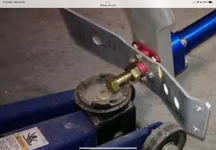
Depends on your bird. If the jack points lift using the gear, the gear isn’t relaxed when set on the scale and provide lateral thrust when lowered. I have the same Jack points as in the stock photo shown. Wheel is lifted and the scale placed under and lowered.

I’m sure there are ways to lift on tri-gear mains to do what can be done on an 8.

Just another point of discussion for nose draggers vs tail draggers, LOL.
 

Attachments

  • IMG_2476.png
    IMG_2476.png
    2.8 MB · Views: 18
FWIW
I thought some of you might care to see the data.
Yes, canopy was closed all weighs. However, flaps were up only on the last one. Forgot.
Figures below are rounded. Actual numbers used in my W&B.
I used a 5 gallon water jug to check the three scales before weigh #3. No error worth noting. Two were exactly the same so they were used for the mains.

1st Weigh. Nose 319, Star 414, Port 408, Total 1141, Lifted &Lowered, Amazon Scales, No slip pads, Flaps Down
2nd Weigh. Nose 318, Star 422, Port 423, Total 1163, Rolled on, Racing Scales, No slip pads, Flaps Down
3rd Weigh. Nose 316, Star 423, Port 423, Total 1162, Rolled on, Amazon Scales, Slip pads, Flaps Up
21lb difference between #1 and #2 on the mains. 1lb difference on the nose.
One pound total difference between #2 and #3. Actually less, 0.6lb. Figures were rounded.

I really wanted to validate my scales because I loaned them out. They appear to be pretty close to the race car scales.
 
FWIW
I thought some of you might care to see the data.
Yes, canopy was closed all weighs. However, flaps were up only on the last one. Forgot.
Figures below are rounded. Actual numbers used in my W&B.
I used a 5 gallon water jug to check the three scales before weigh #3. No error worth noting. Two were exactly the same so they were used for the mains.

1st Weigh. Nose 319, Star 414, Port 408, Total 1141, Lifted &Lowered, Amazon Scales, No slip pads, Flaps Down
2nd Weigh. Nose 318, Star 422, Port 423, Total 1163, Rolled on, Racing Scales, No slip pads, Flaps Down
3rd Weigh. Nose 316, Star 423, Port 423, Total 1162, Rolled on, Amazon Scales, Slip pads, Flaps Up
21lb difference between #1 and #2 on the mains. 1lb difference on the nose.
One pound total difference between #2 and #3. Actually less, 0.6lb. Figures were rounded.

I really wanted to validate my scales because I loaned them out. They appear to be pretty close to the race car scales.
Don’t know what to think. In earlier posts you quote a difference of 30 lbs and now it’s 22.
 
Depends on your bird. If the jack points lift using the gear, the gear isn’t relaxed when set on the scale and provide lateral thrust when lowered. I have the same Jack points as in the stock photo shown. Wheel is lifted and the scale placed under and lowered.

I’m sure there are ways to lift on tri-gear mains to do what can be done on an 8.

Just another point of discussion for nose draggers vs tail draggers, LOL.
Well, just another point of discussion...between me and my buddies, we have weighed 6 aircraft, and none of them had to be hoisted up. 1 7A, 2 7s, 2 8s and a 14. I guess I just don't get the necessity of lifting a plane onto the scales.
 
Well, just another point of discussion...between me and my buddies, we have weighed 6 aircraft, and none of them had to be hoisted up. 1 7A, 2 7s, 2 8s and a 14. I guess I just don't get the necessity of lifting a plane onto the scales.
Again. Just pointing out my error and hoping to save someone else from the same mistake. I didn’t have ramps at that time. I did have a lift. I have ramps now.
 
Always using a folded (and empty) trash bag under each wheel for weighing. Those are pretty slippery.
And as stated by @PaulvS certified scales might improve the results, and are mandatory use
around here too


.View attachment 92855

I wonder how many aircraft are flying around with vastly erroneous W&B data...
I made a sled to test the coefficient of friction of some different lubricants.
It’s my back rivet plate on the SS scale platform with a 31 pound load
Lubricant Force-lb
Lightweight grease 6
3 mil black polyethylene 6.5
20 mil Teflon 2.2
Light coating of Boelube 2.5
 

Attachments

  • IMG_1610.jpeg
    IMG_1610.jpeg
    1.9 MB · Views: 14
  • IMG_1606.jpeg
    IMG_1606.jpeg
    2.4 MB · Views: 14
Last edited:
Again. Just pointing out my error and hoping to save someone else from the same mistake. I didn’t have ramps at that time. I did have a lift. I have ramps now.
Not singling you out, just curious why so many on this thread don't just take the easy way and roll it up on small ramps to the scales. It does have wheels, after all.
:)


Interestingly, there's no mention of using greasy plates or plastic bags or the like. Basically: roll it up on ramps, or jack it up at the jack points on load cells.
 
Last edited:
Not singling you out, just curious why so many on this thread don't just take the easy way and roll it up on small ramps to the scales. It does have wheels, after all.
:)


Interestingly, there's no mention of using greasy plates or plastic bags or the like. Basically: roll it up on ramps, or jack it up at the jack points on load cells.
Still, If your wheels are not perfectly parallel in toe you are putting a side load on the tires as you roll it on.
 
Last edited:
Getting a precise W&B is probably more difficult than most of us think... or are interested in... luckily, in this day and age of serial RV builds (or assemblies), risks are minimised compared to say real experimental prototypes of other brands.
Still, I'm sometimes puzzled by the different wording for different models, or manuals for the same type but differing as of different vintage.
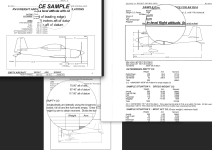
As mentioned somewhere above, I weighed my baby (the metallic one...) a couple of weeks ago, and setting it level longitudinally using the longerons, showed a distinctive nose down attitude bearing little relation to any real flight attitude, but for flying at or very close to Vne...

The difficulty in getting a precise CG is compounded with a TD, as first one has to lift the tail, then support it using makeshift table/platform/whathaveunot on which to place the 3rd scale, all whilst adjusting to whatever attitude will be used. Good luck with that :)

wb.png
 
The difficulty in getting a precise CG is compounded with a TD, as first one has to lift the tail, then support it using makeshift table/platform/whathaveunot on which to place the 3rd scale, all whilst adjusting to whatever attitude will be used. Good luck with that :)
There's an alternate method that's easier:
  1. Weigh all three wheels simultaneously in three-point attitude. This is aircraft empty weight.
  2. Level the airplane and record the weight on the mains in the level attitude.
  3. Subtract #2 from #1 to calculate the weight on the tailwheel in the level attitude.
As an experiment, I did it both ways on my airplane, and the calculated tailwheel weight (#3 above) was within a few tenths of a pound of the actual measured weight.
 
Last edited:
Not singling you out, just curious why so many on this thread don't just take the easy way and roll it up on small ramps to the scales. It does have wheels, after all.
:)


Interestingly, there's no mention of using greasy plates or plastic bags or the like. Basically: roll it up on ramps, or jack it up at the jack points on load cells.
I'm not convinced they are necessary, but they certainly don't hurt. Like Mike said, if the toe is off, there will be side load.

In my case, I built the ramps so the mains could rest adjacent to the scales. It made it easier to figure out shims, level, etc. That way I could roll on. Check level. Adjust shims. Lather. rinse, repeat, using just the tow bar.

The numbers are interesting.
The actual weight is ~9oz different from the racing scales to the postal scales. If my math is right, that's only 0.04% error. Both rolled on. Racing scales used no slip pads and flaps were up. Postal scales used slip pads and flaps were down. 9oz total increase in empty weight.
I need to weigh my 5 gallon water jug on his three racing scales to see if it's just a tolerance discrepancy. If it's 9oz, I may have found the difference. Either way, I feel better for doing it.
 
Last edited:
i posted that very recommendation yesterday in this thread.
Yep. It's mentioned more than once in this thread. Including my original post.

"It may or may not help to add something slippery. I used two sheets of 4mil plastic with oil between. The plastic sandwich was slipped between two of the shims on each scale."
 
Back
Top