Van's Air Force

The definitive Van's Aircraft support community! Buying, building or flying an RV? Join our exclusive family of mentors and enthusiasts!

Fretting on spinner plate

hcccs

Well Known Member
Patron
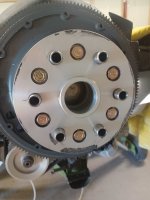
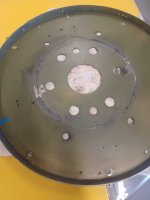
I took off the propeller today and noticed some black patches on the prop extension. At close examination it looked like corrosion and on the spinner plate I could see some marks which look like fretting. I think this can only occur if the spinner plate moves in relation to the prop extension but I can't understand how it is possible. If the drive lug holes in the spinner plate are just a little bigger than the drive lugs this could allow the spinner plate to rub against the extension but they aren't so the question remains: What is going on here? The prop installation has 15-20 hours on it.

p2.jpgp1.jpg
 
You seem to have a wooden prop. Depending on air temp and humidity the bolts will loose their torque from time to time.
Checking the bolt torque in spring and autumn is important.

Good luck
 
Do you have any pictures showing the entire prop installation? Did the prop bolts show any evidence of wear corresponding to the back spinner plate? If it was a wooden prop then Avanza's comment could provide the answer, if not maybe something in the complete installation stack-up was not allowing things to clamp up properly and prevent any movement.
 
Hans, in the case of a wood prop, the drive lugs are a backup...they don't actually drive anything until after the failure of the primary torque transmission, which is static friction between the clamped parts. The fretting says torque capacity based on static friction was inadequate.

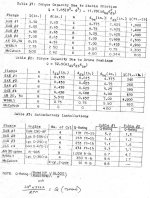
The attached is a page from an article published many years ago by the chief engineer at Sensenich. The underlying equations have since been updated, plus there are certain assumptions, like bare yellow birch on steel. Looks like yours is painted aluminum on anodized aluminum, thus a different coefficient of static friction. So, don't assume the given Q values valid for your case. I post it merely to illustrate the point about the driving capacity of bushings vs frictional driving capacity.

Key factors are coefficient of static friction, clamping force, and diameter.

Coatings and materials make a lot of difference in terms of static friction, plus or minus. I recall a case in which a well known fellow lost a prop becasue he placed a cool carbon fiber/epoxy backplate in the stack.

The available clamping force depends on the crush strength of the propeller hub material, and bolt size.

High compression pistons are also a big deal, as the required torque capacity isn't a dyno average, but instantaneous torque impulse.

sensenich4.JPG
 
Last edited:
Hans,

I had something similar happen when I mistakenly painted the back bulkhead of the spinner. The part should be bare aluminum. It's fine to alodyne for corrosion protection; but the paint screws up the friction fit Dan is talking about. Recommend you strip it when you put everything back together.

I use a Catto prop (wooden) core and regularly re-torque the bolts. The installation manual calls for initial torque, then a check after XX minutes, re-torque after first flight, then again at a short-hour interval. After that, it's every 50 hours (or a change of season). Sorry I don't have specific hour recommendations--the installation manual is at the hangar and I'm not!

Good luck,

Vac
 
Make sure your bolts are not to long and happen to bottom out before reaching static friction between the prop and prop extension. You will get false torqe values if so. Ask me how i know. I almost lost a wood prop that was fine for 15 years and 800 hours. Over time the prop can shrink and crush plates can reduce it's overall thickness with the contstant torquing and relaxing required on a bi-annual basis with a wood prop. An easy (and much cheaper fix) would have been to simply add an 1/8" spacer behind the prop that had been left over from the original build and on the hangar wall for 15 years. Bone head mistake on my part I didn't catch.
 
It's just a thin coating of green 2-K epoxi primer.

Aluminum on aluminum (i.e. your extension spool mated to a bare aluminum backplate) has a coefficient of static friction around 1.0. I can't assign a value for the specific primer used here, but be assured, a paint coating in the joint will decrease that value significantly.

Wood on steel can also be quite low. In many cases a prop manufacturer is actually depending on the varnish to boost static friction. The resulting coefficient is still a lot lower than 1, but it's better than bare wood. Some use a urethane coating on the friction face, which is even better.

BTW, I am not discounting what others have said about making very sure the bolt threads are not bottoming, or the drive lugs are not bottoming in the propeller counterbores.
 
Aluminum on aluminum (i.e. your extension spool mated to a bare aluminum backplate) has a coefficient of static friction around 1.0. I can't assign a value for the specific primer used here, but be assured, a paint coating in the joint will decrease that value significantly.

Wood on steel can also be quite low. In many cases a prop manufacturer is actually depending on the varnish to boost static friction. The resulting coefficient is still a lot lower than 1, but it's better than bare wood. Some use a urethane coating on the friction face, which is even better.

BTW, I am not discounting what others have said about making very sure the bolt threads are not bottoming, or the drive lugs are not bottoming in the propeller counterbores.
Thanks DanH

This is news to me. I don't think I have heard any discussion in our chapter EAA222 about static friction. You learn as you live.

Wise words from D. Rumsfeld:
"There are things we know we know. There are also things we know that we don't know. But there are also things we don't know we don't know."
 
Hans, in the case of a wood prop, the drive lugs are a backup...they don't actually drive anything until after the failure of the primary torque transmission, which is static friction between the clamped parts. The fretting says torque capacity based on static friction was inadequate.

The attached is a page from an article published many years ago by the chief engineer at Sensenich. The underlying equations have since been updated, plus there are certain assumptions, like bare yellow birch on steel. Looks like yours is painted aluminum on anodized aluminum, thus a different coefficient of static friction. So, don't assume the given Q values valid for your case. I post it merely to illustrate the point about the driving capacity of bushings vs frictional driving capacity.

Key factors are coefficient of static friction, clamping force, and diameter.

Coatings and materials make a lot of difference in terms of static friction, plus or minus. I recall a case in which a well known fellow lost a prop becasue he placed a cool carbon fiber/epoxy backplate in the stack.

The available clamping force depends on the crush strength of the propeller hub material, and bolt size.

High compression pistons are also a big deal, as the required torque capacity isn't a dyno average, but instantaneous torque impulse.

View attachment 92057

 
Last edited:
Hans,

I had something similar happen when I mistakenly painted the back bulkhead of the spinner. The part should be bare aluminum. It's fine to alodyne for corrosion protection; but the paint screws up the friction fit Dan is talking about. Recommend you strip it when you put everything back together.

I use a Catto prop (wooden) core and regularly re-torque the bolts. The installation manual calls for initial torque, then a check after XX minutes, re-torque after first flight, then again at a short-hour interval. After that, it's every 50 hours (or a change of season). Sorry I don't have specific hour recommendations--the installation manual is at the hangar and I'm not!

Good luck,

Vac
Vac,
What is the torque value for your Catto prop?

Hans
 
Last edited:
Back
Top