Van's Air Force

The definitive Van's Aircraft support community! Buying, building or flying an RV? Join our exclusive family of mentors and enthusiasts!

foam filling vs open area

RV7a new project owner: Lots of questions....
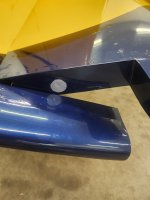
Should the inside edge of the elevator horn (where the weight attaches) and the outboard edge of the elevator be filled with foam to reduce drag?? I've checked each aircraft in our hangars, it's about 50/50 of those filled vs open...
Thoughts??
cindy
 
You can reduce drag like this. But somebody who has one of the fastest RV8 in Socal, he optimizes the cooling drag to get the most bang for the buck based on Dave Anders racing airplane. He said the air in the back is so dirty that you can only gain back a tiny bit.
 
Not foam. Someone sells parts to install. If you want a home builder solution, make sure to use closed cell foam and fiberglass bonded in place so it cannot come loose in flight and jam a control.
Quite a few Google and VAF links out there. Be safe.
 
I took a philosophy early in my build that it would be per plans. Is filling this area in the plans?
Similarly, i decided that if something was attached, you could see how. Wing tips, empennage tips, etc…. You see the fasteners.
Many take different paths, and that’s ok.
I would suggest you adopt your own build philosophy and let it guide you.
 
I filled all my flying surfaces with high density foam from ACS. Sanded and primed and eventually painted look fantastic. Takes a ton more time but always come back to what Bill Repucci said on this site when I was just starting out. "Build the airplane you want to see when you open the hangar" and thats what I've done.
Arnie
 
Last edited:
It looks great when it's done right, but I left mine open since it's lighter, I can inspect inside there, I'm lazy, and my skills at fiberglassing things are really weak. Same on all the empennage pieces - I just did it as the plans showed.
 
I think that, like Arnie and Carl above, you do this to make your airplane look good - which is in the eyes of the beholder. Does it reduce drag to make you faster? I think you’d have to have a pretty sharp pencil to figure that out. And I think that it might actually have the opposite effect - even when not including the very small extra weight you’ve added. Here’s why: that drag is between the upper and lower surface of the airfoil. That airfoil is producing lift. The lift being downward in the case of the smoothed out vertical surfaces of the elevator horn/HS. It seems like anything you can do to impede the spillage of that generated lift and it’s induced drag will make you faster. If you’re spilling lift through that small gap, the airfoil has to produce a little more lift to account for that loss. You would need the same sharp pencil to figure out how much, but it might be something. Some of the Boeings I used to fly had some sort of flexible seal-like thing on the ends of the ailerons that almost sealed up the gap between the aileron and it’s adjacent structure (flap/wingtip). The gaps were much wider than what is on our airplanes, but I think it was there to prevent loss of lift at high speed and altitude. We aren’t flying Boeings, but the same thing might be happening. I don’t think you’re gaining much and probably nothing speedwise by filling those cavities - but it does look good if done right. I did it on my first (of six) RV.
 
Left mine open. Don't need any extra weight on an airplane that is in the aft part of the CG envelope. What ever you decide, remember that across the gap when the elevators are installed, the stab side of that opening ( the outboard rib of the stab ) needs to have an access hole to perform SB-00036 REV 3 to check the rear stab spar for cracks, this assumes that you have not complied with the reinforcement called out in the Service Bulletin.
 
What ever you decide, remember that across the gap when the elevators are installed, the stab side of that opening ( the outboard rib of the stab ) needs to have an access hole to perform SB-00036 REV 3 to check the rear stab spar for cracks, this assumes that you have not complied with the reinforcement called out in the Service Bulletin.
Yep. I drilled a 3/8” hole in the area of the outboard rib lighting hole to allow the borescope to get in. A piece of aluminum backed tape goes over the hole until next year.
Carl
 

Attachments

  • 20250701_111814.jpeg
    20250701_111814.jpeg
    1.3 MB · Views: 64
From the safety perspective, if you decide to fill in the open spaces of the control surfaces, make sure the foam fillers will never come loose while in flight. There was an accident involving a well known aerobatic pilot due to a suspected binding of the control surfaces (per the NTSB preliminary report).
 
From the safety perspective, if you decide to fill in the open spaces of the control surfaces, make sure the foam fillers will never come loose while in flight. There was an accident involving a well known aerobatic pilot due to a suspected binding of the control surfaces (per the NTSB preliminary report).
The accident was a very different scenario. A non saftied removeable plug, in the elevator counterbalance jammed between the counterbalance and the stabilizer.
 
Long term readers recall several builders, serious about speed, filled the rib ends and could not detect a gain.

There are shaped caps available for the inboard ends of the elevators which are reported to offer a little gain:

 
It really comes down to how you want the end product to look. I personally like the look. I used structural foam from ACS. After getting everything filled, 2 layers of glass was used to cover the foam. Then epoxy and micro balloons to fill the weave and blend the edges. If you take care you can do this with minimal weight gain. The MOST IMPORTANT thing is to insure you have 1/8th to 3/16th gap between all of the moving surfaces. Especially at the counter weight area of the elevators and rudder. Building clean is important for efficiency but you want to avoid adding much weight. I'll see if I can find some pictures of my tail group. They turned out pretty good:)
 
The accident was a very different scenario. A non saftied removeable plug, in the elevator counterbalance jammed between the counterbalance and the stabilizer.
True, the accident with the aerobatic aircraft was different, but I think the message is the same - beware of something unexpected happening that could jam control surfaces.
 
Keep in mind, that “cleaner look” is subjective and only visible when the elevators are not in trail.
The same conditions exist for the ailerons and wing tips but nobody fills those as they are typically parked with the ailerons in trail. You don’t see it. So, tie off your stick when you’re parked so the elevators are in trail ;)….problem solved. (That’s a joke).
Certainly build what you want not what others want. However, when I see this on an airplane it puts a question mark in my mind. “How well was this done”? As mentioned, it’s an unforgiving area to have something that has the potential to come loose. That said, I have never heard of an accident caused by this being filled.

Cindy - I think you see now why this is a 50/50 when you walk a flight line. There’s lots of decisions on any build that can go 50/50. You will also find that all of us justify what we did, or did not do, in our builds. That’s human nature…..
 
Keep in mind, that “cleaner look” is subjective and only visible when the elevators are not in trail.
The same conditions exist for the ailerons and wing tips but nobody fills those as they are typically parked with the ailerons in trail. You don’t see it. So, tie off your stick when you’re parked so the elevators are in trail ;)….problem solved. (That’s a joke).
Certainly build what you want not what others want. However, when I see this on an airplane it puts a question mark in my mind. “How well was this done”? As mentioned, it’s an unforgiving area to have something that has the potential to come loose. That said, I have never heard of an accident caused by this being filled.

Cindy - I think you see now why this is a 50/50 when you walk a flight line. There’s lots of decisions on any build that can go 50/50. You will also find that all of us justify what we did, or did not do, in our builds. That’s human nature…..
Yes. Absolutely. Great perspectives and info to consider. I appreciate everyone's help! 90% done, 90% to go! :)
 
Back
Top