Van's Air Force

The definitive Van's Aircraft support community! Buying, building or flying an RV? Join our exclusive family of mentors and enthusiasts!

Testing Fusible Links

TASEsq

Well Known Member
Patron
I have been trying to decide whether to use fusible links, or MIDI fuses FWF for my bus feeds, so decided to do some testing. I welcome all comments and insights!

You can see the test and videos here:

Some conclusions i have drawn from this testing:
  • The silicone wire is a great product for fusible links. The fire and smoke is contained within the insulation totally.
  • On the larger gauges, it really does take a considerable amount of time, and generate a considerable amount of heat. So much so that it damages the insulation on the faston/ring terminals, and i question whether it would cause damage to a relay with a plastic body.
  • While the fusible link opens the wire, continual shorting and arcing can continue while there is still power available.
  • If using silicone wire, the fibreglass / silicone sleeve is not really needed - however, i think i would use it anyway and try and cover the faston/ring terminals at the end as much as i can.
  • Tefzel wire is a very bad product for a fusible link - if this is going to be used, then a fibreglass / silicone sleeve is mandatory! It threw molten wire across the driveway in this test.
  • A MIDI fuse is so much less energy, but does require holes drilled in the firewall, along with a bit more expense (albeit, but really too much cost involved).
 
Thank you for the you-tube videos.
I think that reliability of the electric system is most important in an aircraft.
Looking at a certified aircraft they are mostly built with as few components as possible to reduce the number of failure modes and risk.
The distribution of power to the buses are usually built without fuses of any kind except for the alternator.
When building electric power installations in housing and power distribution it is normally accepted that short cables does not need a
fuse if the routing is considered safe.
This is a balance between the increased complexity and new failure modes against the perceived safety provided by a fuse.
So my aircraft has been built in the conventional way with no fuses/ circuit breakers in the power cables except for the alternators.
Building it this way makes it important to use good quality parts and be sure to route cables in a safe way.
What is the worst that can happen, how will it affect further flight and how likely is it that it will happen.
A 50 hour inspection will mitigate some of the risk.

Good luck
 
Hi Trent.
Good experimenting!
I used midis on both B leads and have had neither blow as yet. 400h or so.
The smaller form factor attracted me to them.
I could get my cross tie and starter relay nice and close together on the firewall.

camphoto_1804928587.jpeg
 
A properly constructed fusible link using standard tefzel aircraft wire is certainly not a "very bad product".

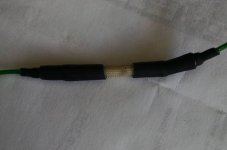
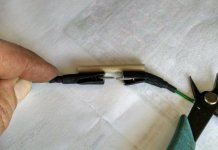
This one was 18 ga with a short length of 22. There's no reason to make the link section longer than a inch. It's built with a fiberglass sleeve, bare inline splice terminals, and four lengths of triple wall (i.e. hot glue) heat shrink. Note it's in-line, not at a termination. Terminations usually have a physical stress in addition to the electrical heating. For sure there are no plastic coated parts in contact with the fuse wire, nor any heat transfer to a connected component. Think about it.

Burned open following a short (fumbled tool). Other than the little brown spot, there is no visual evidence at all:

Fusible Link 1.jpg

The short stiff assembly means the burned ends will never make contact...no arcing concern

Fusible Link 2.jpg

Fusible link vs MIDI / ANL? Ask yourself "Normal load is what percentage of max amps?"

The above is driving an EI with a measured draw just over 1 amp. The 35C rating for 22 ga is 5 amps, so roughly 20% of capacity. Not much heating in normal operation, but guaranteed to melt following a battery-to-ground short, without much energy release. Arguably the 18 ga used the rest of the run is way oversize for 1 amp, but being an EI power source, "mechanically robust" is a good reason to like the larger wire.
 
Last edited:
A properly constructed fusible link using standard tefzel aircraft wire is certainly not a "very bad product".
I guess I meant tefzel with no sleeve. The thing flung a molten bit of wire across the drive. With the sleeve it would be no issue. I think the silicone wire is much better though. Silicone wire and a sleeve for belt and braces.

Is there any rules on length of the fusible link? I thought I read somewhere they had to be 5-6”. (These were 5” long).

What do you mean by:
Fusible link vs MIDI / ANL? Ask yourself "Normal load is what percentage of max amps?"

My normal load on the 10awg feed will be around 12-15 amps (sds efi). I chose a 50a midi based on some calculations from John Bright around fuse ratings etc. it’s there only to protect against a wire short. I’m using 10awg as it’s on a circuit with the monkworkz which can put out 30amps. Who knows I might want to run a microwave one day.

I think my biggest concern is the time it takes compared to a midi, and secondarily the massive heat generated. Inline would solve the heat concern but then it’s another joint / crimp etc to do it that way.

I think it will come down to real estate and practicality when I get around to mounting stuff on the firewall.
 
Hi Trent.
Good experimenting!
I used midis on both B leads and have had neither blow as yet. 400h or so.
The smaller form factor attracted me to them.
I could get my cross tie and starter relay nice and close together on the firewall.
If I can manage with room on the firewall to use copper strips to the midi bases this is the best way I think. If I need to connect a wire direct to the relay / contactor then the fusible link might be better.

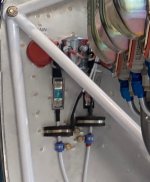
Are those big ADEL’s holding hall sensors?
 
I guess I meant tefzel with no sleeve.

But of course it's not used without a sleeve.

The thing flung a molten bit of wire across the drive.

We could run a similar experiment with uncontained avgas, watch it catch fire, and claim it should not be used in airplanes ;)

I think the silicone wire is much better though. Silicone wire and a sleeve for belt and braces.

Why? Especially in a fiberglass sheath?

Is there any rules on length of the fusible link?

None of which I'm aware.

What do you mean by:
Fusible link vs MIDI / ANL? Ask yourself "Normal load is what percentage of max amps?"

How many amps will you be passing through the fusible wire? Is it a small percentage of its capacity? See below.

My normal load on the 10awg feed will be around 12-15 amps (sds efi). I chose a 50a midi based on some calculations from John Bright around fuse ratings etc. it’s there only to protect against a wire short. I’m using 10awg as it’s on a circuit with the monkworkz which can put out 30amps.

I'd also use a MIDI here. Standard fuse link approach is 4 sizes smaller, so here it would be a 14 ga link with a 35C rating of 15 amps. I don't know what your diagram looks like. If you're saying there is some chance of running the whole generator output through the link, 14 ga is way too small. In my opinion, this fusible link would be too small for even 15 amps, as that would be 100% of the 35C rating. If it's going to run close to max capacity, I'll take the engineered device from a reputable manufacturer.
 
Standard fuse link approach is 4 sizes smaller, so here it would be a 14 ga link with a 35C rating of 15 amps. I don't know what your diagram looks like. If you're saying there is some chance of running the whole generator output through the link, 14 ga is way too small. In my opinion, this fusible link would be too small for even 15 amps, as that would be 100% of the 35C rating. If it's going to run close to max capacity, I'll take the engineered device from a reputable manufacturer.
So that’s not something I think I fully grasped. I don’t think I would ever need 30amps on this bus (it’s an SDS engine bus with a couple of other low power things). But your point really means that rather than using a fuse link wire 4 sizes smaller, you need to use a fuse link wire suitable for the load, then upside the feeder by 4 sizes.

Let say 15amps max. That means in reality a 12awg wire so it has some headroom. So the feeder would need to be an 8awg. That’s a big fat wire for a 15amp load.

I’ve sized it at a #10 because the mz30 is capable of 30 amps and they call out #10 in their documentation. It should be around 15 maximum. Plenty of headroom for a #10.

I had assumed that you just sized the feeder for what you needed then went 4 sizes smaller for the fuse link and accepted that this wire would get hotter than normal.

The ac says a 150c rated tefzel 14awg can carry 14 amps continuous. This doesn’t mean at 14 amps the wire will be 150c I don’t think?
 
.... your point really means that rather than using a fuse link wire 4 sizes smaller, you need to use a fuse link wire suitable for the load, then upside the feeder by 4 sizes.

Yes, that is my conservative view. I see no point in heating the link in normal operation. A short to ground opens it, the fundamental purpose, and other than some unavoidable momentary arcing at the short, the heat release is contained in the known location, inside a fiberglass sleeve.

However, as a practical matter, when the "four sizes" rule of thumb would result in a large diameter wire run. it makes more sense to use wire sized for the load combined with an engineered fuse package. I think that's the circuit you describe above.
 
The length of fusible links does matter. The adjoining wire will conduct heat away and lengthen the time that it takes to open a short fusible link. Bob Nuckolls has conservatively suggested 6".
Fuses will get warm also because they have a certain amount of resistance. Fuses have an advantage in that one can be chosen to open when a precise amount of current flows. Fusible links don't take up valuable space or need a mounting surface. If short circuit protection is not installed, it can not fail. Good workmanship could be all of the short circuit protection that is needed. That is the philosophy of aircraft manufacturers.
 
The length of fusible links does matter. The adjoining wire will conduct heat away and lengthen the time that it takes to open a short fusible link. Bob Nuckolls has conservatively suggested 6".
$20 says there is no significant delay when I short battery amps through 1" of 22 ga crimped to 18 ga.
 
$20 says there is no significant delay when I short battery amps through 1" of 22 ga crimped to 18 ga.
I will take that bet as long as you provide the high speed camera that will take a picture once every microsecond. :)
 
$20 says there is no significant delay when I short battery amps through 1" of 22 ga crimped to 18 ga.
I agree with you on the lighter wires - the 22awg burns through almost instantaneously.

On the larger wires it takes a lot longer.

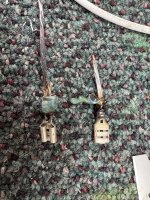
To answer the length question - i did a test. Two links made of 14awg silicone wire, one was 8" long and one was 2" long.

It seems that they both open in an identical time frame, however the longer wire seemed to have a lot more energy when it opened! Based on this, i think the shorter the better for the links. This was a different brand of silicone wire to the other test (a cheaper ebay special) - this didn't perform as well with regard to not seperating. A fibreglass sleeve would be necessary.

Here is the 8" long link:

Here is the 2" long link:

Based on the amount of damage to the connectors, i think that a MIDI is a much better idea for anything bigger than, say, a 22awg fusible link (on an 18awg wire).
IMG_6770 (1).JPG
 
Two links made of 14awg silicone wire, one was 8" long and one was 2" long.

It seems that they both open in an identical time frame, however the longer wire seemed to have a lot more energy when it opened!

You may be seeing a rocket engine, with the longer wire merely storing more fuel. See the smoke shooting out of both ends near the crimps? The hot wire is charring and outgassing the inside of the silicone sleeve. When the wire finally melts at the hottest point, the result is like a loose fire hose, a squirting whip.

Based on the amount of damage to the connectors...

I don't care what Bob shows in his tutorial...don't build fusible links using plastic sleeved connectors, and don't place them at the end terminal. Bare butt splices, isolated a bit away from the power source connector, inside an anchored fiberglass sleeve.

I think that a MIDI is a much better idea for anything bigger than, say, a 22awg fusible link (on an 18awg wire).

I might go a little larger. Beyond that, amen, I'll take a MIDI, or ANL, or even an ATC.

BTW, have you noticed B&C's largest fusible link is a 20 ga for a 16 ga run, and is rated at 7.5 amps, the 35C rating for 20 ga wire?
 
That is very neat. I like that. Are they the AMP100? Do you recall where you got them?

They are KEY100s. I can’t seem to find where I got them in my mail. It was some time ago. Probably one of RS/mouser/digikey/element14 etc.
I notice amploc seem to sell them direct from their website now.

 
… The ac says a 150c rated tefzel 14awg can carry 14 amps continuous. This doesn’t mean at 14 amps the wire will be 150c I don’t think?

The 14A rating is basically 10 deg C rise above ambient for a wire not in a bundle at sea level.

I’ve looked at various temperature rise graphs and I call 14 awg good for 15A, the difference it trivial because the 10 deg C rise criteria is quite conservative. A reason to use a larger feeder is voltage drop in a long run or multiple wires in a bundle, the former is a consideration for something like pitot heat, the latter is not a consideration as far as I’ve seen in our simple little airplanes, YMMV.
 
Last edited:
Back
Top