Van's Air Force

The definitive Van's Aircraft support community! Buying, building or flying an RV? Join our exclusive family of mentors and enthusiasts!

Induction Leak Test

RV8Squaz

Well Known Member
Hello braintrust,

I performed an induction leak test per Mike Busch's article (excerpt attached below). In his article, he states, "If one cylinder (or two adjacent cylinders) exhibit(s) significantly less change than the others, suspect an induction system leak affecting that cylinder (or those adjacent cylinders)." The problem is that he doesn't quantify "significantly less change."

Here's a screen grab from the my test. I'll save you the simple math. The change for each cylinder 1, 2, 3, 4, 5, and 6 is 90, 120, 120, 140, 130, and 85. This is fairly consistent at various time points. I'm not sure there is anything significant here. The odd thing is that the EGT's go up when manifold pressure is reduced from 25 to 15. I performed the test exactly as written in the article. The engine is a Lyc. AEIO-540-L1B5. It's been modified with 10:1 pistons and a 6 into 1 Skydynamics exhaust.

Thanks!

 

Attachments

  • Screen Shot 2025-06-12 at 10.27.15 AM.png
    Screen Shot 2025-06-12 at 10.27.15 AM.png
    268.6 KB · Views: 124
  • Screen Shot 2025-06-12 at 10.32.14 AM.png
    Screen Shot 2025-06-12 at 10.32.14 AM.png
    105.4 KB · Views: 113
OK, I'm here for the discussion and to learn, but it seems to me that because EGT can be affected by a variety of factors, the EGT deltas you report are within normal variation. The good thing about the in-flight test is that it is done at normal vibration and temperature conditions.
I do a different induction leak test, occasionally, during my condition inspections. I continuously pressurize the induction system to not more than 10PSI. Then I spray soapy water solution all over the various junction interfaces and especially at flanges on the cylinders. Bubbles indicate a leak to fix.
 
there is a much simpler way to identify an induction leak. With the engine running at idle, just spray carb cleaner where you think it could be leaking from. If the RPM goes up, it is leaking in the area where you sprayed. Mechanics have been doing it this way for decades in the auto world. principle is identical.
 
there is a much simpler way to identify an induction leak. With the engine running at idle, just spray carb cleaner where you think it could be leaking from. If the RPM goes up, it is leaking in the area where you sprayed. Mechanics have been doing it this way for decades in the auto world. principle is identical.
It's easy if you have a very competent helper and are ok approaching the engine with the death stick spinning next to your head. I'd say the in-flight test is much safer.
 
there is a much simpler way to identify an induction leak. With the engine running at idle, just spray carb cleaner where you think it could be leaking from. If the RPM goes up, it is leaking in the area where you sprayed. Mechanics have been doing it this way for decades in the auto world. principle is identical.
Seriously? You're inches from the spinning prop which is also blowing 50+ mph air at you and the jet of carb cleaner. And FI engines don't idle that well anyway, so it would be hard to sense when the RPM is increasing.

Jose's method using compressed air and soap bubbles is much safer on an airplane.
 
OK, I'm here for the discussion and to learn, but it seems to me that because EGT can be affected by a variety of factors, the EGT deltas you report are within normal variation. The good thing about the in-flight test is that it is done at normal vibration and temperature conditions.
I do a different induction leak test, occasionally, during my condition inspections. I continuously pressurize the induction system to not more than 10PSI. Then I spray soapy water solution all over the various junction interfaces and especially at flanges on the cylinders. Bubbles indicate a leak to fix.
Thank you Radio Flyer. The inflight test was a good initial check. I will be backing it up with your method.
 
Puzzled by one aspect of this video. They are pressurizing the cylinder at TDC, just as you would for a compression test. Then they are turning the prop a short distance (less than 90 degrees rotation) and somehow that is putting pressurized air into the induction tubes? If the piston is at TDC, then rotation forward would be the start of the power stroke, and rotation backward would be the end of the compression stroke. In both cases, both valves are closed. Seems like you would have to turn the prop a full 180 degrees backward to get to the end of the intake stroke where the intake valve would be open.

If you turned the prop a full 360, back to TDC, but inbetween the exhaust and intake strokes, there is enough valve overlap that both valves would be partially open and you wouldn't be able to get any pressure in there.

So?????
 
What method are you using to pressurize the induction system?

Thanks
Gary
So I watched the video above. Me thinks there is a better way that doesn’t require two people and provides continuous low pressure to the induction system. I bet I can devise a contraption or even 3D print something that will fit over the face of the fuel servo. Of course I would have to ensure the intake valves are closed in each cylinder.
 
It's easy if you have a very competent helper and are ok approaching the engine with the death stick spinning next to your head. I'd say the in-flight test is much safer.
Actually this is done at idle, so helper just needs to hold the brakes. Not too much expertise involved.

I get that some folks don’t like getting near the prop. However this test is simple and definitive. Working off egt changes allows other variables to creep in and is nowhere near as definitive. It is incredibly difficult to identify a leak based upon egt unless you also had solid baseline egt data from when that particular cylinder didn’t have a leak. It is very difficult to compare two cylinders egt data and definitively determine one has a leak, for various reasons. You can guess, just can’t be certain.

Good luck in however you approach it.
 
What method are you using to pressurize the induction system?

Thanks
Gary
I have used part of the airflow from the output side of a vacuum cleaner. I've also used regulated pressure from an air compressor tank. Either way I had to fashion an adapter to introduce the pressure into the the mouth of (as in my case) the carburetor.
 
Puzzled by one aspect of this video. They are pressurizing the cylinder at TDC, just as you would for a compression test. Then they are turning the prop a short distance (less than 90 degrees rotation) and somehow that is putting pressurized air into the induction tubes? If the piston is at TDC, then rotation forward would be the start of the power stroke, and rotation backward would be the end of the compression stroke. In both cases, both valves are closed. Seems like you would have to turn the prop a full 180 degrees backward to get to the end of the intake stroke where the intake valve would be open.

If you turned the prop a full 360, back to TDC, but inbetween the exhaust and intake strokes, there is enough valve overlap that both valves would be partially open and you wouldn't be able to get any pressure in there.

So?????
This test is filling the cyl and rolling just past valve opening to release pressure into manifolds. E valve opens about 20* bbdc on power stroke. You cannot do the test on the I valve opening as it is in overlap with the E valve open. You would go just past I closing (20abdc on compression stroke) and rotate backwards to open it. Beware what you see in internet videos. Many creative liberties taken.a
 
Last edited:
So I watched the video above. Me thinks there is a better way that doesn’t require two people and provides continuous low pressure to the induction system. I bet I can devise a contraption or even 3D print something that will fit over the face of the fuel servo. Of course I would have to ensure the intake valves are closed in each cylinder.
That works well for the exhaust. Have tapped a shop vac hose to tailpipe and leaks are easy to find. Very common in auto biz for finding exh manifold leaks. Intake is another matter. You can never get all the valves closed, so you need a LOT of air volume to get pressure. This air is flowing a good amount due to open valves. You run the risk of damaging a fuel servo and with a carb, this will collect and spray fuel throughout the manifold.
 
This test is filling the cyl and rolling just past valve opening to release pressure into manifolds. E valve opens about 20* bbdc on power stroke. You cannot do the test on the I valve opening as it is in overlap with the E valve open. You would go just past I closing (20abdc on compression stroke) and rotate backwards to open it. Beware what you see in internet videos. Many creative liberties taken.a
I agree with what you say here - it is consistent with what I was saying. You have to turn the prop 160 degrees in either direction to get to either valve opening (backward for intake, forward for exhaust). I didn't see them turning the prop anything like that in the video.
 
That works well for the exhaust. Have tapped a shop vac hose to tailpipe and leaks are easy to find. Very common in auto biz for finding exh manifold leaks. Intake is another matter. You can never get all the valves closed, so you need a LOT of air volume to get pressure. This air is flowing a good amount due to open valves. You run the risk of damaging a fuel servo and with a carb, this will collect and spray fuel throughout the manifold.
Is there an engine position where all the exhaust valves are closed?
 
I don't think so. I have never seen cam timing specs for a lyc. However, the E valve is typically open for at least 200* and the cylinders are only offset by 180*
I guess it doesn't really matter as long as there is a position where at least one valve is closed in each cylinder, you can pressurize the exhaust system. Some cylinders will get pressurized too, but as long as those cylinders have closed intake valves, it will work.

The same would be true of the intake system - your point being that the pressurizing process might damage the fuel servo/carburetor?
 
Puzzled by one aspect of this video. They are pressurizing the cylinder at TDC, just as you would for a compression test. Then they are turning the prop a short distance (less than 90 degrees rotation) and somehow that is putting pressurized air into the induction tubes? If the piston is at TDC, then rotation forward would be the start of the power stroke, and rotation backward would be the end of the compression stroke. In both cases, both valves are closed. Seems like you would have to turn the prop a full 180 degrees backward to get to the end of the intake stroke where the intake valve would be open.

If you turned the prop a full 360, back to TDC, but inbetween the exhaust and intake strokes, there is enough valve overlap that both valves would be partially open and you wouldn't be able to get any pressure in there.

So?????
Interesting, he said he starts with #1 at TDC, then puts air into it.. clearly that’s not #1 cylinder on a Lycoming or a Continental.. I think he’s really on the compression stroke and just goes backwards into the cycle where the intake starts to open.
 
Interesting, he said he starts with #1 at TDC, then puts air into it.. clearly that’s not #1 cylinder on a Lycoming or a Continental.. I think he’s really on the compression stroke and just goes backwards into the cycle where the intake starts to open.
The valve cover embossing is slightly out-of-focus to me, but it looks like it's a Continental. Further, it looks like he's pressuring the middle cylinder on the starboard side (#3 if what I googled about Continental cylinder numbering is accurate).

At 2:24 in the video he says "...up towards top dead center..." not "...at top dead center...". I don't know if that minor distinction helps address the issue or if it's irrelevant, but thought I'd pass along the observation.

For those of you who own or are familiar with 6 cylinder engines...can you give some insight into what the upper prop blade position, at roughly 1:00 O'clock (pilot perspective), indicates about piston location? If I recall, on a Lycoming O-360, the upper blade is around 11:00 O'clock when the piston is at top dead center.

Regards,
Rob
 
Interesting, he said he starts with #1 at TDC, then puts air into it.. clearly that’s not #1 cylinder on a Lycoming or a Continental.. I think he’s really on the compression stroke and just goes backwards into the cycle where the intake starts to open.
You are right. He is on cyl #3 if a Lycoming or a Continental. It looks (and sounds) like he is on mid compression stroke, and turns the prop backward enough to just open the intake valve, probably about 20 degrees after bottom dead center. So that should actually work. Effective test, poor description of how to do it.
 
I guess it doesn't really matter as long as there is a position where at least one valve is closed in each cylinder, you can pressurize the exhaust system. Some cylinders will get pressurized too, but as long as those cylinders have closed intake valves, it will work.

The same would be true of the intake system - your point being that the pressurizing process might damage the fuel servo/carburetor?
I think a carb is fine, though the airflow will suck fuel out of the bowl. I would be concerned about a servo though. Don has warned about applying too much pressure to those four pickup tubes.
 
The valve cover embossing is slightly out-of-focus to me, but it looks like it's a Continental. Further, it looks like he's pressuring the middle cylinder on the starboard side (#3 if what I googled about Continental cylinder numbering is accurate).

At 2:24 in the video he says "...up towards top dead center..." not "...at top dead center...". I don't know if that minor distinction helps address the issue or if it's irrelevant, but thought I'd pass along the observation.

For those of you who own or are familiar with 6 cylinder engines...can you give some insight into what the upper prop blade position, at roughly 1:00 O'clock (pilot perspective), indicates about piston location? If I recall, on a Lycoming O-360, the upper blade is around 11:00 O'clock when the piston is at top dead center.

Regards,
Rob
Blade position relative to crank position is not really consistent across applications.
 
would it be easier to just go ahead and replace the gaskets and induction hoses if a leak is suspected or as a preventive maintenance every few hundred hours? The job is relatively quick and inexpensive. It took me a few hrs to do 4cyls but I never touched the engine before except oil changes. I bet someone with just a bit more experience could do it in an hour or two.
 
I think a carb is fine, though the airflow will suck fuel out of the bowl. I would be concerned about a servo though. Don has warned about applying too much pressure to those four pickup tubes.
Without a lot of flow through the servo, pressurizing the servo will just result in roughly equal pressure on the venturi and the impact tubes which ultimately yields equalized pressure on both sides of the diaphragm. This shouldn’t hurt anything.

Skylor.
 
Without a lot of flow through the servo, pressurizing the servo will just result in roughly equal pressure on the venturi and the impact tubes which ultimately yields equalized pressure on both sides of the diaphragm. This shouldn’t hurt anything.

Skylor.
Yeah, I think you are right. I was thinking of the warning i got one time when i was shooting compressed air in those impact tubes to get the fuel flowing for a test.
 
there is a much simpler way to identify an induction leak. With the engine running at idle, just spray carb cleaner where you think it could be leaking from. If the RPM goes up, it is leaking in the area where you sprayed. Mechanics have been doing it this way for decades in the auto world. principle is identical.
In a prop blast, upwind of a canopy and paint, with a solution of MEK and similar?
 
I'm amazed the video I posted resulted in so much debate. I did this exact test on my IO-540 a few weeks ago with the help of a neighbor. The entire process took 10 minutes start to finish, including removing the cowl.

would it be easier to just go ahead and replace the gaskets and induction hoses if a leak is suspected ...


No. Especially on an engine with 45 hours.
 
Last edited:
How about a smoke injector. I use one for auto engines.
We did just that today and found a leak. The #1 cylinder intake tube is leaking past the big fat o-ring at the sump. Tomorrow I will begin to replace all 6 o-rings and gaskets. I don't believe this has ever been done before on this engine. It's 12 years and over 1000 hours SMOH. We will repeat the smoke test when I get it put back together.

What we did was similar to the video. Except that we filled the induction system with smoke through the number 2 cylinder. I used #2 because I already had that spark plug out. We found TDC, backed the prop 270 degrees to open the intake valve and fed the smoke through the spark plug hole using a custom made adapter. The smoke filled the entire induction system and the leak was clearly visible. Yes some smoke could have escaped thorough an exhaust valve somewhere, but there was plenty of smoke to go around. I feel very confident with what we did.
 
We did just that today and found a leak. The #1 cylinder intake tube is leaking past the big fat o-ring at the sump. Tomorrow I will begin to replace all 6 o-rings and gaskets. I don't believe this has ever been done before on this engine. It's 12 years and over 1000 hours SMOH. We will repeat the smoke test when I get it put back together.

What we did was similar to the video. Except that we filled the induction system with smoke through the number 2 cylinder. I used #2 because I already had that spark plug out. We found TDC, backed the prop 270 degrees to open the intake valve and fed the smoke through the spark plug hole using a custom made adapter. The smoke filled the entire induction system and the leak was clearly visible. Yes some smoke could have escaped thorough an exhaust valve somewhere, but there was plenty of smoke to go around. I feel very confident with what we did.
How did you generate the smoke?
 
Just Google automotive smoke machine or smoke generator. The one we used looked like a homemade job, but it worked very well.
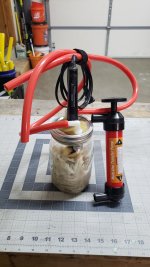
I made mine from a mason jar. The wide mouth lid has more space for the holes.
HF Soldering iron.
HF transfer pump
Assorted fittings for the transfer pump hoses and to connect to the engine
Bottle of baby oil. Dollar store stuff works just fine.
Old sock or t-shirt
Drill a hole for the Soldering iron.
Drill two holes for the transfer pump hoses.
Insert the soldering iron. Goop up the lid and handle on tol with flox so it can't leak. Cure.
Insert the two hoses.
Stuff the jar with the rag. Loose but high enough so the soldering iron is touching.
Fill with baby oil. Let it absorb. Maybe 1" of fluid at the bottom.
Screw on the lid.
Attach the pump.
Plug it in. Wait for the smoke.
Once it gets going, it generates a lot of smoke.
20250624_082051.jpg
 
Hello braintrust,

I performed an induction leak test per Mike Busch's article (excerpt attached below). In his article, he states, "If one cylinder (or two adjacent cylinders) exhibit(s) significantly less change than the others, suspect an induction system leak affecting that cylinder (or those adjacent cylinders)." The problem is that he doesn't quantify "significantly less change."

Here's a screen grab from the my test. I'll save you the simple math. The change for each cylinder 1, 2, 3, 4, 5, and 6 is 90, 120, 120, 140, 130, and 85. This is fairly consistent at various time points. I'm not sure there is anything significant here. The odd thing is that the EGT's go up when manifold pressure is reduced from 25 to 15. I performed the test exactly as written in the article. The engine is a Lyc. AEIO-540-L1B5. It's been modified with 10:1 pistons and a 6 into 1 Skydynamics exhaust.

Thanks!
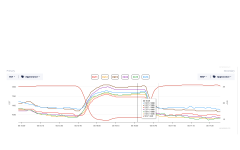
Your induction leak results look good. The slight variation you see could be due to FF variations to each cylinder. It's a good ideal to perform GAMI sweeps during the same flight so the mixture spread can be taken into account.

Pressurizing the induction system with a clean or new shop vac in blow mode and spraying the joints with soapy water is the preferred alternative method at Savvy, especially with carb'd engines, as the in-flight induction test will have a wide variation in changes due to worse fuel/air mixture distribution.
 
He is not on TDC, if you notice the position of the prop and the pressure on the gauge. As he moves the prop up, he is coming up to the TDC to build some pressure and then he moves the prop back to release the pressure into the induction.
 
Back
Top