Van's Air Force

The definitive Van's Aircraft support community! Buying, building or flying an RV? Join our exclusive family of mentors and enthusiasts!

6 Cylinder P-Mag Mode (Fixed/Variable) Switch

Ironflight

VAF Moderator / Line Boy
Mentor
OK, here’s a question for folks to chew on. The Six Cylinder P-Mags (I have a brand new set for the F1 IO-540) have the capability to add a “Mode Switch” that chooses either fixed or variable timing. I see no reason not to add this capability since I’m wiring up the airframe. But the question is…two SPST switches (one for each P-Mag) or a single DPST switch so that both mags have their modes matched at all times. The Ops Engineer in me says “I want to have as much flexible control as I can” - arguing for two separate switches, while the design engineer in me says “keep it as simple as possible” - a single switch. Why risk a pilot accidentally having mixed modes?

Can anyone think of a case where you’d want to have one P-Mag in Fixed and the other in Variable? I can think that there might be downsides to that…which would argue for the single switch to make sure the pilot doesn’t do something dumb. then again, if one is fixed, and the other is variable, the one (fixed) will be firing first and running the engine…

Discussion?
 
I do not think you want to have one P-MAG in Variable while other in Fixed mode. That makes no sense to me as one of the mags will fire earlier than another which will still be variable mode with less efficient mixture burn. You want them to fire at as closer timing as possible to have the best response from the engine. So the answer is likely: single switch for both P-Mags to select Variable or Fixed mode for both mags. And yes this switch is very useful, especially when loaded at gross, while taking off in high OAT. Fixed mode helps to keep CHTs under control.
 
Disclaimer: I have not kept up with possible failure modes of this product, but from a pilot/vehicle interface standpoint, its a function switch. Pilot brains should not be burdened with trying to decide if one half of the ignition is doing something while the other is different. Should be as simple as "Ignition, do this".

Single switch. Leave the Space Shuttle complexity in your past!
 
Last edited:
OK, here’s a question for folks to chew on. The Six Cylinder P-Mags (I have a brand new set for the F1 IO-540) have the capability to add a “Mode Switch” that chooses either fixed or variable timing. I see no reason not to add this capability since I’m wiring up the airframe. But the question is…two SPST switches (one for each P-Mag) or a single DPST switch so that both mags have their modes matched at all times. The Ops Engineer in me says “I want to have as much flexible control as I can” - arguing for two separate switches, while the design engineer in me says “keep it as simple as possible” - a single switch. Why risk a pilot accidentally having mixed modes?

Can anyone think of a case where you’d want to have one P-Mag in Fixed and the other in Variable? I can think that there might be downsides to that…which would argue for the single switch to make sure the pilot doesn’t do something dumb. then again, if one is fixed, and the other is variable, the one (fixed) will be firing first and running the engine…

Discussion?
Yes. The amount of advance needed for optimal performance varies in a somewhat linear fashion with mixture. The leaner you go, the more advance you need due to the lower flame travel rate. In a dual spark setup, total advance time is a combination of both advances. In example terms, if you want 27 degrees total, you can do 25 on one and 29 on the other or 27 on each. When i only had preset advance tables, i set the aggressive tables for optimal advance at 100* lop and used both advance tables for that mixture. But if i was running 30* lop, i wanted less advance and only used the aggressive table on one and the conservative table on the other. Eventually i added a pot for infinitely variable timing, so no longer use the switches that way. Just dial in whatever advance gives me the greatest airspeed on any given flight.
 
Last edited:
I do not think you want to have one P-MAG in Variable while other in Fixed mode. That makes no sense to me as one of the mags will fire earlier than another which will still be variable mode with less efficient mixture burn. You want them to fire at as closer timing as possible to have the best response from the engine. So the answer is likely: single switch for both P-Mags to select Variable or Fixed mode for both mags. And yes this switch is very useful, especially when loaded at gross, while taking off in high OAT. Fixed mode helps to keep CHTs under control.
With the simplistic shape of the lyc cylinder chamber, optimum efficiency does not occur only if the two flame fronts meet in the exact center. All that really matters is where, relative to TDC, that peak cylinder pressure occurs, which is typically when the two fronts meet. The engine stills run pretty good even when only one sparkplug fire. The notable rpm reduction is not inefficiency, but just grossly reatrded timing. There are 100’s or thousands of folks running ei with variable advance on one ignition and a mag with fixed advance on the other. These folks almost universally see performance and efficiency gains when running lop by doing so, proving that the right total advance far out weighs getting the flame fronts to meet in the center.
 
Last edited:
Disclaimer: I have not kept up with possible failure modes of this product, but from a pilot/vehicle interface standpoint, its a function switch.
My view is that if you want redundancy, don't connect the two things to one thing, just in case there is a failure mode that can be triggered by the one thing. Is there a case where, due to a software bug or design issue with the electronics, changing from variable to fixed mode causes the emag to crash? I'd go with two independent switches.
 
OK, here’s a question for folks to chew on. The Six Cylinder P-Mags (I have a brand new set for the F1 IO-540) have the capability to add a “Mode Switch” that chooses either fixed or variable timing. I see no reason not to add this capability since I’m wiring up the airframe. But the question is…two SPST switches (one for each P-Mag) or a single DPST switch so that both mags have their modes matched at all times. The Ops Engineer in me says “I want to have as much flexible control as I can” - arguing for two separate switches, while the design engineer in me says “keep it as simple as possible” - a single switch. Why risk a pilot accidentally having mixed modes?

Can anyone think of a case where you’d want to have one P-Mag in Fixed and the other in Variable? I can think that there might be downsides to that…which would argue for the single switch to make sure the pilot doesn’t do something dumb. then again, if one is fixed, and the other is variable, the one (fixed) will be firing first and running the engine…

Discussion?
The 4 cylinder Pmags have the same capability of different modes. The jumper in or out and this has 2 different variable timings. Didn’t realize the 6 has fixed or variable. Check your WW prop notes to see if it says jumper in on Pmags. I have 330-3 and that’s a note in it but I don’t have the acro version.
In the certified world, you can have fixed slick and one surefly(can be fixed or variable timing, non pilot switchable) and runs great either way. Start up is much better. Electronic ignition is either better or much better.
Keeping cht’s at bay in climb out or better starting then switching at altitude might be benefits as previously mentioned. You never get something for nothing, always a trade off.
KISS
 
My view is that if you want redundancy, don't connect the two things to one thing, just in case there is a failure mode that can be triggered by the one thing. Is there a case where, due to a software bug or design issue with the electronics, changing from variable to fixed mode causes the emag to crash? I'd go with two independent switches.

Three things: The “failure” in this case is fairly benign. We don’t independently switch the nav or landing lights, right? If it fails to function, who cares?

And second, if we are worried enough about the reliability of the product to wire it up with the expectation of failure, then why are we hanging it on the airplane in the first place?

Providing more options does not always provide redundancy, and more often the added complexity will provide reduced safety in the form of unintended consequences. How many gear related failures do you think we’d see if each gear strut on a Bonanza had its own switch, for example?
 
My view is that if you want redundancy, don't connect the two things to one thing, just in case there is a failure mode that can be triggered by the one thing. Is there a case where, due to a software bug or design issue with the electronics, changing from variable to fixed mode causes the emag to crash? I'd go with two independent switches.
Consider the typical application of this switch for the Series 200 pMags:
- The pMags are set at installation for “base timing” and “maximum advance” timing. What I recommend for parallel valve Lycoming engines is 25 degrees BTDC base timing and 34 degrees maximum advance timing.
- The vast majority of operation will be less than 34 degrees as this most advance is at low MP and at least cruise RPM. Here max power (take off) is at 25 degrees with the switch in either position.
- I plan on running the engine with the FIX/VAR mode switch in Fixed for the first few flight to get engine data. Once done then I’ll proceed to Variable operation to compare data.
- As with the four cylinder pMags I anticipate the igntions will remain in Variable for all operations.

In practical terms, failure of this switch is a non event as the engine runs just fine at either setting,

Carl
 
Are there documented benefits (has anyone run a test) for running the IO-540 in Variable mode in cruse - or is this all theoretical? I’m installing my avionics now and just descovered that my AFS panel design did not include this “Variable” switch. So I have three options: 1. Go without. 2. Install a ‘temporary’ test switch (not on the panel) for later possible panel installation or 3. Drill a hole for the switch (won’t be as pretty as my original panel design because of space constraints).
Alan
 
Alan, if your 540 is a parallel valve, hot, high DA days can make the fixed timing option worthwhile for CHT control.

Paul, one switch. FWIW, I've been flying a fixed/variable switch quite a while. Just make sure to use a double pole.
 
Alan, if your 540 is a parallel valve, hot, high DA days can make the fixed timing option worthwhile for CHT control.

Paul, one switch. FWIW, I've been flying a fixed/variable switch quite a while. Just make sure to use a double pole.
Dan, are saying that the Variable timing is of no benefit with the Lycoming IO-540?
Alan
 
Alan, if your 540 is a parallel valve, hot, high DA days can make the fixed timing option worthwhile for CHT control.

Paul, one switch. FWIW, I've been flying a fixed/variable switch quite a while. Just make sure to use a double pole.
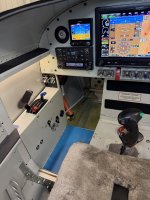
Never closed this out…yup, went with a single DP switch, just below the Throttle so I can find it….

IMG_9118.jpeg
 
Dan, are saying that the Variable timing is of no benefit with the Lycoming IO-540?
Alan

No. Parallel valve Lycomings respond well to timing advance. Angle valve, not so much.
 
Are there documented benefits (has anyone run a test) for running the IO-540 in Variable mode in cruse…
Alan

Short answer YES. Slightly longer answer: do a search on this forum and buckle down for several hours of reading.
 
Back
Top