Van's Air Force

The definitive Van's Aircraft support community! Buying, building or flying an RV? Join our exclusive family of mentors and enthusiasts!

Alternator field wire question

FireMedic_2009

Well Known Member
Patron
While I was flying it appeared I lost my alternator and with a Lithium Iron Phosphate battery it didn’t last long until I lost my entire panel.

I have my field wire connected to the control terminal on a contactor so I can physically disconnect the B-lead from the system if an over voltage situation occurs. The field wire continues to the alternator to excite the internal regulator on a denso mini alternator. I have a B&C OV module to trip the 5A breaker switch on the field wire going to the control terminal contactor so it will automatically disconnect the B-lead from the bus.

I went to an alternator shop and they said the alternator was good. I checked the voltage on the field wire coming from the panel and it checked good. I even replaced the 5A breaker switch with another switch I had in the panel that was unused. I borrowed a charged battery and started the engine and had no voltage increase indicating it was charging. I even increased the rpm to 2000 to make sure I was over the threshold rpm to active the regulator. I called an alternator shop in my hometown and they said to connect the field wire from the alternator directly to the battery which I did but actually connected it on the other side of the master contactor so when I shut it down the regulator wouldn’t drain the battery. I fired up the plane and immediately it was charging the battery and I flew the plane home. Prior to this happening I had flown the plane for about 30 hrs. Does anyone know why all of a sudden the regulator wouldn’t active even though battery power voltage was present at the control terminal on the contactor where the field wire continued onto the alternator?

I currently have the field wire from the alternator connected to the Master contactor. Is there any reason why I shouldn’t leave it as is other than to kill voltage going to the internal volt regulator?

Thanks
 
I know thread drift but interested in your LIFePO4 battery amp-hr. rating and amp draw. Properly charged LiFePO4 batteries should last as long as AGM batteries if properly charged. (13.9 volts min to 14.4 volts with their sweat spot in the 14.2 range). Just because your EFIS says your bus voltage is at ~ 14.2 volts doesn't necessarily mean the battery is seeing this voltage.
 
WEIZE 12V 8AH Group 20, 600CCA LiFePO4 Lithium Motorcycle Battery. My electrical draw is about 16A, 10A is from my Whelen nav and strobes
 
If the B-lead is connected to the Alt contactor and goes from the contactor to the master contactor and from the alt contactor to the shunt (which measures voltage and current) and the shunt connects to the bus, I would think the voltage the battery is seeing is pretty close to the voltage on the efis. If not, please explain. If you are insinuating the field wire wasn’t seeing enough voltage to activate the regulator, what’s the min voltage for the regulator to be activated?
Thanks
 
What size is the wire from the panel 5A breaker for the field supply? If the contactor for the B lead is removed from the system does it make any difference? (thinking about whether the alt contactor draw might be causing a voltage drop at the alternator field supply)

The temporary arrangement as suggested by the alternator shop sounds like there is not any breaker or fuse to protect the field wire where it connects to the master contactor, so that shouldn't be left as-is.
 
The field wire is 18ga and is not connected to the master contactor but to the alt contactor in order for the OV module to trip the field wire breaker thus disconnecting the B-lead. The field is get power from the electrical bus and uses a 5A breaker switch.

Updated after post #7
Correct, I could put a fuse on the field wire going to the master contactor but if it burns the fuse then I lose the alternator. If I don’t use a fuse the wire burns up, I lose the alternator anyway
 
Last edited:
The field wire is 18ga and is not connected to the master contactor but to the alt contactor in order for the OV module to trip the field wire breaker thus disconnecting the B-lead. The field is get power from the electrical bus and uses a 5A breaker switch
18 gauge should be adequate I expect.

The first post states "I currently have the field wire from the alternator connected to the Master contactor. Is there any reason why I shouldn’t leave it as is other than to kill voltage going to the internal volt regulator?" so I wouldn't leave it like that if there is not a fuse or breaker to protect against a short in the field wire.
 
Updated after post #7
Correct, I could put a fuse on the field wire going to the master contactor but if it burns the fuse then I lose the alternator. If I don’t use a fuse the wire burns up, I lose the alternator anyway
And maybe set the engine on fire.....:unsure:
 
And maybe set the engine on fire.....:unsure:
Not very likely with an 18ga wire. If it shorts which is the most likely then it will burn quickly and be done. More likely to have the fuse fail than the wire short. Now if the wire is in a bundle of wires that’s a different story and you want to protect those wires
 
There is no need for the contactor if the internal VR will not work without the 12v feed from your switch. So ,if you kill the switch, alternator stops outputting and end of OV situation. I don’t like the daisy chain approach, but can’t give a reason why it stopped working. However, clearly the internal vr doesn’t like it, so get rid of it..

Fyi, it is not a Field wire. The field is driven by the internal vr.
 
There is no need for the contactor if the internal VR will not work without the 12v feed from your switch. So ,if you kill the switch, alternator stops outputting and end of OV situation. I don’t like the daisy chain approach, but can’t give a reason why it stopped working. However, clearly the internal vr doesn’t like it, so get rid of it..
It’s worked on all my planes and it worked on this one for 30 hrs or so. The reason for the contactor is the internal VR can fail in a way where you are unable to shut it down, although rare, but it has happened

Update, I miss read.
I still have the OVM that will use the contactor to disconnect it. The Field switch (breaker switch ) is connected to the control terminal on the contactor which the OVM is connected to the breaker switch
 
Last edited:
It’s worked on all my planes and it worked on this one for 30 hrs or so. The reason for the contactor is the internal VR can fail in a way where you are unable to shut it down, although rare, but it has happened

Update, I miss read.
I still have the OVM that will use the contactor to disconnect it. The Field switch (breaker switch ) is connected to the control terminal on the contactor which the OVM is connected to the breaker switch
May be mistaken as I don’t have the details of how this internal vr is wired, but it sounds like what you are calling a field wire is just the power source or an on off switch for the internal vr. Tutn of the switch, turn of the vr. No failure mode can make the vr over volt if it is turned off. The alt can’t produce anything unles the vr is feeding it current.

You say you can’t shut it down, but you have a switch feeding the vr. What does it do to the vr? Most vrs pull their source power internally or from an ignition switch lead, but some make special vrs or wire them in such a way that their power source is controlled via an external switch. Sounds like this is what you have. If that is the case, you have full control to shut it down and therefore no need for a contactor.
 
Last edited:
May be mistaken as I don’t have the details of how this internal vr is wired, but it sounds like what you are calling a field wire is just the power source or an on off switch for the internal vr. Tutn of the switch, turn of the vr. No failure mode can make the vr over volt if it is turned off. The alt can’t produce anything unles the vr is feeding it current.
Yes the field wire is the wire from your panel powering the VR

Not once it’s turned off will it fail and turn On. From what I’ve seen mentioned on the forum over the years is the VR can fail in such a way that you have an OV runaway and the VR can’t be turned off even if the field wire is turned off. I believe you can ask Dan H about it
 
WEIZE 12V 8AH Group 20, 600CCA LiFePO4 Lithium Motorcycle Battery. My electrical draw is about 16A, 10A is from my Whelen nav and strobes
So, you have less than 30 mins assuming your battery is fully charged and working perfectly. Seems tight but everyone has their own personal risk assessment. I know little to nothing about this 8AH battery, but spec says it weighs 5.874 lbs. EarthX ETX680 weighs 3.9 lbs. and outputs 12.4 AH. You are not flying a motorcycle.
 
I believe the 12190. Most are 30A but some can be 50A like the one below
That crosses to an ND 100211-4640 (and a whole bunch of other ones) , which *may* use one of the self exciting regulators (ND 126000-0600 126000-0760 126000-1160). You won't know for certain until you take the rear cover off, undo the brush holder and regulator and look at the part number underneath.

The regulator has 2 pins - Lamp, R(IG) Is it safe to assume that your "field" wire is connected to the R/IG pin on the connector?
 
So, you have less than 30 mins assuming your battery is fully charged and working perfectly. Seems tight but everyone has their own personal risk assessment. I know little to nothing about this 8AH battery, but spec says it weighs 5.874 lbs. EarthX ETX680 weighs 3.9 lbs. and outputs 12.4 AH. You are not flying a motorcycle.
No but I didn’t pay $800 for a battery either nor do I pay $800 -$1000 for an alternator. I’ve never had an alternator fail on a car. Half the RVs fly with an mini alternator
 
Yes the field wire is the wire from your panel powering the VR

Not once it’s turned off will it fail and turn On. From what I’ve seen mentioned on the forum over the years is the VR can fail in such a way that you have an OV runaway and the VR can’t be turned off even if the field wire is turned off. I believe you can ask Dan H about it
You may be right. I don’t know what kind of alternator you have or how the vr is wired. So i am Guessing just like you are. While i trust dans input, are you sure his comments are applicable to YOUR alternator? There are MANY different ones that are wired and powered very differently.
 
No but I didn’t pay $800 for a battery either nor do I pay $800 -$1000 for an alternator. I’ve never had an alternator fail on a car. Half the RVs fly with an mini alternator

...and at least one (N53MH) crashed because of an OV condition on a reman ND alternator...

So...anyway...

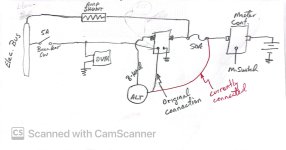
Back to the problem at hand -- no charging, alternator "ok" at the local shop; gotta love that scenario. Can you detail (picture) the connections between the alternator, the buss, the battery, and what control systems (switches, relays, contactors) are in place? I am having a hard time deciphering your OP information.
 
CamScanner 06-04-2025 23.44_1.jpeg
When the breaker switch is closed it closes the alt contactor and would also provide 12V to the VR in the alternator. If the OVM detects a voltage over 16V the OVM shorts the field wire causing the breaker switch to open thus disconnecting the B-lead from the Master contactor. For some reason the wire connected between the alt contactor to the alternator wasn’t exciting the VR. So I moved the field wire connection between the contactor and alternator to the new location shown in red
 
Last edited:
No but I didn’t pay $800 for a battery either nor do I pay $800 -$1000 for an alternator. I’ve never had an alternator fail on a car. Half the RVs fly with an mini alternator
Umm, it’s $ 379.00 for a battery that’s certified and has a BMS engineered in the US. Also has significantly higher AH rating. Penny wise and dollar (life) foolish, you decide. Your car you can pull off the side of the road. Pretty sure your airplane doesn’t have that luxury.
 
Umm, it’s $ 379.00 for a battery that’s certified and has a BMS engineered in the US. Also has significantly higher AH rating. Penny wise and dollar (life) foolish, you decide. Your car you can pull off the side of the road. Pretty sure your airplane doesn’t have that luxury.
The problem wasn’t with the battery, now was it and I’m not flying in IFR conditions and wouldn’t without a backup alternator
 
The problem wasn’t with the battery, now was it and I’m not flying in IFR conditions and wouldn’t without a backup alternator
Your battery crapped out after a brief period of time and you lost your avionics. Probably landed no radio? You then stated you used a cheap LiFePO4 motorcycle battery made and engineered who knows where. You justify this by stating you don’t want to spend $ 800 for a decent battery that costs half of your stated price and actually last much longer when you loose your automotive engineered alternator. Please consider others that fly in the same airspace as you.
 
Besides there was nothing wrong with the alternator as verified by the shop. The original post was after 30 hrs of working why was changing the field wire connection location necessary? Looking at the diagram, the wiring is straight forward electrically and no reason why it stopped working. Wow, has this gone off on a tangent
 
Besides there was nothing wrong with the alternator as verified by the shop. The original post was after 30 hrs of working why was changing the field wire connection location necessary? Looking at the diagram, the wiring is straight forward electrically and no reason why it stopped working. Wow, has this gone off on a tangent
 
i am always interested in anything ovm related. that is because every time i read a thread about it i question everything i thought i knew.
i thought the correct place to put an ovm was on the b lead because there are failure modes that are not remedied by disconnecting the field wire. no? also, i thought that an overvoltage may happen in a split second so any manual switch may be way too slow. no?
 
View attachment 89431
When the breaker switch is closed it closes the alt contactor and would also provide 12V to the VR in the alternator. If the OVM detects a voltage over 16V the OVM shorts the field wire causing the breaker switch to open thus disconnecting the B-lead from the Master contactor. For some reason the wire connected between the alt contactor to the alternator wasn’t exciting the VR. So I moved the field wire connection between the contactor and alternator to the new location shown in red

The B+ wire is isolated from the battery until the 5A breaker/switch is closed (Is this really a combi and not a discrete switch and breaker?)

Therefore, your normal operation should be:

1. Master Relay On/closed
2. 5A Alternator Switch/Breaker On/closed (do you hear the relay close?)
3. Start Engine
4. Observe voltage -- should be ~14.5V

Correct?

Any chance you got the sequence wrong, just once, and tried to bring the Alternator online *after* the engine was running? The VR in this alternator uses B+ voltage/current to supply the field current IIRC. No B+ voltage (because the relay is open until you close the 5A switch), and the alternator won't produce power...no matter what is happening with IG/R input.
 
This is one of the reasons I'm not a fan of the internal regulator. With an external, you can isolate it and troubleshoot it. The regulator will take power in from the bus, sense the bus voltage, decide how hard to drive the alternator to reach the target voltage on the bus, and then send some variable voltage/current to the field coils to generate a variable magnetic field in the rotor that is used to excite the stator coils. You can put a voltmeter on the output of the regulator going to the field coils and watch the field coil input voltage rise and fall according to the electrical demand. Most of the time it will ride down in the 3-8 volt range for our airplanes, applying a full 12 volts to it equates to maximum output on the alternator, something less on the field results in something less on the B+ output. If you are looking at that voltage right after engine start, you'll see it peg out at full voltage for a few minutes to recharge the battery after start, then start pulling back as the regulator tracks the target voltage on the bus.
 
I suggest a basic class in DC circuits/theory and learn how to use a VOM (voltmeter) otherwise you're just shooting in the dark.
 
The B+ wire is isolated from the battery until the 5A breaker/switch is closed (Is this really a combi and not a discrete switch and breaker?)

Therefore, your normal operation should be:

1. Master Relay On/closed
2. 5A Alternator Switch/Breaker On/closed (do you hear the relay close?)
3. Start Engine
4. Observe voltage -- should be ~14.5V

Correct?

Any chance you got the sequence wrong, just once, and tried to bring the Alternator online *after* the engine was running? The VR in this alternator uses B+ voltage/current to supply the field current IIRC. No B+ voltage (because the relay is open until you close the 5A switch), and the alternator won't produce power...no matter what is happening with IG/R input.
I leave the field wire switch ON all the time, no reason to shut it off after engine shut down
 
Hmm.. And what's the make/model of the Alternator contactor?
Rogers – White 14 V continuous duty. Can’t remember the actual model number. I was told by Dan H that there’s no need to shut down the field switch and to just leave it on all the time. If you’re saying, I should exercise the switch every so often then I would agree. I chose to use a breaker switch instead of a switch and a circuit breaker. If I should use a switch and a circuit breaker instead of a circuit breaker switch, please explain why, I have no problem making the change.
 
On Breaker/Switches - there have been a few AD's on them in Beech, Cessnas. If you don't exercise the switch, they won't wear out. The AD issue may still persist however.

Also, your schematic didn't depict any flyback (or snubber) diodes across the contactors or the field circuit -- are they there?
 
Last edited:
Ohhh - breaker switch - yes, those are known to have issues over time. You should carefully verify that you really do have power coming out the other side of that switch. They have a copper braid strap internally that flexes on each use, eventually it will break and fail open.
 
On Breaker/Switches - there have been a few AD's on them in Beech, Cessnas. If you don't exercise the switch, they won't wear out. The AD issue may still persist however.

Also, your schematic didn't depict any flyback (or snubber) diodes across the contactors or the field circuit -- are they there?
I didn't know about the AD's on the breaker switches. Thanks, I will change them out and add CB's. I did test if the switch was making contact, which it was. Yes, I do have diodes for the contactors, I just didn't draw them in.
 
I didn't know about the AD's on the breaker switches. Thanks, I will change them out and add CB's. I did test if the switch was making contact, which it was. Yes, I do have diodes for the contactors, I just didn't draw them in.
Given all that, I don't know why the condition described in your OP happened. Deux ex machina?
 
Back
Top