Van's Air Force
You are using an out of date browser. It may not display this or other websites correctly.
You should upgrade or use an alternative browser.
You should upgrade or use an alternative browser.
Carbon Monoxide in the cockpit
- Thread starter Jctym
- Start date



Paul 5r4
Well Known Member
I get none on my detector. Possible sources... CO will be sucked in through any unsealed holes in the firewall. I've also heard of it coming in from under the seat pans and up through the stick boot holes. Another place is around a poor canopy seal. Finally there are some potential leaky areas on the very aft end of the fuselage where the bottom rudder hinge is. Also make sure you have no apparent leaks around the exhaust. Only place should be out the aft end of the pipes.

It is not normal, not good. I'd find out how CO is getting into the cockpit and seal it up. And of course confirm it's not an exhaust leak.I bought a CO detector and it reads a small level of CO in the cockpit if the air vents are closed. Pulling the cabin heat knob actually decreases the level, but doesn't go away. Is this common with RV's? Anyone else have a CO detector in the cockpit? Thanks.
As a data point, I only see CO on my detector when I've got my back to the wind while running on the ground, or someone in front of me is blowing CO in my direction. In flight, I never see CO.


Jctym
Member
Thanks. I'm between 11 and 20..My portable CO detector in the 7 always read around 2 with the vents closed.
Jctym
Member
Thank you Paul. We did find a leak in the exhaust, but that didn't fix it. I'm going to buy a second CO detector and position them in various differest spots in the cockpit to try and find the source. I hadn't thought of the stick boot hole. Thanks.I get none on my detector. Possible sources... CO will be sucked in through any unsealed holes in the firewall. I've also heard of it coming in from under the seat pans and up through the stick boot holes. Another place is around a poor canopy seal. Finally there are some potential leaky areas on the very aft end of the fuselage where the bottom rudder hinge is. Also make sure you have no apparent leaks around the exhaust. Only place should be out the aft end of the pipes.
Jctym
Member
Thank you. We did find an exhaust leak and fixed it, but that didn't stop the readings. Strange.It is not normal, not good. I'd find out how CO is getting into the cockpit and seal it up. And of course confirm it's not an exhaust leak.
As a data point, I only see CO on my detector when I've got my back to the wind while running on the ground, or someone in front of me is blowing CO in my direction. In flight, I never see CO.
Jctym
Member
Thank you. I would not have thought of that.
I use the Forensics CO detector in the RV9 and it always reads 0.I bought a CO detector and it reads a small level of CO in the cockpit if the air vents are closed. Pulling the cabin heat knob actually decreases the level, but doesn't go away. Is this common with RV's? Anyone else have a CO detector in the cockpit? Thanks.
https://www.sportys.com/forensics-c...?creative=78546576245620&device=c&matchtype=e

I had very high CO levels in my RV7 until I sealed the above areas in the tail. It mad a world of difference.
Paul 5r4
Well Known Member
JCTYM... The stick boot area is a possible inlet but I don't know what you can do about that spot. Seems to me the CO would be getting sucked in at the wing root area then on into the subfloor area and up through the boot area. I would think you're going to have to find the source, (if there is one), and fix that area. Only other thing I can think of that might cause it to get in the wing root areas is maybe if your exhaust pipes aren't turned "down" enough. I recall when building that my builders manual stressed the point of making sure the pipes were aimed down rather that coming out in a more parallel with the fuselage look. Good luck and keep us all posted.

RicoB
Well Known Member
Those holes are hard to seal...One other area that's been reported here is the holes for the flap pushrods.

I can't comment on whether it is a culprit for CO but either way there's a worthwhile mod if only to keep the cold air from blowing up past your sticks: Thread 'Aileron Push Rod Boots?' https://vansairforce.net/threads/aileron-push-rod-boots.156550/JCTYM... The stick boot area is a possible inlet but I don't know what you can do about that spot. Seems to me the CO would be getting sucked in at the wing root area then on into the subfloor area [...]
I don't understand why some RV7's have this issue and others don't. My 7 doesn't currently doesn't have any weatherstripping, aileron pushrod boots, carpet or even stick boots and not a peep from either the built in detector or the one in my headset, which I know works because it went off the other day when I got into a 172 that was already running.
It would be interesting to find the root cause. I suspect you're right to think that it might have something to do with the downturn of the exhaust tips.
It would be interesting to find the root cause. I suspect you're right to think that it might have something to do with the downturn of the exhaust tips.
That seems like a simple fix on the 7A, but it's a little more challenging on the 7. The weldment for the tail gear sticks down through an elliptical hole in the tailcone skin. I suppose you could lay a fillet of pro seal in there?"...I recommended he seal up the aft end of fuse between rudder and aft fuse... problem solved..."
Also, all this talk of sealing up the tailcone doesn't seem to take into account how water that gets in there is going to be trapped. The empennage isn't exactly airtight. There's lots of places for water to get in if it sits out in the rain and on my plane I'd like for it to have a way to get back out. Just something to think about.
Jctym
Member
Good idea, but I'm wondering exactly how to do that. The exhaust pipes are fixed and bolted on. I'd hate to buy new ones or have a welder change the angle only to find it didn't fix it. I wonder if there's any "add on's" that can be attached temporarily for a test.I would first make sure the exhaust are pointed DOWN. A friend here had +CO in the cockpit. I recommended he seal up the aft end of fuse between rudder and aft fuse... problem solved.
Paul 5r4
Well Known Member
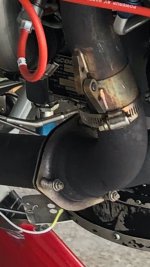
It's been a long time since I finished building, (12 years), but seems I remember a connection of some kind that enables them to be rotated then secured again. I have the standard Vetterman exhaust that came with the kit. Edited: I found a picture of the joint I'm referring to. I think you can adjust at the area where there are springs on the bolts.
Attachments
Last edited:
Jctym
Member
Thank you. I'll look into it.It's been a long time since I finished building, (12 years), but seems I remember a connection of some kind that enables them to be rotated then secured again. I have the standard Vetterman exhaust that came with the kit. Edited: I found a picture of the joint I'm referring to. I think you can adjust at the area where there are springs on the bolts.
Often, during take off and landing, CO enters the cabin through the flap rod actuators, when the flaps are up, the hole is covered. During taxi, depends on the relative wind, but that is the usual time there is CO with on appearant leak noted.I bought a CO detector and it reads a small level of CO in the cockpit if the air vents are closed. Pulling the cabin heat knob actually decreases the level, but doesn't go away. Is this common with RV's? Anyone else have a CO detector in the cockpit? Thanks.
DAR Gary
Jctym
Member
Interesting. I've owned it since October so I'm relatively new. I'll admit that I've never seen it with the flaps up, as I always keep them down on the ground so folks don't step on it. I didn't know the holes were covered in flight. I'll have to look. But no, I get CO readings in cruise consistently.Often, during take off and landing, CO enters the cabin through the flap rod actuators, when the flaps are up, the hole is covered. During taxi, depends on the relative wind, but that is the usual time there is CO with on appearant leak noted.
DAR Gary
Jctym
Member
I tried taping all around the flap actuator rods and did a flaps up takeoff and landing as a test. No affect, I still got the CO reading in the cockpit. So that's not it. I'm now thinking I might need new exhaust pipes that stick out further and point down, or maybe there are extensions that can be added on.Often, during take off and landing, CO enters the cabin through the flap rod actuators, when the flaps are up, the hole is covered. During taxi, depends on the relative wind, but that is the usual time there is CO with on appearant leak noted.
DAR Gary
Jctym
Member
I think I finally solved it, but it took some detective work. Using two CO detectors places in different areas of the cockpit I suspected the CO that registered was coming from the rear. So I took a shoebox and zip tied a CO detector to one inside wall and my cellphone to the other side, facing each other. I zip tied a flashlight onto the floor of the box to illuminate the detector. I then opened the back panel, turned on the video camera on the phone, taped the box to the floor in a safe area, and reinstalled the back cover. After flying the video showed very high levels of CO in the aft fuselage area. That confirmed it. Then I tried taping shut all the flap actuator areas, but that flight showed no difference in levels. (That's good, I'm rather fond of using flaps. Ha.) Finally I taped shut the tailwheel bolt access hole just in front of the tailwheel rod. On that test flight the CO detector on the instrument panel showed zero even with the air vents closed, which has never happened before. The CO detector on the rear wall still showed CO, but only 19 which is the smallest it has ever shown. So for a pretty good temporary fix, I ordered a 3/4 " button hold plug for the hole as opposed to tape. I suppose the permanent fix will be different exhaust pipes or pipe extenders to redirect the exhaust. This is a relief. Thanks for all the help during this process.

Nice. Glad you found the issue.
If you decide to make the aileron boots I cheated and cut sleeves off of a tyvec suit. They worked great. Let me know and I will try and find the photos.
If you decide to make the aileron boots I cheated and cut sleeves off of a tyvec suit. They worked great. Let me know and I will try and find the photos.