Van's Air Force

The definitive Van's Aircraft support community! Buying, building or flying an RV? Join our exclusive family of mentors and enthusiasts!

NPT Fitting - Did I do this correctly?

tims88

Well Known Member
I've watched the EAA Hints for Homebuilders video on NPT fittings but I still want to make sure I did my first NPT fitting correctly or not. I used Loctite 567. Here's how I put it on the fitting:

PXL_20250414_025400442.jpeg

Is that too much/too little sealant?
Is it too close/too far away from the end of the fitting?

When I installed it into my SDS fuel pump module I was only able to get it about 3/4 of a turn past finger tight while holding the pump in my hand. That was pretty far off from the 1.5 to 2 turns that the Van's manual says they should be tightened to so I clamped it to my workbench and got it to about 1 turn past finger tight. That took quite a bit of force to get it that far so I'm not sure how much further it could be tightened without damaging something. So how important is that 1.5 to 2 turns range when tightening these fittings?

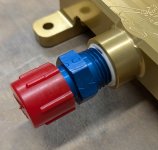
This is how it looked when I stopped tightening. It doesn't seem like the threads with the sealant goes very far into the female fitting. I guess that's normal?
PXL_20250414_031031640.jpeg
 
I use more than that. I apply it all the way from the first thread to about half way up, then I use my finger to press it into the threads. I don’t like any dry threads entering the threaded hole because that could gaul and seize. Or to be confused with spark plugs, I skip the first thread on those so it doesn’t get on the electrode.
 
I use more than that. I apply it all the way from the first thread to about half way up, then I use my finger to press it into the threads. I don’t like any dry threads entering the threaded hole because that could gaul and seize. Or to be confused with spark plugs, I skip the first thread on those so it doesn’t get on the electrode.
+1

All the way to the first thread. Then clean off any that gets ahead of that first thread.
 
+1

All the way to the first thread. Then clean off any that gets ahead of that first thread.
Wow that’s a lot of sealant. Remember that these fittings tighten up to metal to metal. I put one or two vertical stripes on the threads, starting on thread #2. I never want any sealant in the lines themselves. Then use a stiff small brush to spread the sealant around the circumference. If you wet all the metal that’s enough.
 
I'm confused using anything on a fuel line.
I'm confused someone advocating putting stuff on all the threads (none dry to prevent seizing)
I thought fuel and oil related stuff should not have anything on it?
 
I was instructed that Loctite 565 and 567 are the go-to for this type of thread. I use the same/slightly less than original photo above, with the goal to get complete 360’ coverage but not have excess and not allow any into the fuel stream.

Edit- as you can see in your “installed” photo, the pump housing’s threads drive the excess sealant back. There was enough there that you have excess accumulate at the opening high up the fitting. I will add that I start on the second thread.
 
I'm confused using anything on a fuel line.
I'm confused someone advocating putting stuff on all the threads (none dry to prevent seizing)
I thought fuel and oil related stuff should not have anything on it?
-Don't use anything on flared fittings
-You DO have to use sealant of some kind on pipe threads. If you don't, here will always be a slight spiral leak path around the threads.
-Don't use teflon tape, RTV, or fuel tank sealer on anything carrying fluid, as it can get cut and suck threads into the fluid stream. Over the years there have been quite a few planes (not just homebuilts) crash because of not following this guidance.

The IA's at my shop recommend and use Loc-tite 565 or 567. That fleet flies around 8,000 hours a year on about 12 airplanes and we don't seem to have any problems so thats what I used on my RV build.

Section 5 of the build manual covers this and has several recommendations for what type of sealant to use on pipe threads.

Here's a cut and paste of the appropriate verbiage from section 5 of my RV7 build manual.

"...Because we cannot always fully tighten tapered thread fittings, and because even after fully tightening

the fitting a small spiral leak path remains along the full length of threads, a thread sealant must be

used during assembly. Sealants appropriate for use on aircraft NPT fittings areTite-seal, Permatex #2

and Locktite 565. Do not use RTV, Teflon tape or Fuel Lube on NPT fittings.

When installing the fitting, be sure the threads on both parts are clean and dry since most sealants will

not tolerate any oil contamination. First determine the clocking position by installing it

finger tight and marking the desired clocking. Remove the fitting and apply a small amount of sealant to

2 - 3 threads of the male fitting. Leave the first 2 bare to prevent contamination inside the fluid path.

Remember, this is an interference fit so not much sealant is required..."
 
The reason sealant is necessary is because the threads have space at the peaks/ valleys. The metal to metal interface is on the thread faces only. The sealant has to fill the gaps in the valleys. However, you don’t want excess sealant getting into the fluid passages. This is why the sealant should not be applied heavily to the last thread. You don’t want it squeezing out into the fluid passage. It is interesting to note that the first threads don’t engage tightly as they thread in the tapered hole. They only tighten up when the fitting is fully tightened.
 
The reason sealant is necessary is because the threads have space at the peaks/ valleys. The metal to metal interface is on the thread faces only. The sealant has to fill the gaps in the valleys. However, you don’t want excess sealant getting into the fluid passages. This is why the sealant should not be applied heavily to the last thread. You don’t want it squeezing out into the fluid passage. It is interesting to note that the first threads don’t engage tightly as they thread in the tapered hole. They only tighten up when the fitting is fully tightened.
Like Dan said, the idea is to get sealant at the root of the thread. Even though the threads are a tapered fit, fluids tend to wick up around the roots and create alittle leak. The sealant, when properly used, will block that wicking, and along with the proper torque, will permanently seal the joint. I'm the worst of all of you about 'torque' specs. I tend to make things 'tight', which most of you would consider over-torqueing.
 
Wow that’s a lot of sealant. Remember that these fittings tighten up to metal to metal. I put one or two vertical stripes on the threads, starting on thread #2. I never want any sealant in the lines themselves. Then use a stiff small brush to spread the sealant around the circumference. If you wet all the metal that’s enough.
I didn't necessarilly suggest putting it on thick, just good coverage. I usually run my finger around it to squeeze into the threads and minimize excess. You want good coverage on NPT, as it not only seals, but lubricates. Many people don't get NPT fittings tight enough and this helps. It is critical to get all the way to the end though. These are tapered threads and not highly precise. You don't exactly know which part of the thread will get the tightest and do the sealing. The sealant helps in the less tight areas..
 
I'm confused using anything on a fuel line.
I'm confused someone advocating putting stuff on all the threads (none dry to prevent seizing)
I thought fuel and oil related stuff should not have anything on it?
No, you don't use sealants that become solids that can break off and clog things. Even more important is the application of the sealant that prevents the sealant from reaching past the threaded area.
 
No, you don't use sealants that become solids that can break off and clog things. Even more important is the application of the sealant that prevents the sealant from reaching past the threaded area.
......for example Permatex #2 (or any number....) The above Loctite 565 and 567 (the difference is what temperatures it will be exposed to; as I recall 567 is for fittings firewall forward, ie, where the HEAT is). Do NOT use fuel lube that slicks up fuel selector valves. I've seen that fail albeit slowly...... :oops:
 
Last edited:
......for example Permatex #2 (or any number....) The above Loctite 565 and 567 (the difference is what temperatures it will be exposed to; as I recall 567 is for fittings firewall forward, ie, where the HEAT is). Do NOT use fuel lube that slicks up fuel selector valves. I've see that fail albeit slowly...... :oops:
The Loctite website confirms that 567 is for high temperature i.e. forward of firewall
 
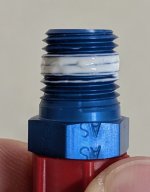
I appreciate all the responses and the discussion. Since several people who responded put the sealant even closer to the end of the fitting I decided to try again. Is this more like it or am I still too far away from the end? It's tough to tell how close to get to the end since the thread isn't fully formed, which seems like would make it more likely for the sealant to get pushed the wrong direction as things tighten up.

PXL_20250414_190921155.jpeg
 
I appreciate all the responses and the discussion. Since several people who responded put the sealant even closer to the end of the fitting I decided to try again. Is this more like it or am I still too far away from the end? It's tough to tell how close to get to the end since the thread isn't fully formed, which seems like would make it more likely for the sealant to get pushed the wrong direction as things tighten up.

View attachment 85251
Re-read Vans’ directions in post 7. “Leave the first two threads bare”. IMHO you’re already past that. Start one thread lower. You do not want the sealant to squeeze past the first thread and into the fluid stream. And in most fittings this is impossible to inspect.
 
Pretty sure most folks just apply it using a finger, pressing it into the threads. Once the fitting is tightened wipe away the excess. If. You get too close to the end, it is a simple thing to wipe a bit away.

The last thing you want is to skimp on the sealant and end up with a leak…

Also, be very careful if you are using a brush. All it takes is is one bristle to cause a leak.

Don’t overthink it.
 
I was instructed that Loctite 565 and 567 are the go-to for this type of thread. I use the same/slightly less than original photo above, with the goal to get complete 360’ coverage but not have excess and not allow any into the fuel stream.
+1 for Loctite 565 and 567.
 
I didn't necessarilly suggest putting it on thick, just good coverage. I usually run my finger around it to squeeze into the threads and minimize excess. You want good coverage on NPT, as it not only seals, but lubricates. Many people don't get NPT fittings tight enough and this helps. It is critical to get all the way to the end though. These are tapered threads and not highly precise. You don't exactly know which part of the thread will get the tightest and do the sealing. The sealant helps in the less tight areas..
Based on my experience even if you put it on super thick, it gets pushed out as you threaded in. If you put one in and immediately pull it out, you will see that there is hardly anything on the threads that got threaded.
 
Re-read Vans’ directions in post 7. “Leave the first two threads bare”. IMHO you’re already past that. Start one thread lower. You do not want the sealant to squeeze past the first thread and into the fluid stream. And in most fittings this is impossible to inspect.
Van's directions are why the picture in my first post had the sealant start farther down. Then the first few people who responded said they go right up to the first thread. This EAA Hints for Homebuilders video also says to go up to the first thread. Luckily this time I'm asking questions before I reinstall the fitting so that I don't have to redo it again.

Don’t overthink it.
I wish I knew how!
 
Van's directions are why the picture in my first post had the sealant start farther down. Then the first few people who responded said they go right up to the first thread. This EAA Hints for Homebuilders video also says to go up to the first thread. Luckily this time I'm asking questions before I reinstall the fitting so that I don't have to redo it again.


I wish I knew how!
Okay, here’s the issue. The tapered fittings we use are not perfect. As you thread them together a lot of excess sealant is pushed down (in your photo). But let’s say it happens to be thread #5 that first comes snug. As you continue tightening, thread #5 will start to slightly deform, while threads #4 and #3 put more pressure on the sealant. Since the sealant can no longer get past thread #5, it will be squeezed up onto threads 2 and 1. If threads 2 and 1 are already full of sealant, it will be squeezed out into the inner ID of the tube, where it is directly exposed to moving gas or oil. This is generally undesirable.
 
By the way, your second attempt does look better in my opinion. That’s much neater than mine usually look.
 
Hmm what happened to using EZ Turn?

View attachment 85272
Good ole “fuel lube”.
My mentor had a big can of the stuff and it was his go to for pipe fittings, gasket conditioner, sticking washers together, tooth paste and hair gel.
I used it extensively (for pipe fittings)
It is basically a silicon paste.
I switched to thread sealant for a couple of reasons. Fuel lube migrates and starts to ooze around the fitting. However the biggest reason is unless you have a straight fitting and can torque it pretty tight, it won’t seal well. This comes into play anytime you need to clock a fitting.
Thread sealant is more forgiving and is a true sealant.
 
Hmm what happened to using EZ Turn?

View attachment 85272
I found two things it's really good for.
1. My 4x4 oil filter always dripped. One day I coated the seal with a thin layer of EZ Turn. No more drip. Now I use it every oil change. Just the 4x4.
2. Holding a gasket in place. Non potable water pump
I don't use it on the airplane. My tube isn't even at the hangar.
 
I appreciate all the responses and the discussion. Since several people who responded put the sealant even closer to the end of the fitting I decided to try again. Is this more like it or am I still too far away from the end? It's tough to tell how close to get to the end since the thread isn't fully formed, which seems like would make it more likely for the sealant to get pushed the wrong direction as things tighten up.

View attachment 85251
You have most opinions here. Don’t think you will find consensus. You already have my opinion, but suspect what you have done here will be leak free. The primary take away should be to use sealants that do not set up hard. These non hardening sealers don’t don’t typically do real damage if a tiny bit gets past the threads.
 
It is basically a silicon paste.
it’s the stickiest stuff i’ve ever met. i used it on the fuel quick sump when replacing without draining the tank. just a very small amount. 567 would have been washed off with fuel before it got a chance to set, since it needs uncontaminated dry threads to cure. i don’t know why ezturn is hated so much. seems like it has some uses.
 
it’s the stickiest stuff i’ve ever met. i used it on the fuel quick sump when replacing without draining the tank. just a very small amount. 567 would have been washed off with fuel before it got a chance to set, since it needs uncontaminated dry threads to cure. i don’t know why ezturn is hated so much. seems like it has some uses.
Nope.. 567 works great on tapered pipe threads, even fuel drain sump fittings with a full tank of fuel. It doesn’t wash away or need time to dry. Fuel lube on the other hand will eventually leak.. I’m tired of having to reseal fittings on customers planes after the fuel lube starts leaking.. it’s a LUBE, not a SEALANT!. It might take several years, but eventually they leak. (I’m looking at you, brake line fittings) I tried it on my fuel selector valve once, it make it turn so easy and nice! Until one day, I was cruising at 17,500 for a n hour or so, then when I tried to turn it, the cold made it almost impossible to turn! Back down lower, in the warmer temps, it was back to smooth.
 
it’s the stickiest stuff i’ve ever met. i used it on the fuel quick sump when replacing without draining the tank. just a very small amount. 567 would have been washed off with fuel before it got a chance to set, since it needs uncontaminated dry threads to cure. i don’t know why ezturn is hated so much. seems like it has some uses.
Nope. 567 does not “wash away”, and as previously posted, can easily be used on sump fittings even with a full tank of fuel…
 
Ewwww nooo! That doesn’t last as a sealant! Go to Amazon and buy a tube of locktite 567, that’s a real sealant! Fuel lube eventually will leak, because it’s a lubricant, not a sealant!, well 1400 hours and 25 years of flying later and no leaks.
Well OK, but 1450 hours and 25 years of flying later and no leaks whatsoever. Do people actually know from their own personal experience, or do they just repeat what someone told them to say?
 
Well OK, but 1450 hours and 25 years of flying later and no leaks whatsoever. Do people actually know from their own personal experience, or do they just repeat what someone told them to say?
I had similar results on the fuel tank drains. However, I switched to sealant to be consistent with my other fittings.
 
Well OK, but 1450 hours and 25 years of flying later and no leaks whatsoever. Do people actually know from their own personal experience, or do they just repeat what someone told them to say?
See post #12 and #30............ :unsure:
 
it’s the stickiest stuff i’ve ever met. i used it on the fuel quick sump when replacing without draining the tank. just a very small amount. 567 would have been washed off with fuel before it got a chance to set, since it needs uncontaminated dry threads to cure. i don’t know why ezturn is hated so much. seems like it has some uses.
565/7 is an anaeorbic sealant. It does not need to be dry to cure. It only needs to be in an air free environment to cure. Good news is that outside of the thread area, like on the tip of the fitting, it will not cure because that area is exposed to air.
 
565/7 is an anaeorbic sealant. It does not need to be dry to cure. It only needs to be in an air free environment to cure. Good news is that outside of the thread area, like on the tip of the fitting, it will not cure because that area is exposed to air.
that must be what stained my wing when the drain developed a leak - the 567 that never fully cured on the outside exposed threads.

If the paste stays put when installing the drain valve while the fuel is streaming down from the tank, then all should be good. for some reason i thought it would dislodge. may be i was wrong.
 
Thank you to everyone who has responded! I did my best to stop overthinking it and got both fittings installed in my fuel pump module last night. I ended up leaving about the first two threads bare like Van's recommends, but went a little closer to the tip than I did in my first photo. As Mehrdad said, I noticed on the fittings that I removed that all of it was pushed to the last couple threads near the back so I don't know that going too close to the first thread is all that important for sealing it anyway. Finally I used a larger wrench and really cranked on it to get the clocking right. I sure hope I never have to take those out again.
 
I appreciate all the responses and the discussion. Since several people who responded put the sealant even closer to the end of the fitting I decided to try again. Is this more like it or am I still too far away from the end? It's tough to tell how close to get to the end since the thread isn't fully formed, which seems like would make it more likely for the sealant to get pushed the wrong direction as things tighten up.

View attachment 85251
Perfect Tim. There was a plane that limped into OSH and DanH and I helped with the diagnosis. It had sealant (cracking) on the end of the spider fittings past the inlet screen. A very tiny piece fouled an injector nozzle. Dan cleared it and all was well.
 
Finally I used a larger wrench and really cranked on it to get the clocking right. I sure hope I never have to take those out again.
Be careful not to overtighten and potentially crack the fittings.
If a fitting won’t clock, work it like a tap, back 1/4 turn, then tighten, back, tighten…. It usually will move a bit each time. If it’s way off, use a different fitting and try again. The fittings seem to have slightly different tolerances and you can usually find one that works better.
 
Thank you to everyone who has responded! I did my best to stop overthinking it and got both fittings installed in my fuel pump module last night. I ended up leaving about the first two threads bare like Van's recommends, but went a little closer to the tip than I did in my first photo. As Mehrdad said, I noticed on the fittings that I removed that all of it was pushed to the last couple threads near the back so I don't know that going too close to the first thread is all that important for sealing it anyway. Finally I used a larger wrench and really cranked on it to get the clocking right. I sure hope I never have to take those out again.
Be very careful over tightening male tapered pipe fittings. Often you will crack whatever it is screwing into. And that item is always more expensive than the fitting itself.
 
Be careful not to overtighten and potentially crack the fittings.
If a fitting won’t clock, work it like a tap, back 1/4 turn, then tighten, back, tighten…. It usually will move a bit each time. If it’s way off, use a different fitting and try again. The fittings seem to have slightly different tolerances and you can usually find one that works better.
Interesting. The Van's manual says that turning the fitting backwards would lead to a high probability of a leak. Maybe that doesn't apply as long as it's screwed back in further than it was before it was backed out.
Be very careful over tightening male tapered pipe fittings. Often you will crack whatever it is screwing into. And that item is always more expensive than the fitting itself.
Yeah I was/am very worried about that. The Van's manual says that the fitting should be installed to hand tight, and then rotated with a wrench another 1.5 to 2 turns. Is it typical for a 3/8" NPT fitting to be able to go that far past hand tight? I don't think the 45 degree fitting took more than 1.5 turns to clock correctly, and I only did the straight fitting about 1.25 turns, but the amount of force it took to get them there using a 9 inch adjustable wrench seemed concerning. Hopefully I don't find a crack when I go back out tonight to keep working on it...
 
. Maybe that doesn't apply as long as it's screwed back in further than it was before it was backed out.
That’s correct, or at least has worked for me.
Tightening these fittings is something you learn through experience. I’ve never found Vans instructions here to be a stead fast rule. While I didn’t know the specs, Pipe fittings just don’t seem to be made to very tight tolerances.
You’ll get it.
 
Note that if you need to clock an NPT fitting, you will be able to do it one time. As has been discussed above, each successive install will require a bit more rotation each time thus changing the clock position.
 
Back
Top