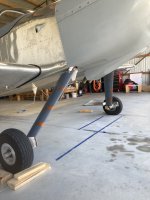
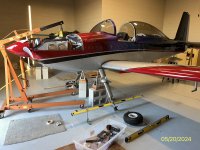
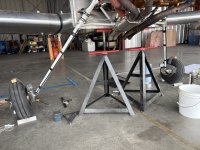
Finally installing my wheel pants and gear leg fairings, so I need a way to lift the tailwheel and level the fuselage... but also I need to keep the plane from nosing over while it's on the jacks, since the lift points are awfully close to the CG. I have a Tail Lift, but it's not really designed to pull downwards, and I didn't want to overload it with ballast.
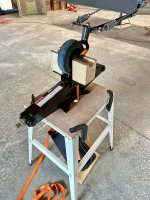
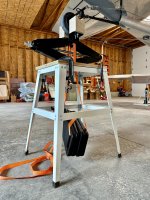
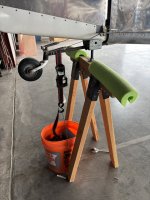
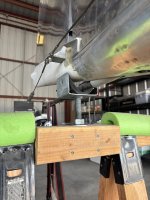
Lots of ways to do this, but here's mine. The base is a steel tool stand with a temporary plywood top, onto which is bolted a Harbor Freight scissor jack. I made some wooden supports that capture the tailwheel fork. A brace of cast iron weights are strapped to the fork; the straps pass straight down through the plywood.
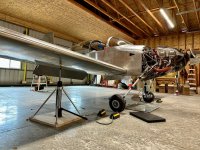
This ended up working great - with the wings raised just enough to get the tires clear of the ground, I only have to extend the scissor jack a couple inches to level the longerons. The lifting motion is straight up and the ballast straps go straight down, so nothing is side-loaded. And unlike the hydraulic jacks under the wings, the tail height is precision-adjustable.
Best of all, I got to use up a chunk of hardwood I've been holding onto for fifteen years and three mailing addresses...!
Lots of ways to do this, but here's mine. The base is a steel tool stand with a temporary plywood top, onto which is bolted a Harbor Freight scissor jack. I made some wooden supports that capture the tailwheel fork. A brace of cast iron weights are strapped to the fork; the straps pass straight down through the plywood.
This ended up working great - with the wings raised just enough to get the tires clear of the ground, I only have to extend the scissor jack a couple inches to level the longerons. The lifting motion is straight up and the ballast straps go straight down, so nothing is side-loaded. And unlike the hydraulic jacks under the wings, the tail height is precision-adjustable.
Best of all, I got to use up a chunk of hardwood I've been holding onto for fifteen years and three mailing addresses...!