Van's Air Force

The definitive Van's Aircraft support community! Buying, building or flying an RV? Join our exclusive family of mentors and enthusiasts!

Stuck Exhaust Valve Resulting in Bent Pushrod and Shroud Tube

asw20c

Well Known Member
Hi All, thought I would share some of my misfortune with the community to raise awareness.

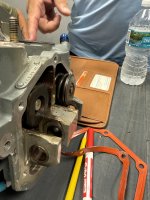
I purchased a YIO-390-EXP340 Thunderbolt engine through Van's for my RV-14A. I had first engine start and first flight last July, 2024. As of today I have put about 138 hours on the engine. This morning when doing a runup prior to takeoff I experienced a great deal of vibration and shaking with my number 2 cylinder going cold at the same time. I aborted the takeoff, came back to the hangar and decowled to see if I could find the problem. I discovered a great deal of oil and my exhaust valve shroud tube bent. This appears to be the classic stuck valve.

I purchased the engine in 2022, so I was sweating bullets whether it was still under warranty. Thank goodness it was, but just barely. Lycoming has entered a service request for a new cylinder kit with associated other parts, and now it is up to me to contact an authorized distributer for the parts before I can start the repairs. In the meantime, there is an awful lot to undo to get the cylinder off. When I put all that together in the first place, I tried to do the best quality work and make the baffles air-tight because I wasn't expecting to have to have to take anything apart for many years. Now, just 8 months later it has to come apart.

I mention all this because while talking to Lycoming they said that when making the repair, they recommended performing mandatory service bulletin 388C on the other cylinders prior to placing the plane back in service. This service bulletin is for determining the exhaust valve guide condition, and if found to be too tight, then there is a process to ream the valve guide (service instruction 1425A). There is yet another service instruction, 1193A, that talks about additional inspections in the event of a valve failure such as what I experienced.

I have made every effort to follow the Lycoming manuals as closely as I'm able to ensure best performance and longevity. I asked Lycoming whether it was possible I wasn't doing something right that could have caused this failure, and was told no, that even with improper operation, 138 hours isn't enough time to cause a stuck valve and therefore it's likely to be a manufacturing defect. All this to say that I highly recommend that folks read and perform service bulletin 388C on their new and very expensive engines. Do this, and you may avoid the heartbreak and downtime that I am going through now.
 
IO-390 cyl 2 which is the hottest showing morning sickness typical. There is something wrong with the design, need input.
 
Hi All, thought I would share some of my misfortune with the community to raise awareness.

I purchased a YIO-390-EXP340 Thunderbolt engine through Van's for my RV-14A. I had first engine start and first flight last July, 2024. As of today I have put about 138 hours on the engine. This morning when doing a runup prior to takeoff I experienced a great deal of vibration and shaking with my number 2 cylinder going cold at the same time. I aborted the takeoff, came back to the hangar and decowled to see if I could find the problem. I discovered a great deal of oil and my exhaust valve shroud tube bent. This appears to be the classic stuck valve.

I purchased the engine in 2022, so I was sweating bullets whether it was still under warranty. Thank goodness it was, but just barely. Lycoming has entered a service request for a new cylinder kit with associated other parts, and now it is up to me to contact an authorized distributer for the parts before I can start the repairs. In the meantime, there is an awful lot to undo to get the cylinder off. When I put all that together in the first place, I tried to do the best quality work and make the baffles air-tight because I wasn't expecting to have to have to take anything apart for many years. Now, just 8 months later it has to come apart.

I mention all this because while talking to Lycoming they said that when making the repair, they recommended performing mandatory service bulletin 388C on the other cylinders prior to placing the plane back in service. This service bulletin is for determining the exhaust valve guide condition, and if found to be too tight, then there is a process to ream the valve guide (service instruction 1425A). There is yet another service instruction, 1193A, that talks about additional inspections in the event of a valve failure such as what I experienced.

I have made every effort to follow the Lycoming manuals as closely as I'm able to ensure best performance and longevity. I asked Lycoming whether it was possible I wasn't doing something right that could have caused this failure, and was told no, that even with improper operation, 138 hours isn't enough time to cause a stuck valve and therefore it's likely to be a manufacturing defect. All this to say that I highly recommend that folks read and perform service bulletin 388C on their new and very expensive engines. Do this, and you may avoid the heartbreak and downtime that I am going through now.
What oil were you using ?
 
I might be wrong but it seems like there was a manufacturing problem with the valve guides being too tight for the valves on a certain number of engines/serial numbers......I believe that was discussed on this forum. A search may be of help. There might be a serial number series that had the problem and a 'wobble' test might need to be done sooner than on other engines..... 138 hours! Yikes!
 
My YIO-390, purchased in 2008,and first flown on my Bearhawk in 2015 had morning sickness without damaging the push rod. That was cylinder #4. Removed the cylinder and had the guide reamed. Happened on #2 as well and reamed it without removing the cylinder. (Both occurred with about 300 hours). Since then I run the engine much harder and try to get >320 degrees for all CHT’s. No problem for 500 hours. My understanding is if the CHT’s are too low lead deposits much more easily.
 
My YIO-390, purchased in 2008,and first flown on my Bearhawk in 2015 had morning sickness without damaging the push rod. That was cylinder #4. Removed the cylinder and had the guide reamed. Happened on #2 as well and reamed it without removing the cylinder. (Both occurred with about 300 hours). Since then I run the engine much harder and try to get >320 degrees for all CHT’s. No problem for 500 hours. My understanding is if the CHT’s are too low lead deposits much more easily.
That is just mike buschs opinion. Please don’t repeat it as factual data. My 6 has 1300 hours on it. I fly a lot in the winter where chts barely get to 300, often 280. My guides are all on the loose side of tolerance. And who said that the material build up in the guides is lead? Have you ever felt lead? It is one of the softest metals, not to mention it is a lubricant. No way that lead in the guide can seize up and bend a pushrod. Carbon, on the other hand can literally be hard as a rock; think diamonds (pure carbon and lots of heat! When you ream the guides, what comes out is jet black, as in coke or oxidezed carbon from the hydrocarbon based oil that got too hot. Lead is grey. We have all seen the little grey balls that form in our spark plugs. That is what lead looks like.
 
Last edited:
My YIO-390, purchased in 2008,and first flown on my Bearhawk in 2015 had morning sickness without damaging the push rod. That was cylinder #4. Removed the cylinder and had the guide reamed. Happened on #2 as well and reamed it without removing the cylinder. (Both occurred with about 300 hours). Since then I run the engine much harder and try to get >320 degrees for all CHT’s. No problem for 500 hours. My understanding is if the CHT’s are too low lead deposits much more easily.
I agree with Ir172 that is unlikely that a cooler CHT is the cause of it as #3 cylinder is typically the coolest CHT in all RV14 and yet vast majority of them have issues with #2 Cylinder which typically has the hottest CHT. Also, it looks like carbon deposit when rimmed.
 
...... performing mandatory service bulletin 388C on the other cylinders ...........
Here's an easy way to measure the wobble distance without buying a tool to hold the dial indicator: https://vansairforce.net/threads/sticky-valve-on-a-thunderbolt-io390.207085/#post-1643900. Just need an Adel clamp and a stack of washers to hold the indicator. You do need to make a valve stem extension from 5/8" round stock by drilling a 1/2" hole into one end and making a saw slot the length of the hole. All the pertinent dimensions are in SB388C.

Please report here what your actual clearances are.
 
Hi All, thought I would share some of my misfortune with the community to raise awareness.

I purchased a YIO-390-EXP340 Thunderbolt engine through Van's for my RV-14A. I had first engine start and first flight last July, 2024. As of today I have put about 138 hours on the engine. This morning when doing a runup prior to takeoff I experienced a great deal of vibration and shaking with my number 2 cylinder going cold at the same time. I aborted the takeoff, came back to the hangar and decowled to see if I could find the problem. I discovered a great deal of oil and my exhaust valve shroud tube bent. This appears to be the classic stuck valve.

I purchased the engine in 2022, so I was sweating bullets whether it was still under warranty. Thank goodness it was, but just barely. Lycoming has entered a service request for a new cylinder kit with associated other parts, and now it is up to me to contact an authorized distributer for the parts before I can start the repairs. In the meantime, there is an awful lot to undo to get the cylinder off. When I put all that together in the first place, I tried to do the best quality work and make the baffles air-tight because I wasn't expecting to have to have to take anything apart for many years. Now, just 8 months later it has to come apart.

I mention all this because while talking to Lycoming they said that when making the repair, they recommended performing mandatory service bulletin 388C on the other cylinders prior to placing the plane back in service. This service bulletin is for determining the exhaust valve guide condition, and if found to be too tight, then there is a process to ream the valve guide (service instruction 1425A). There is yet another service instruction, 1193A, that talks about additional inspections in the event of a valve failure such as what I experienced.

I have made every effort to follow the Lycoming manuals as closely as I'm able to ensure best performance and longevity. I asked Lycoming whether it was possible I wasn't doing something right that could have caused this failure, and was told no, that even with improper operation, 138 hours isn't enough time to cause a stuck valve and therefore it's likely to be a manufacturing defect. All this to say that I highly recommend that folks read and perform service bulletin 388C on their new and very expensive engines. Do this, and you may avoid the heartbreak and downtime that I am going through now.
I had very similar experience albeit cylinder #3. Interesting, Lycomimg told me that stuck exhaust valves are specifically excluded from my warranty.

Marriner
 
That is just mike buschs opinion. Please don’t repeat it as factual data. My 6 has 1300 hours on it. I fly a lot in the winter where chts barely get to 300, often 280. My guides are all on the loose side of tolerance. And who said that the material build up in the guides is lead? Have you ever felt lead? It is one of the softest metals, not to mention it is a lubricant. No way that lead in the guide can seize up and bend a pushrod. Carbon, on the other hand can literally be hard as a rock; think diamonds (pure carbon and lots of heat! When you ream the guides, what comes out is jet black, as in coke or oxidezed carbon from the hydrocarbon based oil that got too hot. Lead is grey. We have all seen the little grey balls that form in our spark plugs. That is what lead looks like.
Chill, Just my experience.
 
My IO360 (angle valve) had morning sickness and the #2 had a sticking exhaust valve. Pulled the jug and found cam lobe damage. Reamed the guide, checked all the others. Maybe a coincidence but the #2 runs cool. also Lycoming wants aeroshell 15w-50 with the extreme pressure additive in the angle valve engines. Phillips Victory oil also has the EP additive, XC does not. Just sayin'
 
Working a couple of sticking exhaust valves (parallel valve engines) the one common element was the pilot operated the engine mostly ROP, including full rich for taxi.

I have ~2000 hrs on three different RVs and never had a sticking exhaust valve. I aggressively lean on the ground and run LOP 90+% of the time. On long cross country trips I strive to keep CHTs around 350 as I do believe Mike Busch's analysis on 100LL additive (not lead) with prolonged low CHT temps. This simply translates to running the engine at Peak mixture instead of LOP for these non-typical conditions. I do however, consider this secondary to not flooding the engine with excess (and thus unburned) fuel.

The point, lean the engine. All that hard, black carbon comes from someplace...

Carl
 
I give you a lot of credit for posting your problem. most people don't report this issue after having this issue with lyc engines. it is the WEAK part of our lyc engines . Robinson helo co has a sb to test at 100 hrs and every 300 after that. find a local robe mechanic and get it done. I just had it done to my engine after having a cylinder replaced 100 hours ago. I sure fells good to eliminate the threat and to know what the measurement is. my guy did the work in about 1 hour. this guy got lucky, stuck valve 6 cylinder engine kept running till landing.
 

Attachments

  • IMG_2454.jpeg
    IMG_2454.jpeg
    1.3 MB · Views: 129
I give you a lot of credit for posting your problem. most people don't report this issue after having this issue with lyc engines. it is the WEAK part of our lyc engines .
Agree, I know a number of people who have had exhaust valve issues on fairly low time Lycomings that don't report it online. Not sure if the problem is getting worse but it seems like I hear more about it in recent years than in the past. My RV-8A's O-360 started running rough at around 800 hrs and inspection revealed one stuck valve and 2 others that didn't pass the wobble test, leading to a full top overhaul. Always ran it as lean as possible on the ground and in cruise, and with dual Lightspeed ignition it always ran on the hot side...370-380F in cruise (340-350 in winter), and always blew through 410F on initial climb on summer days. So I don't think much of Mike Busch's theory that running hot is better. After developing valve problems I spent countless hours researching...my conclusion was there's no clear pattern for how the engine is operated, what oil you use, how often you change it, etc. Lycoming's exhaust valve design sucks and they clearly have no motivation to fix it despite charging us $70k for a new engine. If you don't want to have exhaust valve problems, don't buy a Lycoming engine. Hoping DeltaHawk comes through for us...really need a better design and a company that cares about product development and improvement.
 
what can you do?
1. do the wobble test at 100 hrs on new engine and then at 300 hr intervals. you will now know if your operation method is good or bad by the measured tolerances. if they get tight just ream them out.
2. use decalin or tcp fuel adaptive to soften up the lead deposits.
3. do nothing and roll the dice. hope fully you know the symptoms to look for.
 
Last edited:
I would suggest switching to unleaded fuel and fully synthetic oil. My guess is that the natural oil residue on valve guides is the primary contributor to the problem at hand.
 
To the OP thanks for sharing this.

The question I’ve never seen answered is why in 90% of the cases it’s No. 2 cylinder that seems to be effected?
Any evidence or theories on this?

Thanks Peter
 
I would suggest switching to unleaded fuel and fully synthetic oil. My guess is that the natural oil residue on valve guides is the primary contributor to the problem at hand.
You’re suggesting switching to automotive fuel and oil in a Lycoming?
 
My question is if this was the first time that he noticed this as it seems the stickiness was to the extend that bent the push rod. The common experience is that we feel the morning sickness and as the engine warms up, it releases. As the build up get more extensive than the possibility of a bent push rod increases.
 
The question I’ve never seen answered is why in 90% of the cases it’s No. 2 cylinder that seems to be effected?
Any evidence or theories on this?

Pete, I too have read that assertion. Does anyone have statistical evidence regarding #2, or is it just a perception?

FWIW, exhaust valve wobble, my own 390 at >1250 hours:

#1 - 0.025
#2 - 0.018
#3 - 0.023
#4 - 0.018

Figures adjusted to reflect deflection at 3/4" above the gasket line, per SB388.Obviously a long way from being stuck, and within max limits. Measurements made with the valves unkeyed, springs removed, and valve off the seat. I think it's much more accurate than shoving the assembled spring and keeper to the side.

Aeroshell 15-50 semi-synthetic, no additives. Typical cruise, peak EGT, 23 degree fixed timing, CHT 320 ~ 360. Best power climb max CHT 380F. It's never seen 400.

Above, Sebastian suggested unleaded fuel and full synthetic oil. I'd like that for a lot of reasons, not the least of which is a higher coking temperature. We'll get widely available aviation unleaded eventually.
 
Last edited:
My question is if this was the first time that he noticed this as it seems the stickiness was to the extend that bent the push rod. The common experience is that we feel the morning sickness and as the engine warms up, it releases. As the build up get more extensive than the possibility of a bent push rod increases.

Check this....My Barrett-built kit small main 390 Lycoming, circa 2006, has heavy wall pushrods (15F28864-xx). I seem to recall comparing with a friend who reported standard wall pushrod numbers (15F28834-xx). See SI-1060S.

Obviously not a fix for a valve stem problem, but I found it curious.
 
Check this....My Barrett-built kit small main 390 Lycoming, circa 2006, has heavy wall pushrods (15F28864-xx). I seem to recall comparing with a friend who reported standard wall pushrod numbers (15F28834-xx). See SI-1060S.

Obviously not a fix for a valve stem problem, but I found it curious.
Did you mean 15F28835-XX. My Heavy wall Lycoming pushrods are marked 15F21362-XX. Must be old numbers. Standard wall Superior pushrods are SL15F19957-XX.
The Superior Standard wall pushrod is about 12 grams lighter then the Lycoming Heavy wall pushrod. Heavy wall pushrods won't bend as easy.

BTW, I measured 12 Lycoming and 12 Superior Pushrods. The Lycoming pushrods of the same # were within 0.010 of each other. The Superior Pushrods of the same # were within 0.004 of each other.
 
Last edited:
I'm suggesting following this recommendation. Use it on my EXP119 for over 500h
Unfortunately the 500h mark is not a conclusive enough report to say that the of oil has anything to do with it. My own old RV14 which I still have access to has nearly 500 hours and has never had any sticking valve issue. My friend 14 has over 700 hours and he has not had any sticking valve issue. Both use Philips xcountry oil. We all live in the same area so same temps, same gas, etc.
 
Check this....My Barrett-built kit small main 390 Lycoming, circa 2006, has heavy wall pushrods (15F28864-xx). I seem to recall comparing with a friend who reported standard wall pushrod numbers (15F28834-xx). See SI-1060S.

Obviously not a fix for a valve stem problem, but I found it curious.
My RV7 with the IO360 had over 800 hours when I sold it and still flies regularly and to my knowledge has not had this problem. I would not be surprised if the parts used in these engine have some to do with it.
 
Unfortunately the 500h mark is not a conclusive enough report to say that the of oil has anything to do with it. My own old RV14 which I still have access to has nearly 500 hours and has never had any sticking valve issue. My friend 14 has over 700 hours and he has not had any sticking valve issue. Both use Philips xcountry oil. We all live in the same area so same temps, same gas, etc.
Another data point- I now have 1400 hours on my 320. Steady diet of xc20w50 always changed before turning dark black, which i believe is important in this area (more carbon in the oil to be deposited on the guides). All guide clearances on the loose side.
 
I agree......

I was just tying to correct a typo. You wrote "I seem to recall comparing with a friend who reported standard wall pushrod numbers (15F28834-xx). See SI-1060S."
 
Back
Top