Van's Air Force

The definitive Van's Aircraft support community! Buying, building or flying an RV? Join our exclusive family of mentors and enthusiasts!

Breaking News: tests on landing gear nuts and bolts

I have 2 RV-8 owner friends, neither of which built their planes. Neither of them visit the forum. Neither was aware of the issue. After informing them of the issue and the work Steve did finding a solution we checked both planes. Both had loose stamped gear bolt nuts. Both ordered the nuts and bolts Steve recommended and we installed them when they arrived.

I find it disappointing that Vans has not issued a SB or SL regarding the gear bolt/nut potential issue.The planes are both registered with Vans so they would have received an email of the SB or SL if one was issued or seen it when they checked on the Vans website...which they both do. Even as a builder I was unaware of the issue until I came across this thread on the Forum while building my 8.

I say many thanks to Steve for his effort and Doug for the great resource he provides!
 
I have been a little skeptical about the strength of the NAS679A6 nuts that Van's supplies for the main landing gear bolts on the RV-8. So, I decided to do some tests of various different nuts to see what the different strengths are.

We wanted to simulate the tension load that gets put on the bolt and nut when the landing gear gets a fore-and-aft load, which puts a twisting moment on the gear which tries to pry apart the mounting saddle ( U803) and puts the bolt and nut in tension.

I will describe the results here, then describe the test procedure in a second post.

So, we tested four different nut types, as follows:

MS21042-6 low profile nuts with 7/16 wrench flats
NAS679A6 low profile nuts ( stock style) with 9/16 wrench flats
MS21045-6 full-height metal lock nuts with 9/16 wrench flats
NAS1804-6 mid-height nuts with 12-point 7/16 wrench flats

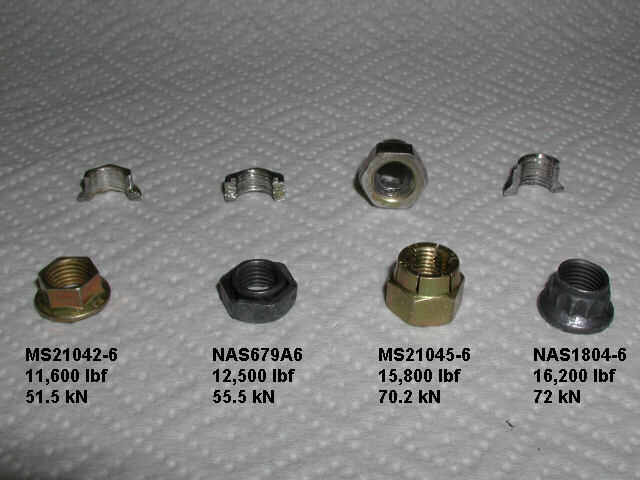
Below is a picture that shows each of the four nuts, and the cut-open failed nuts. The legend shows the breaking strength that we found. All the nuts failed by some or all of the threads stripping. The NAS679 tended to have a couple of threads un-stripped, as if they had radially stretched enough to leap-frog over the mating thread on the bolt. The MS21045 showed significant swelling of the base of the hex, so that a wrench would no longer fit on the flats. This was also true to a lesser extent with the MS21042.

In summary, the strengths were as follows:
MS21042-6 11,600 lb
NAS679A6 12,500 lb
MS21045-6 15,800 lb
NAS1804-6 16,200 lb

The expected strength of the 3/8-24 NAS close-tol bolts is about 14,000 lb. so only the last two types of nuts are capable of developing the full tensile strength of the bolts. We used Unbrako socket-head bolts (better than grade 8) to be sure that the nuts broke and not the bolts.
nut_test2b.jpg

here's the link too: http://www.hpaircraft.net/rv8/nut_test2b.jpg

A couple of other builders in other threads have mentioned using the MS21042 nuts in place of the ones Van's supplies. An advantage is that they take a smaller size socket which helps get a socket on them in the gear tower. But as you can see, they are not as strong. The same benefit of smaller socket can be gained using the high strength NAS1804 nuts. You can order them from GAHco, they are pretty pricey but worth it for the peace of mind in my view.

I always thought this was one of the best pieces of work on VAF.
I was wondering how many current builders used this hardware?
 
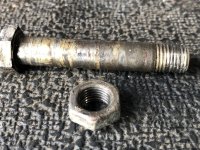
For the none believer. These nuts will jump threads. Found on a friends 8 during a condition inspection.

GM
 

Attachments

  • IMG_3049.jpeg
    IMG_3049.jpeg
    2.5 MB · Views: 143
This thread needs resurrection from time to time.

I have a curiosity question. We now have a lot of collective field experience with NAS1804 or MS21045 nuts replacing the weak NAS679A. Are users still finding an actual need to re-torque after an initial round or two? Put another way, are users still finding loss of bolt preload in the outer clamps following some time in service, and if so, where does it come from?
 
This thread needs resurrection from time to time.

I have a curiosity question. We now have a lot of collective field experience with NAS1804 or MS21045 nuts replacing the weak NAS679A. Are users still finding an actual need to re-torque after an initial round or two? Put another way, are users still finding loss of bolt preload in the outer clamps following some time in service, and if so, where does it come from?
I have about 350 landings on the NAS1804 nuts including some bad enough to break the wheel pants. I checked them twice. No movement. The wrench just clicked.

 
Last edited:
I replaced my RV-8 landing gear bolts, nuts and washers in the U-803 saddle a couple years ago. I check the torque at every annual and so far only found one this year that needed a very slight tightening to torque. Before I did the mod I could actually feel the gear creaking. When I removed the nuts and bolts there weren’t many threads showing and there was evidence that the nuts had slipped a couple threads. If this is such a critical issue why hasn’t Vans issued a service bulletin or at least a notice?
 
This thread needs resurrection from time to time.

I have a curiosity question. We now have a lot of collective field experience with NAS1804 or MS21045 nuts replacing the weak NAS679A. Are users still finding an actual need to re-torque after an initial round or two? Put another way, are users still finding loss of bolt preload in the outer clamps following some time in service, and if so, where does it come from?
Dan, this was my report 5 years ago, I was one of the original problem childs. I may have been patient 1 I can not remember. I have ~2000 hours on the new nuts. Nothing has moved or needed tightening.
"FWIW, mine (replaced nuts) have not budged in years and I likely have the heaviest repeat load tests on the plane being a Super 8 with 84gal of fuel. There is no question that after the stock nuts, replaced a few times, kept loosening, this is fixed."
 
I have 2 RV-8 owner friends, neither of which built their planes. Neither of them visit the forum. Neither was aware of the issue. After informing them of the issue and the work Steve did finding a solution we checked both planes. Both had loose stamped gear bolt nuts. Both ordered the nuts and bolts Steve recommended and we installed them when they arrived.

I find it disappointing that Vans has not issued a SB or SL regarding the gear bolt/nut potential issue.The planes are both registered with Vans so they would have received an email of the SB or SL if one was issued or seen it when they checked on the Vans website...which they both do. Even as a builder I was unaware of the issue until I came across this thread on the Forum while building my 8.

I say many thanks to Steve for his effort and Doug for the great resource he provides!
Same here. Seems the older models have all but been forgotten about. As an 8 builder, there are so many things that I have to keep track of that are not in the plans and are not mentioned by Van's. It's both frustrating and disappointing.

Threads like these are worth the price of admission here.
 
Steve:

So what conclusion am I to draw from this? Are you saying that the nuts Van's supplies are not adequate or does the test show they will do just fine? What are the loads on the nuts in real-life flying? I need a reference point to draw a conclusion.

Chris
OK. The method of the test is clear. It is very interesting BUT..... The question is if even a single RV8 ever experienced broken nuts?
If so many RVs are flying and no one had broken nuts than what is the point?
Ariel
 
OK. The method of the test is clear. It is very interesting BUT..... The question is if even a single RV8 ever experienced broken nuts?
If so many RVs are flying and no one had broken nuts than what is the point?
Ariel
 
OK. The method of the test is clear. It is very interesting BUT..... The question is if even a single RV8 ever experienced broken nuts?
If so many RVs are flying and no one had broken nuts than what is the point?
Ariel
To expand on my earlier reply:

For one thing, nuts weren't getting "broken," and that is part of the problem here. What was happening, and which we demonstrated conclusively by making it happen right in front of us, was that the stamped steel nuts supplied with the earlier kits were actually expanding and leapfrogging over the threads on the bolt. So RV-8 operators were finding that the nuts securing their undercarriage legs at the gear towers were one or two full turns loose at inspection time. And so they'd tighten them that turn or two, only to find them loose or even looser at next inspection. If you follow up the links I posted earlier, you see that one operator found the nut entirely off the bolt.

The obvious result here is that, if the undercarriage legs aren't bolted on properly, they can fail to properly react the loads applied during operations like landing, taking off, or taxiing. As in, fold forward or backwards and allow that side of the airplane to fall to the ground. In addition to the trauma at the gear tower and wingtip, that would also tear up the inboard gear leg attachment and cause a prop strike. All very bad stuff.

What the tests that Steve and I did was show that:

* The failure mode being observed by actual operators finding the nuts loose was not due to them unscrewing, or due to the gear "settling in." The failure mode was the nuts leapfrogging over the threads.

* The leapfrogging was occurring at applied loads within the range applied during normal operation.

* The signs of the leapfrogging were not clear until you removed the nut and inspected its threads, and the threads of the bolt. So operators were just screwing the nuts back down on their damaged threads

* There is commonly available hardware that entirely mitigates the problem, so operators don't have to re-tighten their damaged hardware every annual, and don't have to expose themselves to the risk of failing undercarriage leg attachments.

As to:

...what is the point?

Well, what was the point of all the work that software engineers did to mitigate Y2K issues? What was the point of the Covid-19 vaccines? What was the point of any incipient emergency where people saw the early signs of a problem and averted it? It all worked out fine in the end, right?

If you go back through this thread, all four or so pages of it, you see that we did a lot to raise awareness of a potential problem, and the simple hardware substitution Steve developed to mitigate it. As a result, probably the majority of RV-8s flying today have the upgraded hardware. Which goes a long way towards explaining why this hasn't been a problem - its because people saw the potential for harm and did something about it.
 
I have ~2000 hours on the new nuts. Nothing has moved or needed tightening.

Thanks Mike. My experience also. I installed the slightly longer bolts and better nuts when new, and after an initial interval or two, never again detected any loss of bolt tension.

* The failure mode being observed by actual operators finding the nuts loose was not due to them unscrewing, or due to the gear "settling in." The failure mode was the nuts leapfrogging over the threads.

I suspect there is some initial settling of the component stack. How much could be quantified from nut rotation angle during an early retorque. It's not much. After that, zip.

You and Steve did really good work here.
 
Data point.
FWIW, I installed the longer NAS bolts and improved nut supplied by Grove at the time.
1 bolt out of 4 needed about a ¼ turn at +/- 10 hours (settling in ??).
Last inspection (+/- 200 landings only), and all the ones previously, instant click from the torque wrench, no loosening observed. Oh and yeah, after the second time into the towers (what a pain!!), I flipped them using brackets supplied from a VAFer.
Great mod, super easy to check solo, a couple minutes max if I take my time. (fairings off)
 
Is the "settling in" phenomenon only applicable to fasteners under a significant load or is this more common than people realize? Obviously anything torqued is getting torque seal but for a new builder, just curious if there are other areas that are susceptible to this?
 
Is the "settling in" phenomenon only applicable to fasteners under a significant load or is this more common than people realize? Obviously anything torqued is getting torque seal but for a new builder, just curious if there are other areas that are susceptible to this?
Not really about the fastener. More like squeezing out paint, or squishing a few parts together after some load cycles.

Torque seal's primary purpose is to make people feel righteous.
 
To expand on my earlier reply:

For one thing, nuts weren't getting "broken," and that is part of the problem here. What was happening, and which we demonstrated conclusively by making it happen right in front of us, was that the stamped steel nuts supplied with the earlier kits were actually expanding and leapfrogging over the threads on the bolt. So RV-8 operators were finding that the nuts securing their undercarriage legs at the gear towers were one or two full turns loose at inspection time. And so they'd tighten them that turn or two, only to find them loose or even looser at next inspection. If you follow up the links I posted earlier, you see that one operator found the nut entirely off the bolt.

The obvious result here is that, if the undercarriage legs aren't bolted on properly, they can fail to properly react the loads applied during operations like landing, taking off, or taxiing. As in, fold forward or backwards and allow that side of the airplane to fall to the ground. In addition to the trauma at the gear tower and wingtip, that would also tear up the inboard gear leg attachment and cause a prop strike. All very bad stuff.

What the tests that Steve and I did was show that:

* The failure mode being observed by actual operators finding the nuts loose was not due to them unscrewing, or due to the gear "settling in." The failure mode was the nuts leapfrogging over the threads.

* The leapfrogging was occurring at applied loads within the range applied during normal operation.

* The signs of the leapfrogging were not clear until you removed the nut and inspected its threads, and the threads of the bolt. So operators were just screwing the nuts back down on their damaged threads

* There is commonly available hardware that entirely mitigates the problem, so operators don't have to re-tighten their damaged hardware every annual, and don't have to expose themselves to the risk of failing undercarriage leg attachments.

As to:


Well, what was the point of all the work that software engineers did to mitigate Y2K issues? What was the point of the Covid-19 vaccines? What was the point of any incipient emergency where people saw the early signs of a problem and averted it? It all worked out fine in the end, right?

If you go back through this thread, all four or so pages of it, you see that we did a lot to raise awareness of a potential problem, and the simple hardware substitution Steve developed to mitigate it. As a result, probably the majority of RV-8s flying today have the upgraded hardware. Which goes a long way towards explaining why this hasn't been a problem - it’s because people saw the potential for harm and did something about it.
You say the earlier models had weak nuts. What year did vans replace them?
 
This thread needs resurrection from time to time.

I have a curiosity question. We now have a lot of collective field experience with NAS1804 or MS21045 nuts replacing the weak NAS679A. Are users still finding an actual need to re-torque after an initial round or two? Put another way, are users still finding loss of bolt preload in the outer clamps following some time in service, and if so, where does it come from?
I have yet to find any change in pre-load. I now check them only every 3--4 yrs just to be sure, but I am as confident in those bolts+nuts as any other in the airframe. The remaining area that concerns me is the U-803 saddle, which, if you follow the instructions and maintain a small gap to the longeron, bends a bit under bolt torque. I keep an eye on the corners for cracks. I made some heavier ones where the saddle is thickened to match the depth of counterbores for the bolt heads. It almost doubles the thickness of the saddle without changing the fit into my fairings. But I have yet to install them. I have drawings if anyone is interested.
 
Just curious…. Does anyone know why Vans specified the stamped steel nuts to begin with? I haven’t seen this addressed in any of the 4 pages. Surely, it’s not for weight savings, but I may be wrong.
 
Just curious…. Does anyone know why Vans specified the stamped steel nuts to begin with? I haven’t seen this addressed in any of the 4 pages. Surely, it’s not for weight savings, but I may be wrong.
Knowing what I paid for the new set, I'll take a wild guess and say it was due to cost. The replacement bolts & nuts are expensive, and the factory supplied ones are not.
 
I'm going to help a friend replace the bolts and nuts on his RV_8 Grove gear, I just want to confirm I need to order the NAS 6606-36 bolts and NAS 1804-6 nuts.

Thanks
 
Back
Top