Van's Air Force
You are using an out of date browser. It may not display this or other websites correctly.
You should upgrade or use an alternative browser.
You should upgrade or use an alternative browser.
Oil Filter Tool
- Thread starter DanH
- Start date

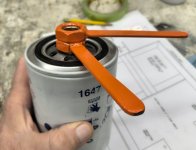


Ooohhhh….a welding project!!! 


I don't know if this will remove a nipple from a used Champion, but it might. Mostly it's for moving that nipple from auto filter to auto filter.
The fast way to remove a stuck one in a Champion is to bandsaw it radially to within a 1/16th of the nipple, then drive a chisel into the slot to pop it.
The fast way to remove a stuck one in a Champion is to bandsaw it radially to within a 1/16th of the nipple, then drive a chisel into the slot to pop it.

Isaac
Well Known Member
I struggled at first trying to remove the nipple from a Tempest 48110-2 oil filter. The first obstacle was finding the correct 3/4 X 16 nuts. Standard size nuts are to thick. The thin jam nut version is necessary. Second it requires using 2 wrenches (1.125") like shown in Dan's photo. With the oil filter secured in a vice, tightening the jam nut while simultaneously turning the other nut in the lefty losey direction with considerable force on both nuts worked for me. YMMV


Someone that was using auto filters put this link on the forum.

Is what I did, though I used a handsaw to keep me fit... not worth sacrificing 2 perfectly healthy nuts for a once in a lifetime jobThe fast way to remove a stuck one in a Champion is to bandsaw it radially to within a 1/16th of the nipple, then drive a chisel into the slot to pop it.


Yes I thought of this but why is this not done?Or you could install the nipple to the adapter only once....
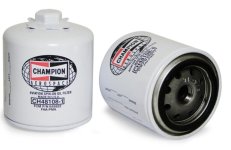

I would doubt the ability to remove the factory installed sleeves. I got a big Class 8 nut from Deere, cut it in half to fit the threaded length available, and then have to jamb the factory faces really, really tight to get the adapter out. Usually, the filter head is deformed in the vice to keep it from spinning. Why? I am making a adapter collection.I don't know if this will remove a nipple from a used Champion, but it might. Mostly it's for moving that nipple from auto filter to auto filter.
The fast way to remove a stuck one in a Champion is to bandsaw it radially to within a 1/16th of the nipple, then drive a chisel into the slot to pop it.
Your tools are a Great Idea for customer installed adapters!!!

Aircraft oil filters torque-on at 18 ft-lbs -- very snug compared to a car filter! Do car filters have the nut on top to accomplish this? Seen guys with big oil puddles under their cowling after hand-tightening the oil filter. They make a special oil filter torque-wrench.
Most auto filters the size of the ones we use are installed by tightening 3/4 turn past contact.... and that equals 18 ft-lbs.Aircraft oil filters torque-on at 18 ft-lbs -- very snug compared to a car filter! Do car filters have the nut on top to accomplish this? Seen guys with big oil puddles under their cowling after hand-tightening the oil filter. They make a special oil filter torque-wrench.
Easy enough to check the next time you change your filter.
Right -- something you should definitely check, but I know my aviation filters are always torqued to 18 ft-lbs without any doubt, which seems much tighter than any car oil filter I've ever changed -- but, please let us know.Most auto filters the size of the ones we use are installed by tightening 3/4 turn past contact.... and that equals 18 ft-lbs.
Easy enough to check the next time you change your filter.
Can an automotive oil filter be safety-wired like an aviation oil filter? And, is the internal over-pressure relief valve pressure rating the same in an automotive filter?Pretty sure I can whip up a torque wrench adapter for an auto filter. How many do you want?
Good info here...... https://vansairforce.net/threads/filter-test-results.226033/ also by Dan.

Sam Buchanan
been here awhile
Not "like an aviation oil filter" but they can be safety wired. I posted a photo some time back illustrating this but can't find it. Put a worm clamp around the filter and use it as the anchor for your safety wire.Can an automotive oil filter be safety-wired like an aviation oil filter?
Well, I can buy an FAA certified exact replacement Tempest oil filter (AA48110-2) for $30 now. A NAPA Gold 1647 oil filter goes for $30 without the threaded insert or worm clamp. So, I don't see a compelling reason to switch to an automotive 1647 oil filter unless we're looking at a lower quality, lower cost automotive filter. In that case, I'm sticking with the Tempest AA48110-2 aircraft oil filter.Not "like an aviation oil filter" but they can be safety wired. I posted a photo some time back illustrating this but can't find it. Put a worm clamp around the filter and use it as the anchor for your safety wire.


Keep this in mind:Or you could install the nipple to the adapter only once....
Since most Lycoming engines have a filter bypass in the filter adapter, the Lycoming specific 48110-series filters omit the bypass valve.
However, the 48108 series has internal bypass.
So, if you install a nipple in the engine and then you go back to an aviation filter without removing the nipple you will have the wrong filter installed.
A big gotcha for a mechanic down the road.
A NAPA Gold 1647 oil filter goes for $30 without the threaded insert or worm clamp. So, I don't see a compelling reason to switch to an automotive 1647 oil filter unless we're looking at a lower quality, lower cost automotive filter. In that case, I'm sticking with the Tempest AA48110-2 aircraft oil filter.
The Tempest is not a wrong choice, but factually, in an ISO 4548-12 test it was out-performed by both the Champion aircraft filter and a Wix/NAPA filter.
BTW, I bought six appropriate Wix filters for $50.
Last edited:
Now that's a very good point! Good place for a CAUTION label.Keep this in mind:
Since most Lycoming engines have a filter bypass in the filter adapter, the Lycoming specific 48110-series filters omit the bypass valve.
However, the 48108 series has internal bypass.
So, if you install a nipple in the engine and then you go back to an aviation filter without removing the nipple you will have the wrong filter installed.
A big gotcha for a mechanic down the road.
Or, just install it in the filter hand tight and transfer it each time.... It can't go anywhere.... Or, just use Dan's tool.
Last edited:

FORANE
Well Known Member
Dan, would you consider selling a set of these to the unwashed masses among us who lack welding skills?Switching to auto filters? Easy little evening project for the bored builder who happens to use 48110's or 111's...tools for installing and removing a filter nipple.
View attachment 81947
Dan, would you consider selling a set of these to the unwashed masses among us who lack welding skills?
Sure. Who wants a set? Send a direct message.
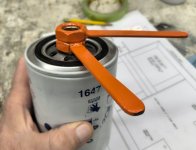

I recently started down this road.. first attempt, I used a bandsaw to slit into the filter top to remove the nipple. Noticed the nipple has been “squished” to provide the locking feature. I unsquished it in a press.. next I went to ACE hardware and was going to buy two thin jam nuts, but instead bought one thick nut and sliced it into two thin nuts on a bandsaw. Double nutting and removing the nipple from an old Tempest filter was easy and seemed to straighten out most of the “squish” that the factory had built in. Now I have 2 nipples and a set of jam nuts for under 2 bucks. (The ACE thin jam nuts were almost $5 each)I struggled at first trying to remove the nipple from a Tempest 48110-2 oil filter. The first obstacle was finding the correct 3/4 X 16 nuts. Standard size nuts are to thick. The thin jam nut version is necessary. Second it requires using 2 wrenches (1.125") like shown in Dan's photo. With the oil filter secured in a vice, tightening the jam nut while simultaneously turning the other nut in the lefty losey direction with considerable force on both nuts worked for me. YMMV
So, you would end up with two by-pass sources.... what could be the problem with that?Keep this in mind:
Since most Lycoming engines have a filter bypass in the filter adapter, the Lycoming specific 48110-series filters omit the bypass valve.
However, the 48108 series has internal bypass.
So, if you install a nipple in the engine and then you go back to an aviation filter without removing the nipple you will have the wrong filter installed.
A big gotcha for a mechanic down the road.
You really only need one. The top nut can be tightened with a wrench

Toobuilder
Well Known Member
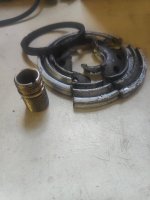
For those planning on removing the 48110 filter nipple, this is what it looks like. Lacking the required 3/4-16 nuts I decided to cut it out with an angle grinder. Didn't go completely as planned...
A single hacksaw cut 99.9% to the threads followed up with a cold chisel in the cut slot will pop the tension on the nipple and it will thread out by hand. No need to remove a whole section.
FORANE
Well Known Member
I've learned that extra 0.2% makes all the difference...A single hacksaw cut 99.9% to the threads followed up with a cold chisel in the cut slot will pop the tension on the nipple and it will thread out by hand. No need to remove a whole section.
Toobuilder
Well Known Member
Indeed. My first attempt at a hacksaw cut went a bit too deep too. Hence, the chisel.I've learned that extra 0.2% makes all the difference...

Bill Boyd
Well Known Member
You are not alone in your befuddlement.So, you would end up with two by-pass sources.... what could be the problem with that?
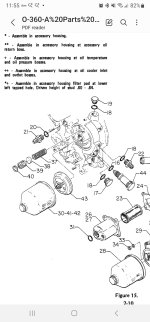
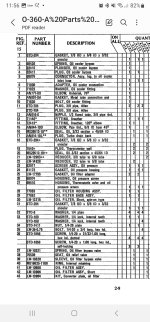
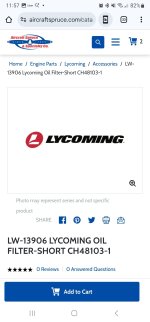
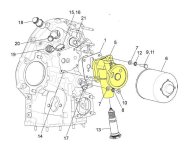
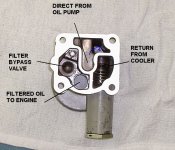
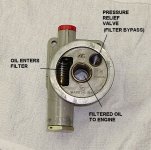
Next question... How do I know if my oddball O360A1F6D has internal bypass? I've been installing the 48103 that came with from the 4th owner.
The standard Lycoming horizontal filter adapter w/ 3/4" female thread does have an internal bypass. Use a 48110 or 48111 aircraft filter, or (subject to field experience and possible test) Wix 51647 and equivalents, filters with no bypass inside the filter can. The auto filters will require the addition of a nipple.
To the best of my knowledge, no aftermarket filter adapter includes an internal bypass. One clue is a factory installed nipple in the adapter to fit the 48108 & 48109:
Superior Air Parts, angled or horizontal; No internal bypass, use 48108 or 48109 aircraft filter. Many users report good operating experience with Wix 51515 and equivalents (Napa Gold 1515 is common) . The filter's internal bypass setting (8 to 11 psi)is a bit low for the aircraft application.
B&C BC700: No internal bypass, use 48108 or 48109 aircraft filter. See above.
Continental Titan: No internal bypass, use 48108 or 48109 aircraft filter. See above.
Airwolf Universal Lycoming Homebuilt Kit AFC-K001: No internal bypass, use 48108 or 48109 aircraft filter. See above.
Casper Labs: No internal bypass, use 48108 or 48109 aircraft filter. See above.
ECI Titan: No internal bypass, use 48108 or 48109 aircraft filter. See above.
To the best of my knowledge, no aftermarket filter adapter includes an internal bypass. One clue is a factory installed nipple in the adapter to fit the 48108 & 48109:
Superior Air Parts, angled or horizontal; No internal bypass, use 48108 or 48109 aircraft filter. Many users report good operating experience with Wix 51515 and equivalents (Napa Gold 1515 is common) . The filter's internal bypass setting (8 to 11 psi)is a bit low for the aircraft application.
B&C BC700: No internal bypass, use 48108 or 48109 aircraft filter. See above.
Continental Titan: No internal bypass, use 48108 or 48109 aircraft filter. See above.
Airwolf Universal Lycoming Homebuilt Kit AFC-K001: No internal bypass, use 48108 or 48109 aircraft filter. See above.
Casper Labs: No internal bypass, use 48108 or 48109 aircraft filter. See above.
ECI Titan: No internal bypass, use 48108 or 48109 aircraft filter. See above.
Attachments
You usually only offer the left one....Is what I did, though I used a handsaw to keep me fit... not worth sacrificing 2 perfectly healthy nuts for a once in a lifetime job

Ahh. You reminded me of the tools needed to figure this out. The A1F6D has an oddball accessory case with an integrated oil filter mount.The standard Lycoming horizontal filter adapter w/ 3/4" female thread does have an internal bypass. Use a 48110 or 48111 aircraft filter, or (subject to field experience and possible test) Wix 51647 and equivalents, filters with no bypass inside the filter can. The auto filters will require the addition of a nipple.
View attachment 99712
View attachment 99713
To the best of my knowledge, no aftermarket filter adapter includes an internal bypass. One clue is a factory installed nipple in the adapter to fit the 48108 & 48109:
Superior Air Parts, angled or horizontal; No internal bypass, use 48108 or 48109 aircraft filter. Many users report good operating experience with Wix 51515 and equivalents (Napa Gold 1515 is common) . The filter's internal bypass setting (8 to 11 psi)is a bit low for the aircraft application.
B&C BC700: No internal bypass, use 48108 or 48109 aircraft filter. See above.
Continental Titan: No internal bypass, use 48108 or 48109 aircraft filter. See above.
Airwolf Universal Lycoming Homebuilt Kit AFC-K001: No internal bypass, use 48108 or 48109 aircraft filter. See above.
Casper Labs: No internal bypass, use 48108 or 48109 aircraft filter. See above.
ECI Titan: No internal bypass, use 48108 or 48109 aircraft filter. See above.
Attachments