Van's Air Force

The definitive Van's Aircraft support community! Buying, building or flying an RV? Join our exclusive family of mentors and enthusiasts!

Back up Alternator- on/off ?

Italiancowboy

Active Member
Patron
So I’ve got a back up alternator on my 10 and was wondering about having it on or off. “On” would mean you know it’s working when it’s needed.
And I suppose it’s always turning (so “off” is really just sending the current to ground ?) so not really saving any wear-n-tear or life expectancy.

Thoughts ?
 
So I’ve got a back up alternator on my 10 and was wondering about having it on or off. “On” would mean you know it’s working when it’s needed.
And I suppose it’s always turning (so “off” is really just sending the current to ground ?) so not really saving any wear-n-tear or life expectancy.

Thoughts ?
Some run both all the time, but with the primary regulator set for 14.3 volts, and the backup at 13.6 volts. During normal operation, the backup ‘loafs’. If you see the buss drop to 13.6, you know the primary alternator has quit.
 
Some run both all the time, but with the primary regulator set for 14.3 volts, and the backup at 13.6 volts. During normal operation, the backup ‘loafs’. If you see the buss drop to 13.6, you know the primary alternator has quit.
This is how mine is set up. I have an indicator for each one. As part of my start-up checklist, I turn the backup on first and observe the indicator and ammeter for proper operation. Then turning on the primary takes the load and overrides the backup...
 
This is how mine is set up. I have an indicator for each one. As part of my start-up checklist, I turn the backup on first and observe the indicator and ammeter for proper operation. Then turning on the primary takes the load and overrides the backup...
The only problem with that method is you're asking the backup to charge the battery after start, which is a significant load for the smaller backup.
I start with both on and after things settle down (battery is charged), turn off the primary and observe the voltage change.
(the backup will not be producing any output if the buss voltage of the primary alt is higher than the voltage of the backup)
 
It also depends on your electrical architecture. I am running a dual split bus so the second alternator is on all the time…
 
To each their own on this subject, but here is what I do. I have dual electric fuel pumps (plumbed in parallel for a failure), and in flight every time I switch tanks, I also switch the fuel pumps, and switch from the primary alternator to the backup. This lets me exercise both my backup alternator and backup fuel pump during each flight and catch a failing component before it becomes an emergency. In 1830 hours on the airplane so far I've caught two dying alternators and one dying fuel pump this way but have not had to break off a flight for the failure.

I only run one alternator at a time - the EFIS gives me a voltage alarm if it falls below 13.5, and an amperage alarm if I draw more than 15 from the battery. Both suffice quite nicely to get your attention if the currently running alternator fails, and to bring on the backup unit.
 
The only problem with that method is you're asking the backup to charge the battery after start, which is a significant load for the smaller backup.
I start with both on and after things settle down (battery is charged), turn off the primary and observe the voltage change.
(the backup will not be producing any output if the buss voltage of the primary alt is higher than the voltage of the backup)
Just a data point: I'm doing the same method as 'recapen' (Backup ALT ON first, then add the Main ALT) and usually I do observe about 12 amps draw from the Backup ALT right after startup. With the RPM at 1000-1200 the backup alt is not able to put out more amps.

Both alternators are from B&C
1 batt, 2 alternators in my case
 
Just a data point: I'm doing the same method as 'recapen' (Backup ALT ON first, then add the Main ALT) and usually I do observe about 12 amps draw from the Backup ALT right after startup. With the RPM at 1000-1200 the backup alt is not able to put out more amps.

Both alternators are from B&C
1 batt, 2 alternators in my case
Good point, low RPM with a 'standard' backup won't put out much, this is not the case for the Monkworx unit.
 
Walt, what kind of alternator do you have that you turn off in flight to test? I asked PlanePower about this and this is the response I got. I have a B&C backup so I'm not sure the primary alternator would see much of a load when returned to service, and we didn't discuss that. But here it is:

"If you have load on the electrical system and just turn the field off, yes you will see a surge but I do not know how much. It’s also very hard on the alternator when/if you re-energize the field with the load still on the system. That would not be a normal function of the field switch as typically, the alternator output has decreased/gone to zero, load would be removed from the system and then the alternator would be cycled. So, we would not recommend cycling the alternator with full load applied."
 
The battery(ies) and alternator(s) and associated voltage regulators and wiring have to be considered as a system. For example, an ETX900 battery has a maximum charging current of 80 Amps. (Possibly less, because the battery capacity C is 15.6 Ampere-hours, and the maximum charging rate is 5C.) If you charge it after starting with a single 60 Amp alternator, you'll be OK. If you charge it with a 60 Amp primary alternator and a 40 Amp backup alternator running in parallel, you may exceed the 80 Amp maximum charging rate, depending on how fast the battery can drink from the firehose of electrons, and the alternator, regulator, and wiring characteristics in your aircraft. The backup alternator output voltage is typically set below the primary alternator output voltage, so the primary alternator will supply most of the charging current, but it's possible that the backup alternator may augment that. And lithium batteries have a lower internal impedance than lead-acid batteries, enabling them to drink very fast. References: https://earthxbatteries.com/faqs/, "Why is alternator output important when selecting the proper battery for your cars or airplanes?" and "Can a lithium battery over-load (over-heat) my alternator and cause it to fail prematurely?"
 
Walt, what kind of alternator do you have that you turn off in flight to test? I asked PlanePower about this and this is the response I got. I have a B&C backup so I'm not sure the primary alternator would see much of a load when returned to service, and we didn't discuss that. But here it is:

"If you have load on the electrical system and just turn the field off, yes you will see a surge but I do not know how much. It’s also very hard on the alternator when/if you re-energize the field with the load still on the system. That would not be a normal function of the field switch as typically, the alternator output has decreased/gone to zero, load would be removed from the system and then the alternator would be cycled. So, we would not recommend cycling the alternator with full load applied."
I have been running the 40amp B&C as a primary since I built the plane. No issue turning it off in flight, but I do recommend reducing the load and I personally also reduce RPM when re-engaging. I will run on the backup for 15-20 minutes to confirm all is well.
 
I like to run my backup too. I have a feeling that when the backup is keeping the load satisfied, the battery is almost fully charged, and turning on the primary alternator in that setting is no different than turning it on after a start. There is a lot of different guidance on it for sure. In my Arrow, the manual had the master on, alt off for start, then turn on the alternator after start. Of course there will be a big initial load to recharge the battery with that. So is that really bad for the alternator, or just a feature? I suspect it's just a feature for the most part. I continue to turn on the alternator after startup, but I know opinions vary.

I like the idea of turning the backup on first and seeing it work before turning on the primary alternator. Hadn't done that seems a good easy check.
 
[snip]
"If you have load on the electrical system and just turn the field off, yes you will see a surge but I do not know how much. It’s also very hard on the alternator when/if you re-energize the field with the load still on the system. That would not be a normal function of the field switch as typically, the alternator output has decreased/gone to zero, load would be removed from the system and then the alternator would be cycled. So, we would not recommend cycling the alternator with full load applied."

Wow!

There's no harm in turning the alternator "FIELD" off/on while the alternator is under "load."
At worst, there will be a bit more drag on the pulley/belt as the torque induced by the magnetic field in the rotor changes.

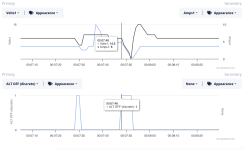
There is no "surge" as has been reported - see screen shot.

"ALT OFF" is the lamp output that the alternator sinks when the Field is turned off.
"Volts 1" is the voltage produced by the alternator on the "B" lead.

The spike in Amps 1, seen at ~00:07:52 is caused by the slightly discharged battery charging up once the alternator field is turned back on and the voltage rising above the battery "float" voltage.

Screenshot 2025-03-22 at 11.09.03 AM.png

As a point of clarification, and this is why the "Big" circuit breakers are not usually pullable, if the 40-80A circuit breaker opens and the alternator is producing "a lot" of power, there will be damage done to the stator/rectifier side of the alternator -- not the field/rotor/regulator side. This is a different circuit than the "field."

 
I keep it simple:
- Primary alternator, B&C 60 amp
- Backup alternator, Monkworkz installed in standby mode
- Primary and backup alternator feed the same battery terminal on the firewall mounted starter solenoid
- Two PC-625 batteries, for normal operation, including start, they are in parallel. Busses can split if needed (a backup mode)
- Both the B&C and Monkworkz are on all the time (as in from before engine start)
- B&C is turned off only periodically to test the Monkworkz

There is value to have a backup alternator (generator) pick up, without pilot action, if the primary fails.

Carl
 
I keep it simple:
- Primary alternator, B&C 60 amp
- Backup alternator, Monkworkz installed in standby mode
- Primary and backup alternator feed the same battery terminal on the firewall mounted starter solenoid
- Two PC-625 batteries, for normal operation, including start, they are in parallel. Busses can split if needed (a backup mode)
- Both the B&C and Monkworkz are on all the time (as in from before engine start)
- B&C is turned off only periodically to test the Monkworkz

There is value to have a backup alternator (generator) pick up, without pilot action, if the primary fails.

Carl
Dang, this is the second time Carl and I agree on something, I forget what the first was ;)
 
Wow!

There's no harm in turning the alternator "FIELD" off/on while the alternator is under "load."
At worst, there will be a bit more drag on the pulley/belt as the torque induced by the magnetic field in the rotor changes.

There is no "surge" as has been reported - see screen shot.

"ALT OFF" is the lamp output that the alternator sinks when the Field is turned off.
"Volts 1" is the voltage produced by the alternator on the "B" lead.

The spike in Amps 1, seen at ~00:07:52 is caused by the slightly discharged battery charging up once the alternator field is turned back on and the voltage rising above the battery "float" voltage.

View attachment 83458

As a point of clarification, and this is why the "Big" circuit breakers are not usually pullable, if the 40-80A circuit breaker opens and the alternator is producing "a lot" of power, there will be damage done to the stator/rectifier side of the alternator -- not the field/rotor/regulator side. This is a different circuit than the "field."

Exactly. There is a lot of bad information, and lack of understanding, about exactly how the field operates and how the regulator drives it.
 
To the OP’s question. I have a primary Plane Power alternator and backup Monkworkz on my -10 and I fly with the backup “On”. If the primary fails, I get a CAS alert that the backup is providing power. I test the backup for about an hour on long trips and once ran it for 5 hours with no problems.
 
Either one or the other is on, with my switching. 3 position switch, Off, Alt1, Altbu
I’ll test the backup during taxi sometimes, just to make sure it’s putting output.
 
I have had the plane power alt and SD8, wired via Nuckolls plan to have the voltage regulator of the SD8 below the plane power. Works well but due to wise tells of turning the plane power on/off to make sure the SD8 is functioning actually doing it takes a back seat.

First couple failures of the PlanePower everything went great, EFIS alarms main Alt/Voltage as SD8 comes online automatically and can fly as long as there’s fuel in the tanks. Then one time PlanePower power fails and SD8 doesn’t come online, turns out the SD8 regulator failed and I need to find a place to land battery power only.

I’ve found I prefer to set my backup alternator’s regulator so it is on providing a few amps in normal ops. After takeoff when I’m shutting down fuel pump/lights I verify the SD8 is providing amps then turn it off. Keeps me way more honest that my backup system is gonna be there when I need it.
 
Wow!

There's no harm in turning the alternator "FIELD" off/on while the alternator is under "load."
At worst, there will be a bit more drag on the pulley/belt as the torque induced by the magnetic field in the rotor changes.

There is no "surge" as has been reported - see screen shot.

"ALT OFF" is the lamp output that the alternator sinks when the Field is turned off.
"Volts 1" is the voltage produced by the alternator on the "B" lead.

The spike in Amps 1, seen at ~00:07:52 is caused by the slightly discharged battery charging up once the alternator field is turned back on and the voltage rising above the battery "float" voltage.

View attachment 83458

As a point of clarification, and this is why the "Big" circuit breakers are not usually pullable, if the 40-80A circuit breaker opens and the alternator is producing "a lot" of power, there will be damage done to the stator/rectifier side of the alternator -- not the field/rotor/regulator side. This is a different circuit than the "field."

Hi Brian, it looks like you have your data sample rate at 1/second and depending on what's getting this data, it can decide to produce the min value it saw in this second, the max value, an average, median, or something else. In the magic world of electricity, a lot can happen in 1 second. I have no idea if the PP guy that said it's not a good idea to power cycle their alternator is right or not, but I'd caution against using such a slow sample rate to conclude that the supplier of the component is wrong.
 
I have had the plane power alt and SD8, wired via Nuckolls plan to have the voltage regulator of the SD8 below the plane power. Works well but due to wise tells of turning the plane power on/off to make sure the SD8 is functioning actually doing it takes a back seat.

First couple failures of the PlanePower everything went great, EFIS alarms main Alt/Voltage as SD8 comes online automatically and can fly as long as there’s fuel in the tanks. Then one time PlanePower power fails and SD8 doesn’t come online, turns out the SD8 regulator failed and I need to find a place to land battery power only.

I’ve found I prefer to set my backup alternator’s regulator so it is on providing a few amps in normal ops. After takeoff when I’m shutting down fuel pump/lights I verify the SD8 is providing amps then turn it off. Keeps me way more honest that my backup system is gonna be there when I need it.
First couple of Plane Power failures should be a clue. I’ve heard numerous tales with Plane power. That’s why I chose B&C. Again, that is why either the primary or backup is on for me. Having 2 alternators on simultaneously is problematic, without fancy wiring scenarios IMHO.
 
Hi Brian, it looks like you have your data sample rate at 1/second and depending on what's getting this data, it can decide to produce the min value it saw in this second, the max value, an average, median, or something else. In the magic world of electricity, a lot can happen in 1 second. I have no idea if the PP guy that said it's not a good idea to power cycle their alternator is right or not, but I'd caution against using such a slow sample rate to conclude that the supplier of the component is wrong.

Mickey,

Yup, you are totally right, the G3X isn't fast enough to catch a transient like this -- I'll post some screen grabs of the Voltage transition from my real scope later this week.

B
 
Hi Brian, it looks like you have your data sample rate at 1/second and depending on what's getting this data, it can decide to produce the min value it saw in this second, the max value, an average, median, or something else. In the magic world of electricity, a lot can happen in 1 second. I have no idea if the PP guy that said it's not a good idea to power cycle their alternator is right or not, but I'd caution against using such a slow sample rate to conclude that the supplier of the component is wrong.

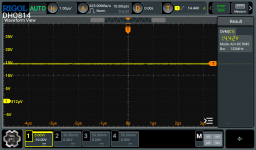
Just to follow up -- No Spikes..


RigolDS1.png
 
I keep the backup off. If the primary fails the G3X touch is configured to flag an alt failure and of course you will see loss of amps and voltage will begin to drop. Positive confirmation of an alt failure. I run the backup for about 10-15 minutes during my flights (if cross country) to ensure all is good.
 
I have my Monkworkz generator turned on. If/when my Planepower/Hartzell fails the Monkworkz takes over. Dual SDS CPI-2 Electronic Ignition with SDS backup battery.
 
Back
Top