Van's Air Force

The definitive Van's Aircraft support community! Buying, building or flying an RV? Join our exclusive family of mentors and enthusiasts!

Barrett CAI Scavenge Filter, please help solve this problem

Dustyone

Well Known Member
Friend
Problem:
Unable to service the Scavenge filter on the Barrett Sump.

The Filter in question is 4 1/8" long and resides in the rear of the sump. It is not possible to remove the filter to clean and inspect as it interferes with the Nose Gear leg support.
AP1GczNdDBSCX40Ri6UpJM_x8YBsiIDrX-1WMbzG24RXWxrDUJNuMnbCwWWnOeIG8lPcNAN-9CXiPOl6phJ88MrLFA7ysiQ4p3VUYRfkKYBVjFJsB4ugw52hMtf0-MTQ9Cfkc_V6sPkGABJOZo7FBL1DbdQLeg=w1000-h1400


AP1GczMR9Df4TCicXRw4IRk7jSfQKtZnXdtsdJa-6mxCepzTRFOobTogBCk9dIcQbNlnnNimbpnRNVCzDBH2efKNYegDtcokpKXatyMDEbtxJhfMthxmOmLuwdqJtQnw3KGGRF0om0Vnx7_a7K_b3Apj-LVxRg=w1500-h1400


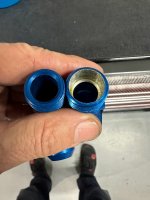
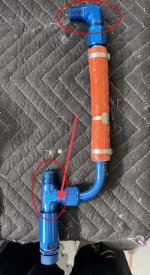
To make matters worse, the Barrett supplied fitting that retains this filter is a custom machined elbow. The elbow must be reinstalled and "clocked" to the correct location to align with the heavy #10 oil pump feed hose. Now "clocking" this already weakened fitting, takes more HP than I would ever like to use on an engine.
Barrett fitting on the Right.
AP1GczMsvqepkQPsQPPHbxZBC0uoQpckbFI8MWqHZxe14ooxSEXGashajiu6z7d1sKFzeZUVYKIGnkT8cYCSZ6W-nehtPfze1myqCGDbLRifhb9JPjUZR5uAbCeX3UCtWvyJom1fE26aslv4lbaOP7cf-AmRUw=w1000-h1400


Tom at TS Flightline and many others have exhausted all known parts bins to find a suitable answer. the current version is to remove the scavenge filter and install an inline much smaller filter from Dry Sump Solutions that can be serviced easily at every oil change.
AP1GczMEjTNIyQRR7AiZVO24fOpJSllGZ7QLFhxehSv54dU3I1vPcW1jiUqlO6dSHxf2HfckGhxKO_0ifwt1tXeg3V6iO9G8L7fhx2XJzetG5y7r58e4Zdye_A_f3oBNMKv3PeSdby_JZWHgpK31BElf3Z86CQ=w1000-h1400


The Scavenge filter from Dry Sump Solutions is correctly installed at this location.
AP1GczPra9IEQq1P6CRM_1RMexThojUJL0E6qNXXgkxVFuGQyeBRmhLJ7LEVWXelp4-zRTFxeeitT1xDkbUnyjHzmqSygneiRcIHWHNXu7FtLrDqFlRRkpUIpYM3rrPNVe2FIlOrbqUQvDaZ_hpEuKe7o0_yYg=w1000-h1400


AP1GczMfA554mJuIQpRCb-sz9WDvX8s0lR5wUj4Kks3HZZk7_7CIbyui587bLxkElqPdsIqM05CSHQLEUW3yS7TKP2ydYF4HnBBQgUe_FyojKiPix8YLzjy2aMVXtfcfLdkTrWkpUoYqYFFdAt2R_jJ4-Rt_-Q=w1000-h1400


AP1GczMPvs6JGhAn7x3MzHbWv_lOwZsxFpek4TpYCkXXpk9cp0nkeuXGnL8AeQViFaY4p-DkZmQFMrMFa7g2cYHH4RZ9VfDiQ-2rYaG7UYcljVrl_oZgRbScGCl8GHOEwRZvjhCUIiaFmTX4h3umBEmo8YXK0w=w1200-h1400


In another thread, experienced maintainers have all chimed in with very heavy sludge blocked scavenge filters that would make the filter capacity of the Dry Sump option not suitable.

What is required is an external in-line,CNC machined, serviceable filter that still retains the capacity of the original scavange filter. Something that would fit at this location shown below and machined so as to delete the adapter stack that is currently employed.
AP1GczMvNSWof_mXtpA7fMnSPdfRKqVOKn5KOKkLaAsTWWgleQ9k_rt0Ej4kBlsioD0mb5ZWpsUVcdJGCb6xnp1wHlLLKYmjfEHAU4MfV4PWfROt0hiwEm3jZw_XzItXfT3n4y3lkKI52I7h_bwSJpZisjNWYA=w1000-h1400


Looking forward to the VAF collective solving this problem.
 
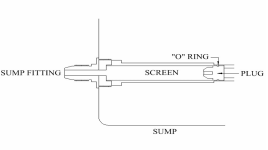
Ashley, there's no requirement for the tubular screen (or an equivalent) to be located in a short line as proposed. Monty B designed that sump for acro customers, who installed it with a Christian or Raven inverted oil system. In this app, simply run the lines to and from a sizable remote screen rather than to the clunk valve.

Here, quick search, just an example:


BTW, note the flow direction shown in the .pdf document...inside to outside.


ScreenHunter_2737 Mar. 11 19.26.jpg
 
Last edited:
Talked to Rhonda (Barrett engines) this morning. Apparently, this sump was made for aerobatic systems, and the front oil inlet screen port is not there so the oil source has to come from the fitting that replaces the normal sump plug. She has looked at these threads and will do some more investigation and let us know what they ultimately think and if they feel the 'Dry sump systems" design being used here is appropriate.
 
Talked to Rhonda (Barrett engines) this morning. Apparently, this sump was made for aerobatic systems, and the front oil inlet screen port is not there so the oil source has to come from the fitting that replaces the normal sump plug. She has looked at these threads and will do some more investigation and let us know what they ultimately think and if they feel the 'Dry sump systems" design being used here is appropriate.

I have been in contact with Rhonda on this for the past 2+ years about this. I also talked with her this morning.

The consensus was the same as it was over the last two years. Checking the scavenge screen at every oil change and monitoring oil pressure, which you do anyway, should be adequate for this application.

Dan's post is likely the best case scenario; an actual full sized oil screen that is externally mounted. It solves most of the issues but comes at the expense of locating the external screen and, of course, an extra hose.

Next oil change, I will be looking to see if there is a convenient way of locating and mounting such a filter screen. Another potential issue with externally mounting a screen is whether or not the vibration between the engine and the remote screen through the 10D hose would fatigue the fitting installed in the sump. If the screen could be mounted somewhere on the engine then this would not be an issue.
 
Is there enough meat in the existing threaded hole to re tap with and AN SAE straight thread and machine an O ring boss so you can use a standard AN fitting? That largely solves the problem IMHO. Seems an easy job for a milling machine.
 
Likely won't work but could you shorten the screen and take a regular fitting and machine just an 1/8" deep grove to hold the screen in place?


IMG_1555.jpg
 
If modification of the sump is off the table:

- Modify a -8 AN 816 (steel) nipple by re cutting the NPT so the fitting itself sits deeper in the sump. You want as much room as possible between it and the nose gear bits. Will also need to counterbore the NPT side to capture the screen. Maybe shorten the screen a touch as required.
- Install a standard AN 816-8 in the bottom of the sump.
- Have Tom or someone build a rigid steel or SS tube assembly with the bend radius appropriate to clear the NLG bits during operation. This tube will be 270 degrees of bend to capture the two straight fittings installed in the sump.

Draining the oil is as simple as removing the tube (have to do it anyway to access the screen). The Lycoming suction screen is accessed by removing the rear AN 816 fitting. This scheme gets rid of a number of NPT pipe fittings, the quick drain valve, the hose and firesleeve, and the flow restricting 90's. Should be lighter, less expensive and more reliable.
 
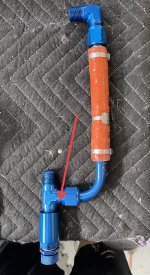
I’m also using the filter from Dry Sump Solutions on my RV-10 with the Barrett CAI.

It sits inline with the hose in the T fitting.

IMG_3361.jpeg
 
Likely won't work but could you shorten the screen and take a regular fitting and machine just an 1/8" deep grove to hold the screen in place?


View attachment 82710
Can’t help with your issue here, however, that fitting is a bit concerning to me. There appears to be VERY little meat between the machined ID and the minor diameter of the thread, making it very weak and prone to cracking.

Put a caliper in there and measure the id. Then go to a chart to get the thread dimensions for whatever size thread it is and grab the minor diameter spec. Be sure you match the diameter and pitch in the chart. The minor diameter is the OD at the bottom of the thread. Don’t forget that wall thickness is only half of the difference between these two numbers.

I fabricate a lot of stuff like that fitting and this is an area that must be carefully considered.

Looks to me that the wall is well less than 1/16” and that is too thin for this application imho. Might be ok with steel, but not aluminum. This isNOT a fitting you want to break! Ther are standards for these kinds of things and this is pretty far off them.
 
Last edited:
Looks to me that the wall is well less than 1/16” and that is too thin for this application imho. Might be ok with steel, but not aluminum. This isNOT a fitting you want to break!

Agree. A very good reason to use a standard fitting and some kind of external screen

While on the subject, I'm seeing a lot of "AN-like" fluid fittings on RV's. They're all over the internet and certainly cheaper than the real thing, but hey folks, we're building airplanes here. Why buy a quality hose from Tom and hook it to who knows what?

IMG_3361.jpg

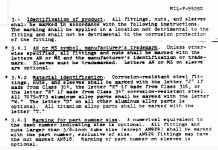
Basic field rule #1: If it isn't marked per standard (see below), it isn't really AN, probably for good reason.

Basic field rule #2: It doesn't matter where you bought it.

Even colors mean something. A blue AN fitting is supposed to be made of 2014 or 2024, while a brown AN is 7075. How do you know what material they used for a black or red fitting from Fast and Furious Auto Supply?

I'm not saying you'll surely die if you use a copycat fitting (and we are EAB), but some common sense applies. If subject to a lot of mechanical stress, particularly with vibration, maybe it would be best to stick with the real thing. Or use a steel fitting. I'll accept a Parker JIC steel fitting all day long, as compared to an Asian copycat.

ScreenHunter_2740 Mar. 13 08.30.jpg
 
Last edited:
The Barrett CAI Sump photos,
AP1GczPLKcGfWjfCHBXmun7nJTLfZbNfQXlUfHp3VGm4201-zHqUnwqigzubzONSNXYish6PqTxgx7hjiiA53-p1Kdqt5T6q9PWk-2JG4t-BvvJ3OGBJcLv48aJQj-a3uKK9rke2QxJKbRogHEyqTLBhO9lChQ=w1500-h1000


Close up of Oil Drain hole and Oil pump feed hole,

AP1GczOTywwFhlIohRXHuLYhDYknWiLPVqfFjvLxAlI2Xbq2UFx7uL7m72Sa3kIzzTEKQc1eqR1lmT2mfM-QAMNIF-QLtiRPvQ3YFUbSCy5o8m6zqMM3XU8I496kzEwGQL9mehqT3SsNSTm7LG8P4297joGJ6g=w1500-h1000


Scavenge Filter installed,
AP1GczMG2i14-y35k3OCBHyDfeqwEb_YYGjRDPNuZERi2sD0XSMRtvHsvbq3MNxEBRfyBQ_EphQwagIV-vsmdIUuTw-MonSABvsOm6PVt13Ie2KwgQuXrlG2iZkFjv_Xa4AR_0kCn-HuZVLdr9gQ8Dy-bX9Dqg=w1500-h1000


Shining a torch into the oil screen,
AP1GczO-Exrq4KfdGa1LntdceRGYX_zjxfn5TiZ3-ZAkiGQPdmu2i6gFQLInoSqScT5SqN3nh2qMi9j-Ubiyd5vcjW7ffb9uVQSQDzS2tmkwwI__8VYbCMP0z6pp9Zw_UI4l7CL3XEsO8b7u4KVJq5LdNeQX9w=w1500-h1000


At the rear of the oil scavenge housing there is a locating boss for the filter in the casting,
AP1GczMECLyeQiMZQAHmhV2YGtnuhdRbgfDUcGf7TWR1ggCdiwxRHRMwZ5pgRZQgOLuUEXJgpB2jO_fUaMoWASfRavQwXNHavakvDIzhBFDkG2tjM0vt4Ys1Ct1BInSSi0MVeUaqvk_F2rqTXpMUw5mWiOUgDg=w1500-h1000


CAI Sump with FM300R fitted,
AP1GczM8r4U2HsOvk-zk0060V7LYKDTYHc3z_fxOzVGOEI5yzDZWjy47DID1uzh_g-kX-8iYvWiiMfXGgLhz9FQU-Uzm9iBXZuTXD7bt8Dzl-WyRpUti9rLZ6URU9Ym0z1VSlTguUVujCS6Gtf920NKhzpJsEw=w1500-h1000


AP1GczPCG7pVm-Qoq3JLxzSBTzqVg1Iim7eg4Jv34n2iLz-Gh4Hf40fUjf0yke7wA33HeIC85-P8B1xyCVeDNGeEy_O4f0ZIo490CUMrUW5YseDO4gwMpz-ux_yh7ECo6_WkiEoBLF7Oi43cfR_bIf9rhMEEZw=w1500-h1000
 
Step -1 remove engine
Step 0 remove sump
😭
Still doesn’t solve the problem of not being able to remove the screen as it hits the top of the nose gear tower.
 
Last edited:
Step -1 remove engine
Step 0 remove sump
😭
Still doesn’t solve the problem of not being able to remove the screen as it hits the top of the nose gear tower.
1. The engine does not need to be removed to remove the sump. Yes, the lower mount ears bolt to the sump but the engine can hang/remain located by the upper ears.

2. Re machining the rear plug for the larger hole and thread size will allow a bit more room to get the screen out

And 3. I thought the other thread established that the screen could be removed, but it was “hard”. If it does not actually come out after the larger plug boss has been created, then possibly provide some clearance at the NLG tower or shorten the screen a bit.
 
Thank you Ashley. Clearly illustrative.
Indeed. Also just adds to questions about the marketing choices the MFR made here. The simple addition of a threaded pipe plug at the front of the screen housing allows one to configure the sump for aerobatic or conventional oiling systems. Return to the standard threaded boss at the rear allows either the standard Lycoming screen plug OR the available AN fitting adapters offered by Christen or Raven. Very simple machining operations allows this sump so serve both users. Instead they force this messy external hose solution. Strange.
 
1. The engine does not need to be removed to remove the sump. Yes, the lower mount ears bolt to the sump but the engine can hang/remain located by the upper ears.

2. Re machining the rear plug for the larger hole and thread size will allow a bit more room to get the screen out

And 3. I thought the other thread established that the screen could be removed, but it was “hard”. If it does not actually come out after the larger plug boss has been created, then possibly provide some clearance at the NLG tower or shorten the screen a bit.

Yes I figure I can probably hang it on the top ears and/or leave it attached to the hoist in place as long as required.

You definitely can’t get the screen out. At least I can’t. I doubt an extra 1/4 or so would make a difference it’s more like 1.5 inches. I’ve just pulled it as far as I can, satisfied myself that it’s clear and put it back. It’s not a disaster but it’s far from ideal.

How would you approach the front of the screen in this setup? I assume the cast bore is larger than the screen by some amount. Does the screen need a snug (not loose) bore at the front to recess into?

I agree this looks like it would have had a simple solution at inception with a little forethought.

The photos are a great help. This is good progress.
 
1. The engine does not need to be removed to remove the sump. Yes, the lower mount ears bolt to the sump but the engine can hang/remain located by the upper ears.

2. Re machining the rear plug for the larger hole and thread size will allow a bit more room to get the screen out

And 3. I thought the other thread established that the screen could be removed, but it was “hard”. If it does not actually come out after the larger plug boss has been created, then possibly provide some clearance at the NLG tower or shorten the screen a bit.
I don’t think you are completely understanding the problem.

The screen can be removed with a ton of fiddling…BUT…the larger issue is that the oil pickup line that feeds the screen is dependent on the clocking of the AN fitting that is installed at the screen location. That hose is a -10 hose, it is short, and doesn’t have much flexibility.

Once you remove the AN fitting, you CANNOT clock it to the same place again; it will need to be tightened further due to the nature of the NPT threads. In the new clock position, the -10 line will NOT fit. This is the larger issue and as long as there is an NPT fitting there, it will always be present.

Several of us are working on a solution that will not require removal or or machining of the sump.

Hopefully, moving forward, there will be a better way. As of right now, the smaller scavenge screen is working fine in several aircraft, each running it for several hundred hours, while checking it at every oil change interval. Thus far, no one has found even a single piece of debris in any scavenge screen.
 
I don’t think you are completely understanding the problem.

The screen can be removed with a ton of fiddling…BUT…the larger issue is that the oil pickup line that feeds the screen is dependent on the clocking of the AN fitting that is installed at the screen location. That hose is a -10 hose, it is short, and doesn’t have much flexibility.
I understand. See post #18. I'm well past needing the external hoses now. A little machine work now or even less during manufacture makes this sump look and act like a standard Lycoming oiling system. NO external fittings at all.
 
On the newer front gear towers, that means removing the front gear tower.

My students hope to have a 3D mock up of a solution this weekend.
How about a 2 piece screen? One half has a brass sleeve soldered to the outside and the other half nests inside the sleeve.
 
Does the screen need a snug (not loose) bore at the front to recess into?
Yes. Just like the stock Lycoming plug captures the rear of the screen and keeps the screen centered (off the walls) of the larger cavity. Unlike most "filters", oil flows from inside to outside. The large cavity provides space for oil to flow around any localized plugging of the screen and still get to the oil pump.
 
I agree this looks like it would have had a simple solution at inception with a little forethought.

Forethought? Aww, come on guys, ease off a little. Monty designed that thing at least a decade before the RV10, maybe more. It was intended for hard core aerobatic customers. I doubt the original included a screen. Yes, the bored out aluminum 90 so a screen can be included is a kluge. Doesn't matter here, as the screen is too long to clear the RV10 airframe. With a remote screen housing, an unmodified AN822 offers plenty of clearance, and never needs to be removed...just as intended with the inverted oil valve.

Today I was speaking with a customer who has a Raven swivel fitting in his sump, with screen. Servicing a screen in the standard sump location is a royal PITA, and worse with inverted plumbing. In retrospect, I wish I would have installed a remote screen.
 
I understand. See post #18. I'm well past needing the external hoses now. A little machine work now or even less during manufacture makes this sump look and act like a standard Lycoming oiling system. NO external fittings at all.
That's great but not sure everyone
Forethought? Aww, come on guys, ease off a little. Monty designed that thing at least a decade before the RV10, maybe more. It was intended for hard core aerobatic customers. I doubt the original included a screen. Yes, the bored out aluminum 90 so a screen can be included is a kluge. Doesn't matter here, as the screen is too long to clear the RV10 airframe. With a remote screen housing, an unmodified AN822 offers plenty of clearance, and never needs to be removed...just as intended with the inverted oil valve.

Today I was speaking with a customer who has a Raven swivel fitting in his sump, with screen. Servicing a screen in the standard sump location is a royal PITA, and worse with inverted plumbing. In retrospect, I wish I would have installed a remote screen.
Exactly. It is too easy to sit behind a keyboard and bash someone else's design.

Dan, you are right on point with a remote screen housing and there are several of us working on one that will allow access to the screen, sufficient filter capability, and little to no modification or machining of the sump.

Going forward, obviously a sump modification would be the best option but hopefully, there are (or will be) other options for folks already flying.
 
That's great but not sure everyone

Exactly. It is too easy to sit behind a keyboard and bash someone else's design.

Dan, you are right on point with a remote screen housing and there are several of us working on one that will allow access to the screen, sufficient filter capability, and little to no modification or machining of the sump.

Going forward, obviously a sump modification would be the best option but hopefully, there are (or will be) other options for folks already flying.
Ease up guys. I’m not bashing the design or the designer. I meant forethought for this application.
It’s obviously perfectly functional for its original intended purpose.
That it is not for an RV10. The fact that 100% of them in service have this issue proves it.

The dirty reality everyone here knows is that a large percentage of these screens will never be checked because of the design. It’s been clear for at least 7-8 years that it’s a problem in search of a better solution. Barrett must have known after the first one or two installs that it was a poor solution. Who’s going to be in the firing line when a bored out NPT fitting gets over torqued and fails?
I doubt anyone with this sump is satisfied with what they have yet there must be dozens of them out there.
 
Today I was speaking with a customer who has a Raven swivel fitting in his sump, with screen. Servicing a screen in the standard sump location is a royal PITA, and worse with inverted plumbing. In retrospect, I wish I would have installed a remote screen.
Been there done that, never again!
 
Please note the title of this thread. Have we reached a point in our society where spirited discourse means hurt feelings?
No hurt feelings here; only pointing out that some here calling for an easy fix aren't affected, and do not really understand all of the issues.

It is too easy to sit and type when you haven't actually tried to remove and reinstall the pieces and parts being described; and saying that the fix is just to machine the sump, well, that isn't really avail option for most folks running this setup...certainly not saying that machining the sump wouldn't be a better option, just that it isn't viable in most cases.
 
No hurt feelings here; only pointing out that some here calling for an easy fix aren't affected, and do not really understand all of the issues.

It is too easy to sit and type when you haven't actually tried to remove and reinstall the pieces and parts being described; and saying that the fix is just to machine the sump, well, that isn't really avail option for most folks running this setup...certainly not saying that machining the sump wouldn't be a better option, just that it isn't viable in most cases.
It appears the OP was looking for ideas. He got some. If the intent was to constrain the "fix" down to tighter restrictions like "no sump removal, no scratching of paint, must be able to use parts from Home Depot... etc", then that is a different ask.

I have fabricated a Lycoming sump from scratch. I have struggled with a bitc# of a screen, I have machined a screen housing from a raw piece of bar stock, I have completely re plumbed inverted oil systems. Cant speak for others, but "my" suggestions are a result of that experience. Pulling a sump from flying RV 10 and re machining it is a weekend job, and IMHO, NOT processing it that way to begin with (and thereby bypassing market share) is a "lack of foresight" (as evidenced by this very thread)

Sometimes there is a "keyboard commando" posting, but not always.
 
Ha I thought it was aimed at me…
Anyway.
This is a great thread. All options should be on the table and discussed. It’s an ordinary setup that I’m sure precisely zero flying owners are happy with.
 
It appears the OP was looking for ideas. He got some. If the intent was to constrain the "fix" down to tighter restrictions like "no sump removal, no scratching of paint, must be able to use parts from Home Depot... etc", then that is a different ask.

I have fabricated a Lycoming sump from scratch. I have struggled with a bitc# of a screen, I have machined a screen housing from a raw piece of bar stock, I have completely re plumbed inverted oil systems. Cant speak for others, but "my" suggestions are a result of that experience. Pulling a sump from flying RV 10 and re machining it is a weekend job, and IMHO, NOT processing it that way to begin with (and thereby bypassing market share) is a "lack of foresight" (as evidenced by this very thread)

Sometimes there is a "keyboard commando" posting, but not always.
Hi All----Our friend Ashley Miller sent pics of the inside of the sump, including the cavity where the 70484 screen is located. See Ashley's post #13. For me, SINCERE thanks to Ashley for posting these, and also sending them to me. IN SHORT, the screen cavity is NOT open to the sump interior. There is NO WAY the oil in the sump gets to the screen via the sump internals, unlike a Lycoming sump, or a Superior sump. Thus, the external hose that Monty wanted for this. It appears the oil from the hose flows into the aft fitting, then through the ID of the screen, filling the closed cavity, then supposedly the oil bleeds through the holes in the screen to the small void area between the screen OD and the cavity wall. I dont know that clearance, but it looks like maybe .075 clearance. Then at the aft vertical port, the suction passage for the oil pump, the screen has about 1/2 inch exposed to the passage.
Our involvement with this goes back several (more than 5) years, with owners wanting a different solution to the long hose originally used for this application. We've done several interations. Some pretty good, others werent so good, but it was all a means to a solution. The dry sump scavenge screens seemed to be a legitiment solution, but like all things, needed testing. Bob Lussow, Ashley Miller and others are using this system wil favorable results. But understand, its a work in progress.

Tom
 
IN SHORT, the screen cavity is NOT open to the sump interior...
Yes. That is obvious. A fairly simple machining operation will remedy that.

Tom, are you aware that the "stock" Lycoming sump is modified for inverted oil by welding the oil pickup closed and adding a bung on the bottom? Looks just like the CAI sump when done. Drill a hole in a casting or weld a casting closed.... The architecture and the theory of operation is the same between a modified Lycoming sump and the piece shown in this thread. Therefore, opening the casting in the front and capping the rear makes it work exactly like a standard Lycoming sump.

You guys are making this WAY too hard
 
Last edited:
Generally ( may or may not help in this case) any time a fitting must always be clocked to a certain orientation, a good choice is an AN o-ring straight thread boss, with the o-ring compressed by a jam nut. You turn the elbow fitting to the clock position you need, and then you tighten the jam nut, compressing the o-ring.

That may not be a modification option for an existing sump, since the straight thread is about the same size as the original NPT. But it would be good design practice. (forethought!!!!).

If you are as willing and able as Michael is to pull the sump and do machining modifications to it, you could have the NPT welded up and re-machined as a straight thread w/ o-ring boss.

Honestly I think straight thread+o-ring fittings are under-utilized in our engines and FWF installations. I suppose the fittings are a little bit more expensive, and the machining to cut the thread boss is a little more expensive. But they provide a solution that does not require pipe-thread sealant, does not leak if under-tightened, and does not risk breaking a fitting off if over-tightened. It is a more elegant solution in many cases where the expedient thing to do is cut a pipe thread and let the rest of the world cope with it forever down the road.

My other soap box issue is using aluminum AN pipe fittings screwed into an engine, instead of steel. But I'll save that rant for another day.
 
It appears the oil from the hose flows into the aft fitting, then through the ID of the screen, filling the closed cavity, then supposedly the oil bleeds through the holes in the screen to the small void area between the screen OD and the cavity wall. I dont know that clearance, but it looks like maybe .075 clearance. Then at the aft vertical port, the suction passage for the oil pump, the screen has about 1/2 inch exposed to the passage.
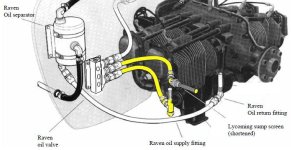
Not picking on you here Tom but you have described the theory of operation correctly and it occurs to me that many people have not given the oil pickup much thought. And when I say "oil pickup", I mean the architecture of the passage from the oil containment side of the sump to the screen cavity. In a "normal" sump, there is often a casting that extends off the front wall of the screen cavity. Its usually smaller diameter than the main screen cavity and sits above the floor of the sump. This "finger" is drilled from the main screen cavity and either capped at the tip or not drilled all the way through. The area between the bottom of the finger and the floor of the sump (think of the area where your fingerprint is located) is machined just enough to break into the drilled passage feeding the screen. This serves as a durable and large area passage to resist a single point failure due to a flap of gasket, leaf or other debris from completely choking the oil feed. This acts as a crude "finger strainer", much like the slits cut into the fuel feed lines in the RV tanks or the brass finger strainers in most other aircraft tanks. This single point blockage possibility is why aerobatic oil fittings used as a pickup in the floor of the sump (as shown in the CAI unit here) usually have finger strainers or slits in a standpipe or some other method to keep a single piece of debris from finding its way to the fitting opening and blocking it (see "Raven oil supply fitting" in Post #3). Without a method to shield the opening, it would not take much to completely block all oil to the pump.

All that said, WHERE the oil enters the screen cavity is irrelevant, so long as it is from one end of the screen or the other. A stock Lycoming sump is modified to provide oil to the screen externally by welding the front oil passage closed and adding a hose nipple to the rear port cap. When thats done (and you tap into the floor of the sump with a feed fitting) you match the hydraulic architecture of the CAI. THAT modification is a whole lot more invasive than my possible suggestion of "unwelding" the oil inlet port (drilling a hole) in the CAI screen cavity and "converting" it back to a non aerobatic configuration.

For years people have been welding passages closed and adding bungs to their sumps to achieve the hydraulic architecture shown in this CAI... All it takes to return the process is drilling a single hole to feed to screen from the other end.
 
It appears the OP was looking for ideas. He got some. If the intent was to constrain the "fix" down to tighter restrictions like "no sump removal, no scratching of paint, must be able to use parts from Home Depot... etc", then that is a different ask.

I have fabricated a Lycoming sump from scratch. I have struggled with a bitc# of a screen, I have machined a screen housing from a raw piece of bar stock, I have completely re plumbed inverted oil systems. Cant speak for others, but "my" suggestions are a result of that experience. Pulling a sump from flying RV 10 and re machining it is a weekend job, and IMHO, NOT processing it that way to begin with (and thereby bypassing market share) is a "lack of foresight" (as evidenced by this very thread)

Sometimes there is a "keyboard commando" posting, but not always.
…and how many builders have access to the kind of equipment that allows you to do the machining you speak of?

As I said before, machining the sump is likely the best option going forward; there are other viable options for those who do not have your capabilities…
 
A stock Lycoming sump is modified to provide oil to the screen externally by welding the front oil passage closed and adding a hose nipple to the rear port cap.

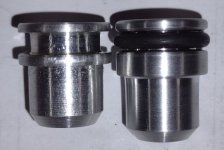
Welding works, but doesn't happen much these days. The current approach is a plug with an o-ring held in place by a slightly shortened screen. Walt posted a Raven drawing in post #2. I'm just sayin'...

Sump Pickup Plugs.jpg

All it takes to return the process is drilling a single hole to feed to screen from the other end.

And either re-machine for straight threads at the outer port and install an OEM plug, or counterbore a steel NPT pipe plug. Certainly a reasonable approach if fitting the Barrett sump to something like a Rocket without an inverted system. You, or I, or dozens of others are capable of doing the custom work.

However, we're discussing an RV-10 with CAI, where as illustrated repeatedly, (1) the standard screen apparently can't be removed without fouling the nose gear structure, and (2) the owners desire a bolt-on solution.
 
However, we're discussing an RV-10 with CAI, where as illustrated repeatedly, (1) the standard screen apparently can't be removed without fouling the nose gear structure, and (2) the owners desire a bolt-on solution.
Fair enough. But I have also repeatedly heard that “some” RV-10 owners can’t remove the screens and others can. I also missed the fact that this solution needed to be “bolt on”.

I also find it somewhat ironic that we are discussing the use of a sump not intended for this application and creates some significant operational limitations - yet the “fix” needs to be bolt on or COTS. And we are doing this on a forum where the entire airplane was built in a garage. I have described a “fix” that involves nothing more than drilling a single non precision hole - a skill EVERY RV builder now possess- and THIS is the hill some die on? Look how much flack I got for adding a bypass filter to my engine - an installation where the failure of the oil supply system would cause a slow “ooze” of oil. Failure of the oil line in this thread causes nearly instantaneous engine destruction, yet nary a peep.

Further, the existing external oil hose solution has been illustrated to exhibit some limitations of its own, and is even described as a “kludge” by the supplier. This is the PRIMARY oil supply path and it features several sins including aluminum fittings, one significantly weakened with a large and deep counterbore, multiple NPT adapters and hose connections for potential leak and failure paths, no provision for debris protection on the inlet, and just for fun it’s all hanging out in the breeze right above the exhaust. Where is the pushback from the “no modification” crowd? Where is the hand wringing from the safety experts?

True, it’s a pain to remove a sump from a completed airplane, but the modifications I have described can be performed by many builders at home using the tools they used when the airplane was constructed in the first place. If not ANY competent local machine shop can do it.

If we have learned anything here, it’s that going off script and installing parts not suited from your application will require more work than you bargained for. Might be best to stick to the plans if you are not willing to go the full distance with a modification.
 
and how many builders have access to the kind of equipment that allows you to do the machining you speak of?
Unless your shop is in the Yukon wilderness, there are multiple machine shops close by. Check Google for “machine shops near me”.

And this is only if you want to go the full Monty with O ring fittings at the back. If you “just” want to create an oil passage, anyone who has ever drilled a spar attach hole has the tools and skill to do this.
 
Unless your shop is in the Yukon wilderness, there are multiple machine shops close by. Check Google for “machine shops near me”.

And this is only if you want to go the full Monty with O ring fittings at the back. If you “just” want to create an oil passage, anyone who has ever drilled a spar attach hole has the tools and skill to do this.
Hi Michael---no offense taken, of course. And I do agree with Steve about ORB fittings, and in particular this application. The exercise here is to do a modification that allows the stock Lycoming screen or a shortened version---to be used in the sump so it would clear the Rv10 nose gear mount. Now---I understand that the manufacturer of the sumps is taking in the suggestions and 'may' make those modifications. Yes---changing to an ORB port in the sump rear would help dramatically, but shortening the screen or a different type of screen is also part of the equation. As for homebuilders wanting to take a perfectly good and expensive sump and to a mod, might give the builder some pause--especially if that dont have your skills, and thats a compliment. We'll see where this takes us.
Tom
 
I also missed the fact that this solution needed to be “bolt on”.

You and I both know a high percentage of our community are assemblers, not fabricators...and I mean no slight to them when I say it. It's been a good trend overall.

Look how much flack I got for adding a bypass filter to my engine

Not from me. I'm really interested in your results.

The exercise here is to do a modification that allows the stock Lycoming screen or a shortened version---to be used in the sump so it would clear the Rv10 nose gear mount.....Yes---changing to an ORB port in the sump rear would help dramatically, but shortening the screen or a different type of screen is also part of the equation.

Tom, a significantly shortened screen has little virtue. The goal here should be to provide screen area similar to or greater than the original OEM. When an engine begins to self-disassemble, more screen area means more flight time until seizure.

Any screen or no screen works fine when everything is normal.
 
You and I both know a high percentage of our community are assemblers, not fabricators...and I mean no slight to them when I say it. It's been a good trend overall.


Not from me. I'm really interested in your results.


Tom, a significantly shortened screen has little virtue. The goal here should be to provide screen area similar to or greater than the original OEM. When an engine begins to self-disassemble, more screen area means more flight time until seizure.

Any screen or no screen works fine when everything is normal.
Dan---yes sir all great points. In the case of the Barrett CAI, the dry sump screens would protect the oil pump passage from large debris, as would the Lycoming screen. Again, a work in progress. Do we ever stop improving? Tom
 
You and I both know a high percentage of our community are assemblers, not fabricators...and I mean no slight to them when I say it. It's been a good trend overall.


Not from me. I'm really interested in your results.


Tom, a significantly shortened screen has little virtue. The goal here should be to provide screen area similar to or greater than the original OEM. When an engine begins to self-disassemble, more screen area means more flight time until seizure.

Any screen or no screen works fine when everything is normal.
The one I am working on actually is a shorter screen but larger diameter. It actually has more area than the stick screen.
 
Fair enough. But I have also repeatedly heard that “some” RV-10 owners can’t remove the screens and others can. I also missed the fact that this solution needed to be “bolt on”.

I also find it somewhat ironic that we are discussing the use of a sump not intended for this application and creates some significant operational limitations - yet the “fix” needs to be bolt on or COTS. And we are doing this on a forum where the entire airplane was built in a garage. I have described a “fix” that involves nothing more than drilling a single non precision hole - a skill EVERY RV builder now possess- and THIS is the hill some die on? Look how much flack I got for adding a bypass filter to my engine - an installation where the failure of the oil supply system would cause a slow “ooze” of oil. Failure of the oil line in this thread causes nearly instantaneous engine destruction, yet nary a peep.

Further, the existing external oil hose solution has been illustrated to exhibit some limitations of its own, and is even described as a “kludge” by the supplier. This is the PRIMARY oil supply path and it features several sins including aluminum fittings, one significantly weakened with a large and deep counterbore, multiple NPT adapters and hose connections for potential leak and failure paths, no provision for debris protection on the inlet, and just for fun it’s all hanging out in the breeze right above the exhaust. Where is the pushback from the “no modification” crowd? Where is the hand wringing from the safety experts?

True, it’s a pain to remove a sump from a completed airplane, but the modifications I have described can be performed by many builders at home using the tools they used when the airplane was constructed in the first place. If not ANY competent local machine shop can do it.

If we have learned anything here, it’s that going off script and installing parts not suited from your application will require more work than you bargained for. Might be best to stick to the plans if you are not willing to go the full distance with a modification.
Wow.
 
Fair enough. But I have also repeatedly heard that “some” RV-10 owners can’t remove the screens and others can. I also missed the fact that this solution needed to be “bolt on”.

I also find it somewhat ironic that we are discussing the use of a sump not intended for this application and creates some significant operational limitations - yet the “fix” needs to be bolt on or COTS. And we are doing this on a forum where the entire airplane was built in a garage. I have described a “fix” that involves nothing more than drilling a single non precision hole - a skill EVERY RV builder now possess- and THIS is the hill some die on? Look how much flack I got for adding a bypass filter to my engine - an installation where the failure of the oil supply system would cause a slow “ooze” of oil. Failure of the oil line in this thread causes nearly instantaneous engine destruction, yet nary a peep.

Further, the existing external oil hose solution has been illustrated to exhibit some limitations of its own, and is even described as a “kludge” by the supplier. This is the PRIMARY oil supply path and it features several sins including aluminum fittings, one significantly weakened with a large and deep counterbore, multiple NPT adapters and hose connections for potential leak and failure paths, no provision for debris protection on the inlet, and just for fun it’s all hanging out in the breeze right above the exhaust. Where is the pushback from the “no modification” crowd? Where is the hand wringing from the safety experts?

True, it’s a pain to remove a sump from a completed airplane, but the modifications I have described can be performed by many builders at home using the tools they used when the airplane was constructed in the first place. If not ANY competent local machine shop can do it.

If we have learned anything here, it’s that going off script and installing parts not suited from your application will require more work than you bargained for. Might be best to stick to the plans if you are not willing to go the full distance with a modification.
The top of the nose gear elastomer mount tower design changed significantly around 2019. Newer engine mounts/nose gear assembly are very different and take up a fair bit more room. Hence the some.


I’m sure what you propose is well within the capabilities of most builders.
I also suspect that if we all knew what we know now when the engine was hanging naked on the hoist - then most of us would have done exactly what you suggest. Potentially with a 2 piece screen or not depending on the gear tower type.

When Barrett proposed the workaround most people are dealing with - nobody critically analyzed and pushed back for whatever reason. It doesn’t stand up to an objective engineering analysis. This was an error on all our part. Nobody can truly justify that modified part in that system.

Anyway. Back to the hole…is a simple hole sufficient provided the screen fits tight against the forward edge of the cavity?
How high do we think the hole is above the base of the sump and do we think this increases the minimum amount of oil required compared to the pickup being at the lowest point currently.
Would a tapped AN fitting with a 3/8 or 1/2 al pickup down to closer to the very lowest point in the sump be an option or unnecessarily complicate everything?

I think I’ll sleep best knowing that a hole is pretty foolproof. Nothing to break or come loose.
 
Ashley, there's no requirement for the tubular screen (or an equivalent) to be located in a short line as proposed. Monty B designed that sump for acro customers, who installed it with a Christian or Raven inverted oil system. In this app, simply run the lines to and from a sizable remote screen rather than to the clunk valve.

Here, quick search, just an example:


BTW, note the flow direction shown in the .pdf document...inside to outside.


View attachment 82679
Hey Dan and All,

Thank you to the VAF collective for debating the prose and cons of many variations.

As Dan has pointed out, the filter can only be serviced if it is external to the sump. To that end, some very talented Industrial Design Students have signed up to the challenge and are very close to a 3D printed mock up for a fit check. Once we get a little closer, I'll post the results for the VAF review 😀.

Thank you to all who have contributed, this is really the best part of the VAF community.
 
Back
Top