Van's Air Force

The definitive Van's Aircraft support community! Buying, building or flying an RV? Join our exclusive family of mentors and enthusiasts!

RV-3B Dave's in Colorado

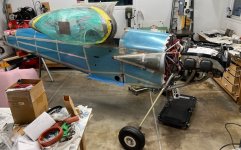
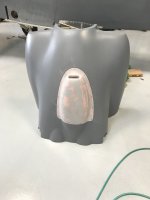
It's a fairly trivial bit of work, but I put the cowl back on for some checks and adjustments yesterday. I identified some areas to work. Like I said, trivial -- but the first bit of work on it since they hacked into me. And the week included two of the regular activities that I'd previously had. So I call it "progress."

However, it's quite clear that there's more recovery ahead, at a minimum.

Dave
 
Sorry, yet another post with no photos.

Here’s what’s been going in. As I continue to recover, my recovery progress is steady but slow, slower than I like. Today happened to be an unusually good day in many respects and I was able to work on this kit plane well over three hours. First time in a long time for that.

If I’m fortunate enough to get more such days, I’ll take ‘em.

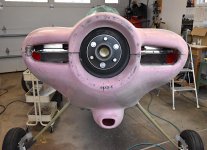
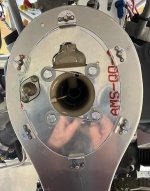
Since the cowl tool had been sent back (it centered on the crankshaft and held Wirejock’s centering disk; I thought I was done with it), I used the centering disk as an alignment reference and found that the cowl was roughly a quarter inch off center laterally and about 3/32” off center vertically. At this stage, the top and bottom cowl are held together on the sides with screws and nutplates. The nutplates are installed but I’m using clecos instead of the screws.

The aft edge is quarter-turn fasteners and nutplates, with the quarter-turn fasteners along the top and lower sides and the nutplates along the cheeks. I had been using clecos at both the nutplates and the quarter-turn fastener locations for convenience.

The turtledeck between the panel and the firewall, which is removable on an RV-3B, was off.

The first step was to put the turtledeck back on. Done. I didn’t expect that this would affect the cowl position but I wanted to be certain. And sure enough it didn’t.

Then I unclecoed the entire aft edge. This left the top and bottom sides attached to each other, giving me a cowl which was floating on the firewall and baffle seals. I clecoed the front of it to the alignment disk and found that indeed, I could move the centering of the cowl around as I pleased. I checked with my mentor and he’s returning the cowl tool. That will let me nail down the cowl position, hopefully better this time, and redrill the firewall attachment holes.

At least conceptually, this problem is solved.

While I was at it, I tweaked the gaps between the top and bottom cowl halves a bit and filled one or two holes. Small stuff.

Dave
 
Here I am back again.

The cowl tool is working out just fine but this 2-day job is dragging; I haven't been working on the airplane. I got the cowl assembled and back on and found that the aft edge of the lower cowl needed trimming. I spent much of today doing that: mark where needed, remove, trim, install, repeat. But getting fairly close.

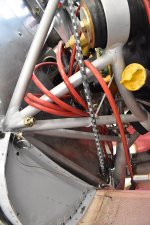
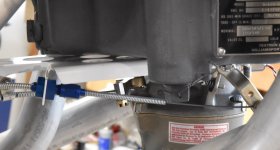
I've been using a bungee across the top of the engine mounts and down to two clips on the lower cowl to help support it while doing the removal/reinstallation. Here's a very poor photo, showing the bungee, the fitting and the ignition leads which are presently unconnected.

Cowl Support.JPG

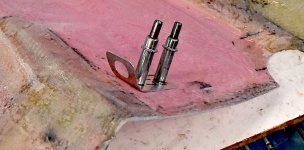
Here's a shot of the left-hand fitting:

Cowl Support Fitting.JPG

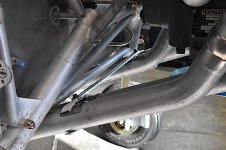
On a different topic, my mentor called today with some comments about the exhaust hanger. The Vetterman exhaust came with the standard hose and tube arrangement, and the instructions said to attach it to this bar (the blue bar between the exhaust pipes). We discussed different approaches. Since I'd like to prevent vertical motion of the exhaust at this point, I'll have to build something with that in mind. It's still somewhat off in the future. I'll decide then if I want to connect it to the airframe of the engine; both appear possible, although hoses might get in the way.

Exhaust Hanger Brace S.jpeg

Dave
 
Here I am back again.

The cowl tool is working out just fine but this 2-day job is dragging; I haven't been working on the airplane. I got the cowl assembled and back on and found that the aft edge of the lower cowl needed trimming. I spent much of today doing that: mark where needed, remove, trim, install, repeat. But getting fairly close.

I've been using a bungee across the top of the engine mounts and down to two clips on the lower cowl to help support it while doing the removal/reinstallation. Here's a very poor photo, showing the bungee, the fitting and the ignition leads which are presently unconnected.

View attachment 58712

Here's a shot of the left-hand fitting:

View attachment 58713

On a different topic, my mentor called today with some comments about the exhaust hanger. The Vetterman exhaust came with the standard hose and tube arrangement, and the instructions said to attach it to this bar (the blue bar between the exhaust pipes). We discussed different approaches. Since I'd like to prevent vertical motion of the exhaust at this point, I'll have to build something with that in mind. It's still somewhat off in the future. I'll decide then if I want to connect it to the airframe of the engine; both appear possible, although hoses might get in the way.

View attachment 58714

Dave
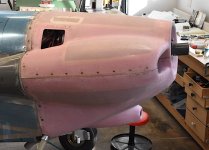
It's good to see you back and pushing on with the build!

The bar on the exhaust looks like it would need to be beefed up or replaced with an angle if the intent is perhaps to suspend it from in between the tail pipes?
 
Thanks for the comment!

At this point all I've settled on is to attach the upper end of whatever the connection turns out to be to engine bolts. What's shown in the photo is straight out of the instructions that came with the Vetterman exhaust.

Dave
 
I got a reasonable insurance quote for my C180 and since I’m getting a few years on and have definitely passed age 75, asked about possibly insuring other kinds of planes. The agent told me that with some aircraft, it would be a matter of the underwriter’s being familiar with the make and model, as well as my own experience. She then mentioned one client, an 85 year old pilot with a C185 who downsized to an RV-4. She said that the pilot easily got insurance because the plane was smaller, less expensive and also a tailwheel type.

That’s when I told her that I was building the RV-3B. She took it well.

Incidentally, the company is BWI, not Gallagher.

The cowling’s Mil-Spec quarter-turn fasteners are installed now. Still need to add the various locking elements. These quarter-turn fasteners are equivalent to Skybolts, the chief differences being that I had to make my own mounting strips and Mil-Spec seems to be out of business now. I started with an RV-4 kit for these but didn’t use them on the sides, deciding instead to use nutplates and screws. I have a number of spares now in case of an issue. I inventoried the parts and there’s plenty left for the sides, I I decide to change to them there.

Making my own mounting strips for the quarter-turn fasteners was a good thing. Mine are more compact than Skybolts and lighter, both plusses for this little RV-3B. On the sides, I laid up some glass to make glass flanges.

Up to now I’d been using clecos in the screw holes. Today I drilled them out to #19 for the #8 screws. I used a #19 reamer in the #30 holes and this worked perfectly. I got smooth accurate holes.

When I tried inserting the screws, I learned that two of the #8 nutplates had mysteriously shrunk down to #6. Probably I’d gotten them mixed up in the bins years ago. That gave me some practice removing rivets and installing new ones.

With AN525-7 screws and thin nylon washers, the cowl is finally secure. It lines up nicely with the cowl tool off, and I’m ready to move on. There’s some glasswork still needed before finishing, though.

Looking at these photos, I realized that I’d forgotten to install the nutplates and final drill for the front center attachments. Please let me know what else I missed! And yes, I added them today.

Dave

Cowl Fasteners RH S.JPG


Cowl Fasteners Front S.jpeg
 

Attachments

  • Cowl Fasteners RH S.JPG
    Cowl Fasteners RH S.JPG
    161 KB · Views: 111
  • Cowl Fasteners RH S.JPG
    Cowl Fasteners RH S.JPG
    161 KB · Views: 105
Looking at that last photo, it looks like the cowl is a little off-center. But the perimeter is centered, apparently the inside rim isn't.

Dave
 
Nice Dave!
Re the slight off center, my humble guess is that if the spinner is +/- centred on the cowl all will be good. Looks like the recess ape is not entered on the actual hole anyway ;)

PS
Nice to see you using the same tool trolley as my beloved uses for her knitting gear :cool:
 
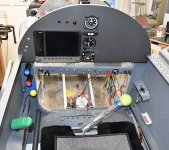
After climbing in and out of the cockpit too many times, I finally decided where to put the prop and mixture verniers and the carb heat control.

Engine Controls In Cockpit S.jpeg

Here, none of them conflict with anything else and are all easy to operate. I’d thought of putting the carb heat control under the mixture where the blue tape is, but that was too awkward; the yellow trim control is in the way.

I'm sure that you know all this but for the record:

Throttle is green (and yes, it's a Flonase bottle cap)
Trim is yellow
Red on left is mixture
Prop is blue
Carb heat is black on the switch panel
Cabin heat is red on the switch panel
Stick grip is the tennis ball (really).
The black bar to the left of the seat cushion is the manual flap.

So far, none of these, including the throttle cable, are hooked up. The throttle cable, though, at least has its firewall pass-through location identified and pilot drilled with parts on order. And I know pretty much where the prop cable leaves the cockpit and how it gets routed to the governor. The switch panel isn't attached at its cockpit end and is sagging down, if it were attached it would be immediately under the panel. There are no controls on the right because that's where I routed most of the wiring.

I've been working on it pretty regularly and it sure felt good.

Dave
 
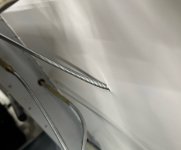
The governor cable leaves the cockpit through a hole in the left side of the footwell,

Gov Cable From Cockpit.jpg

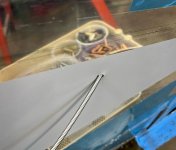
And goes forward in the left-hand cheek extension, which covers the primed area.

Gov Cable In Cheek Extension.jpg

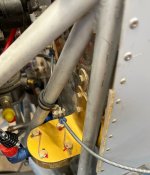
It then passes over the remote oil filter bracket,

Gov Cable 1.jpg

And terminates at the governor.

Gov Cable 2.jpg

And

Gov Cable 3.jpg

The cable is a solid-wire cable. If this is not suitable, why not?

The clamp on the governor bracket is a dimpled one from McFarland. You can see the dimple. The two adjacent cables that are clamped to the bottom of the firewall recess are there just to get them out of the way for now as they won't be there permanently. I needed a place to stash them for now.

Dave
 
Last edited:
I'm still here, but May through June is my busy season and this year I got badly slammed. Haven't been working on the project since early May. I expect another two or three weeks before things settle back to normal.
 
Happy Friday the 13th!

It looks like I worked roughly three hours last month. Believe it or not, though, I got the mixture control hooked up.

I attached one of the carburetor throttle and picture fittings from Van’s, and since this is an RV-3B, I needed to do some trimming. The cut edges didn’t have the white powder coating so I got the bottle of touch-up paint that I’d bought long ago from Van’s. Looks like they changed the powder-coating color because the tough-up paint is gray and the fitting is white.

After cutting, deburring, drilling and so on, I got the silly fitting to fit. The mixture appears satisfactory now, so on to the throttle.

Incidentally, there are several options for firewall pass-through fittings for the control cables. I chose p/n 05-15705 from Aircraft Spruce. It’s a compact steel collet and nut arrangement that works great and is easy to use. The one caveat is that it doesn’t offer any way to bring an engine control through the firewall at an angle, just perpendicularly. So if you use this device bear that in mind with your planning.

Sorry no photos yet.

When I said that I got badly slammed, it was really worse than that. Ultimately I turned some things over to a hired manager to deal with; I'm easing out of my second 30 year career. I'm not completely free yet but maybe in another year. Now l need to get my C180 back in the air after its May annual.

Dave
 
The throttle, mixture and governor controls are hooked up. Can’t hook up the carb heat control just yet. The main impediments at this time are that the control’s firewall pass-through itself isn’t located, and the FAB hasn’t been built yet. Minor things.

Throttle Connection.JPG

Knowing that I’ll be installing and removing the bottom cowl numerous times, and maybe even the exhaust, to install it has thus far been what Robert Persig, I believe, has termed a “gumption trap.” I’ve decided to build and install the FAB anyway. Here’s the beginning photo showing the parts.

FAB Start.JPG

It’s been a while since I really worked on this project, so getting organized took some time.

The first thing that stopped me was the need for cutting the length of the FAB for my cowl. I attached the top plate to the carb, installed the lower cowl, and measured in from the air intake lip to that for a reference dimension. That gave me an accurate dimension for cutting it.

The distance still seemed excessive so I asked VAF for a sanity check, found I was sane enough to do this, and whacked it off.

FAB Snout.JPG

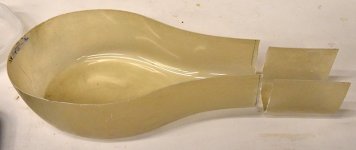
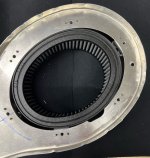
After some positioning adjustment, I located and drilled the air box top plate, the aluminum part with the curvy flanges to the top plate. Once I drilled the rivet holes for those filter-retention clips, I found that either things were way off, or my 2013 filter had shrunk, as is their tendency. I have a request into VAF Support right now asking for their opinion.

FAB Filter Fit.jpg

Although I don’t have any photos of it, I determined how high the front of the FAB snout should be raised and fluted the sides of the banjo-shaped bent plate to raise it that much.

Dave
 
The throttle, mixture and governor controls are hooked up. Can’t hook up the carb heat control just yet. The main impediments at this time are that the control’s firewall pass-through itself isn’t located, and the FAB hasn’t been built yet. Minor things.

View attachment 74883

Knowing that I’ll be installing and removing the bottom cowl numerous times, and maybe even the exhaust, to install it has thus far been what Robert Persig, I believe, has termed a “gumption trap.” I’ve decided to build and install the FAB anyway. Here’s the beginning photo showing the parts.

View attachment 74884

It’s been a while since I really worked on this project, so getting organized took some time.

The first thing that stopped me was the need for cutting the length of the FAB for my cowl. I attached the top plate to the carb, installed the lower cowl, and measured in from the air intake lip to that for a reference dimension. That gave me an accurate dimension for cutting it.

The distance still seemed excessive so I asked VAF for a sanity check, found I was sane enough to do this, and whacked it off.

View attachment 74885

After some positioning adjustment, I located and drilled the air box top plate, the aluminum part with the curvy flanges to the top plate. Once I drilled the rivet holes for those filter-retention clips, I found that either things were way off, or my 2013 filter had shrunk, as is their tendency. I have a request into VAF Support right now asking for their opinion.

View attachment 74886

Although I don’t have any photos of it, I determined how high the front of the FAB snout should be raised and fluted the sides of the banjo-shaped bent plate to raise it that much.

Dave
It is good that you are still making progress Dave. The FAB can be quite a bit of work. Here is a suggestion for an alternative way of connecting the ram air inlet to the FAB with a piece of SCAT instead of the baffle seal material. The SCAT flexes to accommodate the engine start/stop shake and the removable snout makes it easier when installing the lower cowl.
20240915_091650.jpg
 
It is good that you are still making progress Dave. The FAB can be quite a bit of work. Here is a suggestion for an alternative way of connecting the ram air inlet to the FAB with a piece of SCAT instead of the baffle seal material. The SCAT flexes to accommodate the engine start/stop shake and the removable snout makes it easier when installing the lower cowl.
View attachment 74888
Haaa, the famous shrinking filters... not really uncommon, though I only thought it'd happen when in service, e.g. engine running/flying. Great work Dave, as usual.

Yes, a removable snout or lower cowl part would sure be the way to go, and what I'll do on my next build.
In my next life that is.
 
Haaa, the famous shrinking filters... not really uncommon, though I only thought it'd happen when in service, e.g. engine running/flying. Great work Dave, as usual.

Yes, a removable snout or lower cowl part would sure be the way to go, and what I'll do on my next build.
In my next life that is.
I made mine removable and it is much simpler to put the lower cowl on.
If you look close, you can see it on the finished plane.
Well worth the effort, I think
 

Attachments

  • IMG_0819.jpeg
    IMG_0819.jpeg
    987.1 KB · Views: 117
  • IMG_1032.jpeg
    IMG_1032.jpeg
    357.8 KB · Views: 117
Thanks, friends, for the inlet ideas. Steve, that's a very slick installation indeed. I like.

Hypothetically, with a removable snout like that, it might be possible to split the lower cowling on the vertical centerline and then it might be much easier to remove and reinstall. Just wondering.
 
Hypothetically, with a removable snout like that, it might be possible to split the lower cowling on the vertical centerline and then it might be much easier to remove and reinstall. Just wondering.
I had a removable inlet on the RV 10, and thought about splitting the lower cowl also. With a 3 blade prop it would have been a great mod. Really easy to do too.
 
While awaiting Van’s response to my filter question, I decided to make a wear plate that fits under the filter to protect the fiberglass air box. I had some extra titanium sheet, .020 thick, that I decided to use. It’s Grade 2 or Grade 3 and cuts like a stiffer sort of aluminum. Unfortunately titanium is 60% denser than aluminum, and this piece weighs 53 grams. I’d cut a hole in the middle if I could figure out how to make an elliptical cut-out. For reference, a 2.5” diameter round hole would only save 7 grams.

Titanium Wear Plate.jpg

If I’d made it of .016 aluminum, it would only weigh 27 grams without a hole. I chose the titanium because I am pretty sure it’s more wear-resistant. The top of the filter will be constrained by the six clips and I don’t expect much wear there.

I plan to use either G/flex or 2216 epoxy to affix it to the bottom of the air box. I thought of Pro-Seal and have some, but the bottom of the air box isn’t flat and I think the epoxy will be better suited to this. I’ll decide later, but I note that one fellow’s reasoning is that Pro-Seal can withstand fuel. That would be a good point except that epoxy can, too.

After that I adjusted the height of the parts to fit the filter. I hope that the filter shrinkage hasn’t affected the height. The FAB plans are explicit and simple for doing this.

I got a reply from Support about the apparent shrinkage in the filter: “The clips should be arranged so the filter slides in easily. It appears that it was assembled correctly. You might want to try a new filter to see how it fits, but, I would say it was fine.” Based on this, I won’t buy a new filter until the plane is otherwise ready for flight. I learned that my local O’Reilly auto parts store sells this filter for a bit under Van’s price, as of late November, 2024.

Right now I’m in the middle of adjusting things and checking things. I’m only 90% retired, and some work-related things popped up and took a bit of time. But I’m this far along.

FAB Being Fitted.jpg

One thing I learned is that those forward clecos interfere with the cowl inlet. I repositioned them n the inside and that worked.

Dave
 
My O320 filter does not contact the fiberglass. It has a plate on the bottom of the filter and gets bolted up to the top plate. This leaves a space between the plate and the bottom of the FAB. Your inlet is smaller than mine. You may try to fit the carb heat flap and see. Your air box may need to be lowered.
 
My O320 filter does not contact the fiberglass. It has a plate on the bottom of the filter and gets bolted up to the top plate. This leaves a space between the plate and the bottom of the FAB. Your inlet is smaller than mine. You may try to fit the carb heat flap and see. Your air box may need to be lowered.
Mine is like that also, there is an oval plate that holds the filter via 6 long bolts and there is clearance between the plate and the fiberglass bowl. My FAB kit was from Van's in 2000 and it appears the design was changed since then to eliminate the plate, hence the contact and wear problems that some people experience.
 
Both of you, thanks for the thoughtful comments.

I'm following my revised FAB plans fairly closely. There was a change in 2021, I think, and at that time I bought the upgrade parts. But the earlier version of the FAB that I got in the Finishing kit in 12/2013 didn't have that plate you mentioned.

You can download the FAB plans on Van's website somewhere.

Dave
 
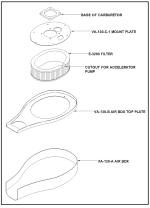
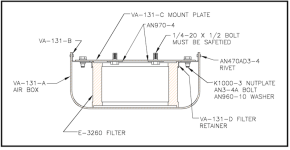
Here are a couple of pictures from the FAB plans revised on 6-3-21. This is what I'm building.

First, the overall:

Stack-Up.png


And then the cross-section:

Cross-Section.png

Dave
 
Plugging along on the FAB. I managed to screw up the top plate and put another one on order, so I’ll get to redo many of the fitting checks that I’d just completed. What joy.

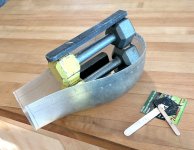
The glue decision has been resolved for that bottom Titanium plate I made. It’s being glued down with Pro-Seal.I had an unopened container in my freezer and figured this was a good time to introduce it to the room temperature world. The weights shown are to help hold the plate firmly in contact with the fiberglass, and it’s on my kitchen counter because this time of year it’s more reliably warm than in the shop.

FAB Air Box.jpg

You can make out the cut lines - still have to do that. I'll do that after I've got the new top plate all made and fitted, though.

The sticks and card are the mixing tools for the Pro-Seal. I'll use that to verify that the goop is cured and then give it another day or two before moving it. In case anyone's interested, I used 7.0 grams of the white stuff and 0.7 of the black stuff and that was just barely enough. If you do the same (even with aluminum, of course), the quantities should be a good starting point. If I were doing it again I'd add another gram or two of the white.

I chose the Pro-Seal because my epoxies are getting old. While they'd probably work fine, I think it's time to replace them, at least the G/flex. Still, that's only 4.5 years old. Guess I'll test it and see if it's okay. West System's data sheet says "With proper storage, resin and hardener should remain usable for several
years." But it doesn't define either "proper storage" nor "several."

Dave
 
Last edited:
Plugging along on the FAB. I managed to screw up the top plate and put another one on order, so I’ll get to redo many of the fitting checks that I’d just completed. What joy.

The glue decision has been resolved for that bottom Titanium plate I made. It’s being glued down with Pro-Seal.I had an unopened container in my freezer and figured this was a good time to introduce it to the room temperature world. After glueing down the titanium ellipse, I set it on a floor heat vent in the house, with weights to help hold it down. After a week it was fully cured. It might have been cured before then but that’s when I checked it.

The O-320 FAB plans call for AN970-4 washers for the mounting plate bolts to the carburetor. But these are so big that they overhang the air flow path. I got some AN970-3 washers, which are the right OD, and drilled out the ID for an F drill, clearance for the 1/4” bolts. Then I primed them (can’t leave a bare steel edge) and baked them. I bake small primed things at 150 F for an hour, and they fully cure. Just put them in a small oven on some aluminum foil. Don’t want food on my parts or primer on my food, after all.

AN970 Washers.jpg

Safetying the attachment bolts was interesting. Initially I thought that the easiest way would be to use the DMC Daniels Safe-T-Cable gun. I guess I don’t quite have that skill yet. After cutting off a dozen cables, I gave up and used safety wire. USAF taught me that skill well over 50 years ago.

Dave
 
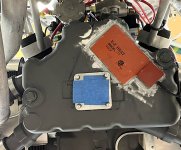
The recent thread here on VAF about engine heaters and AntiSplat Aero’s heater reminded me that I bought both that one and a pad heater, and haven’t installed either. My pad heater on my C180 has worked flawlessly since the late ‘80s, so I decided to install that one. I had to remove the carburetor to do it.

I’d bought the EZ-Heat 441, which clearly didn’t fit my O-320-D1A (or some suffix like that). After cutting out and trying most of their templates, I ordered a 270. After a bit of finagling, that did fit, just barely. I had to remove the oil sump part number, which was raised numbers, and their tenacious paint. I did that with coarse and then fine sanding drums on an air drill. But it did eventually fit. The oil sump was at an awkward height for me and I thought seriously about ordering an Aerocreeper. Those things are about $500 now! Fortunately, I remembered an old book, “Don’t Raise the Bridge, Lower the River,” and put the tail up on a sawhorse. If I can’t raise me up, I can lower the oil sump. That did it. Here it is, auditioning as a nose wheel airplane.

Nose Dragger.jpg

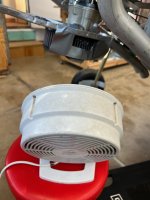
The instructions said to install above 70 F. The shop was in the mid 60s. I positioned a 1,500 W space heater under the sump and shortly it was in the high 70s, so I went ahead with the install. I’d covered the oil sump air inlet opening and the carb’s inlet and outlet. Didn’t want aluminum dust in any of these.

The aluminized silicone that the instructions say to spread along the perimeter didn’t come with a pointed spout. I used a shaped popsicle stick to help there.

Heating Pad 270.jpg

Anyone want a new, uninstalled AntiSplat Aero’s sump heater? Send me a PM.

The 3260 air filter for the FAB is designed to be formed into an ellipse and then the rim is supposed to be cut out to clear part of the carburetor. The cut area is then Pro-Sealed up. That sounded sketchy as heck to me so following some advice here on VAF, I bought a 3322 air filter. It’s the same size but thinner, and the idea with that one is to form it around the protuberance. I could not get it shaped right, so I thought hey, let’s follow the FAB plans and see how it works.

The filter’s rim was easy to cut. I’ve got an Xacto saw that’s pretty thin and used that. No problem. Mixed the Pro-Seal, spread it on and taped everything in place. I'd reinstalled the carburetor by then. Here it is with the space heater helping it cure. The heat loosens the tape, so I had to restretch it a couple times. Fortunately it didn't loosen the tape's adhesive.

Proseal 2.jpg

The Pro-Seal was a bit thin, and crept down away from where I wanted it - if you’re going to do this, I suggest adding a little Cab-O-Sil to it to make it stay in place better. But the way I did it, did work. Another way to handle it, probably better, would be to remove the carb and air box mount, and do the Pro-Seal job with all that upside down on your work bench. That way, the Pro-Seal will creep around the carb and enhance the seal. Excess can be trimmed off later.

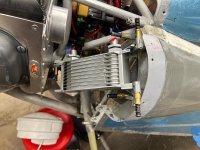
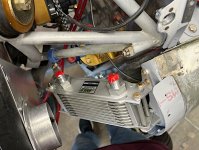
In other news, I finally, finally, figured out how to physically mount the oil cooler. It’ll get attached to the LH cheek and engine mount. Finding the one spot that:

a) Offered decent air inlet and exit,
b) Gave the hoses room,
c) And would actually attach to something...

all took much more thinking time than I’d like to admit.

Oil Cooler Mount S.jpeg

And yes, some duct work is ahead, but not imminently.

Dave
 
Actually making a set of oil cooler installation brackets that fit took the usual amount of time and thought. At some point I realized that access to the nuts on the aft sides of the cowl cheek extension bulkhead was somewhere between zero and negligible and decided to put in nutplates. That worked for the the bottom mount on the bulkhead but led to another new top mount. Plus some filled holes in the glass bulkhead, which I’d reinforced beforehand.

Here’s a test installation.

Oil Cooler Brackets.jpg

Interestingly, the screws for the top mount are accessible with a standard screwdriver working through the oil cooler air inlet hole in the baffle with a regular Phillips or just a short Philips screwdriver.

Which reminded me of a childhood friend, Phillip. Great guy. He died a few years back and the day after I heard of that, I was at a maintenance facility with my C180, and a Snap-On truck pulled up. I took the opportunity to buy not just any old Phillip’s screwdriver, but Phil’s Memorial Screwdriver.

Now back to the FAB. I’d started on the oil cooler mount while waiting for some Pro-Seal to set up. It has now cured.


Dave
 
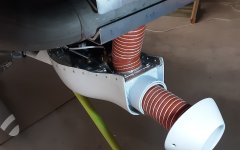
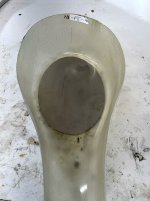
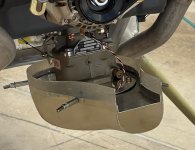
After some fuss and bother, I finally got the FAB together. The somewhat oversized flapper valve works and seals both closed and open.

IMG_4714.jpg
IMG_4715.jpg
IMG_4716.jpg

I’m using Robbins Wings carb and cabin heat hardware. You can see that I haven’t yet removed all my markings.

There were two articles, one in Kitplane and one in Sport Aviation, on quitting flying due to age-related medical issues. The two articles arrived here within a week of each other and together made me thing hard about flying, as I’m closing in on the ages of the writers, being in my late 70s. So for what it’s worth, yeah, I’ve got some issues but I’ve also got a daily exercise and workout program and a weekly stretching arrangement, and all in all, feel pretty darn good. How far that'll take me, who knows?

Dave
 
I’ve also got a daily exercise and workout program and a weekly stretching arrangement, and all in all, feel pretty darn good. How far that'll take me, who knows?
Well, you looked pretty fit to me 2 1/2 years ago... keep going!
Nice to see you moving forward on that nice little machine. I'm sure the constant decision making process keeps one's brain fit too :)
 
After some fuss and bother, I finally got the FAB together. The somewhat oversized flapper valve works and seals both closed and open.

View attachment 82259
View attachment 82260
View attachment 82261

I’m using Robbins Wings carb and cabin heat hardware. You can see that I haven’t yet removed all my markings.

There were two articles, one in Kitplane and one in Sport Aviation, on quitting flying due to age-related medical issues. The two articles arrived here within a week of each other and together made me thing hard about flying, as I’m closing in on the ages of the writers, being in my late 70s. So for what it’s worth, yeah, I’ve got some issues but I’ve also got a daily exercise and workout program and a weekly stretching arrangement, and all in all, feel pretty darn good. How far that'll take me, who knows?

Dave
Box and air intake look great!

For what it's worth, the last time I flew with my instructor in his PA-12, he was 87 years old and still mumbled about the slight bounce landing on his short sod runway! Everyone is different but you might only have 8-10 more years of flying left! 😊
 
A guy in a hangar across the ramp is 87 and he has an unfinished Glasair he'd bought and expects to start a Zenith kit shortly. He has an engine for it. Some people can do that sort of thing. but I'm pretty sure it won't be me.

Dave
 
After some fuss and bother, I finally got the FAB together. The somewhat oversized flapper valve works and seals both closed and open.

View attachment 82259
View attachment 82260
View attachment 82261

I’m using Robbins Wings carb and cabin heat hardware. You can see that I haven’t yet removed all my markings.

There were two articles, one in Kitplane and one in Sport Aviation, on quitting flying due to age-related medical issues. The two articles arrived here within a week of each other and together made me thing hard about flying, as I’m closing in on the ages of the writers, being in my late 70s. So for what it’s worth, yeah, I’ve got some issues but I’ve also got a daily exercise and workout program and a weekly stretching arrangement, and all in all, feel pretty darn good. How far that'll take me, who knows?

Dave
I like the story about Clayton Scott, born in 1905, a long time aviator who was Bill Boeing's personal pilot for eight years in the 30s, who then became a long time test pilot for Boeing. He was the first pilot to land on Boeing Field, before it was official opened. In 2005 he flew a twin-engine Aerostar into Boeing Field to attend a celebration at the Museum of Flight where the nearby Renton Airfield was named in his honor. This airfield is adjacent to Boeing production facilities where the first B29s were built. His pilot certificate was #2255, the lowest numbered active certificate. Not only was the celebration in honor of Renton Airfield being named for him. It was his 100th birthday...
 
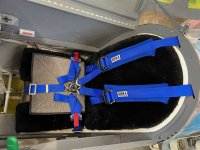
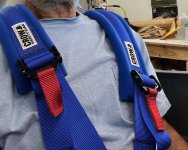
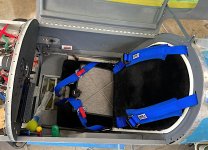
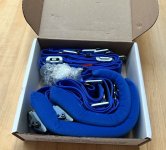
The seat belt and shoulder harness arrived from Crow and I installed them. This included a crotch strap.

In the Box.jpg

1. The sewn-on shoulder harness pads are very thick and I don’t know yet if I’ll get rid of them. They are comfy, though, and so far feel great.

2. The plane’s mounting points on the turtledeck above the baggage area need to be made to fit a bolt and nut and washer. I’d done that, and installed them okay, but had to install the bolt pointing up because I could get the nut into the space but not the whole bolt. No biggie.

3. I had to use the work platform I’d made years ago to do the install, laying on my back. Getting in and out was harder than it was back then, mostly because I’d forgotten the routine bends and twists, but also because the cockpit is more mature now and more things are in it.

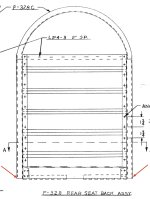
4. The bottom outboard corners of the seat back needed trimming to clear the seat belt attachment fittings. They already cleared the plane’s mounting points. I had to rim the corners about 1/2” for this.

Seat Back A.jpg

5. Somewhere along the way, I misunderstood the thickness of the bottom crotch strap attachment fitting and made it so a 1/16” bracket and perhaps a .090” bracket would fit. As received, it was just under 1/8”. I called Crow and their recommendation was to grind the bracket’s tang down. As this seemed easier than remaking the plane’s mounting point, I did that. It wasn’t too hard. Primed and baked it and installed it.

I’d thought that the 2’ wide crotch strap would chafe or worse, but on the RV-3B, the rudder pedals are wide enough and my legs spread enough, so that is a complete non-issue.

6. Crow sent me a belt and harness for the RV-4 or RV-8, and it fits, with some adjustment needed. The adjustment capability was there and I trimmed off 24” excess belt length, cumulatively. The straps still allow for a considerably larger pilot than I am. The shoulder harness straps did not need trimming.

7. I’d ordered the 2” aluminum adjusters and was told that they absolutely hold and don’t slip. They are a bit awkward to work and I wouldn’t make that choice again. I need to press the barrel adjacent to the lift tang to make it work. Plus, they stick out about 1 3/4” from the harness belt’s surface. I didn’t know these things when I ordered this. Frankly, I don’t care for them. They can be operated one-handed, though.

Adjusters.jpg

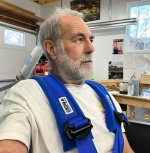
Yes, that's me in the photo. A rare selfie.

8. I thought I ordered the black hardware but unfortunately it came with the standard silver, except for the adjusters. A miscommunication.

9. I placed the order on Monday just after noon Mountain time and when I got up Wednesday morning, the box was on my front steps. Amazing service. Also, they are easy to talk with.

10. I ordered the blue, expecting to receive a navy blue system. Instead, it’s a bright cobalt blue. This is fine, just unexpected. Color samples might be in order if you care about a particular color.

Harness Complete.jpg

Dave
 

Attachments

  • Harness In.jpg
    Harness In.jpg
    263.3 KB · Views: 9
The seat belt and shoulder harness arrived from Crow and I installed them. This included a crotch strap.

View attachment 82758

1. The sewn-on shoulder harness pads are very thick and I don’t know yet if I’ll get rid of them. They are comfy, though, and so far feel great.

2. The plane’s mounting points on the turtledeck above the baggage area need to be made to fit a bolt and nut and washer. I’d done that, and installed them okay, but had to install the bolt pointing up because I could get the nut into the space but not the whole bolt. No biggie.

3. I had to use the work platform I’d made years ago to do the install, laying on my back. Getting in and out was harder than it was back then, mostly because I’d forgotten the routine bends and twists, but also because the cockpit is more mature now and more things are in it.

4. The bottom outboard corners of the seat back needed trimming to clear the seat belt attachment fittings. They already cleared the plane’s mounting points. I had to rim the corners about 1/2” for this.

View attachment 82759

5. Somewhere along the way, I misunderstood the thickness of the bottom crotch strap attachment fitting and made it so a 1/16” bracket and perhaps a .090” bracket would fit. As received, it was just under 1/8”. I called Crow and their recommendation was to grind the bracket’s tang down. As this seemed easier than remaking the plane’s mounting point, I did that. It wasn’t too hard. Primed and baked it and installed it.

I’d thought that the 2’ wide crotch strap would chafe or worse, but on the RV-3B, the rudder pedals are wide enough and my legs spread enough, so that is a complete non-issue.

6. Crow sent me a belt and harness for the RV-4 or RV-8, and it fits, with some adjustment needed. The adjustment capability was there and I trimmed off 24” excess belt length, cumulatively. The straps still allow for a considerably larger pilot than I am. The shoulder harness straps did not need trimming.

7. I’d ordered the 2” aluminum adjusters and was told that they absolutely hold and don’t slip. They are a bit awkward to work and I wouldn’t make that choice again. I need to press the barrel adjacent to the lift tang to make it work. Plus, they stick out about 1 3/4” from the harness belt’s surface. I didn’t know these things when I ordered this. Frankly, I don’t care for them. They can be operated one-handed, though.

View attachment 82760

Yes, that's me in the photo. A rare selfie.

8. I thought I ordered the black hardware but unfortunately it came with the standard silver, except for the adjusters. A miscommunication.

9. I placed the order on Monday just after noon Mountain time and when I got up Wednesday morning, the box was on my front steps. Amazing service. Also, they are easy to talk with.

10. I ordered the blue, expecting to receive a navy blue system. Instead, it’s a bright cobalt blue. This is fine, just unexpected. Color samples might be in order if you care about a particular color.

View attachment 82762

Dave
Any concern about chafing the shoulder straps where they come through the bulkhead?
 
The seat belt and shoulder harness arrived from Crow and I installed them. This included a crotch strap.

View attachment 82758

1. The sewn-on shoulder harness pads are very thick and I don’t know yet if I’ll get rid of them. They are comfy, though, and so far feel great.

2. The plane’s mounting points on the turtledeck above the baggage area need to be made to fit a bolt and nut and washer. I’d done that, and installed them okay, but had to install the bolt pointing up because I could get the nut into the space but not the whole bolt. No biggie.

3. I had to use the work platform I’d made years ago to do the install, laying on my back. Getting in and out was harder than it was back then, mostly because I’d forgotten the routine bends and twists, but also because the cockpit is more mature now and more things are in it.

4. The bottom outboard corners of the seat back needed trimming to clear the seat belt attachment fittings. They already cleared the plane’s mounting points. I had to rim the corners about 1/2” for this.

View attachment 82759

5. Somewhere along the way, I misunderstood the thickness of the bottom crotch strap attachment fitting and made it so a 1/16” bracket and perhaps a .090” bracket would fit. As received, it was just under 1/8”. I called Crow and their recommendation was to grind the bracket’s tang down. As this seemed easier than remaking the plane’s mounting point, I did that. It wasn’t too hard. Primed and baked it and installed it.

I’d thought that the 2’ wide crotch strap would chafe or worse, but on the RV-3B, the rudder pedals are wide enough and my legs spread enough, so that is a complete non-issue.

6. Crow sent me a belt and harness for the RV-4 or RV-8, and it fits, with some adjustment needed. The adjustment capability was there and I trimmed off 24” excess belt length, cumulatively. The straps still allow for a considerably larger pilot than I am. The shoulder harness straps did not need trimming.

7. I’d ordered the 2” aluminum adjusters and was told that they absolutely hold and don’t slip. They are a bit awkward to work and I wouldn’t make that choice again. I need to press the barrel adjacent to the lift tang to make it work. Plus, they stick out about 1 3/4” from the harness belt’s surface. I didn’t know these things when I ordered this. Frankly, I don’t care for them. They can be operated one-handed, though.

View attachment 82760

Yes, that's me in the photo. A rare selfie.

8. I thought I ordered the black hardware but unfortunately it came with the standard silver, except for the adjusters. A miscommunication.

9. I placed the order on Monday just after noon Mountain time and when I got up Wednesday morning, the box was on my front steps. Amazing service. Also, they are easy to talk with.

10. I ordered the blue, expecting to receive a navy blue system. Instead, it’s a bright cobalt blue. This is fine, just unexpected. Color samples might be in order if you care about a particular color.

View attachment 82762

Dave
Looking good Dave. Looks like you are getting closer!!
 
Yes. I need to add anti-chafe to that.

Dave
David - we just built a doubler out of 0.060” (or maybe a little thicker), riveted it on, and then radiused the slot all the way around - have never had any chafing problems on the harness. Going on 13 years and just shy of 900 hours…..
 
And that's according to the plans, Paul, if my memory works right that far back. Several ways to do this. On the list....

Thanks to you both. And hi, Rocky!

Dave
 
Back for the moment to today's installment of the FAB.

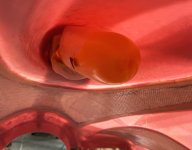
The FAB manual gives a procedure for extending the inlet snout on the cowl. It involves shaping some provided foam and glassing it, followed by some other steps, including more glassing. The shaping went okay but when I tried to glass it, the glass would not adhere to the inside of the foam on top. It made a sticky mess, sticking to my gloves, sticks or anything else I tried to get in there, sticking to everything except for the upper inside of the foam. I removed that glass.

Reset.

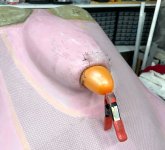
I bought some balloons and with them in hand, used reinforced packing tape to wrap around the exterior of the foam, so that the balloon would not burst it.

1 Taping the Foam.jpg

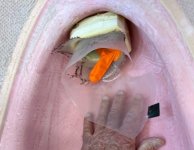
I wetted out some more glass. I taped some plastic to a balloon because I was concerned that the glass would stick to the balloon. This time, I painted the inside of the foam with epoxy and that helped hold the glass to the foam while I pressed the plastic to the inside of the glass. The balloon really did the work. I inflated it in place, using the compressor instead of blowing into it. I just didn't have the lung power for the longer balloon. A round balloon was no problem but didn't work.

2 Layup & Balloon.jpg

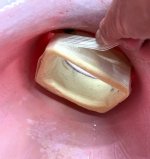
Checking inside the cowl for a different look at it,

3 Balloon Inside.jpg

After the glass cured, I deflated the balloon.

4 Ballon Deflated.jpg

The plastic wasn’t properly in place but seemed to be mostly inside the cowl. I had gotten it mislocated.

5 Plastic & Baloon After.jpg

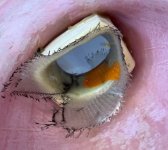
After unwrapping the plastic I found that part of the balloon did indeed get stuck to the glass. But otherwise this seems to have done okay.

6 Residual Balloon.jpg

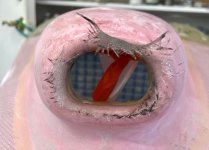
Next, after trimming the fore and aft edges of the glass, I needed to remove as much of the foam as I could. A common wood chisel seemed to be the best choice, pushing it by hand, giving me a closer shave than a hacksaw blade. It also worked nicely to remove most - not all - of the hot melt glue I’d used to hold the foam in place. The residual balloon came off easily with a drum sander. You can see some left-over hot melt glue above the snout. It's that black spot.

7 After Foam.jpg

There’s still some clean-up (I'm looking at you, hot melt glue...), and more glassing to do but that’ll need to wait for another installment.

Initially I tried using a 16” diameter round balloon, figuring that in the small inlet cavity, there would be enough available rubber to conform to the surface. Turns out that a long balloon worked better. Fortunately, balloons aren’t expensive, and no, I didn’t tell the store that it was going to be used for airplane tooling.

Dave
 
This one caught me by surprise. It's entirely on topic, though.

Sport Aviation's January issue has a feature article on the Dingo ultralight. It's modeled after the Hovey Wing Ding. Back somewhere around 1971 to 1973 at the Mojave Airport, I saw someone flying a Wing Ding. It came around the corner of a hangar, and set down on the ramp. It was tiny, flew slowly, and looked like a huge amount of fun. It had a chainsaw engine, and if I remember right, that thing put out 12 hp. Less at Mojave's field elevation. And now here's a kit that goes together something like an RV-12, except that it's a biplane UL.

This was serious. I wondered it I could assemble it in my shop after the RV-3B moves out. I can't do that with the RV.

I started looking into it, thinking that this wee little thing might be great fun, flying in a way that neither my RV-3B project could or my C180 does. However, I learned something which put it into perspective:

It is actually longer, wider and higher than my RV-3B. That's right - this wee little toy is a bigger aircraft than my RV-3B.

Dingo At Rest.png

Dave
 
Back on the FAB, which has been more difficult for me than I'd expected.... For the cowl snout layup, I’d suggest a male mold inside the snout, with plastic release tape (i.e., packing tape) on just the foam. Let the layup cover the cowl fiberglass as needed. And go from there.

Anyway, that’s all done.

I made the black connection between the cowl and the FAB and that’s in progress, not yet installed. With some experimentation, I decided to use SD-42-BSLF blind rivets and AN 960-06 washers inside the FAB where the black stuff is single layer. On top, where it's double layer, I'm going to use SD-4-4 and the same washers. The washers are just to protect the FAB fiberglass.

Right now the black connection is on the FAB, and the Pro-Seal I'm using both for sealing and security is curing.

The cowl cheek extensions are now permanently glued on and the corners are riveted, just in case. I used LP4-3 rivets for these. Here’s the left side while the glue is still curing, with magnets helping the bond joint, before I riveted its corners. Later I took the magnets off. When I use magnets to hold something, I've got to also back them up with magnets on the other side, since the aluminum is (roughly speaking) transparent to magnetism.

LH Cheek Extension.jpg

I’d sent the shoulder harness back to Crow to replace those adjusters that stick out so far. The replacement is fine. But you wouldn’t believe how many trips I had to make into the tailcone, laying on my back, to get these installed and adjusted.

Harness.jpg

I tend to stuff things into my shirt pocket. Looks like that's not going to happen in the -3B.
 
The FAB is officially done. I can get the lower cowl on with the black part in place, some swearing is required, as well as some manipulation, but it all goes on and fits okay. I’m not completely happy with it, though, and might redo it. But it’s certainly acceptable as-is.

FAB Done.jpg

I installed the oil cooler. You might remember back when I worked out how to do it. Haven’t done it before because I needed to glue the cowl cheek extensions on. It’s plenty solid and completely unattached to the baffles. No hoses yet. That's the cowl cheek extension on the right.

Oil Cooler Mounted 1.jpg

The idea was to make a plenum for it and use a hose to attach it to the baffle exit, but I’m thinking of a different approach now that would give it more air.

Dave
 
I started mocking up the hoses. With the guidelines on Aircraft Specialty Flightlines and a thread here a while back on VAF, it was reasonably straight-forward. The big ones, -8, are for the remote oil filter and the oil cooler. There are a couple sensor hoses and the fuel lines still to go.

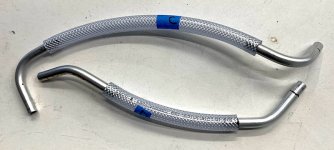
The photo shows the mock-ups for the oil cooler hoses.

Hose Mockups.jpg

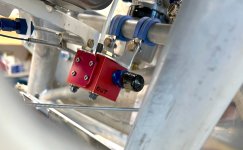
When I got done with the oil filter and oil cooler hose mock-ups, I made similar ones for the sensor hoses, manifold pressure, oil pressure and fuel pressure. Finally, I tackled the fuel hoses. The hardest problem was locating a good spot for the Red Cube, as it’s just a bit bigger and needier than some of the other things. Wish I’d had that in mind way back when I was working with the transparent firewall simulator to locate things.

It does appear as if I can hang it off the engine mount, though, sort of in the middle, low and aft of the carburetor. This puts the Red Cube’s outlet at about the same level as the carburetor. Ideally, it would be lower than the carburetor, but that’s not very feasible.

After some work, I did just that. The Adel clamps were a pain, of course. It took 2:16 to get those snug. The photo should be rotated about 30 degrees CCW.

Red Cube Mounted.jpg

The hoses for this, from the engine fuel pump and to the carb, need to be redefined, of course.

Dave
 
My carburetor has a female hose inlet that’s a -5. Or so I thought. The clues pointed in that direction. But have you ever tried to source -5 AN fittings? Fortunately, Tom Swearengen took one look at a photo and correctly identified it as an NPT. Sure enough, when I tried a 1/4” NPT plug, it fit perfectly.

With that taken care of, I placed an order for the engine hoses, firewall forward. The set consists of:

2x Remote oil filter hoses,
2X Oil cooler hoses,
1x Gascolator to the engine-driven fuel pump,
1x Fuel pump to the red cube,
1x Red cube to the carburetor,
1x Oil pressure sense line,
1x Fuel pressure sense line,
1x Manifold pressure sense line.

In the meantime and with considerable difficulty, I installed the cabin heat muffler. I used a Robbins Wing one and the best things I can say about it are that it uses two exhaust pipes and fits. The installation was hard because getting the side and end screws to line up was nearly impossible. Eventually, I had to open up the side screw holes to make it possible, and even then it took some fiddling.

The good news is that it does not need to be disassembled for condition inspections. There’s nothing to see inside.

Cabin Heat Muff.jpeg

The Robbins Wing carb heat muffin was easier to install, once I found a place for it. This one lacks those difficult screws. I installed it on #1 cylinder ahead of the cabin heat muff. This will tend to rob that of some of those cozy BTUs, but I hope it’ll work out.

CH 1.jpg

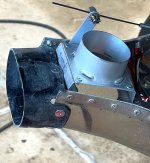
I didn’t check the carb heat muff’s instructions before building the FAB, and I had to close off the side gaps in the hose adapter at the snout of the FAB. That proved easier than I'd thought. I removed the welded hose adapter tube/plate and inserted a .016 cover, using tank sealant to cover small gaps.This muff also has no need to disassemble it for the CI.

The hoses arrived and so far most are giving me problems, generally related to the very minimal space between the engine and firewall.

Dave
 
Dave,
I've enjoyed reading through your build log! Lots of good nuggets of details that are applicable to other builds. Thanks for taking the time to detail them out.

I'm still working on my bottom heat shield out of titanium for the -10. Your details were very helpful in my design features.

Keep at it, we want to see this plane fly!

Brad
York, PA
RV-10 build.
 
The side gaps in the FAB hose adapter that I mentioned above were an easy fix. I made a cover that sandwiches between the open fitting and the hose adapter and closes off the ends. It’s made out of .016.

Turns out that the remote oil cooler hoses are too fat for the space available and they interfere with each other. I thought about changing the fittings on the engine adapter, but to do that, I’d need to remove a few things from the engine; there’s not access to do that otherwise, and even if I did that, I think its problematic that would give me a cure.

The remote filter mount could be moved, but I’m beginning to suspect that I’d need to move it out of state to get things to fit. Still, it’s a possible option.

If I replaced the Lycoming oil filter adapter that I had on earlier, and for which I made the firewall recess, I’d need to relocate the cabin hot air valve, which now occupies its cavity. Ironically, if I moved it to the most convenient spot, not only would I need a duct inside the cabin to relocate the air outlet, but hooking up the hose to the muffler would be much simpler, unlike the cabin heat control cable, with would become a bit of a headache. But this is doable. Not quick or easy, but doable.

It should be theoretically feasible to replace the remote oil filter system with a B&C filter adapter and the 1.4” spacer that would be necessary. However, this option paces the filter exactly where the sensor manifold is now. I believe that Randall Munroe might have mentioned what happens in one of his “What If” books. He also has the comic strip www.XKCD.com, worth checking out.

I could change the fittings at the remote filter mount and it seems at least potentially feasible. I even have a candidate fitting that shows promise. This would be the cheapest, simplest approach to this problem.

Did I mention that there’s not much room between the firewall and the engine?

All this comes because I didn’t know how fat the integral firesleeved hoses are, nor how bulky their end fittings. If you’re figuring out you own hoses, I recommend that you get some hoses with different ends, in the sizes likely to cause issues, just to assess this sort of hose conflict. Perhaps you can get stub hoses with ends and a few inches of integral firesleeve. I was told that the hose and firesleeve combo can be bent over a fairly tight radius and that’s true. Except at the ends, which includes the fat part of the firesleeve. There, it doesn’t bend. This means that short hoses are pretty stiff.

Dave
 
Back
Top