Bill Boyd
Well Known Member
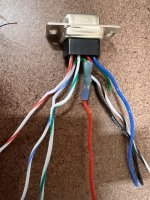
In the process of tracking down possible causes for serial EI Red Cube sensor failures, with much-appreciated customer support from Advanced Flight, I was able to determine that the apparent loss of at least two of my last 3 cubes (I didn't save the first one after it "died") was not a failure of the cube itself but a flaw in the wiring harness. The brand new cube I was about to install tested "bad" before installation, which led to the discovery of missing voltage on the red wire. This was traced back to a jumper connection in the Sky View Network cabling having an intermittent (probably a cold solder joint in a solder sleeve inside the 9-pin D-sub going to the SV EM 220 engine monitor module). Once this was rectified with a new plug and jumper more robustly made, I was shocked to discover that my avionics no longer worked at all - red X's all over the EFIS display, annunciators saying the ADHRS units were both offline as were all the remote avionics - GPS, comm radios, engine instruments, ADS-B, everything was T/U. Unplugging the SV Network cable to the SV-220 engine monitor box brought everything back again; plugging it in again killed everything, back and forth. Clearly a short somewhere, of which the system was thankfully only temporarily intolerant.
Turned out after a little head-scratching that I had forgotten to finish terminating the wiring harness leads to the red cube - the bare ends of the red, white and black wiring harness extension wires were left twisted together, from yours truly pushing them back through cable support clamps along its route firewall forward (I mount my cube between spider and servo, suspended by the fuel hoses). This created a hard fault condition (well, no kidding!) that pulled the 8 volts on the red wire (and probably throughout the AFS avionics environment) to zero, taking out everything dependent on the SV network to function. Once the resident dummy untwisted those wires everything came back to life as before. Perhaps unsurprisingly, the two previous red cubes I still had in the junk box that had "died" in the previous hundred flight hours tested good, as did the new one I was about to install (and am now returning). Their supposed deaths were apparently due to the cold joint in the wiring harness vibrating randomly in flight and depriving the cube of its operating voltage. Customer support had alluded to this possibility on my first phone call, so it may be something that has happened to someone else before - not sure.
I report this for two reasons - it's a starting point for anyone else troubleshooting the loss of a red cube in the Advanced Flight environment. I understand this jumper, from pin 5 to pin 7 on the 9-pin D-dub on the SV-220 box that internally supplies 8V to pin 15 on the 37-pin D-sub to the engine probes, is a workaround that is not needed in an all-Dynon (vs. AFS) avionics suite. If you have red cubes acting intermittent or failing outright in an AFS system, I suggest verifying there is no 8V where it should be on the red lead before ripping out plumbing and saying bad words - the fault may not be in the cube but the harness; you're going to be replacing wire in some uncomfortable cockpit yoga positions depending on where you mounted the avionics modules.
Second, and much more of a safety concern, is the demonstrated vulnerability of the entire avionics suite to shut-down from a ground-fault anywhere along the length of the red wire supplying the cube's power. Any builder not using the tunnel location in the RV-10 for the cube will likely need to extend the factory wiring harness as I did (although I'm sure AFS will supply a longer pigtail on request when they first build your system. If this extension wire bundle is not made with a tough, sheathed tefzel cable and carefully supported along its length, an eventual abrasion and short-to-ground scenario would take all the EFIS/avionics functionality offline until it rectified itself. This is a failure mode not addressable in flight, and could be catastrophic in IMC (or VFR-on-top) without robust, independent backups. As I said, in my panel both ADHRS were taken offline along with all comms, A/P and GPS. The redundancy of dual ADHRS, three display screens and two GPS receivers was moot. (I neglected to note whether my Avidyne IFR navigator was affected, as it was not powered-up during this accidental experiment).
Please treat the +8V red wire going to your red cube with the same care as the wires coming from your electronic ignition flywheel Hall sensor. If that wire is compromised via short to ground, it could lead to a very bad day.
Turned out after a little head-scratching that I had forgotten to finish terminating the wiring harness leads to the red cube - the bare ends of the red, white and black wiring harness extension wires were left twisted together, from yours truly pushing them back through cable support clamps along its route firewall forward (I mount my cube between spider and servo, suspended by the fuel hoses). This created a hard fault condition (well, no kidding!) that pulled the 8 volts on the red wire (and probably throughout the AFS avionics environment) to zero, taking out everything dependent on the SV network to function. Once the resident dummy untwisted those wires everything came back to life as before. Perhaps unsurprisingly, the two previous red cubes I still had in the junk box that had "died" in the previous hundred flight hours tested good, as did the new one I was about to install (and am now returning). Their supposed deaths were apparently due to the cold joint in the wiring harness vibrating randomly in flight and depriving the cube of its operating voltage. Customer support had alluded to this possibility on my first phone call, so it may be something that has happened to someone else before - not sure.
I report this for two reasons - it's a starting point for anyone else troubleshooting the loss of a red cube in the Advanced Flight environment. I understand this jumper, from pin 5 to pin 7 on the 9-pin D-dub on the SV-220 box that internally supplies 8V to pin 15 on the 37-pin D-sub to the engine probes, is a workaround that is not needed in an all-Dynon (vs. AFS) avionics suite. If you have red cubes acting intermittent or failing outright in an AFS system, I suggest verifying there is no 8V where it should be on the red lead before ripping out plumbing and saying bad words - the fault may not be in the cube but the harness; you're going to be replacing wire in some uncomfortable cockpit yoga positions depending on where you mounted the avionics modules.
Second, and much more of a safety concern, is the demonstrated vulnerability of the entire avionics suite to shut-down from a ground-fault anywhere along the length of the red wire supplying the cube's power. Any builder not using the tunnel location in the RV-10 for the cube will likely need to extend the factory wiring harness as I did (although I'm sure AFS will supply a longer pigtail on request when they first build your system. If this extension wire bundle is not made with a tough, sheathed tefzel cable and carefully supported along its length, an eventual abrasion and short-to-ground scenario would take all the EFIS/avionics functionality offline until it rectified itself. This is a failure mode not addressable in flight, and could be catastrophic in IMC (or VFR-on-top) without robust, independent backups. As I said, in my panel both ADHRS were taken offline along with all comms, A/P and GPS. The redundancy of dual ADHRS, three display screens and two GPS receivers was moot. (I neglected to note whether my Avidyne IFR navigator was affected, as it was not powered-up during this accidental experiment).
Please treat the +8V red wire going to your red cube with the same care as the wires coming from your electronic ignition flywheel Hall sensor. If that wire is compromised via short to ground, it could lead to a very bad day.
Last edited: