Van's Air Force

The definitive Van's Aircraft support community! Buying, building or flying an RV? Join our exclusive family of mentors and enthusiasts!

Filter Test Results

Analogy Alert !!!

Ignoring building codes for a moment, you could build and wire a house without circuit breakers/arc fault/gfci devices and you would be just fine -- until that errant splash of water, or power surge from the electric cooperative happens...

Same can be said for using reusable screens -- your engine will probably run just fine until you fly around/through/near a Haboob, Saharan dust, Mexican sugar cane fires and all the <20uM crud they put into the air...
 
Analogy Alert !!!

Ignoring building codes for a moment, you could build and wire a house without circuit breakers/arc fault/gfci devices and you would be just fine -- until that errant splash of water, or power surge from the electric cooperative happens...

Same can be said for using reusable screens -- your engine will probably run just fine until you fly around/through/near a Haboob, Saharan dust, Mexican sugar cane fires and all the <20uM crud they put into the air...
As a former electrician I detest arc fault breakers but I digress haha.

I noticed the suggestion of air born particulate earlier but didn't give it any thought. After thinking on it I have a sincere question. If the engine has a good air filter how does all that crap get into the oil? With the amount of blow by in these engines isn't the crank case essentially positive pressure? If not, and the means of ingress is through the breather, wouldn't a filter on the breather be more effective than removing the contaminates after its got into the oil and through the pump?

I tend to think in terms of analogies. My 30yr old Toro lawn mower has run its whole life in a very dirty environment. Similar layout to a Lycoming. Similar rpms, similar operating temps. No oil cooler, no oil filter. I've just occasionally blown out the air filter and changed the oil every few years. Still starts on the second pull and still cuts the grass.
 
Basically, the Fram filters that most of us use are about as useful to air as the screen filters are to oil... coarse at best.
 
As a former electrician I detest arc fault breakers but I digress haha.

I noticed the suggestion of air born particulate earlier but didn't give it any thought. After thinking on it I have a sincere question. If the engine has a good air filter how does all that crap get into the oil? With the amount of blow by in these engines isn't the crank case essentially positive pressure? If not, and the means of ingress is through the breather, wouldn't a filter on the breather be more effective than removing the contaminates after its got into the oil and through the pump?

I tend to think in terms of analogies. My 30yr old Toro lawn mower has run its whole life in a very dirty environment. Similar layout to a Lycoming. Similar rpms, similar operating temps. No oil cooler, no oil filter. I've just occasionally blown out the air filter and changed the oil every few years. Still starts on the second pull and still cuts the grass.

Asked and answered your honor :)

I submit that our air filters (e.g. K&N 33-2060) are about as effective as a chain link fence stopping cigarette smoke (ooooo another analogy :LOL:). They just keep the birds, bats out of the intake...

The rest of the "dirt" in the engine comes from combustion byproducts, dissolved solids in the fuel, and the engine metal itself.
 
Asked and answered your honor :)

I submit that our air filters (e.g. K&N 33-2060) are about as effective as a chain link fence stopping cigarette smoke (ooooo another analogy :LOL:). They just keep the birds, bats out of the intake...
Is this a product of undersized filters from space constraints or some other issue specific to aviation engines? Or do aviation K&N's use a different filter media than the rest of their filter line? Same question for other brands (usually a paper element)?

K&N type filtering (oiled foam) performs pretty well in other far harsher applications. As long as they are properly maintained that is (frequent cleaning and not over or under oiled). I couldn't afford new top ends in my dirt bike as a kid. So that mean't after every ride or race, hands in a bucket of gas squeezing the foam. Then when dry squeezing out excess oil. Pretty gratifying btw to see all that crud in the bottom of the bucket later.
 
Is this a product of undersized filters from space constraints or some other issue specific to aviation engines? Or do aviation K&N's use a different filter media than the rest of their filter line? Same question for other brands (usually a paper element)?

K&N type filtering (oiled foam) performs pretty well in other far harsher applications. As long as they are properly maintained that is (frequent cleaning and not over or under oiled). I couldn't afford new top ends in my dirt bike as a kid. So that mean't after every ride or race, hands in a bucket of gas squeezing the foam. Then when dry squeezing out excess oil. Pretty gratifying btw to see all that crud in the bottom of the bucket later.
Oiled foam air filters in dirt bikes are actually the "gold standard". K&N filters are not the same, and they simply don't catch anywhere near the amount of dirt that an oiled foam filter will. The K&N is probably fine in our aircraft since the air that most of us fly in is pretty clean. Clearly there are exceptions, and when we get Sahara dust here in Europe we can see it in the intake on the other side of the filter. I assume it's the same with fires or other dusty environments.

While I know I've got less than ideal filtering with the K&N, I'll let someone else blaze a trail to find a better air filter.
 
Oiled foam air filters in dirt bikes are actually the "gold standard". K&N filters are not the same, and they simply don't catch anywhere near the amount of dirt that an oiled foam filter will. The K&N is probably fine in our aircraft since the air that most of us fly in is pretty clean. Clearly there are exceptions, and when we get Sahara dust here in Europe we can see it in the intake on the other side of the filter. I assume it's the same with fires or other dusty environments.

While I know I've got less than ideal filtering with the K&N, I'll let someone else blaze a trail to find a better air filter.
The paper element filters are certainly better than K&N at catching dirt. I'm guessing that on an aircraft they have to be a bit more permeable because their size restricts the element area thus restricting breathing. And maybe that makes them less effective?

You probably already know this but for others that may not. With a K&N, if your seeing oil along with the contaminants behind the filter, the filter is over oiled. And that excess oil is pulling contaminants in with it.

Sounds like we need to search for the biggest filter UNI makes and build an intake housing to fit an RV. :unsure: :)
 
Ignoring building codes for a moment, you could build and wire a house without circuit breakers/arc fault/gfci devices and you would be just fine -- until that errant splash of water, or power surge from the electric cooperative happens...

Precisely.

I'll be replacing an old Federal Pacific Stab-Loc breaker box later this month. They're notorious for high rates of breaker failure, i.e. not tripping even with significant overloads. Statistically, 25% of the FP breakers may not work, but they seem fine, because they have never been required to trip.

Filters are like that. Anything or none works fine...until there is something to catch.

Same can be said for using reusable screens -- your engine will probably run just fine until you fly around/through/near a Haboob, Saharan dust, Mexican sugar cane fires and all the <20uM crud they put into the air...

Need can be subtle. It doesn't require a Haboob. Our city recently repaved the ramps around our t-hangars. Beautiful, smooth new asphalt. Trouble is, for some reason it's shedding sand as it wears, in enough quantity to cause propeller leading edge erosion on some airplanes. I'd be insane to run my 390 without at least the K&N air filter, and I'm actively looking for a better replacement. The last oil filter washout did show increased grit.
 
About the only thing that keeps me up at night is the thought of flying through rain and have the air filter saturated to the point of air starvation and loss of power.
I would never consider a paper filter in an airplane.
 
About the only thing that keeps me up at night is the thought of flying through rain and have the air filter saturated to the point of air starvation and loss of power.
I would never consider a paper filter in an airplane.

Bees...
 
About the only thing that keeps me up at night is the thought of flying through rain and have the air filter saturated to the point of air starvation and loss of power.
I would never consider a paper filter in an airplane.

Do I smell wet filter deltaP data from the AC industry?

I was seriously planning to check with a water hose on a running 390 if I find an appropriate filter. The Baldwin in hand turned out to have a hard plastic frame, and I need to curve it for my airbox. The K&N is rubber.
 
About the only thing that keeps me up at night is the thought of flying through rain and have the air filter saturated to the point of air starvation and loss of power.
I would never consider a paper filter in an airplane.
Having flown in snow a few times, it's definitely high on my mind for its ability to plug a filter.
 
Plan B is the automatic alternate air door on my airbox. Opens at a few inches of water, deltaP, and illuminates a panel light. I'm just sayin'...
 
Yep, and for us mortals, the manual alternate air door...
I flew in light rain, and breifly (less than a minute) through wet snow, nothing to report. I wonder though if moderate rain or + could choke in a way that filter.
Again, in these situations, a close look to the MP is called for.
 
Last edited:
Having flown in snow a few times, it's definitely high on my mind for its ability to plug a filter.
The first FATAL RV accident that I now about from flying in snow was NTSB ID: LAX01LA110. Air filter got snow plugged and engine did not get enough air. Air Traffic Control audio files were available years ago.

Van's aircraft came out with air filter bypass after this accident.
 
Not sure this is an endorsement for those filters. Cam lobes and lifters are hardened and therefore far more resistant to scratches from small debris. The wear seen on them is typically from the substantially higher pressures pushing the two parts together as they rotate or pitting from corossion kicking off a wear cycle. The bearings OTOH are very soft and quite prone to wear from abrasives.
 
Is this a product of undersized filters from space constraints or some other issue specific to aviation engines? Or do aviation K&N's use a different filter media than the rest of their filter line? Same question for other brands (usually a paper element)?

K&N type filtering (oiled foam) performs pretty well in other far harsher applications. As long as they are properly maintained that is (frequent cleaning and not over or under oiled). I couldn't afford new top ends in my dirt bike as a kid. So that mean't after every ride or race, hands in a bucket of gas squeezing the foam. Then when dry squeezing out excess oil. Pretty gratifying btw to see all that crud in the bottom of the bucket later.
K&N filters are NOT oilled foam and do not filter the same way. They are a cotton gauze construction with a metallic mesh super structure holding it together. Convential wisdom says they are LEAST effective when new or clean! the sticky oil used on them helps to collect dust on the exterior of the filter and this collected dust layer enhances the matrix and improves filtration efficiency. Most makers of oilled cotton filters, including K&N. tell you NOT to clean them often. They even give you pictures to help you understand how bad they should look before you clean them.

The convetional wisdom that cleaner is better simply doesn't apply to oilled cotton air filters.
 
Last edited:
The convetional wisdom that cleaner is better simply doesn't apply to oilled cotton air filters.

Prove it.

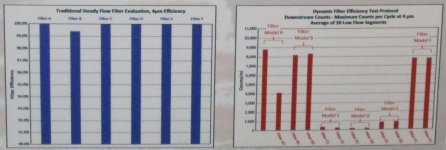
A current hot topic within the filtration industry involves the effect of cyclical flow and vibration on fuel, oil, and air filtration efficiency. A constant pressure system tends to operate like you describe, with rising efficiency as it gains contaminant load. A water system with constant head (i.e. a water tower) is a great example.

Our systems are nothing like constant head. The air filter on a RV is exposed to dynamically varied upstream and downstream pressure, in response to aircraft velocity and throttle position, but also at high frequency...propwash and intake system pulsation. All this while sitting in a shaking container attached to the engine.

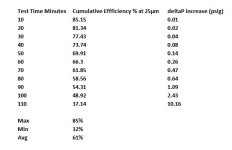
Previously demonstrated, oil filter efficiency declines significantly with loading, even without pulse and vibration, because it's a constant volume system, not constant pressure. For review, here's a partial data table (i.e. 25µm only) for the recently tested Champion 48108-1, at 6 gallons per minute.

ScreenHunter_2681 Feb. 09 10.31.jpg

Ok, so add some shake, pulsating flow, etc. Here's an illustration I picked up when visiting a respected lab, the same diesel fuel filters tested in a static vs dynamic environment. Sorry it's so fuzzy. Best I could get was a quick cell phone shot:

Filter Shake.jpg
 
Prove it.

A current hot topic within the filtration industry involves the effect of cyclical flow and vibration on fuel, oil, and air filtration efficiency. A constant pressure system tends to operate like you describe, with rising efficiency as it gains contaminant load. A water system with constant head (i.e. a water tower) is a great example.

Our systems are nothing like constant head. The air filter on a RV is exposed to dynamically varied upstream and downstream pressure, in response to aircraft velocity and throttle position, but also at high frequency...propwash and intake system pulsation. All this while sitting in a shaking container attached to the engine.

Previously demonstrated, oil filter efficiency declines significantly with loading, even without pulse and vibration, because it's a constant volume system, not constant pressure. For review, here's a partial data table (i.e. 25µm only) for the recently tested Champion 48108-1, at 6 gallons per minute.

View attachment 80488

Ok, so add some shake, pulsating flow, etc. Here's an illustration I picked up when visiting a respected lab, the same diesel fuel filters tested in a static vs dynamic environment. Sorry it's so fuzzy. Best I could get was a quick cell phone shot:

View attachment 80490
I have no way to prove it. I was simply stating recommendations from the people that make the filters; Arguably more reliable than "internet experts." I don't know how the unique dynamics of aircraft implementations change the behavior of these filters. I suspect no one does, as 99% of them are installed under the hood of an automobile and the filter makers specifically prohibit their use on aircraft. I know many of these filters sit out in the breeze on motorcycles, but doubt anyone has done performance testing on that use case.
 
Last edited:
Ok, where does K&N say filter efficiency goes up with loading?
Looked quickly but don’t see it on the website anymore. They used to have a pdf with pictures to help you understand how much dirt was ok and when it was too much. They were clear in stating not to clean it until the dirt was at a certain level, as some level of debris helped with the efficiency over a fresh filter. Maybe too many people took that to mean don’t ever clean and got rid tof it. I have heard from many sources that the exterior loading improves the efficiency but have nothing that would satisfy your level of need.

I did find that they do iso 5101 testing with 97-99% results. They did not clarify if that was clean or dirty.
 
Looked quickly but don’t see it on the website anymore. They used to have a pdf with pictures to help you understand how much dirt was ok and when it was too much. They were clear in stating not to clean it until the dirt was at a certain level, as some level of debris helped with the efficiency over a fresh filter. Maybe too many people took that to mean don’t ever clean and got rid tof it. I have heard from many sources that the exterior loading improves the efficiency but have nothing that would satisfy your level of need.

I did find that they do iso 5101 testing with 97-99% results. They did not clarify if that was clean or dirty.
I recall seeing this as well in some of their literature. I interpret it to mean "our filters are full of big holes, and when some dirt gets stuck in one of the holes, it filters slightly better!" I can still recall the horror and expense when I installed one of these filters on my MX bike (1977 CR-125) and saw a bunch of sand sitting in the carb throat when I took it off to clean it. I had probably done 10 laps. Not to mention that I had to rebuild the entire engine, which for a HS kid working a part time job for $2/hour was a huge expense. Yes, I still hold a grudge! :LOL:
 
I recall seeing this as well in some of their literature. I interpret it to mean "our filters are full of big holes, and when some dirt gets stuck in one of the holes, it filters slightly better!"
This is loosely my understanding as well. The cotton/oil matrix does a decent job stopping dirt, relative to paper filters that are better. The oil attracts dirt in operation and this dirt becomes part of the filter. Thiss additional material mass further blocks debris and, in theory, increases effectiveness. I believe most experts agree that paper filters have much better filtration effectiveness than cotton/oil. Most K&N customers either don't know any beter (assume a cool looking filter used by racers MUST be better) or are those looking to improve flow/reduce airflow restriction at the expense of filtration effectiveness, like racers.

Oilled foam filters have been used for many decades and work on the same principle. First, the sticky oil (not your average oil) captures particles preventing them from passing. Once particles have attached to all of the oil, you now have a dense, fine matrix of material that does a decent job of filtering. Other than K&n, these filter types are rarely seen any more, as they are generally less effective than paper and a lot more maintenace. These filters do flow better than paper and therefore still see them in use cases looking for high flow without the ability to increase filter size to achieve that flow with paper
 
Last edited:
There was a foam/oiled air filter on my previous Cessna, it was very sticky indeed.
Is there a paper filter that would be a drop-in for the square K&N ??
If so, outside of a better air filtration, would it be appropriate for our use in airplanes ??
 
There was a foam/oiled air filter on my previous Cessna, it was very sticky indeed.
Is there a paper filter that would be a drop-in for the square K&N ??
If so, outside of a better air filtration, would it be appropriate for our use in airplanes ??
Generally, I would prefer a paper filter. However, while i have no science to back it up, I think that the oilled filters are less likely to accumulate water and restrict airflow. My theory is that the water will absorb into the paper and block flow. Capillary action brings the water from the front to the back. The oil on the cotton filter should repel the wate and prevent it from restricting air flow. If you fly in the rain this is a serious consideration. I am sure there is a reason very few airplane engines have paper filters and this seems like a valid reason.
 
There was a foam/oiled air filter on my previous Cessna, it was very sticky indeed.
Is there a paper filter that would be a drop-in for the square K&N ??
If so, outside of a better air filtration, would it be appropriate for our use in airplanes ??
From air filter cross ref on K&N website . Fits a bunch of weird Nissans. Wish I knew if one of them used synthetic media.
Nissan 1654641B01

Nissan 16546AX600

Pipercross PP1262DRY

Premium Guard PA4468

Premium Guard PA80084

Purepro A4468

Purolator A37113

Repco RAF88

Ryco A1348

Service Champ AF4468

Simota ON002

STP SA6395

Valvoline VA84

Warner WAF351

Wesfil WA944

WIX WA6305
 
First air filter I ordered raised a new issue, at least for my application. The frame was hard molded plastic, not rubber like the K&N. I can't bend it to fit my airbox. Bending may not be an issue for others, but a round filter, as might be used in the updraft airbox, would need rubber seals.

Should we start a new thread just for air filters?
 
First air filter I ordered raised a new issue, at least for my application. The frame was hard molded plastic, not rubber like the K&N. I can't bend it to fit my airbox. Bending may not be an issue for others, but a round filter, as might be used in the updraft airbox, would need rubber seals.

Should we start a new thread just for air filters?
I would also suggest yes, both filter types ??
 
Cool, I need a reuseable hangar coffee filter to go with my coffe mug that used to house a 35 micron stainless mesh sieve.

ISO, ASTM, STC, PMA or folgers?
 
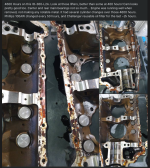
Surely one would have thought based on some strong opinions in this thread this engine should have began to self-destruct shortly after using a Challenger.
FWIW it does say that the bearings were not in a good shape and an unknown number of jugs changed over the course of 4000 hrs.
 
Surely one would have thought based on some strong opinions in this thread this engine should have began to self-destruct shortly after using a Challenger.

I have a winter coat. It's a glorified tee shirt when compared to the parkas worn in the Land of Bob, but it keeps me warm enough, because it's not real cold here.

Operating environment drives the filtration requirement. Given clean air and short oil change intervals, screen filter performance is essentially the same as the best filter in the world...or no filter at all.
 
The same folks worried about installed tie down ring drag want to filter less from their oil? Pennies and seconds on a leg or?

I truly hope the stuff paper media filters grab that was NOT in the reuseable/cleanable mesh, in my personal, real world, install, fly, inspect, judge world is suspended in the oil and not closing the gap that would otherwise be microns of wear-free oil!
 
Last edited:
Just got my issue of Kitplanes, and was happy to see that article. Dan, thanks for authoring it, and of course all the work to get the data. I suspect most VAF users subscribe to Kitplanes, but, it’s great to get the info out there for none VAF users.
 
Last edited:
Thanks guys. Could not have done it without you.


Last edited:
I’m considering using a Carquest Premium 85515HD on my Lyc IO-360. It has a 15 micron absolute efficiency rating according to the manufacturer, Premium Guard Inc. (98.7% at 15 microns, 99.5% at 20 microns).

On the BITOG forum the Premium Guard EX filters which are sold as Carquest Premium, Napa Gold, or Microguard Select as well as a few other brands like Mobil 1 and their own “Premium Guard” house brand, seem to be the most well regarded filters. This is due to Mann+Hummel (Wix/Purolator) and First Brands (Fram) constantly cheapening their product and lowering efficiency, as well as bad QC like excess glue (makes it way to oil pickup screens), tearing media, and closed louvers in the metal cores.

My main concern is the burst pressure as referenced in Dan’s article, as I am in a very cold place and even using the Aeroshell 15W-50 and I don’t know what consequence the ~300 psi burst pressure would have vs the Champion 48108-1 I’ve been using that has a 500 psi burst. The Carquest is 30% the price of a Champion
 
I’m considering using a Carquest Premium 85515HD on my Lyc IO-360. It has a 15 micron absolute efficiency rating according to the manufacturer, Premium Guard Inc. (98.7% at 15 microns, 99.5% at 20 microns).

On the BITOG forum the Premium Guard EX filters which are sold as Carquest Premium, Napa Gold, or Microguard Select as well as a few other brands like Mobil 1 and their own “Premium Guard” house brand, seem to be the most well regarded filters. This is due to Mann+Hummel (Wix/Purolator) and First Brands (Fram) constantly cheapening their product and lowering efficiency, as well as bad QC like excess glue (makes it way to oil pickup screens), tearing media, and closed louvers in the metal cores.

My main concern is the burst pressure as referenced in Dan’s article, as I am in a very cold place and even using the Aeroshell 15W-50 and I don’t know what consequence the ~300 psi burst pressure would have vs the Champion 48108-1 I’ve been using that has a 500 psi burst. The Carquest is 30% the price of a Champion

Random thought...(get your popcorn ready)

The NTSB/FAA isn't going to look twice at an airframe equipped with aircraft parts, even if it's "EXPERIMENTAL".

But, show me a smoking hole in the ground with a Carquest Oil Filter, or Alternator, or any other retail thing on it, and suddenly the liability picture changes; uninformed, bereft family members, victims, and attorneys start seeing $$$'s ... probably the same ones that you were trying to save in the first place.
 
Random thought...(get your popcorn ready)

The NTSB/FAA isn't going to look twice at an airframe equipped with aircraft parts, even if it's "EXPERIMENTAL".

But, show me a smoking hole in the ground with a Carquest Oil Filter, or Alternator, or any other retail thing on it, and suddenly the liability picture changes; uninformed, bereft family members, victims, and attorneys start seeing $$$'s ... probably the same ones that you were trying to save in the first place.

Thanks for the perspective. Considering mine is a 2 seater and flown by me solo 99% of the time over completely unpopulated areas, I don’t think that’s a huge factor. It is less about the money and more about the far superior efficiency of the automotive filters; I’d still be interested in switching if the price were the same. Particles between 5 and 40 microns which are larger than the minimum oil film thickness on parts of the engine have shown to increase wear, and even the champ filter does a lousy job of getting those.

Why can’t Champion produce a filter for $40 that’s at least as efficient as a $10 parts store filter? They have no incentive to innovate and the profit on their filters has to be massive. Same reasons 15W is the best winter grade we can get on an oil unless you go to Rotax.
 
Last edited:
Thanks for the perspective. Considering mine is a 2 seater and flown by me solo 99% of the time over completely unpopulated areas, I don’t think that’s a huge factor. It is less about the money and more about the far superior efficiency of the automotive filters; I’d still be interested in switching if the price were the same. Particles between 5 and 40 microns which are larger than the minimum oil film thickness on parts of the engine have shown to increase wear, and even the champ filter does a lousy job of getting those.

Why can’t Champion produce a filter for $40 that’s at least as efficient as a $10 parts store filter? They have no incentive to innovate and the profit on their filters has to be massive. Same reasons 15W is the best winter grade we can get on an oil unless you go to Rotax.

I have been using K & N HP1002 oil filters for over 1400 hrs on O-320 and O-360 engines with no issues. They are supposed to filter down to 10 microns, have pressure relief and anti-drain back valves, 550 psi burst and a 1" lock wire nut. They are smaller than the Champ or Tempest filters making changes a little easier space wise. FWIW.
 
Random thought...(get your popcorn ready)

The NTSB/FAA isn't going to look twice at an airframe equipped with aircraft parts, even if it's "EXPERIMENTAL".

But, show me a smoking hole in the ground with a Carquest Oil Filter, or Alternator, or any other retail thing on it, and suddenly the liability picture changes; uninformed, bereft family members, victims, and attorneys start seeing $$$'s ... probably the same ones that you were trying to save in the first place.
I think that is a stretch. If you kill someone in your camry, are you worried that you will get sued if you had a napa filter instead of a Toyota oem filter?

If you built a plane in your garage, they have a treasure trove of negligence items to work with. Using a napa filter that has a proven reputation across millions of vehicles will not likely be one of them. Using non pma parts on an eab is not negligent behavior, because it is an accept standard of care. Putting one on that doesn’t fit and leaks, causing an engine failure is negligent.

If your whole negligence case is using non pma parts on an eab, you are not going to win. If most aircraft have an oil filter and you choose not to use one and that causes an engine failure, they have a shot at negligence.
 
Last edited:
Random thought...(get your popcorn ready)

The NTSB/FAA isn't going to look twice at an airframe equipped with aircraft parts, even if it's "EXPERIMENTAL".

But, show me a smoking hole in the ground with a Carquest Oil Filter, or Alternator, or any other retail thing on it, and suddenly the liability picture changes; uninformed, bereft family members, victims, and attorneys start seeing $$$'s ... probably the same ones that you were trying to save in the first place.

I'm skeptical, because I think if this was really a thing, there'd be lots more actual cases of it happening.

There is also a false, or at least questionable, assumption in your theory that is that the main motivation for using other parts is to save money. We can all think of examples where non-certified/PMA'ed/etc. stuff is fact better than the certified equivalent simply because it isn't frozen in amber from 40 years ago and in many cases that, not cost, is the driver behind the choice.
 
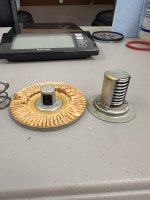
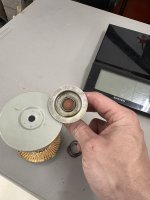
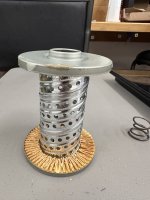
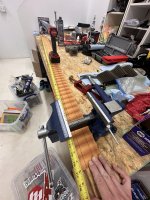
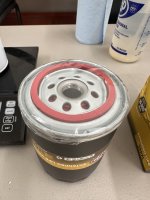
How important is the size of the internal oil filter bypass valve for our purposes? I decided to take apart one of the STP S8AXL (premium guard XL) oil filters that I was planning to use on my Lyc. IO-360 (98.7% @ 15 microns). The bypass valve was tiny compared to the Champion Aerospace 48108-1.

The diameters of the valves were about 9mm vs 18mm. This means the Champion valve’s surface area is 4x higher. I used a trigger pull gauge to see how much pressure it took to begin opening them and it was about 4 lbs for the STP vs 9 lbs for the Champion. I was using a 9mm bullet sitting on top of the valves to depress them with said trigger pull gauge. The STP is specified to open at 15 PSI, which I think is about the same as the champion. With a positive displacement oil pump, I guess the size of the valve shouldn’t matter if the math for the spring and valve area still works out to 15 psi? (I’ve read that journal bearing oil passages are much more restrictive than any filter media or bypass valve ever would be.)

I tried using some online calculators and it seems like even the smaller valve of the STP would still allow 10 gpm of oil flow if the filter media was completely clogged. I think that’s about peak flow from the Lycoming oil pump at 2700 rpm.

I’m not sure what to make of all this though. If the filter media became completely clogged with contamination I’d prefer to have full flow through the bypass valve available.

The STP did have about 15% more media area than the Champion (280 vs 240 sq in).

IMG_6622.jpeg
IMG_6620.jpeg
 

Attachments

  • IMG_6619.jpeg
    IMG_6619.jpeg
    1.5 MB · Views: 36
  • IMG_6615.jpeg
    IMG_6615.jpeg
    2 MB · Views: 33
  • IMG_6594.jpeg
    IMG_6594.jpeg
    1.4 MB · Views: 32
Last edited:
Back
Top