Van's Air Force

The definitive Van's Aircraft support community! Buying, building or flying an RV? Join our exclusive family of mentors and enthusiasts!

Rough running while accelerating

Bicyclops

Well Known Member
I built my Lycloning engine with 10:1 compression, Superior cold air sump, dual Lightspeed ignitions, and an FM-150 fuel servo. I recently posted a thread about going to smaller injectors. My problem predates the .024 injector installation but seems to have gotten worse. For some time, I've noticed a stumble when coming off idle and applying takeoff power. It clears up immediately once I get some significant RPMs and I really hadn't been viewing it as a bad problem, but it is getting worse and I've got to jockey the throttle to pass 12 or 1300 RPM.

To add to the mystery/symptom list, when I pull to idle the MAP actually increases to about 20" from about 16" at 1000. Should be more like 10. To tell the truth, I can't say it hasn't done that for a long time because I just started looking at that. Don at AFP said to check the throttle opening pulled to the idle stop, looking for .004 - .008. I measure .006. Pulled hard to the stop she idles about 600RPM, and as is typical, smoother at 700-750. I'm going to see if I can't figure a way to check the MAP indication somehow. Another data point is that I adjusted the idle mixture so that the linkage is as short as it can go and I still get about 200 RPM rise at ICO.

I suspected an induction leak and found fuel staining and a wet hose at one of my intake tubes. I replaced it and the gasket with no change to the symptoms. I'll do the other ones, but I'm not expecting much. Don thinks I might have an ignition problem so that's next. I tried to strobe the timing today, but the light wasn't bright enough and the marks weren't clear enough to see much in bright sunshine. I'll improvise a shade and try again after I replace the harness. I'll do new spark plugs and wires and check the coils for resistance.

Compressions tested in the high 70s a month ago.

Ideas?

Ed
 
Sounds weird, on one hand the idle mixture should not be at the stop and still have a rise, but stumbling is usually caused by lean mixture.
Not sure how old your 150/spider is but it might be worth a quick trip back to visit Don for a flow check.
And yes on checking the LSE timing, if the vac sensor fails in the box it goes to full advance.
 
Last edited:
What kind of snorkel do you have? I had a similar issue, and it was fixed with an airflow straightener.
 
Two fuel delivery circuits in these systems. An idle circuit and a main circuit. The transition from idle to main is right around 1200 or so and the quality of the transition has a lot to do with the idle mixture. Your symptoms sound like an overly rich idle circuit, but difficult to say that without being able to hear and feel it happen. IMHO, there is something going on inside the servo. You should be lean enough to be running very poorly with the idle mixture at the full lean setting. On a properly behaving system, you should NOT be able to get an RPM rise at full lean idle mixture and have my doubts it would even run there.

You can possibly confirm the over rich transition by having someone observe the plane as you go WOT on take off. A puff of black or gray smoke from the exh during the transition confirms over rich.

There is a rod sticking out of the servo and one of the idle mixture arms is attached to it. If someone loosened the screw on that arm and moved it, it would explain this behavior. That arm must be set while measuring fuel delivery volume.
 
Last edited:
Two fuel delivery circuits in these systems. An idle circuit and a main circuit. The transition from idle to main is right around 1200 or so and the quality of the transition has a lot to do with the idle mixture. Your symptoms sound like an overly rich idle circuit, but difficult to say that without being able to hear and feel it happen. IMHO, there is something going on inside the servo. You should be lean enough to be running very poorly with the idle mixture at the full lean setting. On a properly behaving system, you should NOT be able to get an RPM rise at full lean idle mixture and have my doubts it would even run there.

You can possibly confirm the over rich transition by having someone observe the plane as you go WOT on take off. A puff of black or gray smoke from the exh during the transition confirms over rich.

There is a rod sticking out of the servo and one of the idle mixture arms is attached to it. If someone loosened the screw on that arm and moved it, it would explain this behavior. That arm must be set while measuring fuel delivery volume.
It is also possible that the problem is in the spider. The spider has 4 V shaped slots and at idle, the piston goes to the bottom of the V in order to restrict fuel flow (fuel pressure acting against the restriction in the spider). the piston rises up the V during transition and then mixture is controlled by pressure acting against the injector orifice. Restriction size is key in these systems, as the servo does not regulate volume, only pressure. Idle fuel flow (i.e. mixture) is a balance between the servo fuel pressure (set by the adjuster bar) and the spider restriction. If the piston is hanging up and staying at the top of the V, it will likely produce your symptoms - in ability to lean idle mixture adequately. This would cause you to go excessively lean on the idle pressure to get a smooth idle at 700, but would be way too lean at 1200 and create a lean bog/stumble later in the RPM range and during transition. This also matches your syptoms. you can get stumbles from either too rich or too lean. They sound different, but hard for the novice to differentiate.
 
Last edited:
I built my Lycloning engine with 10:1 compression, Superior cold air sump, dual Lightspeed ignitions, and an FM-150 fuel servo. I recently posted a thread about going to smaller injectors. My problem predates the .024 injector installation but seems to have gotten worse. For some time, I've noticed a stumble when coming off idle and applying takeoff power. It clears up immediately once I get some significant RPMs and I really hadn't been viewing it as a bad problem, but it is getting worse and I've got to jockey the throttle to pass 12 or 1300 RPM.

To add to the mystery/symptom list, when I pull to idle the MAP actually increases to about 20" from about 16" at 1000. Should be more like 10. To tell the truth, I can't say it hasn't done that for a long time because I just started looking at that. Don at AFP said to check the throttle opening pulled to the idle stop, looking for .004 - .008. I measure .006. Pulled hard to the stop she idles about 600RPM, and as is typical, smoother at 700-750. I'm going to see if I can't figure a way to check the MAP indication somehow. Another data point is that I adjusted the idle mixture so that the linkage is as short as it can go and I still get about 200 RPM rise at ICO.

I suspected an induction leak and found fuel staining and a wet hose at one of my intake tubes. I replaced it and the gasket with no change to the symptoms. I'll do the other ones, but I'm not expecting much. Don thinks I might have an ignition problem so that's next. I tried to strobe the timing today, but the light wasn't bright enough and the marks weren't clear enough to see much in bright sunshine. I'll improvise a shade and try again after I replace the harness. I'll do new spark plugs and wires and check the coils for resistance.

Compressions tested in the high 70s a month ago.

Ideas?

Ed
May be advanced timing issue
 
And yes on checking the LSE timing, if the vac sensor fails in the box it goes to full advance.
I’ve seen failed LSE MAPs that sent timing past 45 degrees (at all throttle and MP settings). The usual first indication however are abnormally high CHTs. Does this apply to you?

Anyone installing LSE MUST verify timing with a light.

Side note - what did you set for base timing?

Carl
 
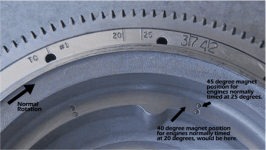
I'll try and answer all the questions/comments. The magnets for the LSE were set by Klaus for a high compression engine. There is a scribe mark on the back of the ring gear with 39 scratched into it which jibes. For a low compression engine it would be 45. I do get high CHTs, particularly on #4, but also on #2. These are always controllable with mixture - either very rich or LOP. I know it's stupid but I never did get a timing light reading because it ran great and I had the same problem with sunlight that I did yesterday. The hesitation on accel wasn't always there or at least not as bad as it is now. One thing I did notice yesterday while I was trying to light it up was that it didn't seem to make any difference whether the MAP hose was connected or not. That's a bad sign for sure. It would appear that I do have advanced timing though I want to verify it before I start digging out the boxes.

How does advanced timing increase the MAP with the throttle on the stop? I don't understand the physics of that.

I've got a homemade straight scoop on the belly going into a can with a conical filter. The flow should be fairly undisturbed, but the wildcard is that I made a flat box behind the filter with an appendage off one side for an alternate air door. The flow could possibly be turbulent in that box. If it is true that my idle circuit is overly rich, the RPM rise being the clue and perhaps caused by turbulence in front of the boost venturi, there isn't a lot I can do to verify that and/or correct it until I am sure of my ignition.

The MAP hose comes off a restrictor fitting on #3 and across the firewall in a braided AN3 hose. I have that teed with one side going into the MAP pickup for the EFISs with a flex hose and the other side into a flex tube through the firewall and teed into the two ignitions with barb fittings. There aren't any obvious leaks. The MAP on the EFIS didn't change with the EI hose off the tee. That should rule out a leak in that tube but not necessarily the tee or the hose to the MAP sender. I have a differential electronic manometer that I'm going to plug into the ignition tube which will give me the drop from ambient. A little math and I should be able to tell if MAP on the EFIS is anywhere near correct.


If, as is now my active theory, the advanced timing is at the root of most, if not all, of the symptoms, I will need to reset the idle mixture to somewhere in the middle to get it to run at all once I have known good boxes back in. It's too rainy to run it again today, but I think my next move is to make more visible marks on the ring gear and think of some kind of sunshade that the prop blast won't blow straight into the canopy so I can get a real reading on the timing. Maybe late afternoon when the hangar provides some shade.

Thanks for the ideas. Please keep them coming.

Ed
 
Ed,

Examples of your CHTs??

On your question, LS ignition should have no timing advance at high manifold pressure (e.g. takeoff), timing advance comes in with altitude and a drop in manifold pressure.

No clue what the scribe marks mean. I suggest however you ask Klaus:
- For this engine, what is the base timing? For 8.5 pistons it is 25 degrees BTDC. For your engine I’m guessing 20 degrees BTDC would be better.
- At low manifold pressure and 2500 RPM, how many degrees of timing advance will there be?

Using a timing light check the timing on the back of the flywheel. Engine at idle and the manifold pressure line to the Light Speed boxes disconnected. Let us know what you get.

On your inlet air, if you think it might be an issue bypass it long enough to see if the problem persists.

Carl
 
Howdy Carl,

This is out of the LSE installation manual:

Engines Normally Timed at 20 degrees BTDC,
Including Turbo Normalized Engines
(Leading Magnet Installed At 40 degrees Before TDC):


These are usually engines with compression ratios of 8.7:1 or higher.
The timing is retarded 5 degrees.
- At idle the timing display should indicate 35º ± 2º when the manifold pressure hose is connected and 16º ± 2º when disconnected.

Timing:

The leading magnet is installed in the 45-degree location for engines timed at 25 degrees BTDC per the engine data plate. Higher compression engines normally have the magnets installed in the 42 or 39-degree location. Normally the magnets are installed at LSE based on the timing information provided to LSE when the system was ordered. If you are installing your own magnets, be sure to have the South Pole facing the sensors.

DC Mini Dual Install


Dual 4-cylinder DC Mini Sensor & Mounting Bracket Installation.
Note Cable Routing.
3.1 B: DC MINI SENSOR INSTALLATION
Magnet Ring Installation


Mounting the DC Mini Sensor Magnet Ring to the Lycoming flywheel requires high precision. For this reason, the 6 mounting holes must be located and drilled using a CNC machine. If CNC machining is not available, the flywheel can be sent to Light Speed Engineering for modification and magnet ring installation at $95 plus shipping. Alternatively, pre-drilled flywheels are available for purchase from ECi and the Lycoming Thunderbolt Division upon request.

Only flywheels with a large diameter alternator pulley and 6 mounting bosses, as shown, can be used with the Mini sensor or the Direct Crank Sensor Circuit Board.

DC Mini Sensor Magnet Ring Installation, Lycoming Type Flywheel


The flywheel was sent to Klaus and modified by LSE. When he says timing display, he is referring to the optional timing display he sells. The scribe mark at 39 degrees indicates that the magnets were placed in accordance with the high compression instructions. The actual magnets are in a ring bolted to the rear of the flywheel for the "mini sensors" to read, one at the full advance position and one at TDC for starting.

As for CHTs, my EFIS alarms at 400F. I usually notice when the displays turn yellow at 380 and do something about it - enrichen and/or nose over, reduce MAP, open cowl flaps. Always controllable one way or another and never exceeding 400 for more than seconds. When not overheating, they run in the 330 to 360 range depending on OAT, load and mixture. I usually run WOT, ~24" MAP, and 8 1/5 - 9 gph LOP. On a warm day with the .028 restrictors I would occasionally have briefly go back to 12 1/2 gph to get the CHTs under control and redo the big pull once they were. There was a narrow range between LOP enough to control #4 CHT and rough running. So far, and it's only been a few flights with the .024s, I can do the big pull and sneak back up on the mixture without any hint of overheating and I can run much further LOP without running rough. The FM-150 seems to operate flawlessly in flight. If indeed my ignitions are always advanced, one would expect that any overheating problems will be reduced or eliminated after that is corrected. The idle mixture is obviously still in question, but as I remember from my old Triumph motorcycle days, there is no hope of getting carburetion correct before ignition is spot on.

Ed
 
Looking more closely at the picture I took of my scribe mark, I think it says 37. More from the manual:

7.3: TIMING TEST USING A STROBE LIGHT

To verify proper operation of the ignition system, you can check ignition timing using a strobe light, automotive style, both on your new ignition and, should you still have one, on the magneto. The magneto timing should be set to the manufacturers specs.

LSE Timing Values for Plasma CDI:

Engines Normally Timed at 25 degrees BTDC:

These are usually engines with compression ratios less than 8.7:1.
At idle the strobe light should indicate 40º ± 2º when the manifold pressure hose is connected and 21º ± 2º when disconnected.

Engines Normally Timed at 20 degrees BTDC,
Including Turbo Normalized Engines:

These are usually engines with compression ratios of 8.7:1 or higher.
The timing is retarded another 5 degrees. This setting should show idle strobe light readings of 35º ± 2º when the manifold pressure hose is connected and 16º ± 2º when disconnected.

Turbo and Super-Charged engines:
At idle the engine timing should be 35º ± 2º when the manifold pressure hose is connected and 24º ± 2º when disconnected. The leading magnet(s) should be installed 40º BTDC.

Note that these numbers are for sea level. You can add 1 degree for each 1,000 ft. of density altitude. The low number (MAP hose disconnected) is the most important! When the hose is connected the timing depends on the MAP. Smoother running engines have more vacuum and that yields more timing advance.
1738795991020.png
 
i wont challenge your approach, but will offer that I run 35* of advance at idle on my IO-320. runs great, doesn't get hot and my mixture is perfect in the middle of the adjustment range. i state this only so that you will see that something else is going on here. you SHOULD NOT get a 200* EGT rise with the mixture adj maxed out lean.
 
So Larry, what is your MAP at idle? This is the part of the whole mess that I'm having trouble explaining to myself. Do I really have a massive induction leak or not? Maybe I should try spraying some brakleen around the intake tubes and see if it'll suck it in.

Ed
 
So Larry, what is your MAP at idle? This is the part of the whole mess that I'm having trouble explaining to myself. Do I really have a massive induction leak or not? Maybe I should try spraying some brakleen around the intake tubes and see if it'll suck it in.

Ed
approximately 10-10.5. lower MAP at idle is a sign of proper mixture. In fact, I set idle mixture by adjustung to the lowest map at a set rpm. a far better method than egt rise. if your advance is 25, this may be 11 instead of 10. the higher advance lowers the map and i run 35 at idle, though it drops back to 23 as the rpm ramps up.

If you had a massive induction leak, you would NOT be getting a 200* egt rise. induction leaks will lean out the idle mixture and you would be on the rich side of adjustment not the lean side. please go back and review my other posts.
 
Last edited:
approximately 10-10.5. lower MAP at idle is a sign of proper mixture. In fact, I set idle mixture by adjustung to the lowest map at a set rpm. a far better method than egt rise. if your advance is 25, this may be 11 instead of 10. the higher advance lowers the map and i run 35 at idle, though it drops back to 23 as the rpm ramps up.

If you had a massive induction leak, you would NOT be getting a 200* egt rise. induction leaks will lean out the idle mixture and you would be on the rich side of adjustment not the lean side. please go back and review my other posts.
Your reasoning seems sound to me and I still don't get the massive difference in manifold pressure between what I see and what I should see. I'm trying to account for about 10" of missing vacuum. I get that idle mixture can be set by looking for the best manifold pressure, but we should be talking about tenths not inches, shouldn't we?

I used a brighter timing light today with inconclusive results. With the hose disconnected, I should see near 20 degrees timing, which I did more or less. With the hose on it should be fully advanced - 35 degrees or so. Didn't move much at all, if any. Maybe the ignitions see 20" MAP as a good reason not to advance. I'm not ready to do surgery to extract them from in front of the panel just yet. I did some other basic troubleshooting on them. I measured the primary coil resistance at appx. .8 ohm. LSE says about 1. Close enough in my book. Neither terminal is shorted to the secondary on any of the coils. The output terminals spark across a ~1 1/4" gap when you rock the prop back and forth across TDC and plugs showed blue spark when I checked them. The spark plug wires ohm out at 67 to 100 for the longer ones. MSD wires are supposed to be 50 ohm/ft and my longest wires are about 2'.

Back to induction leaks. I tried spraying brakleen at all the places you'd expect to find leaks with no discernible result. Testing with the differential pressure tool showed a difference between manifold and ambient, but not as much as I might have expected. I'm not sure my test was valid. I wish I had a boost gauge lying around. It'd be easier to understand.

I did the flow divider flow test at idle and got about the same amount of fuel in each container. The flow divider doesn't seem to be grossly malfunctioning at idle fuel flow.

Still baffled,

Ed
 
Your reasoning seems sound to me and I still don't get the massive difference in manifold pressure between what I see and what I should see. I'm trying to account for about 10" of missing vacuum. I get that idle mixture can be set by looking for the best manifold pressure, but we should be talking about tenths not inches, shouldn't we?

I used a brighter timing light today with inconclusive results. With the hose disconnected, I should see near 20 degrees timing, which I did more or less. With the hose on it should be fully advanced - 35 degrees or so. Didn't move much at all, if any. Maybe the ignitions see 20" MAP as a good reason not to advance. I'm not ready to do surgery to extract them from in front of the panel just yet. I did some other basic troubleshooting on them. I measured the primary coil resistance at appx. .8 ohm. LSE says about 1. Close enough in my book. Neither terminal is shorted to the secondary on any of the coils. The output terminals spark across a ~1 1/4" gap when you rock the prop back and forth across TDC and plugs showed blue spark when I checked them. The spark plug wires ohm out at 67 to 100 for the longer ones. MSD wires are supposed to be 50 ohm/ft and my longest wires are about 2'.

Back to induction leaks. I tried spraying brakleen at all the places you'd expect to find leaks with no discernible result. Testing with the differential pressure tool showed a difference between manifold and ambient, but not as much as I might have expected. I'm not sure my test was valid. I wish I had a boost gauge lying around. It'd be easier to understand.

I did the flow divider flow test at idle and got about the same amount of fuel in each container. The flow divider doesn't seem to be grossly malfunctioning at idle fuel flow.

Still baffled,

Ed
20” of map at idle is insanely high. Are you sure that is MAP and not vacuum? I see how you jump to leaks, but that doesn’t mesh with maxed out lean mixture and still running too rich. Something doesn’t add up here. Not sure what to recommend beyond checking for a leak in the line going to map sensor

Your spider test does not address the issue that i raised- piston hanging. In that case, all 4 cylinders would get an equal amount of too much fuel.
 
It is MAP read on the EFIS. Yes, insanely high. If it were vacuum such as might be read on an turbocharged car's boost gauge, it would be about right. It's real and it definitely needs to be cured, but might not/probably isn't the reason I'm having the stumble accelerating off the idle circuit. It is, or seems to be affecting my ignition advance, but it doesn't seem as if lack of advance because the ignition is seeing higher manifold pressure and not advancing would cause the main problem. After all magnetos never advance.

Don has given me a fuel flow test to accomplish and a directive to send it in if it fails. I'm inclined to open the spider before the send in and, if there is something I could cure, do another test before the return to manufacturer. Will advise.

Thanks for advice.

Ed
 
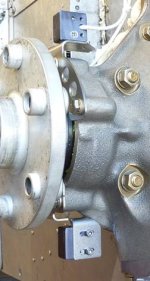
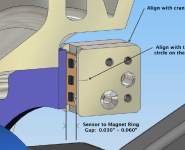
I'm reminded of a story about Wolfgang Meyn's F1; the LSE mini sensors were positioned a little too far away from the magnet ring and under acceleration the engine would "miss". Adjusting the gaps solved the issue -- The thinking was that the crank pulled forward ever so slightly but was enough to disrupt the hall effect sensors...

Screenshot 2025-02-07 at 5.22.28 PM.png

Just a thought...
 
I'm reminded of a story about Wolfgang Meyn's F1; the LSE mini sensors were positioned a little too far away from the magnet ring and under acceleration the engine would "miss". Adjusting the gaps solved the issue -- The thinking was that the crank pulled forward ever so slightly but was enough to disrupt the hall effect sensors...

View attachment 80422

Just a thought...
That's one of the nice things about mounting an electronic ignition pickup in the standard magneto mounting position. You can pull it out and check it on the bench.
 
Well, I did verify the sensor gap years ago during the installation. I hear what you're saying about end play. I'll look at that.

I chose the mini pickups over the hall effect mag hole sensors because I didn't want to worry about bearings or gear lash affecting the timing. Lot's of people seem happy with the E-mags. If I were doing it now, I'd do CPI 2.

Ed
 
For today's session, I ignored my perceived induction leak/high idle MAP and worked injection system only.

I did Don's fuel flow test. I verified gap between throttle plate and bore at .006". I disconnected the hose from the flow divider and rigged a way to dump it into a bucket. Supposed to run the boost pump with throttle wide open and mixture full rich for a couple of minutes and then look at fuel flow. Target 3-5gph. Slowly moving mixture towards lean should reduce fuel flow and it does. Then, mixture full rich again and reduce throttle. Passing through ~1/2 throttle flow should start to decrease and it did. Fuel flow at idle stop should be 1.2gph. Mine read zero but I could see fuel coming out of the hose so I redid the whole test into graduated cups with stopwatch.

Full rich, WOT I got 5oz of fuel in 30 seconds. 5/128 oz/g x 120 seconds yields 4.6875 gph. That's within the 3-5 target.
Full rich, on the idle stop gave me 4oz of fuel in a minute. 4/128 x 60 yields 1.875 gph which is way over the 1.2 target. This jibes with my excessive ICO rpm rise.

I investigated whether I could change the relationship of the throttle shaft to the idle circuit shaft and it is one solid arm. I could not have possibly miss-clocked it during initial fitting. My troubles really seemed to have gotten intolerable when I attempted to adjust the idle mixture and at the same time changed the injector restrictors, so I lengthened the idle mixture adjustment arm to somewhere near where it had been previously and ran the same test getting about 3 1/4 oz in 30 seconds for 3.05 gph. That makes sense. Richer idle mixture adjustment = more fuel flow. Should aggravate the stumble. For giggles, I put the hoses back in place and ran the engine. It really didn't like fast idle at full rich so I pulled most of the way to ICO, reducing throttle to maintain 1k rpm for warm up, where it seemed a lot happier. This is what I always used to do - lean after start and for taxi just like I'd do with a carb. After she warmed up a bit, I moved the mixture fairly quickly to full rich and she almost choked. Went back to about halfway on the mixture and was able to accelerate through 1200rpm with only a little hesitation. I did it again after slowly advancing mixture to full rich and got similar results with or without boost pump, certainly no worse than it's been for 7 years. The only difference is that my airbox and filter are off it.

So...the fuel control servo is not in spec, but operationally viable. Setting the mixture closer to spec makes it a lot worse. What's a motorvated team associate to do? (anybody catch that reference?)

Ed
 
For today's session, I ignored my perceived induction leak/high idle MAP and worked injection system only.

I did Don's fuel flow test. I verified gap between throttle plate and bore at .006". I disconnected the hose from the flow divider and rigged a way to dump it into a bucket. Supposed to run the boost pump with throttle wide open and mixture full rich for a couple of minutes and then look at fuel flow. Target 3-5gph. Slowly moving mixture towards lean should reduce fuel flow and it does. Then, mixture full rich again and reduce throttle. Passing through ~1/2 throttle flow should start to decrease and it did. Fuel flow at idle stop should be 1.2gph. Mine read zero but I could see fuel coming out of the hose so I redid the whole test into graduated cups with stopwatch.

Full rich, WOT I got 5oz of fuel in 30 seconds. 5/128 oz/g x 120 seconds yields 4.6875 gph. That's within the 3-5 target.
Full rich, on the idle stop gave me 4oz of fuel in a minute. 4/128 x 60 yields 1.875 gph which is way over the 1.2 target. This jibes with my excessive ICO rpm rise.

I investigated whether I could change the relationship of the throttle shaft to the idle circuit shaft and it is one solid arm. I could not have possibly miss-clocked it during initial fitting. My troubles really seemed to have gotten intolerable when I attempted to adjust the idle mixture and at the same time changed the injector restrictors, so I lengthened the idle mixture adjustment arm to somewhere near where it had been previously and ran the same test getting about 3 1/4 oz in 30 seconds for 3.05 gph. That makes sense. Richer idle mixture adjustment = more fuel flow. Should aggravate the stumble. For giggles, I put the hoses back in place and ran the engine. It really didn't like fast idle at full rich so I pulled most of the way to ICO, reducing throttle to maintain 1k rpm for warm up, where it seemed a lot happier. This is what I always used to do - lean after start and for taxi just like I'd do with a carb. After she warmed up a bit, I moved the mixture fairly quickly to full rich and she almost choked. Went back to about halfway on the mixture and was able to accelerate through 1200rpm with only a little hesitation. I did it again after slowly advancing mixture to full rich and got similar results with or without boost pump, certainly no worse than it's been for 7 years. The only difference is that my airbox and filter are off it.

So...the fuel control servo is not in spec, but operationally viable. Setting the mixture closer to spec makes it a lot worse. What's a motorvated team associate to do? (anybody catch that reference?)

Ed
This makes sense, servo throwing too much fuel to the point that the fine adjustment cannot deal with it. That is what I suggested a few days ago.

On the 20” of map, i remain convinced this is an instrumentation error . Either a faulty sensor, improperly configured ems, or a leak in the tubing between engine and sensor. I believe it is impossible to have 20” of map with a .006” throttle opening. Sure, with a massive leak that is plausible, but it would run like sh!^ and you would never get the idle down to 650. You cannot get an engine down to 650 with crazy amounts of airflow. It must be heavily restricted and this creates a lot of vacuum. This is engine 101 stuff; more airflow = more rpm. If you want the rpm to come down, you must restrict the airflow.
 
Last edited:
For today's session, I ignored my perceived induction leak/high idle MAP and worked injection system only.

I did Don's fuel flow test. I verified gap between throttle plate and bore at .006". I disconnected the hose from the flow divider and rigged a way to dump it into a bucket. Supposed to run the boost pump with throttle wide open and mixture full rich for a couple of minutes and then look at fuel flow. Target 3-5gph. Slowly moving mixture towards lean should reduce fuel flow and it does. Then, mixture full rich again and reduce throttle. Passing through ~1/2 throttle flow should start to decrease and it did. Fuel flow at idle stop should be 1.2gph. Mine read zero but I could see fuel coming out of the hose so I redid the whole test into graduated cups with stopwatch.

Full rich, WOT I got 5oz of fuel in 30 seconds. 5/128 oz/g x 120 seconds yields 4.6875 gph. That's within the 3-5 target.
Full rich, on the idle stop gave me 4oz of fuel in a minute. 4/128 x 60 yields 1.875 gph which is way over the 1.2 target. This jibes with my excessive ICO rpm rise.

I investigated whether I could change the relationship of the throttle shaft to the idle circuit shaft and it is one solid arm. I could not have possibly miss-clocked it during initial fitting. My troubles really seemed to have gotten intolerable when I attempted to adjust the idle mixture and at the same time changed the injector restrictors, so I lengthened the idle mixture adjustment arm to somewhere near where it had been previously and ran the same test getting about 3 1/4 oz in 30 seconds for 3.05 gph. That makes sense. Richer idle mixture adjustment = more fuel flow. Should aggravate the stumble. For giggles, I put the hoses back in place and ran the engine. It really didn't like fast idle at full rich so I pulled most of the way to ICO, reducing throttle to maintain 1k rpm for warm up, where it seemed a lot happier. This is what I always used to do - lean after start and for taxi just like I'd do with a carb. After she warmed up a bit, I moved the mixture fairly quickly to full rich and she almost choked. Went back to about halfway on the mixture and was able to accelerate through 1200rpm with only a little hesitation. I did it again after slowly advancing mixture to full rich and got similar results with or without boost pump, certainly no worse than it's been for 7 years. The only difference is that my airbox and filter are off it.

So...the fuel control servo is not in spec, but operationally viable. Setting the mixture closer to spec makes it a lot worse. What's a motorvated team associate to do? (anybody catch that reference?)

Ed
I'm looking at a FM-150 and it looks to me like the fuel control arm is not attached to the throttle arm with a solid arm. The fuel control arm has a bolt and nut that pinches on the fuel control shaft. It can be miss clocked. It you can't make the arm long enough the lean it out at idle, loosen the nut and bolt that pinch the arm on the fuel shaft and change the clocking to a leaner position. About 5 degrees should do it. Very sensitive adjustment.
 

Attachments

  • FM-150.jpg
    FM-150.jpg
    46.2 KB · Views: 26
The problem is that I can't make the adjustable linkage short enough to lean it properly. The rod end bearings are bottomed on the jam nuts.

I had to mount the servo with the controls on the bottom to talk to cables coming under the cold air sump. That meant that I had to remove the throttle lever and move it to the other side of the servo leaving the idle mixture linkage on the top. The one piece arm that I'm talking about is behind that throttle arm that you can see in the picture. It extends out to pick up the adjustable linkage and sticks out the other side to hit the throttle stop. It has a roll pin to secure it to the shaft so it can't be re-clocked. I had imagined that I could rotate is slightly and re-engage the serrated teeth as you can with the throttle lever itself, but no. Even if I could move it a few degrees, the other end would move a similar amount and the idle stop would leave the throttle plate with the wrong amount of opening.

Late. I'll get back to Larry in the morning.

Ed
 
I'm looking at a FM-150 and it looks to me like the fuel control arm is not attached to the throttle arm with a solid arm. The fuel control arm has a bolt and nut that pinches on the fuel control shaft. It can be miss clocked. It you can't make the arm long enough the lean it out at idle, loosen the nut and bolt that pinch the arm on the fuel shaft and change the clocking to a leaner position. About 5 degrees should do it. Very sensitive adjustment.
Personally I would NOT touch that arm with the pinch bolt. That is not considered a field adjustment. It is used to manipulate the gross idle flow into the specified range (fine adj is the turnbuckle, which is a field adj) and requires volume and pressure measuring equipment. If Don gives you instructions to play with it, I am sure it is fine, but highly doubt he would. Pretty sure that servo flowed exactly what it should have when it left Don's shop. Now that it doesn't do that anymore, it really should go back to Don to find out why. Playing with adjustments you don't understand (no documentation for adjusting), to paper over another unknown flaw, is just asking for a serious problem down the road. It seems highly unlikely that arm just slipped. That means something inside has changed that shouldn't have. That thing needs to be found and fixed. The thing that changed may be stable for the next 1000 hours or it may get radically worse in the next hour; you just can't predict untill you know what is. with most servos, you set the idle mixture at install and it is rock solid all the way to TBO. I havn't touched mine in 1300 hours. This is a warning that should not be ignored.
 
Last edited:
Personally I would NOT touch that arm with the pinch bolt. That is not considered a field adjustment. It is used to manipulate the gross idle flow into the specified range (fine adj is the turnbuckle, which is a field adj) and requires volume and pressure measuring equipment.
This. Time to call Don.
Carl
 
The problem is that I can't make the adjustable linkage short enough to lean it properly. The rod end bearings are bottomed on the jam nuts.

I had to mount the servo with the controls on the bottom to talk to cables coming under the cold air sump. That meant that I had to remove the throttle lever and move it to the other side of the servo leaving the idle mixture linkage on the top. The one piece arm that I'm talking about is behind that throttle arm that you can see in the picture. It extends out to pick up the adjustable linkage and sticks out the other side to hit the throttle stop. It has a roll pin to secure it to the shaft so it can't be re-clocked. I had imagined that I could rotate is slightly and re-engage the serrated teeth as you can with the throttle lever itself, but no. Even if I could move it a few degrees, the other end would move a similar amount and the idle stop would leave the throttle plate with the wrong amount of opening.

Late. I'll get back to Larry in the morning.

Ed
 
The problem is that I can't make the adjustable linkage short enough to lean it properly. The rod end bearings are bottomed on the jam nuts.

I had to mount the servo with the controls on the bottom to talk to cables coming under the cold air sump. That meant that I had to remove the throttle lever and move it to the other side of the servo leaving the idle mixture linkage on the top. The one piece arm that I'm talking about is behind that throttle arm that you can see in the picture. It extends out to pick up the adjustable linkage and sticks out the other side to hit the throttle stop. It has a roll pin to secure it to the shaft so it can't be re-clocked. I had imagined that I could rotate is slightly and re-engage the serrated teeth as you can with the throttle lever itself, but no. Even if I could move it a few degrees, the other end would move a similar amount and the idle stop would leave the throttle plate with the wrong amount of opening.

Late. I'll get back to Larry in the morning.

Ed
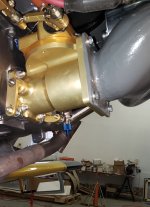
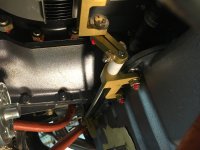
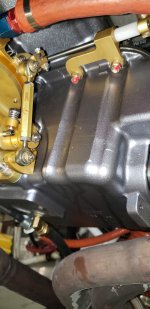
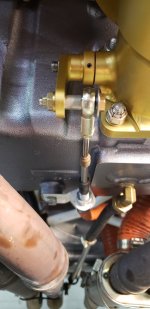
I assume you are not using the new FM-150C FM. For forward injected engines this make running controls and such much easier. Some photos of this install on my IO-360-M1B.

Call Don to see if this makes sense for your ship.
Carl
 

Attachments

  • 20220125_160346.jpeg
    20220125_160346.jpeg
    1.1 MB · Views: 23
  • IMG_3798.jpeg
    IMG_3798.jpeg
    2.5 MB · Views: 21
  • 20220125_160418.jpeg
    20220125_160418.jpeg
    1.5 MB · Views: 24
  • 20220125_121646.jpeg
    20220125_121646.jpeg
    1.3 MB · Views: 26
I was under the impression that the arm to the idle circuit could have been miss-clocked by myself when I moved the throttle arm from one side of the shaft to the other. I was going to re-clock it slightly and test run to see if that would make a proper idle mixture adjustment possible and if it might cure the stumble. As soon as I determined that my assumption was incorrect and that a re-clock wasn't possible, that went out the window.

Yup, no intention of making ad hoc mods to the servo. Moving an arm across the servo to get a cable on it is one thing and was actually covered in the install manual. I may be crazy but I'm not stupid. Wait. Maybe it was the other way around. ;-) Agreed, a call to Don is in order. He's going to tell me to send it in. He already told me to if it failed the flow test. So that's probably next.

I agree with you about the manifold pressure which is a red herring in this mystery. Suction is suction and it has to be going somewhere or the indication isn't real. The leak is probably in the line to the sensor. It wouldn't take a huge leak to change the reading and the ignitions not advancing kind of backs up that the indication might be for real. The restrictor in the fitting at the intake port would tend to minimize the effect of a leak on the way the engine runs.

Ed
 
Carl,

I think mine is the old version. Mine is anodized black. I got it 8 or 9 years ago. Not sure I want to re-engineer my whole installation. Your pictures are interesting. I like the belcrank and torque tube setup. That was definitely not offered to me back then. I would have mounted mine like yours and had the idle mix adjustment a lot easier to get to. I have the Superior sump which also probably has a little different geometry.

Ed
 
I took a jam nut off and there was no change. My fuel servo and spider are on their way to South Carolina.

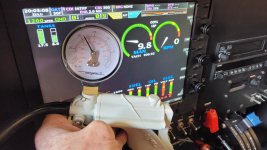
On the manifold pressure front, I hooked a hand vacuum pump up to the sensor. I pulled about 1.3 atmospheres of vacuum to get it down to ~10" MAP on the EFIS. Really? 19psi to account for about 19"hg. That, as they say, does not compute. I'm thinking bad sensor.

Ed
 
looked at the pic. Sorry, but back to science class. 19" of vacuum is 65 kpa (.65 atmospheres, not 1.3). Absolute pressure (i.e. MAP) is found by subtracting the vac from the actual atmosphere. If we assume atmo at 100 KPA, the MAP reading for 65 KPA of vacuum is 35 KPA of abs pressure, which is 10.5 inHG. You are likely not at SL and that accounts for the difference; Actual atmosphere less than 100 kpa.

It gets confusing because we use inHG for both MAP and vacuum gauges but they cannot be compared to each other on that scale. VERY generally, idle should be around 20" of vacuum and 10" of MAP.

Your sensor appears to be behaving within spec. Time to look for a leak.
 
Last edited:
looked at the pic. Sorry, but back to science class. 19" of vacuum is 65 kpa (.65 atmospheres, not 1.3). Absolute pressure (i.e. MAP) is found by subtracting the vac from the actual atmosphere. If we assume atmo at 100 KPA, the MAP reading for 65 KPA of vacuum is 35 KPA of abs pressure, which is 10.5 inHG. You are likely not at SL and that accounts for the difference; Actual atmosphere less than 100 kpa.

It gets confusing because we use inHG for both MAP and vacuum gauges but they cannot be compared to each other on that scale. VERY generally, idle should be around 20" of vacuum and 10" of MAP.

Your sensor appears to be behaving within spec. Time to look for a leak.
Your'e right. I looked right at that gauge and I was sure it said psi. Expectation bias strikes again. That and the small print.

Ed
 
Your'e right. I looked right at that gauge and I was sure it said psi. Expectation bias strikes again. That and the small print.

Ed
Fyi, 19 psi is well above atmosphere (14.7). It isn’t technically a vacuum until the pressure goes below atmospheric pressure. Also, You can’t get an engine above atmo without some type of boost. Idle vacuum is around 10 psi.

Sorry, you probably would prefer fix suggestions over more science. I will stop now.
 
Last edited:
Fyi, 19 psi is well above atmosphere (14.7). It isn’t technically a vacuum until the pressure goes below atmospheric pressure. Also, You can’t get an engine above atmo without some type of boost. Idle vacuum is around 10 psi.

Sorry, you probably would prefer fix suggestions over more science. I will stop now.
No, I get it. When I thought I was dealing with psi, I looked up the formula. That's where I got those unbelievable numbers. The hand pump is gauge and the EFIS is absolute, both in inches hg. There was no way I could have used a hand pump to pull more vacuum than outer space. Duh. Once you pointed out that it was inhg, I knew that I'd been an idiot. I do appreciate suggestions and getting the terms right is a great suggestion. With more realistic numbers, I could pretty much rule out a bad sender. I'm glad I did before I ordered a new one at $100 or $150 for a kavlinco.

I changed out some fittings and hose today and sucked vacuum from the end disconnected from the cylinder head testing the entire assembly including the ignition boxes. Pumped it down to 20inhg gauge indicated vacuum and saw 9.3inhg map on the EFIS starting from 29". Even if one or the other reading is a little off, the numbers are within the realm of possibility. That part at least is good to go. I'll need to wait for my fuel control to come home and then I should be back in business. Then I hope to be able to set my idle mixture correctly and check the ignition timing for advance.

Ed
 
No, I get it. When I thought I was dealing with psi, I looked up the formula. That's where I got those unbelievable numbers. The hand pump is gauge and the EFIS is absolute, both in inches hg. There was no way I could have used a hand pump to pull more vacuum than outer space. Duh. Once you pointed out that it was inhg, I knew that I'd been an idiot. I do appreciate suggestions and getting the terms right is a great suggestion. With more realistic numbers, I could pretty much rule out a bad sender. I'm glad I did before I ordered a new one at $100 or $150 for a kavlinco.

I changed out some fittings and hose today and sucked vacuum from the end disconnected from the cylinder head testing the entire assembly including the ignition boxes. Pumped it down to 20inhg gauge indicated vacuum and saw 9.3inhg map on the EFIS starting from 29". Even if one or the other reading is a little off, the numbers are within the realm of possibility. That part at least is good to go. I'll need to wait for my fuel control to come home and then I should be back in business. Then I hope to be able to set my idle mixture correctly and check the ignition timing for advance.

Ed
Hopefully that remediation resolved the leak and all will read correctly once up and running again.
 
It's been a while, but my issues seem to have been resolved. Firstly, I cured the leak in the manifold pressure sense line. My fuel servo and fuel distribution spider were overhauled by AFP. There is now no hesitation coming off idle with advancing throttle. After mounting up the servo, my number 1 ignition failed an inflight LOP stress test, so I replaced the spark plugs and wires.

While I was at it, I bought a type 2 ram air/filter setup from HP Aircraft and modified it to fit my cowl induction scoop. I got a test flight in today and the first results are very encouraging. She took off normally with the ram air flapper shut. I set up a lean of peak cruise and did another stress test on the ignition. It's much better. I climbed to 6500', was lean of peak at about 8.8gph, WOT, and saw about .2" increase in MAP when I opened it up. The airspeed increased by maybe 2 or 3 knots, much more than I expected. I played with it for about an hour and it seemed to be fairly consistent. I took a few screenshots but forgot to bring an SD card with me. I'll be playing with it more and so far it has exceeded expectations.

Ed
 

Attachments

  • 20250410_141338[1].jpg
    20250410_141338[1].jpg
    795.9 KB · Views: 27
  • 20250411_122828[1].jpg
    20250411_122828[1].jpg
    987.2 KB · Views: 25
  • 20250411_122938[1].jpg
    20250411_122938[1].jpg
    963.1 KB · Views: 28
Back
Top