Van's Air Force

The definitive Van's Aircraft support community! Buying, building or flying an RV? Join our exclusive family of mentors and enthusiasts!

Electrical Puzzler...

bjdecker

Well Known Member
Ambassador
Greetings Hivemind,

This one has me stumped. The behavior I saw isn't what I expected to see - so I thought I would present y'all with the data and see what you think the answer might be.

The Equipment:
  • RV-7 with Lycoming IO-360-A1B6,
  • Plane Power Alternator - AL12-EI60, (HET ALT5020T) internally regulated
  • Monkworks MZ30L Backup Generator
  • EarthX ETX680 Primary Battery
  • Dual Garmin G3XT Avionics suite.
The Configuration:
  • Single Primary Battery
  • Backup Battery - TCW, Avionics
  • Main buss - Avionics buss
  • Single Alternator -- connected to Main buss at "output" of Battery Master Relay
  • Backup Alternator -- connected to Main buss at "output" of Battery Master Relay (configured for standby operation)
  • All switches are Honeywell AML34 SPST
  • Battery Master Relay -- Littelfuse/Cole Hersee 24115 (Van's ES 24115), ground through "Batt" switch to activate.
  • Alternator Field -- Connected to Primary Alternator pin #3 via 5A CB on Main Buss. Also serves as Voltage Sense to alternator regulator (Jumper at Alternator connector, pins 3-2)
  • Current Shunt - Installed on the B+ lead between alternator and main buss.
  • ANL - Installed on the B+ lead between alternator and main buss.
Discussion - Normal Start:
  • Arm/Engage Standby Generator
  • Arm/Engage Backup Battery (G3X PFD/MFD begin to boot)
  • Battery Master "ON" - Hear the clunk the of the CH 24115
  • Wait for "AHRS Align" message of PFD to clear
  • Perform the Engine pre-start song & dance and short prayer if hot.
  • Start Engine
  • Adjust Throttle to 1000RPM
  • Observe Oil Pressure
  • Alternator (Field) "ON"
  • Observe Primary Alternator amps quickly rise to >55A (sometimes as high as 65A - depends on how long starter was engaged) then fall to ~14A within 2 minutes
  • Observe Voltage - 14.5Vdc...
  • ...No surprises...

Here's the puzzler; If you completed all of the above steps successfully, and the RPM was at ~900, buss volts was at 14.5Vdc, and amps were ~13A, and you were to disable the battery master, and leave everything else on - just removing the primary battery from the buss, what would you expect to see with regards to buss voltage? Alternator Amps?

I was expecting to see nothing - not a blip. However, I saw something else - Buss Volts climbed to 15.5V, amps jumped to 17A... I re-engaged the battery master and everything returned to normal. I was reluctant to "let it go" and hope/trust that the OV protection in the alternator would trip the field breaker.

Link to Savvy is here: https://apps.savvyaviation.com/flights/shared/flight/9176126/4e8ba547-d47e-4990-a206-0f7e4cb30766
Event data starts at 04:20 - 04:32.

Comments appreciated.
 
Last edited:
I suspect you are just seeing the large AC component (DC ripple) now riding on the bus which the gauges are seeing as well.
If you hooked up a Multimeter (or scope) on AC function, you would see that the AC component.
 
I suspect you are just seeing the large AC component (DC ripple) now riding on the bus which the gauges are seeing as well.
If you hooked up a Multimeter (or scope) on AC function, you would see that the AC component.
Thanks Walt! I was thinking about that as a possibility, although not the same outcome -- too bad I didn't have my headphones on at the time I did the "experiment" so I could hear the whine.

I'll instrument the buss and before/during/after and see what lurks there...
 
I’m sure you’re aware the most common failure mode of a capacitor is a short, Any concerns?
Nope, been around this stuff for decades, failure rates on modern large industrial power supply filter caps are extremely rare.
This particular unit is a 75v milspec unit. If was out of an antique radio that would be a different story.
In this case the cap also has a very easy life, overrated for application, low heat exposure, low ripple current makes for long life.
 
Last edited:
Update:

I instrumented the AC/ripple on the buss with the battery disconnected and it measured >1.5V, until the OV in the alternator tripped. With the battery connected, the AC/ripple was <0.06v (IIRC).

Thanks for the tip @Walt
 
Update:

I instrumented the AC/ripple on the buss with the battery disconnected and it measured >1.5V, until the OV in the alternator tripped. With the battery connected, the AC/ripple was <0.06v (IIRC).

Thanks for the tip @Walt
I wonder how the B&C voltage regulator would have performed vs the PlanePower unit.
 
Lesson learned. If you are relying on a power backup mode to be an alternator running without a ship battery (which I do not recommend) test it before you need it.

The only alternator I know of that is tested to run with no battery is the MonkWorkz. I have it on my plane but still do not consider this a backup mode as a multiple of failures would need to happen to get down to that.

Carl
 
Lesson learned. If you are relying on a power backup mode to be an alternator running without a ship battery (which I do not recommend) test it before you need it.

The only alternator I know of that is tested to run with no battery is the MonkWorkz. I have it on my plane but still do not consider this a backup mode as a multiple of failures would need to happen to get down to that.

Carl
Agreed -- I also tested this with the MonkWorkz and it performed quite well, no ripple transients that I could measure. I did manage to trip the thermal protection because I was essentially running the MZ30L without any airflow and at a low-RPM.

So now I have data to work with and an understanding of another failure mode and some mitigations to put in place --- a good day :)

I wonder how the B&C voltage regulator would have performed vs the PlanePower unit.
@NTex - Try it out and report back.

The B&C regulator just provides the field current to the alternator (and overvoltage protection). The conversion of AC to DC, and the resulting ripple current, is done inside/by the alternator bridge rectifier. I would be very surprised, and would want to understand why, if the B&C regulator/alternator combination did not also demonstrate the same behavior.
 
walt, im sure you know you need to check that thing every now and then by grabbing both terminals with damp fingers! :)
 
I’m sure you’re aware the most common failure mode of a capacitor is a short, Any concerns?
I'd like to see a capacitor of that physical size that will stay shorted for more than a second with the kind of current the battery and/or alternator can deliver. I've only seen electrolytic caps that exploded after overvoltage exposure. Normally a cap fails open (or lower and lower capacitance) in my experience.

But I'd like to be educated, if you please.
 
This is my solution to the possibility of battery going off line.
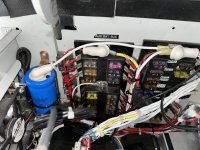
12,000 uf hanging on the main bus feed.
Hi Walt, can you give me the part number or source or manufacturer of that cap?

I'd like to use 33,000uF or higher for my estimated 10A+ current draw to keep engine running (EFI pumps, injectors and ignition coils).
 
Hi Walt, can you give me the part number or source or manufacturer of that cap?

I'd like to use 33,000uF or higher for my estimated 10A+ current draw to keep engine running (EFI pumps, injectors and ignition coils).
Price has literally jumped up $50 in the last few weeks, it was already insane now it's worse, and not sure if anyone else has seen it but Mouser which I have done tons of business with over the years, is now adding a "tariff" fee!
https://www.mouser.com/ProductDetail/598-101C123U075EB2B
 
I'd like to see a capacitor of that physical size that will stay shorted for more than a second with the kind of current the battery and/or alternator can deliver. I've only seen electrolytic caps that exploded after overvoltage exposure. Normally a cap fails open (or lower and lower capacitance) in my experience.

But I'd like to be educated, if you please.
Not from me ;) my experiences date me terribly. Walt has confidence in the modern dielectric materials not being prone to breaking down.
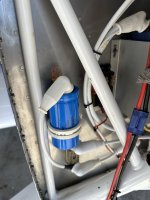
…and yes, a short would be a very ugly and a quick event.
 
Not from me ;) my experiences date me terribly. Walt has confidence in the modern dielectric materials not being prone to breaking down.
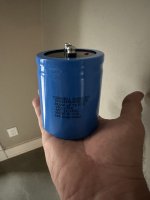
…and yes, a short would be a very ugly and a quick event.
First time I saw a cap blow up was on a motor as a kid. Whole room covered with "paper". Can't remember last time, but could be during 70s as an apprentice where we got a kick out of applying too high voltage to relatively small caps. Also, was fun to pop a paper bag next to someone working on a live circuit to see how high they jump -- those were the days.

Catch 22. I'd like to keep it out of the cockpit and near the alternator, but looks like life is shortened at higher temps even if rated to 105C.
In any case I guess the top should be pointed away from critical items if it should blow its top and let the electrolyte out.

Perhaps a fusible link in the wire to it in the (hopefully) rare event of a short?

I need to learn more about ripple current and higher voltage transients which appear to be causes of failures or shortened life.
 
As a quick follow up, Brian has had OV trips at 16v with his PP alternator after disconnecting the battery.
I did a quick test today and my B&C held 15v with no issues, the AC component from my Fluke 77 showed about .8v.
I believe the B&C is holding about the same 14.5 with some expected AC ripple.
Will do some more testing soon with some increased loads to see how it behaves.
I have a scope on the way so I can get a better look at what's going on.
 
Last edited:
Update: We aren't done yet, and/or we're gonna need a bigger boat...

I installed a 12KuF 75V e-cap between the alternator feed point and firewall ground and re-ran the test. I noticed that the voltage "rise" time was a bit longer, but it still topped out at 16.0V which caused the PlanePower OV to trip the field breaker and shut down the primary alternator...

IMG_6949.jpg


I've had long discussions with the EarthX folks, B&C, and Hartzell and I've come to the conclusion that the EarthX battery (any battery really) is a really big cap and following guidance from EarthX and looking at B&C's kit , I am going to install a BIGGER cap -- 25KuF -- and re-run the test.

IMG_6956.jpg

Hartzell suggested that removing the battery was causing a "load dump", but after looking at the buss amps before/during/after switching the master off, I don't think this is the case in my installation -- Amps is 10A before the switch is thrown, 9A afterwards. The 1A difference is the lightspeed ignitions. Is a 1A difference going to be enough to trigger the load dump failure scenario? (1A at 14.5V is 14.5W)

Voltage regulators should regulate -- The regulator is supposed to sense the buss voltage and vary the field voltage (current to the rotor); Buss Voltage Increases, Field Voltage (and current) Descreases. Buss Voltage Decreases and Field Voltage Increases.

If the issue is the unsuppressed ripple voltage causing the OV to trip then there's something else going on, or there is a fundamental flaw in the IN240/IN257 VR Unipoint/Victory 6621 VR in the Plane Power Alternator and/or the OV "hack" that they installed...

The ask:

Opening this up for the rest of the installed base to try -- I am especially interested in the B&C crowd and how their regulator handles the "load dump" and loss of capacitance; Does the buss voltage run away to the OV trip point or does it go up a little and come back down to 14.4 - .5Vdc?

...Stay Tuned...

p.s. I can't afford the 105C cap that Walt used :) The temps on my firewall at the gear leg socket are <38C in flight, <60C post shutdown, so the 85C should be plenty of thermal headroom.
 
Last edited:
Brian, a spitball...

Before going further, perhaps it would be worth a few minutes to confirm the mechanical condition of the Plane Power. Recall we've seen quite a few with an enlarged bearing bore in the rear case. Here I'm wondering what happens when the commutator ring whirls about. Can the brushes follow the motion?

The check is easy enough. Clamp the pulley in a vice with the slip ring end pointed up. Now rock the alternator case back and forth. Any freeplay you can feel is a bad bearing bore.
 
Brian, a spitball...

Before going further, perhaps it would be worth a few minutes to confirm the mechanical condition of the Plane Power. Recall we've seen quite a few with an enlarged bearing bore in the rear case. Here I'm wondering what happens when the commutator ring whirls about.

The check is easy enough. Clamp the pulley in a vice with the slip ring end pointed up. Now rock the alternator case back and forth. Any freeplay you can feel is a bad bearing bore.

Already looked at that -- no movement.

Just looking at the disassembled unit on my desk :) any "slop" in the end bearing would create excessive/uneven wear in the brushes/slip rings, I would think. This would cause the field to fail, output wouldn't be stable...did you find a different failure mode?
 
Try reducing the current draw. If the DC voltage still rises at for example 2 amps, I would suspect the voltage regulator. Or the OVP triggers too fast or at too low voltage.

I found this:

Vripple = I /(f * C)
10A / (120Hz * 0.012F) = 6.9V
2A / (120Hz * 0.012F)= 1.4V

Not sure what frequency to use. Idle RPM / 60 * 2 * 3 * crankshaft pulley / alternator pulley diameters?

Anyway, for testing I don't see the need for those expensive caps.

Here's a 68,000uF 25V:
 
My RV-12 has a 22,000µF capacitor located on the aft side of the firewall.
I protected it with a 5amp fuse but the inrush current blew the fuse.
So I replaced it with a 10amp fuse. All good now.
 
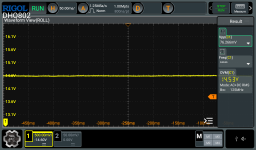
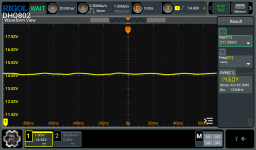
For those interested I grabbed a couple of shots with the O-scope to see what effect disconnecting the battery would have on the bus.
Voltage remained pretty Stable at @14.5-14.6V. Increasing the load didn't effect it. So for me I feel confident that even if the battery 'opens' or the master contactor fails basically is a non issue.

Battery connected:
1739661263533.png

Battery disconnected:
1739661767678.png
 
Last edited:
For those interested I grabbed a couple of shots with the O-scope to see what effect disconnecting the battery would have on the bus.
Voltage remained pretty Stable at @14.5-14.6V. Increasing the load didn't effect it. So for me I feel confident that even if the battery 'opens' or the master contactor fails basically is a non issue.

Battery connected:


Battery disconnected:
Is that with the 12,000uF cap?
Current draw?
 
Odd. Per my previously posted formula I would expect to see more ripple.
What was the current draw with the battery disconnected (2nd scope picture)?
Additional information -

Plane Power 99-1012, and B&C are both 12 pole alternators. Frequency is RPM*Poles/120.

Alternator RPM is 3.545 * Engine RPM (assuming 9.75" Flywheel pulley and 2.75" Alternator pulley)
 
Odd. Per my previously posted formula I would expect to see more ripple.
What was the current draw with the battery disconnected (2nd scope picture)?
Yes I expected more too, I had the avionics off just to be safe but turning on pitot heat didn’t change things much at all.
I didn’t have a lot of time today so testing was rather brief, plan on doing more comprehensive ground and flight testing.
Yes the second picture is with battery disconnected/master off.
I’m still getting used to operating the digital scope compared to the old analog scopes I cut my teeth on.
 
Last edited:
In reading this thread, I'd like to come at at from another angle. One of the purposes of having a master switch is to remove power from aircraft busses in case of an in-flight emergency. Turning off the master switch should also turn off the alternator. This is the case with the red split master/alternator we all know from Cessnas, etc. You can also address this by using a double pole master switch, and wiring the alternator field circuit in series with the master switch and alternator switch.

I'm not aware that running purely on alternator without the "battery in the loop" is a normal operating mode. This thread seems to imply it is. Am I missing something here, or is this thread just a thought exercise?
 
In reading this thread, I'd like to come at at from another angle. One of the purposes of having a master switch is to remove power from aircraft busses in case of an in-flight emergency. Turning off the master switch should also turn off the alternator. This is the case with the red split master/alternator we all know from Cessnas, etc. You can also address this by using a double pole master switch, and wiring the alternator field circuit in series with the master switch and alternator switch.

I'm not aware that running purely on alternator without the "battery in the loop" is a normal operating mode. This thread seems to imply it is. Am I missing something here, or is this thread just a thought exercise?
I basically agree with the above. I actually had to remove my 3 pos switch and install a separate alternator sw to accomplish the testing above.
I’ve done it both ways on panel upgrades, single 3 pos switch and separate master/alt switches. Not sure one is better than the other but your point is valid.
More importantly some alternators will continue to output (self excitation) if they are turning despite the field /master being turned off.
 
Last edited:
In reading this thread, I'd like to come at at from another angle. One of the purposes of having a master switch is to remove power from aircraft busses in case of an in-flight emergency. Turning off the master switch should also turn off the alternator. This is the case with the red split master/alternator we all know from Cessnas, etc. You can also address this by using a double pole master switch, and wiring the alternator field circuit in series with the master switch and alternator switch.

I'm not aware that running purely on alternator without the "battery in the loop" is a normal operating mode. This thread seems to imply it is. Am I missing something here, or is this thread just a thought exercise?
Don't necessarily disagree, however - since most of us copied the GA fleet in our system (Mooney, Cessna, Piper, Grumman, Rockwell, etc.) and or some variation of Bob Nuckolls work, we ended up with switches for every power source and load. Having a solid understanding of what happens when what happens happens was what I was driving at.

In my system, turning the battery "Off" removes the battery from the buss. This scenario was important for me to understand as a failure mode of the Contactor (aka Master Relay) *AND* the Primary Battery (thanks to the BMS - LiFePo).

It was a little bit of an "Ah Ha!", when that condition also tripped the OV on the alternator, which subsequently removed power from the buss and the EFIS/AHARS ran off the standby battery...all of the other loads (non-essential) were unpowered.
 
Why not buy an 8-cell AA battery pack and put some rechargeables in it. Plug it in an accessory lighter socket. Seems like it would behave like a 12V batter and provide a little backup.
Maybe I'm electronically challanged.
 
Why not buy an 8-cell AA battery pack and put some rechargeables in it. Plug it in an accessory lighter socket. Seems like it would behave like a 12V batter and provide a little backup.
Maybe I'm electronically challanged.
Yeah, except the cigar/accy plug is connected to the buss by a 22ga wire and protected by a 5A CB. It's not going to pull 16-20A through that for very long...
 
Yeah, except the cigar/accy plug is connected to the buss by a 22ga wire and protected by a 5A CB. It's not going to pull 16-20A through that for very long...
Seemed like a good idea for about 10 minutes! Dang. Couldn't let me breathe that rareified air for a little bit longer! :LOL:
You brainiacs crack me up.
 
Seemed like a good idea for about 10 minutes! Dang. Couldn't let me breathe that rareified air for a little bit longer! :LOL:
You brainiacs crack me up.
I know a guy who tried to jump start his airplane with a jump pack plugged into the cigar port...Those little 22ga wires won't carry that kind of current.. ;)
 
In reading this thread, I'd like to come at at from another angle. One of the purposes of having a master switch is to remove power from aircraft busses in case of an in-flight emergency. Turning off the master switch should also turn off the alternator. This is the case with the red split master/alternator we all know from Cessnas, etc. You can also address this by using a double pole master switch, and wiring the alternator field circuit in series with the master switch and alternator switch.

I'm not aware that running purely on alternator without the "battery in the loop" is a normal operating mode. This thread seems to imply it is. Am I missing something here, or is this thread just a thought exercise?
Marc,
This is not a thought exercise. I have a VPX-Pro and both alternator field wires are controlled by the VPX. When I shut off the Master switch, without first shutting off the alternator, the VPX remained powered up for a few seconds until it detected an over-voltage condition and then the VPX shut off the alternator field, which in turn killed power on the bus and the VPX subsequently shut down. Although the VPX did what it was supposed to, shutting off the Master when using a VPX doesn't seem like a clean way to shut off the alternator. I now have a step in my emergency procedures to shut of the alternator before the Master Switch. Same goes for my shut down procedures.
 
...The mystery continues...

Thanks Walt for modifying and instrumenting your aircraft. The data is greatly appreciated.

Now to quote Paul Harvey (& Jr.) "...the rest of the story."

During my unscientific/uncontrolled testing with various sized e-caps, I noticed an odd behavior of the Alternator & OV "protection."

Background: In the Plane Power alternator regulator, someone (Hartzell/Plane Power, Victory/Unipoint) modifies the "stock" voltage regulator (maybe a Denso IN240) to run a wire from one of the commutator brushes to an input on the regulator IC. When the regulator "detects" an overvoltage condition, it asserts this input which serves to short the field current supply to ground ("Crowbar") which opens the alternator field breaker (5A cb)...

...except it doesn't do this all the time...

On three separate events, I observed the Alternator trip off-line (signature on the EFIS -> amps = 0, volts drop off to 13.2 and standby generator turns on) after reaching the OV point (16.1Vdc) without tripping the Alternator field breaker (5A). And, oh by the way -- the alternator lamp "output" (active lo signal at the alternator) floats - so there's no indication from the alternator that it's sick/dead/offline.

--- interesting interesting interesting ---

I am trying to find actual schematics of the PP regulator + modification to do a proper analysis. Might have to decap the IC... :)

Given these results and behaviors, I am REALLY leaning toward ripping out the Plane Power and installing the B&C LX60 + LR3D. At least I know that it will regulate properly *AND* provide OV protection should the master contactor drop out.
 
I'm not aware that running purely on alternator without the "battery in the loop" is a normal operating mode. This thread seems to imply it is. Am I missing something here, or is this thread just a thought exercise?
Marc, running with the battery disconnected is most certainly an abnormal procedure and not recommended. However, the testing has revealed some alternator/systems behaviors that were previously unknow. I think it started with what happens when the Ex battery BMS disconnects the battery from the bus or if the master contactor fails. At least in my setup (B&C with a capacitor on the bus) things continue to work normal for the most part, and if it actually happened, I may not even notice it as voltage/current remained stable.
 
On three separate events, I observed the Alternator trip off-line (signature on the EFIS -> amps = 0, volts drop off to 13.2 and standby generator turns on) after reaching the OV point (16.1Vdc) without tripping the Alternator field breaker (5A). And, oh by the way -- the alternator lamp "output" (active lo signal at the alternator) floats - so there's no indication from the alternator that it's sick/dead/offline.
I think the same happened, leading to my forced landing. The 5A breaker did not trip. Theory is that crowbar kills field and thus alternator output (which also fed the breaker when battery open) so fast that the breaker didn't have time to trip. Can't think of any other explanation.

Been wondering about Walt's test results. Is it possible that voltage regulator can vary the field fast enough to mostly eliminate ripple voltage -- or was his current load really small? How fast can one vary the magnetic field in the alternator?

You wrote:
"Plane Power 99-1012, and B&C are both 12 pole alternators. Frequency is RPM*Poles/120.
Alternator RPM is 3.545 * Engine RPM (assuming 9.75" Flywheel pulley and 2.75" Alternator pulley)"

Assuming 500 RPM engine idle, that's 178Hz (or maybe 355Hz due to bridge rectifier doubling ripple frequency). That means field strength would vary in 3mS or less to compensate for ripple. Surely the magnetic field inertia in the alternator would be higher than that? But then I have no clue.
 
In my testing I left the avionics off, battery was charged so current was low around 2-3 amps. I did turn on lights and pitot heat and was surprised that there was almost no change in ripple. One thing that I noticed was the current pulse from the CPI ignition was clearly visible but in the scope trace above I turned off the ignition so as to not to confuse things. At no time did my voltage exceed 14.7 and never had an OV trip. When it warms up I’m gonna do a bit more testing and grab some more scope pics.
 
In my testing I left the avionics off, battery was charged so current was low around 2-3 amps. I did turn on lights and pitot heat and was surprised that there was almost no change in ripple. One thing that I noticed was the current pulse from the CPI ignition was clearly visible but in the scope trace above I turned off the ignition so as to not to confuse things. At no time did my voltage exceed 14.7 and never had an OV trip. When it warms up I’m gonna do a bit more testing and grab some more scope pics.
What RPM did you run the engine at?

Reading this paper:

https://www.scannerdanner.com/media/kunena/attachments/4419/updatingyourripplevoltagetutorial.pdf

I think my posted ripple voltage formula is very wrong. We have three-phase bridge-rectified output from our alternators.
Edit:
Unlike a single-phase output, where the rectified voltage reaches zero, a three-phase bridge rectified output only drops to 0.866 of peak, from what I've now read.
Loading a 60 amp alternator with only 10 amps, each winding should easily carry the load during its third of a cycle.
So, even without a capacitor, given average DC of 14.5V, I guess ripple would only be (1 - 0.866) * 14.5 = 1.94V, or output varying from about 13.5 to 15.5V.
In other word, the capacitor only needs to "carry" or "fill in" much smaller valleys.

I wonder what the correct ripple voltage formula is to calculate the needed capacitance for a 3-phase bridge-rectified output. Looking ...
Update: Unable to find a formula. So closest I can guess is: Vripple = (1 - 0.866) * I /(f * C) or 0.134 * I /(f * C)
So if we can tolerate 0.5V Vpp ripple (14.0 to 15.0V), a 12,000uF cap at 300Hz would allow 13A current draw.

Huge difference from the 33,000uF cap I thought I'd need. Obviously still subject to testing.

But much more in line with Walt's 0.2Vpp ripple at 2-3 amps @1,000 engine RPM
 
Last edited:
What RPM did you run the engine at?

Reading this paper:

https://www.scannerdanner.com/media/kunena/attachments/4419/updatingyourripplevoltagetutorial.pdf

I think my posted ripple voltage formula is very wrong. We have three-phase bridge-rectified output from our alternators.
Edit:
Unlike a single-phase output, where the rectified voltage reaches zero, a three-phase bridge rectified output only drops to 0.866 of peak, from what I've now read.
Loading a 60 amp alternator with only 10 amps, each winding should easily carry the load during its third of a cycle.
So, even without a capacitor, given average DC of 14.5V, I guess ripple wold only be (1 - 0.866) * 14.5 = 1.94V, or output varying from about 13.5 to 15.5V.
In other word, the capacitor only need to "carry" or "fill in" much smaller valleys.

I wonder what the correct ripple voltage formula is to calculate the needed capacitance for a 3-phase bridge-rectified output. Looking ...
RPM 1000-1200
 
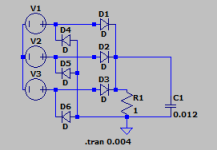
Did a simulation on LTSpice this morning.
If it is true that the lowest ripple frequency that we'll see is 300Hz, then a 4,700uF cap at 15A current draw gives 1Vpp ripple voltage.
So the formula for ripple voltage for a three-phase full bridge rectified alternator is close to Vpp = 0.13 * I / (F * C)

Obviously we don't want inrush current from flap activation, turning on lights, radio transmission, etc. to cause a spike after regulator compensates for the increased load to trigger OVP. But 12,000uF sure seems sufficient.

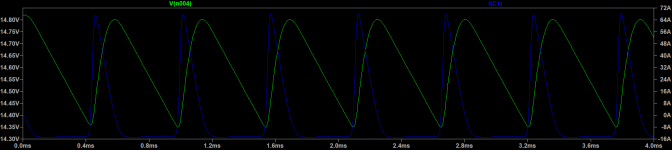
Here's 12,000uF, 14.8A load at 300Hz:
0.5Vpp ripple. The blue line is the current through the capacitor (important when selecting the capacitor to purchase and for wiring to/from the capacitor):
1739896100108.png
1739896230341.png
 
Last edited:
Back
Top